“I love using Rick Steves books! I take them along on every trip. In fact, it’s challenging when I go someplace that Rick doesn’t cover. Everything’s just so much harder.”
I hear this a lot when I bump into fellow travelers in Europe. Many are fiercely loyal to their Rick Steves books…maybe even to a fault. (Some B&B owners grouse that our readers refuse to consider their personal, carefully curated restaurant recommendations…just because they’re not “in the book.”)
And the flipside of loving Rick Steves books is getting frustrated when you don’t have one. I just got back from a vacation to one such place, New Zealand. And struggling with travel information that felt like it was nibbling around the edges of actually being helpful, while leaving me with more questions than answers, got me thinking about what makes a good guidebook…a good guidebook. And so, from the perspective of someone who’s spent more than 20 years working on the Rick Steves books, here’s my take on the “secret sauce” of what sets them apart.

I brought along four different guidebooks to New Zealand, hoping to cover as many bases as possible. And I found some great tips, leads, and advice in each one; all of them earned their weight in my rucksack, at one point or another. But at the same time, all of those books spent more time in my bag, or in the backseat of my rental car, than in my hands. They were useful to a point, but they weren’t indispensable; they didn’t give me the feeling of actually traveling with a knowledgeable friend. Why? What’s missing?
One of the biggest problems with many other guidebooks is that they strive to be comprehensive, which forces them to skimp on depth. You know: “Jack of all trades, master of none.” A typical publisher’s book on New Zealand assumes an obligation to cover any city or town in the country over a certain size — regardless of how visit-worthy it may be — which spreads resources and word count too thin.
Conversely, you could rightly ding Rick Steves books for not covering enough places. Travelers are sometimes aghast that we don’t include Bologna in our Italy book, or Geneva in our Switzerland book, or Valencia in our Spain book, or Bordeaux in our France book. And if you’re going to those places, your disappointment is understandable. However, years ago, Rick determined that being selective was key to providing solid guidebook coverage. So, if a place is covered in our books, it’s covered completely. But that means we can’t get to everything.
Which leads into the next feature of those less-satisfying guidebooks: They assume that travelers are independent spirits who don’t want or need detailed, prescriptive information. Surely there are travelers who fit this description. And those travelers would probably find Rick Steves books too hand-holding, even pushy.
But the fact is, when most travelers are going to a new place, deep down they really want someone to help them shape their trip, whether it’s a trusted globetrotting friend, an Instagram or TikTok influencer whose travel style matches their own…or a good guidebook.
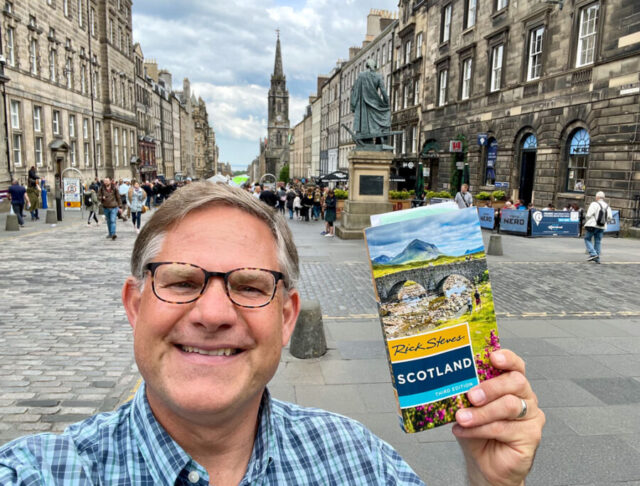
That goes double for us Americans, who have the shortest vacations in the rich world. (It feels borderline-subversive that my wife and I took two whole weeks for our New Zealand trip.) We American travelers need to be efficient and smartly use our time, even if some of what we’re using that time for is just relaxing. After all, some places are better for relaxing than others…and we’d like to know which are which.
That’s why a hallmark of Rick Steves guidebooks is that we’re opinionated. We’ll tell you, unapologetically, our idea of the best way to plan your time, and we’ll rank sights (using our “pyramids” system) based on our highly subjective opinion about which are the most worthwhile.
That said, if you read between the lines of our books, you’ll notice that only a select few favorites are presented as unmissable. Rather, for the vast majority of our listings, we try to describe them with precision, clarity, and actionable details — knowing that a specific place is not for everyone, but hoping to steer each traveler in the right direction. When we describe a hotel, a restaurant, a museum — really anything — our guiding principle is to give the reader enough information to make their own decision about whether it’s worth their time. We want to help them knowledgably distinguish among their many choices.
For example, let’s get back to that “relaxation” goal, and specifically beaches. If you’re in an area with several beaches, our job is to help you sort out which one suits your style. Are you a boogie-boarder or a snorkeler? Do you like gentle wading or splashing in surf? Sand or pebbles? Family-friendly, mellow, or rollicking beach bars? Shade or sunshine? Best for long walks or for sunbathing?

Taking the time to parse these kinds of choices also helps make our books feel personal, handcrafted, and approachable, rather than stuffy and generic. Often, one of our biggest challenges when training new researchers or editors is convincing them that the quirky takes, memorable turns of phrase, offbeat sense of humor, flashes of informality or even irreverence…these aren’t “bugs” in our books; they’re features. They remind the reader that there are real people hiding out between those pages, leading you by the hand through Europe.
Your narrator “Rick” (whether or not Rick personally wrote it) prides himself on taking you to a little hole-in-the-wall tavern where you can sample the local firewater, or a bakery to nibble a favorite pastry. Along the way, he’ll fill you in with gossipy tangents about the neighborhood you’ll be calling home for the next few days. He’ll introduce you to the owner of the place, and point out all the quirky decor plastered to the walls. That kind of intimacy is risky, and it’s rare — and it’s why people love our books.
So often, using those other books on my trip, I felt like they were scattering a few sparse breadcrumbs for me to connect myself. For example, on New Zealand’s Coromandel Peninsula, one of the top attractions is Cathedral Cove, a dreamy beach surrounded by rocky pinnacles. But you can’t just drive right to Cathedral Cove, hop out of your car, and walk five minutes down a well-marked path. Rather, there are at least three different ways to get there by foot — all of them requiring a lengthy, moderately strenuous hike — plus there are options by taxi boat, kayak, and RIB (rigid inflatable boat) tour from a nearby beach town.
Bits and pieces of that intel was scattered across the various guidebooks I was using; the rest of the picture was filled in by some online research. Sorting through the basic question of how to get there — to this iconic location that’s on the to-do list of virtually everyone visiting the Coromandel — probably consumed at least half an hour of my precious vacation. All the while, my “guidebook author” instincts kept screaming inside of me: Why can’t one of these guidebooks come up with a section called “Getting to Cathedral Cove,” with a clear, strategically organized list rattling off my choices, with pros and cons for each?

When we write our guidebooks, our goal is to anticipate what the traveler needs to know, just before they realize they need to know it. The people who write, update, and edit Rick Steves guidebooks are travelers ourselves: We’ve been in those very situations, and we know the questions and challenges we faced as someone trying to smartly use our time. When updating our material, Rick’s top admonishment is to “live the book” — even if you’ve done this or that a dozen times before, follow the instructions laid out in the book as if it’s your first time…and then fill in any gaps you find along the way. This requires time, energy, an affection for the reader, and an affinity for problem-solving.
And that’s another hallmark of Rick Steves books: We update our books lovingly, frequently, and in person. Now, I don’t want to make any unsubstantiatable claims about other guidebook publishers. I honestly don’t know how, or how often, they update their material. But my strong suspicion is that the frequency and rigor of our update schedule far exceeds anyone else’s.
This is based mainly on feedback from the businesses we list in our guidebooks — hoteliers, restauranteurs, museum ticket-takers, and so on. On each research trip, I generate double-takes on the part of Europeans who recognize me from a previous visit, and are borderline-shocked that I’ve returned already to check things again. “You’re back!” they say as I walk in the door. “Weren’t you just here?” Then they pull me in close, dart their eyes conspiratorially, and whisper, “I haven’t seen anyone from that other guidebook in eight or nine years.”
The proof is in the pudding, and that generous, on-the-ground research really distinguishes our books. All of that travel not only ensures that our guidebooks are the most accurate and up-to-date on the market. It also feeds into all of the other features I’ve outlined here — making our books a rare breed that are created by travelers, for travelers…by traveling.

So then, why don’t we cover more of Europe? Or, for that matter, so many other places? It’s a fair question. And I’ll be honest with you: I’m number one in line suggesting a Rick Steves New Zealand guidebook.
But no matter how many times I ask, Rick will say no. And he’ll be right. He figured out a long time ago that it’s better to do one thing, and do it exceptionally, rather than expand beyond your means. We could slap the Rick Steves name on hundreds of guidebooks, ranging from Disney World and Las Vegas to Down Under…but they’d lose that personal touch. (These days, this trendy concept is called “scaling.” Rick has never used that word…but it’s been his instinctive ethos for decades.)
In the meantime, let’s compare notes on suitable alternatives for places Rick doesn’t cover. Personally, I find the big brands can be decent, but they tend to be hit-or-miss; some titles are spot-on, while others are disastrous. Often the best books are by someone (like Rick) with a tight focus and a longstanding passion. For example, Andrew Doughty’s Hawaii Revealed series is my trusted companion anytime I’m traveling to the Hawaiian Islands; they have a depth of hard-earned wisdom, and an endearingly informal personality, that make them the “next best thing” to a Rick Steves Hawaii book. On a visit to Costa Rica a few years back, I enjoyed using James Kaiser’s Costa Rica: The Complete Guide, which has a similar approach.
Moving beyond paper guidebooks, the GyPSy Guide audio driving tours — covering many national parks and other scenic drives across the US and Canada — are outstanding. I’ve followed every single one of their tours in Hawaii, and I actually get excited when I’m going somewhere new that they cover. Just like a Rick Steves book, they seem to intuit when you’re getting hungry and suggest just the right place to pull over for a sticky slice of banana bread.
Other “non-guidebook” sources I trust include Katie Parla, an American expat who offers well-researched, insightful, playfully opinionated advice about where to eat in Italy. And Rick and I have both been relying more heavily on Michelin Guide’s “recommended” or “Bib Gourmand” restaurants — less expensive and more accessible than the big-ticket “starred” choices — when looking for nice places to eat.
What about you? Any others you can suggest?
And while we’re on the topic: Am I missing anything? What makes you enjoy using the Rick Steves books? Or am I off-base on any of the above?
Speaking of fresh guidebooks, 2022 was a huge year for getting all of our books fully up-to-date after a lengthy, unplanned pandemic hiatus. Most of those brand-new editions are either available now, or coming in the next few weeks. With all the changes brought about by COVID — and the simple passage of time — it’s essential to get your hands on the newest material if you’re heading to Europe this year. You can find all of our titles in the Rick Steves Travel Store, or wherever books are sold.
We love using the Rick Steves Guide Books as we travel in Europe. Last September, I saw so many people standing in long lines out Florence museums. They had obviously not read Rick’s instructions (complete with websites) about getting tickets on-line before your trip. The guidebook’s advice and the downloadable audio tours were fabulous!
Only problems with Rick Steve’s books is that there aren’t any in French We have very good French
Translators here I’m sure I would love to produce French versions of Rick’s books
Crystal, for anyone who’s used a good guidebook to avoid long lines, it’s simply mystifying to see the huge volume of travelers who spend so much of their time just standing around in line! Figuring out how to beat lines (sometimes creatively) is one of our main goals in the books. Even if you hate guidebooks, it’s wroth investing in one if only to save a few wasted hours in line.
You’ve put a name to my pain! I really appreciate the Rick Steves’ guide approach and haven’t found it anywhere else. Of the ‘big names’, I find Moon the most useful, but it’s missing this: “When we write our guidebooks, our goal is to anticipate what the traveler needs to know, just before they realize they need to know it.”
Thanks Cameron and to the entire Rick Steves team for writing with the traveler’s day in mind.
p.s. Please put me #2 in line for Rick Steves New Zealand (and in the meantime, I would appreciate hearing from other travelers which guides worked best for them).
Next time you are in New Zealand, try Scott Cook’s NZ Frenzy books. No hotels or restaurants – but very detailed information on visiting all the outdoor places in NZ.
Robyn, wow–thanks for the tip! I had not heard of these. They look a little out of date (2016) but I just ordered one to check it out and compare to the other options.
I sometimes “use” Rick as a framework for our trips and sometimes as a guide to “unmissable” locations. We usually rent a car and have hotels booked for on the way, but some of the most memorable places we’ve been to have been places that I’ve seen on the map are nearby and then looked them up in the book. One place that springs to mind is Trier in Germany. We had spent a few days in the Mosel Valley and were continuing on to Luxembourg, not intending to stop there until I looked it up. We spent an amazing half day there and it would have been a pity to be so close and miss out on it!
I agree with this completely! 8)
I’ll be like, “OK, what would I enjoy seeing and doing in Germany?”, and your first several dozen guidebook pages will give me a great overview, creating a framework or skeleton to build the trip upon.
Then I go add other sources. I’ll get other guidebooks that provide more details in regions you don’t cover — Bologna? 8). I’ll use TripAdvisor to find popular sites to visit in an area, especially outside of towns. I’ll just pop around on Google Maps and see what it pops up.
I did a great Dresden – to – Nuremberg trip last year in this manner, starting with your guidebook, spending 2.5 weeks. And all by train.
When I made plans for the Mosel Valley I also looked and said, why should this tour end in Trier and not Luxembourg?
I greatly enjoy the Rick Steves guide books. On my recent Rick Steves tours I take the guidebook. I usually go to one or two other European places after the tours and I use separate guide books for those locations, also. They have never failed to bring me tremendous information on places I should visit. They are just outstanding and I will use them again this summer.
My favorite part if Rick’s books are the tongue and cheek comments. Especially the museum guides. I also greatly appreciate the insight into how to avoid crowds. What I don’t tend to use them for is for housing and food. I tend to use travel websites for that because they are more comprehensive and up to date. I also make my own walking tours by pulling info from a number of sources, Rick Steve’s being one of many so that I can customize to my specific interests
Carla, I will admit that I also use online sources, in conjunction with the Rick Steves books, when scouting hotels and restaurants–that’s a scene that changes a little too fast for a print guidebook to entirely keep up with. I find that by reviewing Rick’s best tips, and comparing to other info I find online, I can usually cobble together a pretty good overview of my choices.
I used Rick Steves guidebook for Spain on my very first trip to Europe…in 2000! And I got hooked on the very specific recommendations, the great anticipation of things I would need to know to make the day and the week go smoothly. My husband and I have been on two My Way tours with Rick’s company and have used the guidebooks all over Europe. We just wish we could use them all over the rest of the World!
What is your opinion of the My Way tours? Where did you go?
My husband and I have been traveling on our own in Europe for 25+ years, but aging has made us say that we don’t want to drive in Europe any longer. Would you recommend the My Way tours?
Margaret, I think the My Way tours could be an ideal transition for you, as that’s exactly what they are for: Independent travelers who are happy filling their own free time (with the hands-on advice of an expert traveling along with you), but would rather have someone else deal with planning the itinerary, booking the hotels, and–most important–transporting you between places. For more details on the May Way tours, check out this page: https://www.ricksteves.com/tours/my-way-european-vacations
My wife and I did a My Way tour of Spain in 2019. We are not tour people. I was very satisfied with the My Way approach because it freed me from worrying about hotels and intercity transportation for 11 days. It let me focus on what to do, where to eat, etc. everywhere we went. We added several days to our trip before we started the My Way portion, and a couple weeks afterwards. Having the My Way portion in between gave us a breather from worrying about hotels and transportation. It turned out to be a wonderful way to spend a month in Spain.
I love Rick’s guidebooks for all of the reasons above, especially because it easy to figure out the highlights and things to skip. When I travel to Asia, South America, or Australia, I am forced to figure it out myself. I do it by using Lonely Planet, Fodor, reading reviews on Trip Advisor, and reviewing itineraries of the luxury packaged tours. With this information, I craft my own itinerary, including what to see each day. However, this is very time consuming. In Europe, I just use Rick’s guidebook and I’m done planning in no time. In Canada and the US, there are Michelin Green Guides for select areas, such as New England. I find them helpful for finding places to visit that I would have missed.
Barbara, I agree, that’s one of the biggest frustrations when using non-Rick guidebooks: Simply advise on where to go, and how long to spend there. Fortunately, we have a friend (who also happens to be a tour guide!) who lives in New Zealand, who helped us with in-depth itinerary advice for both of our trips there so far. But if you don’t have that, I find it takes tremendously more effort and planning to simply decide where to go.
We have done the “I sure wish there was a Rick Steves book” for numerous destinations over the years. Here’s what I value most about RS and what our recent experiences using Lonely Planet for Australia and New Zealand confirmed:
1. I can quickly determine how much time to spend in a particular city or area based on RS recommended itineraries. This is crucial for planning.
2. RS walking tours are a great introduction to most places — good info and maps at the ready. I’ve used them both from the book and from the app.
3. Museum tips — helpful routes and highlights. Even if the museum has been reorganized, they are still helpful.
4. Prioritization lists — while I don’t always agree with the 3 triangles v. 2 or 1, having a quick guide to “not to be missed” is appreciated.
Helping us manage our time is the key. Most other guidebooks fail in this regard.
Keep up the good work!
The compact local phrases are where I get my entertainment in the Rick Steves books. Especially useful is the commentary about whether a particular phrase will come across as funny, assertive, or a pick-up line. For example, in North America, we say a comment is “tongue in cheek” to denote a wry sense of humour. This is sometimes misquoted as ‘tongue and cheek’ by those less familiar with the language.
Thanks so much for your great, fun and informative Rick Steves guidebooks, they are the best! We really appreciate all you and all your staff does for us world travelers!
For non-Rick Steves destinations, I’ve been gravitating to Fodor’s lately. Their books seem to be much better than they were 10 years ago. Conversely, I used to rely on Frommers, but no longer use them as they are way too general.
Wasn’t Andy Steves (Rick’s son) doing something in the travel industry a few years ago? I was hoping that we’d get new tour book series called Andy Steves’ _________ (insert your favorite place that Rick doesn’t cover).
A Rick Steves guidebook is like having a well traveled distant cousin tell you what he has done on his recent visits to the country. I would not go to Europe without one.
I agree that they are not perfect. An area woefully lacking is hiking information. I realize that most RS travelers are not big hikers. Since Rick has gone on a few real hikes lately, maybe he will consider researching hikes in each country or at least some of them. After all he does a few specialty books-art-for example. Hiking books would attract a younger crowd and therefore the company’s future sales.
While guidebooks are lovingly revised, we are craving redos on many filmed visits to countries.
Sandra – I think you are right about hiking (and it not being a top priority for the RS guide audience). This makes business sense, “ know your customer”. We use Lonely Planet guides if we want more info on activities in places. The writers are younger, most were, or still are, hostel-sleeping former dirt baggers (lol). Yep, I am writing this RS style.
Sandra, that’s a completely fair criticism. Hiking is not our focus. I think you’d find in some of our guides, where hiking is a bigger deal, we do a better job–for example, our Switzerland guide has rather extensive hiking advice. But admittedly, in other places we prioritize other things. I find AllTrails website or app useful in getting info on hikes anywhere: https://www.alltrails.com
The “how” is what separates RS books against all others. “Avoid going on these days; use this museum pass as it pays for itself after 3 museums and allows you to skip the lines; this place is open late on X night and the crowds are much easier to handle.” A few years ago, I went to Paris armed with RS’s book. I walked past the line on a Friday afternoon with my museum pass and the Louvre emptied out early in the evening, just as RS said it would. Meanwhile, a friend of mine went a few months later, strolling into Paris without RS by his side, and found himself frustrated when he tried to go to the Louvre on a Tuesday when it was closed. He also went to Versailles on the day the palace was closed.
Europe is busy. It can be frustrating with all the crowds. But Rick helps navigate those difficulties, gives you the needed advice of a friend that has done it many times, provides historical interwoven contexts to give a location more depth and understanding, all of which provide for better experiences.
Two things stand out to me in this post: helping the traveler before they need help and the book’s personal turn of phrase.
First, on a trip to Germany, we needed to store our luggage at the Frankfurt train station. All the lockers were full. Panicked what to do with them, I wondered “What would Rick do?” and checked the book. BOOM! It Said “if the lockers at front are full, go to track yadda yadda…” Problem solved. We think of it as Rick traveling on our shoulder.
Second, the funny descriptions for sites or hotels. I’ve used the books enough to know they’re accurate. So when something is “weird and wonderful” it likely is just that.
Ultimately just as you described here, Rick’s books feel like a human actually went on that trip, not a robot or AI.
After years of using Fodors and Frommers to plan our trips, we switched to Rick Steves after seeing so many fellow travelers carrying them, and have found them vastly more user-friendly. The only thing on which we don’t agree: as card-carrying introverts, my husband’s and my travel mission is NOT to make new friends, but rather to see, experience, learn and discuss amongst ourselves the scenery, history and culture of an area. That may sound anti-social, but it’s just the way we best enjoy our travels. Rick’s approach seems to lean heavily on interaction with locals, especially in the area of accommodations. We do not enjoy the “staying in someone’s spare bedroom” style of B&B lodging or breakfast arrangements that include sharing a table with strangers. So we check (and cross check and check again) other resources for our lodging choices and find it works well for us to maintain our sanity and a little solitude, while definitely relying on Rick’s advice on not-to-miss sights and time saving tips.
Bev, I totally agree. In fact, I consider myself an introvert, and when my wife and I are on vacation, we approach it similarly to the way you describe. That said, I do enjoy having the name of the person who owns the restaurant or runs the hotel in the book, because it’s nice to have that personal connection when you walk in the door. You don’t need to become best buds, but I find that little extra bit of intimate detail helps pull me out of my shell a little bit and feel like I’m not so far away from home.
As someone who has been to New Zealand five times (cumulatively totaling one year of my life) and then twice to Europe since then (3+ weeks each in the Czech Republic & Catalonia), I can definitely vouch for what you say, Cameron. I am a highly-independent traveler who loves to research and plan my own itineraries, yet I still found Rick Steves guides especially helpful. (And I wish I had had a Rick Steves New Zealand guidebook for my earlier visits). I habitually use multiple resources for planning my adventures and I did so for Europe as well. BUT, Rick Steves guidebooks were the only ones I actually brought with me on the trips.
Rick Steves guidebooks are incredibly detailed. I decided to add a short stay in Portugal after finishing a tour in Spain. I was able to purchase a Lonely Planet book in English that was worthless. Another member of our tour had the Portugal book and I was able to copy several pages. I hired a private guide to Sintra, loved the tram tips, plus knew about the “not free” appetizers at the tourist fado show. I have considered traveling outside Europe, but as in your New Zealand adventure, have found the planning too difficult.
We have used RS guidebooks for years (decades?) A memorable moment from long ago was when we told the owner of a wonderful little hotel in Bruges that we’d found her establishment in a RS guidebook. She was so surprised and flattered! Things have changed greatly since that early “back door” experience, though. During a trip to the Loire valley a few years ago we stopped into a restaurant the guidebook recommended. It was very busy—full of travellers all pouring over their RS guidebooks! It was pretty funny!
Katie Parla is a gem! Her website is filled with great suggestions. Book a half day tour for an exceptional treat!
For Puglia restaurants, we like Elizabeth Minchilli’s website and newsletter.
elizabethminchilli.com
Yes, I have also used Elizabeth Minchilli’s tips and have enjoyed those as well. Great tip!
One of our favorite parts of the Rick Steves guide books is the “Walks.” We recently followed Rick’s “walk” in Verona and had a simply lovely and wonderful day in that fair city. Thanks for helping us see the best of Europe.
Margaret, thanks for calling these out. I almost mentioned them in this post but didn’t want to gild the lily too much. I totally agree that the town and museum walks are another critical hallmark of our books, which I love using as a traveler as much as I enjoy creating as a writer. I do find similar sorts of “walks” in other guidebooks, but find they lack the depth, intimacy, and insights of our tours (which are more like actually being with a tour guide, rather than just an outline for your wanderings).
Spot on. My wife and I use Rick Steves guidebooks whenever we travel to a destination that has one. The main reason is that they give very precise information about how to visit places mentioned. They don’t just give the address, opening times and ticket prices. They may suggest approaching from a certain direction so you are walking downhill instead of uphill. They may suggest a less crowded time of day, a particular bus route, a specific ticket booth. And they may tell you what really isn’t worth your time. We often follow the walking tours and appreciate how they are mapped out.
SInce you have a Portugal guide please, please include the Azores. These islands are a gem, very accessible fom the U.S., and they haven’t been overrun with Starbucks, American fast food restaurants, and high rise hotels yet.
I used Lonely Planet New Zealand for a 2 month trip to New Zealand in 2019. I found it worked well and had most of the info I needed. The rest of it I did through online research and getting info at my destination.
I have used Rick Steves books before. The maps are excellent and there’s lots of good info on what to see and do. However, it only covers select areas and sometimes that are glaring omissions. For example, I’m planning a trip to Scandinavia right now and Rick Steves Scandinavia doesn’t include Gothenburg, Sweden even though it’s one of Sweden’s largest cities (and from what I’ve heard a wonderful place to visit). Turku, Finland’s second largest city, gets just a paragraph in the book.
Evan, your critique is spot-on and I won’t attempt to defend our books. Gothenburg is not in our Scandinavia book, nor is Turku, nor lots of other places that are worth visiting. That’s a designed shortcoming that we’ve decided to live with.
Over the years, I’ve come to appreciate the Connections the most. Arrivals and how to get to the city center is also invaluable. Those sections saves me precious planning time and eliminates unnecessary stress!
Also, when Rick sets a recommended time in a town, I usually add an extra day – two or three days for blockbuster cities such as London.
Helen, those Connections and Arrival sections are time-consuming to update and sometimes we debate if they’re worth the hassle. Thanks for confirming that you find them useful.
I strongly agree with Helen’s statement about arrivals and connections. I am hard-pressed to list in any order the sections I find most helpful, but if you need further affirmation of this section, I will list it as number one. I have to get to my ultimate destination, and the less time spent arriving, the more time to tour my destination. I am returning to Paris for what has almost become an annual visit, and I still use the Paris book to tweak my visits there and add what I have missed. Even with frequent visits, there are places I have yet to go. Perhaps skipping Muse D’Orsay and Notre Dame to check the progress would give me another day!
Cameron, I bought your book as a Christmas stocking stuffer to myself. Can’t wait to read it!
Thank you! Enjoy!
Whether on a Rick Steves Tour (oh, and yes on a competitor’s tour) the guidebook provides the traveler pre-trip knowledge for background and planning, on-trip information and post-trip memory aid.
The guidebooks have been a valued education in how to travel, where to travel, why we travel and how to make the most out of the limited time we get to spend away from our day to day lives. Thanks for doing that for us !
What I think would be perfect is a binder book. You could remove only the pages needed for a particular day and easily carry them without the whole book. Then you could return them leaving the book intact.
Hi Patricia. Believe it or not, this solution already exists: https://store.ricksteves.com/shop/p/guidebook-page-binder
What I appreciate most about your guides (apart from the selective ethos and in-depth coverage) is you teach people HOW to travel. Coupled with the videos and other content, you have taught me to be smart and resourceful as I travel. Other big-name guides are decent to tell you once over lightly where may be of interest, but your guides tell me how to get from A to B, likely with a fun walking route in between.
I look at the guide books as a trusted reference like a good movie reviewer. Not all are the same. You find one, follow it, and then determine if it guided you on a journey that you liked. If so, you then use one for your next trip trusting in the comments in the book. If you read a movie reviewer’s review of a movie, go see it, and don’t find the review matching what you thought, then you may not use that reviewer in determining which movie to see next. Find one that provides the same impression that you have and then trust that most of the reviews will lead you to a movie that you also might like. When I read a Rick’s guidebook looking for a place to stay, I can now trust which I would most likely enjoy based on having stayed at others that he had recommended that I stayed at.
John, that’s a great comparison (speaking as someone who was, in a previous life, a movie reviewer).
Another similarity with good movie reviewers is that, over time, you can calibrate them. I have used RS guidebooks for 20 years, and by now, I have them reasonably well calibrated. As with a movie review, I can assess from a Rick Steves entry whether it is for me. (Stay in Gimmelwald? Nope. I very much enjoyed a stay in Muerren, though, in a hotel room perched 2000 feet (600 m) above the valley floor. I watched base-jumping kiters way down below. The walk down to Gimmelwald and back was nice.)
Never leave home with the appropriate Rick Steve’s guidebook for the country I will be visiting. My bible for want of a better word! All are well read and marked up prior to go on my journey.
We love the RS guidebook details of the places we have travelled, always on a RS tour; we pre-read what is in planned each day and also where we will venture on our own – it’s exciting adventures every day and time is never wasted. Alas, the guidebook returns home tattered and marked up, but well read.
I want to say the Rick Steves Pocket Books are my favorite. We live in Barcelona now and I prepared for our visit to Sagrada Familia and the guidebook was spot on! I have taken a few walking tours and find that preparing with the Pocket guide adds to my experience.
I did read “Europe through the back door.” It has lot of good information to consider before you get here. I read “Snapshot: Sevilla, Granada, & Andalucia” while our visa situation was getting resolved in the US. I cannot wait to go south!! I also recommend Cameron’s book “The Temporary European.” His writing style and story telling make you feel like he is sitting with you!! The “Jams Are Fun” sections are excellent. Moises, I want to work for the cult!!
I recently had the opportunity to use multiple guidebooks for the same region in Italy, and this blog post came just as I was trying to articulate why RS guidebooks are the best around. Cameron has laid it all out beautifully.
I love that you don’t just give information; you give advice. For example, I’m so glad you recommended I enjoy mazapan while gazing at the Toledo cathedral from a park bench in the adjacent plaza. I’m so glad you told me to make a slow 360 spin in the center of Piazza Santissima Annunziata in Florence so I could appreciate this Renaissance square. I’m glad that you have a point of view. I can always disregard your advice but I’m glad you give it.
You guys make it look easy but of course it’s not, so thank you for all your hard work!