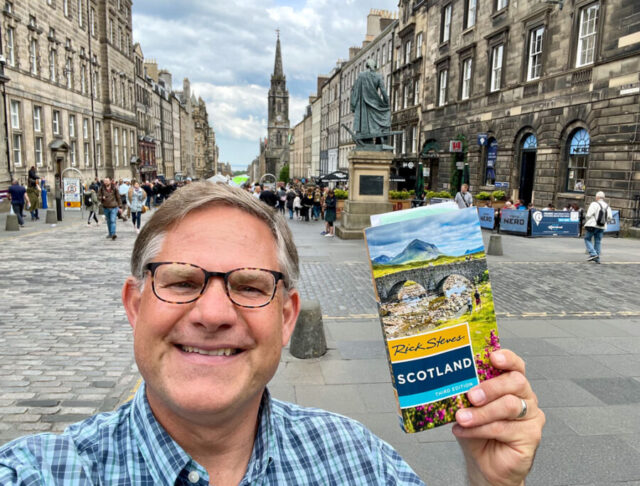
“I love using Rick Steves books! I take them along on every trip. In fact, it’s challenging when I go someplace that Rick doesn’t cover. Everything’s just so much harder.”
I hear this a lot when I bump into fellow travelers in Europe. Many are fiercely loyal to their Rick Steves books…maybe even to a fault. (Some B&B owners grouse that our readers refuse to consider their personal, carefully curated restaurant recommendations…just because they’re not “in the book.”)
And the flipside of loving Rick Steves books is getting frustrated when you don’t have one. I just got back from a vacation to one such place, New Zealand. And struggling with travel information that felt like it was nibbling around the edges of actually being helpful, while leaving me with more questions than answers, got me thinking about what makes a good guidebook…a good guidebook. And so, from the perspective of someone who’s spent more than 20 years working on the Rick Steves books, here’s my take on the “secret sauce” of what sets them apart.

I brought along four different guidebooks to New Zealand, hoping to cover as many bases as possible. And I found some great tips, leads, and advice in each one; all of them earned their weight in my rucksack, at one point or another. But at the same time, all of those books spent more time in my bag, or in the backseat of my rental car, than in my hands. They were useful to a point, but they weren’t indispensable; they didn’t give me the feeling of actually traveling with a knowledgeable friend. Why? What’s missing?
One of the biggest problems with many other guidebooks is that they strive to be comprehensive, which forces them to skimp on depth. You know: “Jack of all trades, master of none.” A typical publisher’s book on New Zealand assumes an obligation to cover any city or town in the country over a certain size — regardless of how visit-worthy it may be — which spreads resources and word count too thin.
Conversely, you could rightly ding Rick Steves books for not covering enough places. Travelers are sometimes aghast that we don’t include Bologna in our Italy book, or Geneva in our Switzerland book, or Valencia in our Spain book, or Bordeaux in our France book. And if you’re going to those places, your disappointment is understandable. However, years ago, Rick determined that being selective was key to providing solid guidebook coverage. So, if a place is covered in our books, it’s covered completely. But that means we can’t get to everything.
Which leads into the next feature of those less-satisfying guidebooks: They assume that travelers are independent spirits who don’t want or need detailed, prescriptive information. Surely there are travelers who fit this description. And those travelers would probably find Rick Steves books too hand-holding, even pushy.
But the fact is, when most travelers are going to a new place, deep down they really want someone to help them shape their trip, whether it’s a trusted globetrotting friend, an Instagram or TikTok influencer whose travel style matches their own…or a good guidebook.
That goes double for us Americans, who have the shortest vacations in the rich world. (It feels borderline-subversive that my wife and I took two whole weeks for our New Zealand trip.) We American travelers need to be efficient and smartly use our time, even if some of what we’re using that time for is just relaxing. After all, some places are better for relaxing than others…and we’d like to know which are which.
That’s why a hallmark of Rick Steves guidebooks is that we’re opinionated. We’ll tell you, unapologetically, our idea of the best way to plan your time, and we’ll rank sights (using our “pyramids” system) based on our highly subjective opinion about which are the most worthwhile.
That said, if you read between the lines of our books, you’ll notice that only a select few favorites are presented as unmissable. Rather, for the vast majority of our listings, we try to describe them with precision, clarity, and actionable details — knowing that a specific place is not for everyone, but hoping to steer each traveler in the right direction. When we describe a hotel, a restaurant, a museum — really anything — our guiding principle is to give the reader enough information to make their own decision about whether it’s worth their time. We want to help them knowledgably distinguish among their many choices.
For example, let’s get back to that “relaxation” goal, and specifically beaches. If you’re in an area with several beaches, our job is to help you sort out which one suits your style. Are you a boogie-boarder or a snorkeler? Do you like gentle wading or splashing in surf? Sand or pebbles? Family-friendly, mellow, or rollicking beach bars? Shade or sunshine? Best for long walks or for sunbathing?

Taking the time to parse these kinds of choices also helps make our books feel personal, handcrafted, and approachable, rather than stuffy and generic. Often, one of our biggest challenges when training new researchers or editors is convincing them that the quirky takes, memorable turns of phrase, offbeat sense of humor, flashes of informality or even irreverence…these aren’t “bugs” in our books; they’re features. They remind the reader that there are real people hiding out between those pages, leading you by the hand through Europe.
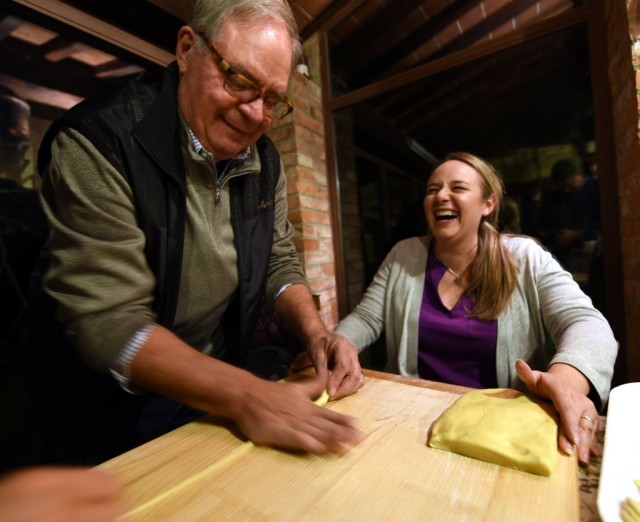
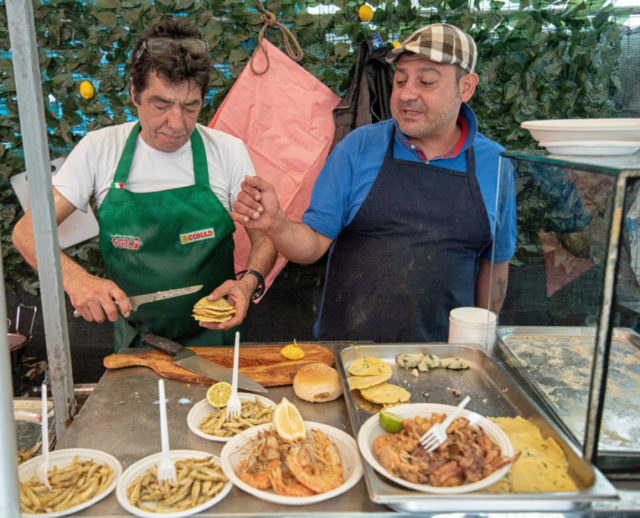
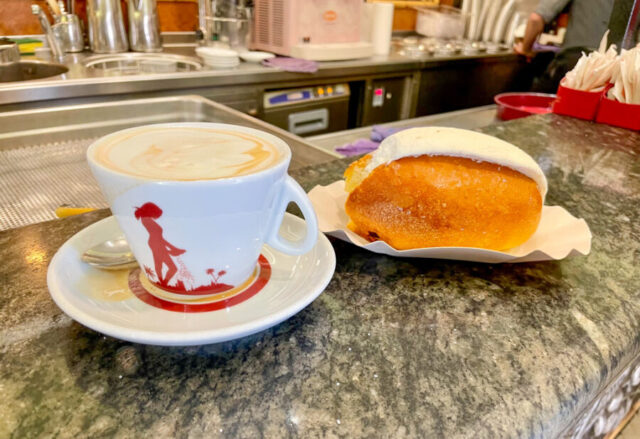
Your narrator “Rick” (whether or not Rick personally wrote it) prides himself on taking you to a little hole-in-the-wall tavern where you can sample the local firewater, or a bakery to nibble a favorite pastry. Along the way, he’ll fill you in with gossipy tangents about the neighborhood you’ll be calling home for the next few days. He’ll introduce you to the owner of the place, and point out all the quirky decor plastered to the walls. That kind of intimacy is risky, and it’s rare — and it’s why people love our books.
So often, using those other books on my trip, I felt like they were scattering a few sparse breadcrumbs for me to connect myself. For example, on New Zealand’s Coromandel Peninsula, one of the top attractions is Cathedral Cove, a dreamy beach surrounded by rocky pinnacles. But you can’t just drive right to Cathedral Cove, hop out of your car, and walk five minutes down a well-marked path. Rather, there are at least three different ways to get there by foot — all of them requiring a lengthy, moderately strenuous hike — plus there are options by taxi boat, kayak, and RIB (rigid inflatable boat) tour from a nearby beach town.
Bits and pieces of that intel was scattered across the various guidebooks I was using; the rest of the picture was filled in by some online research. Sorting through the basic question of how to get there — to this iconic location that’s on the to-do list of virtually everyone visiting the Coromandel — probably consumed at least half an hour of my precious vacation. All the while, my “guidebook author” instincts kept screaming inside of me: Why can’t one of these guidebooks come up with a section called “Getting to Cathedral Cove,” with a clear, strategically organized list rattling off my choices, with pros and cons for each?

When we write our guidebooks, our goal is to anticipate what the traveler needs to know, just before they realize they need to know it. The people who write, update, and edit Rick Steves guidebooks are travelers ourselves: We’ve been in those very situations, and we know the questions and challenges we faced as someone trying to smartly use our time. When updating our material, Rick’s top admonishment is to “live the book” — even if you’ve done this or that a dozen times before, follow the instructions laid out in the book as if it’s your first time…and then fill in any gaps you find along the way. This requires time, energy, an affection for the reader, and an affinity for problem-solving.
And that’s another hallmark of Rick Steves books: We update our books lovingly, frequently, and in person. Now, I don’t want to make any unsubstantiatable claims about other guidebook publishers. I honestly don’t know how, or how often, they update their material. But my strong suspicion is that the frequency and rigor of our update schedule far exceeds anyone else’s.
This is based mainly on feedback from the businesses we list in our guidebooks — hoteliers, restauranteurs, museum ticket-takers, and so on. On each research trip, I generate double-takes on the part of Europeans who recognize me from a previous visit, and are borderline-shocked that I’ve returned already to check things again. “You’re back!” they say as I walk in the door. “Weren’t you just here?” Then they pull me in close, dart their eyes conspiratorially, and whisper, “I haven’t seen anyone from that other guidebook in eight or nine years.”
The proof is in the pudding, and that generous, on-the-ground research really distinguishes our books. All of that travel not only ensures that our guidebooks are the most accurate and up-to-date on the market. It also feeds into all of the other features I’ve outlined here — making our books a rare breed that are created by travelers, for travelers…by traveling.

So then, why don’t we cover more of Europe? Or, for that matter, so many other places? It’s a fair question. And I’ll be honest with you: I’m number one in line suggesting a Rick Steves New Zealand guidebook.
But no matter how many times I ask, Rick will say no. And he’ll be right. He figured out a long time ago that it’s better to do one thing, and do it exceptionally, rather than expand beyond your means. We could slap the Rick Steves name on hundreds of guidebooks, ranging from Disney World and Las Vegas to Down Under…but they’d lose that personal touch. (These days, this trendy concept is called “scaling.” Rick has never used that word…but it’s been his instinctive ethos for decades.)
In the meantime, let’s compare notes on suitable alternatives for places Rick doesn’t cover. Personally, I find the big brands can be decent, but they tend to be hit-or-miss; some titles are spot-on, while others are disastrous. Often the best books are by someone (like Rick) with a tight focus and a longstanding passion. For example, Andrew Doughty’s Hawaii Revealed series is my trusted companion anytime I’m traveling to the Hawaiian Islands; they have a depth of hard-earned wisdom, and an endearingly informal personality, that make them the “next best thing” to a Rick Steves Hawaii book. On a visit to Costa Rica a few years back, I enjoyed using James Kaiser’s Costa Rica: The Complete Guide, which has a similar approach.
Moving beyond paper guidebooks, the GyPSy Guide audio driving tours — covering many national parks and other scenic drives across the US and Canada — are outstanding. I’ve followed every single one of their tours in Hawaii, and I actually get excited when I’m going somewhere new that they cover. Just like a Rick Steves book, they seem to intuit when you’re getting hungry and suggest just the right place to pull over for a sticky slice of banana bread.
Other “non-guidebook” sources I trust include Katie Parla, an American expat who offers well-researched, insightful, playfully opinionated advice about where to eat in Italy. And Rick and I have both been relying more heavily on Michelin Guide’s “recommended” or “Bib Gourmand” restaurants — less expensive and more accessible than the big-ticket “starred” choices — when looking for nice places to eat.
What about you? Any others you can suggest?
And while we’re on the topic: Am I missing anything? What makes you enjoy using the Rick Steves books? Or am I off-base on any of the above?
Speaking of fresh guidebooks, 2022 was a huge year for getting all of our books fully up-to-date after a lengthy, unplanned pandemic hiatus. Most of those brand-new editions are either available now, or coming in the next few weeks. With all the changes brought about by COVID — and the simple passage of time — it’s essential to get your hands on the newest material if you’re heading to Europe this year. You can find all of our titles in the Rick Steves Travel Store, or wherever books are sold.