Become a Temporary Londoner: 10 Tips for Experiencing Untouristy London

London is the most entertaining city in Europe —  and the fun extends well beyond its famous sights. London is extraordinarily crowded these days, and escaping from the tourist hordes is more important than ever. Don’t forget to take a break from the sightseeing grind to actually enjoy London. Do a deep dive into the city, and become a temporary Londoner. Explore parks, markets, and neighborhoods where you’re the only out-of-towner.

I just returned from a two-week visit to London, updating our Rick Steves London guidebook. At my typical breakneck pace, two weeks sounds like an eternity. In London, it’s a sprint. Racing from sight to sight, I kept getting hit with waves of nostalgia for my all-time-favorite visit, when my wife and I rented an apartment here for an entire week. We had one goal: Live like a Londoner. Do nothing touristy. And never pass through a museum turnstile. We got tips from friends who lived or had lived in the city, and we read up on blogs designed for locals — not for tourists. (Thank goodness.) And it turned out to be one of the best weeks of travel we’ve ever enjoyed.

Based on that trip — and years of other London visits — I’ve assembled this collection of my 10 favorite ways to bust out of the tourist rut and settle into the real London. One caveat: London has so much to offer that another traveler might have an entirely different list, which would likely be just as good as this one. (I’d love to hear your suggestions in the Comments.)

1. Escape “The City” in the Inns of Court

The one-square-mile historic core of London — called simply The City — is a busy and intense commercial district, where third-wave coffee shops and glitzy skyscrapers with clever nicknames mingle with Wren churches and Cockney accents. The former stomping grounds of Shakespeare and Dickens, The City exerts a strong magnetism on travelers. Its narrow streets are an exhausting traffic jam of distracted, slowpoke tourists blocking the sidewalk and impatient office drones sprinting through their lunch break.

Thank goodness for the Inns of Court. While following The City Walk in our Rick Steves London guidebook, I was ready for an escape from congested urban streets. The tour told me to step through an easy-to-miss doorway at No. 17 Fleet Street…and instantly, I was swallowed up by tranquil gardens with chirping birds and mellow Londoners speaking in hushed tones — as if double-decker buses weren’t rumbling by just a few steps away.

The Inns of Court — a gaggle of professional associations for lawyers — occupies a sprawling chunk of The City, stretching from Fleet Street all the way down to the Thames. It’s the open-to-the-public stomping grounds of barristers and law interns who work at the Royal Courts of Justice across the street. This sprawling series of interconnected, higgledy-piggledy courtyards, parks, and lanes is a delight to get lost in. You’ll find gurgling fountains, inviting benches, pristine gardens, stately red-brick buildings, and virtually no tourists.

If that’s not enough to slow your pulse, several nearby historic churches offer free lunchtime concerts around 1:15 p.m., designed to provide office workers with a cultured break from a busy workday. Options include Temple Church in the Inns of Court (Wednesdays), St. Bride’s (usually Tuesdays and Fridays), and St. Dunstan-in-the-West (Fridays).

2. Browse Hipster Street Markets

On a sunny Saturday, the park called London Fields is filled with thousands of people — out enjoying the green space after gorging themselves at their choice of trendy food trucks. It looks like a hipster Woodstock. Strolling a world of tattooed new dads with coiffed beards and vintage eyeglasses pushing prams, I realized that Hackney is where London’s hipsters go to breed.

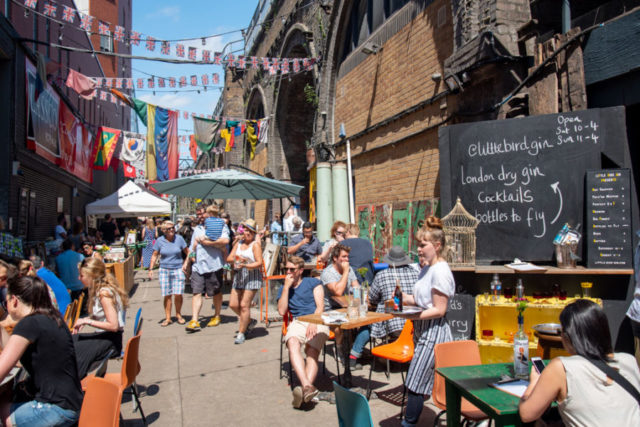
At the southern edge of London Fields begins Broadway Market — which is the name both of this area’s main drag, and of the lively open-air festival of foods and crafts that fills it each Saturday. This otherwise nondescript Victorian strip becomes ground zero for all that’s hip and trendy, with an edge of pretense: seasonal organic produce, designer creams and lotions, farm-fresh meat and eggs, creative jewelry,  handmade fashions, twee craft projects, “bespoke” anything and everything, and a staggering variety of food trucks and other pop-up culinary offerings. (Don’t miss the Schoolyard Market — filling a leafy primary school playground, tucked just off the main drag, near the park — with the highest concentration of food stalls.)

Broadway Market is just one of many such London markets that are a delight to explore. In a previous post, I wrote about one of my favorite weekend street food hotspots, Maltby Street Rope Walk Market.

On Sundays, Brick Lane — in London’s achingly hip East End — becomes one big parade of food vendors, live music, and happy young Londoners, all jammed into a street-art-slathered, post-industrial cityscape. Walking the length of Brick Lane, you can dip into the UK’s largest assortment of vintage vendors, a food hall devoted entirely to vegan and vegetarian street food, and hole-in-the-wall shops selling gourmet chocolates and traditional bagels. If you keep going north, you’ll wind up at the more sedate but equally appealing Columbia Road Flower Market — ideal for buying a bouquet to brighten up your dumpy London hotel room.

And those are just a few examples of the many street markets that enliven London. The list goes on: Portobello Road Market on Fridays and Saturdays in Notting Hill; the everyday, funky Camden Lock Market along the Regent’s Canal (see the next item); Brixton Market, which runs Mondays through Saturdays in the rapidly gentrifying multicultural neighborhood south of central London; and many others. On that one-week visit to London, my wife and I set a goal of visiting a different street market every day…and we never tired of them.

3. Cycle the Regent’s Canal

Slicing through the middle of North London is Regent’s Canal, a long-forgotten  industrial waterway built in the early 19th century. Today, some parts of the canal remain industrial and blighty, while others are being tidied up.

The most charming area along the Regent’s Canal is Little Venice, in the northwest corner of central London. This neighborhood feels more Amsterdam than London: mossy, murky, tree-lined canals lined with houseboats.

When my wife and I asked our expat friends in London for suggestions on where to go for a bike ride, they said that Little Venice would be a fine spot to begin a low-impact pedal through town. And we were glad we took their advice. We rode the Tube to the Warwick Avenue station, grabbed bikes from London’s bike-share system, and followed the narrow towpath about two and a half miles along the canal.

While this route requires an occasional detour into city streets, for the most part it stays along the tranquil canal, offering glimpses of little-seen-by-tourists facets of London: sleepy and cozy residential zones, heavy willow boughs dipping into the murky waters, forgotten industrial canals slathered with street art,  old barges used as garbage scows or floating homes, blocky modern residential developments, dreamy lily-padded eddies out of a Vermeer painting,  and the back edge of Regent’s Park and the London Zoo.

The occasional tour boat would trundle past, plying the still and brown waters — a reminder of the time when the Regent’s Canal was a virtual highway for transporting goods throughout the city.

Soon we pedaled our way into the sprawling, funky Camden Lock Market. Dropping off our bikes at one of the ubiquitous return stations, we explored the thriving food circus, enjoyed a great street-food lunch, then hopped the Tube back to the center.

If we’d had more time (and if it weren’t so hot), we could have pedaled around Regent’s Park a bit more, or even followed the canal farther east. The options are endless. Just be careful to stay on the towpath — inexperienced or distracted cyclists might find it all too easy to go for an inadvertent dip in the mucky water.

4. Get a Cheap “Day Ticket” for West End Theatre

I love the London theater (ahem, “theatre”) scene. But it can be expensive, and the big-name plays sell out well ahead. Fortunately, same-day tickets (called “day seats”) are a screamin’ deal for frugal procrastinators who enjoy being spontaneous. It’s a smart way for savvy Londoners to enjoy budget theater — and it works for visitors, too.

“Day seats” are sold only in person when the box office first opens  (typically at 10:00; for popular shows, people start lining up much earlier). These same-day-only tickets cost around £20 (about $25); sometimes they’re front-row seats, while other times they can be in the nosebleed section or have a restricted view.

Over the years, I’ve taken advantage of day seats to see several London plays — from big, bombastic musicals (Wicked, Miss Saigon, The Lion King) to lower-key plays starring well-known actors (Stephen Merchant in The Mentalists). I might not splurge on full-price tickets for some of those shows, but when you can get a great seat for little more than the price of a movie ticket, it’s hard to resist. In most cases, I was in the front row — where the only discernible downside is that you can’t see the actors’ shoes, and sometimes the singers spit on you a little bit when belting out a tune. For this, you pay a fraction of what the suckers sitting immediately behind you paid.

The best roundup of day seats is on the very low-tech Theatre Monkey website. Ignore the 2004-vintage graphics and skim the priceless list of which shows offer these cheap tickets — with recent reports from theater lovers of how early they got to the box office, and which seats they snagged. Each show’s website also has information about their own day seats policy.

This strategy works best for shows that have been around for a while and are no longer “hot tickets.” In fact, the most popular shows don’t bother with day seats at all. However, a few big-name shows distribute discounted, last-minute tickets in a fun way. For example, when I was in London a few weeks ago, The Book of Mormon had a lottery system for anyone who showed up between 17:00 and 17:30 for that evening’s performance. At 17:30,  they began a drawing, in which 20 fortunate theater-lovers won the opportunity to buy heavily discounted tickets. They turned the event into an entertaining little spectacle in itself, with a wisecracking emcee pulling each name to the cheers and jeers of the gathered crowd. It’s the most fun I’ve ever had not getting a ticket for a show.

Hamilton — currently the hottest ticket in town, with affordable seats that sell out months in advance — has a “lucky seat” lottery: Submit your information on their website for the chance to buy last-minute £10 tickets. (I entered this about 10 times during my London visit — and I was 0-for-10. Oh, well…worth a try.)

If you happen to be near a theater when the box office opens, try dropping by to see what’s available tonight. Assuming you go into it with that “worth a try” attitude, you may be pleasantly surprised.

5. Hike across Hampstead Heath (with or without Roger Ebert)

While I’ve had many fine strolls around London, my favorite was the time I had Roger Ebert as my guide through the sprawling North London parklands of Hampstead Heath. It’s the kind of place where bobbies ride horses as if they were Mister Darcy.

As a cinephile who loves movies as much as I love travel, I’ve admired Roger Ebert’s work since I was a teenager in small-town Ohio. When I discovered that he wrote a book called The Perfect London Walk, it was a marriage of two of my favorite things. I found a used copy online (for about $20) and devoted half a day to following its 30-year-old instructions through Hampstead Heath. By today’s standards, the book is endearingly low-tech; each step of the walk is illustrated with grainy black-and-white photographs that were clearly shot on the run. But it delivered on its promise: an unusually intimate and satisfying look at a corner of London most tourists miss.

With or without Roger Ebert, Hampstead Heath is well worth a visit. Ride the Tube to the Hampstead stop, wander through the village on Flask Walk — which becomes Well Walk — then enter Hampstead Heath near the mixed bathing pond. Winding your way through the park, you’ll pop out at Parliament Hill, offering grand (if distant) views of the London skyline.
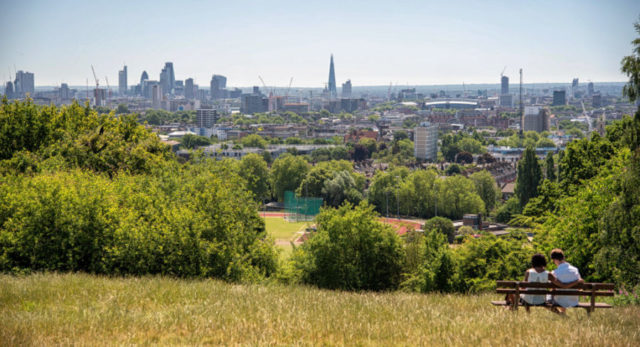
Then walk up through the park all the way to Kenwood House — a stately manor overlooking the rolling hills (and familiar to eagle-eyed Notting Hill fans for an unfortunate “live mic” incident). Exiting the park behind the mansion, it’s a short walk to the Spaniards Inn, a classic London pub with a generous outdoor terrace.

Tucked along the east side of Hampstead Heath is the charming bedroom community of Highgate, home to Highgate Cemetery — London’s answer to Père Lachaise, with grand old tombs of VIPs silently aging in a tranquil wood. It’s a fine place wrap up your outing before heading back to town.

The striking thing about Hampstead Heath is the feeling that you’re fully out in nature, even though you’re just a short Tube ride from the center. I can’t think a better place to escape London’s urban intensity. Returning to civilization, you feel that you’ve had a rugged adventure.

6. Grab a Pint after Work and Drink It Outside

Britain is famous for its many pubs, each one a fine opportunity to tip a glass of a local ale while making new friends. And in London, pubs are an après-work mainstay. It seems that everyone who leaves their office heads straight to their favorite pub to catch up with friends. And when the weather’s fine, they do it out on the curb.

While “public consumption” is taboo stateside, in London it’s a social institution. Popular pubs have more people outside than inside — spilling out onto the sidewalk, unapologetically blocking the street, creating one big, gregarious scrum of happy drinkers. Walking anywhere in the city between the hours of about 5 and 7 p.m., I love coming across these convivial, civilized keg parties.

If you want to take part, navigate your way to the bar to order, then bring your pint out to the street. Strike up a conversation with a Londoner. Or introverts can just eavesdrop on the office gossip about people you’ll never work with, Karen’s latest dating drama, and football chatter.

7. Head to Shoreditch for Dinner and Street Art

Shoreditch, in the East End, is one of London’s culinary hotspots. It’s where talented young chefs transition from food trucks to brick-and-mortar, with lower rents and lower stakes than more central neighborhoods. (Many chefs test their mettle in Shoreditch before opening their second restaurant in central, high-rent Soho.)  On my latest trip, one highlight was scouting new Shoreditch restaurants for our Rick Steves London guidebook.

Right at the Shoreditch High Street train station is the Boxpark — a gigantic Lego-like stack of shipping containers filled with dozens of pop-up food and craft vendors. The lineup is constantly changing; this time around, I was especially tempted by the Korean BBQ burritos, vegan burgers, and bubble waffles.

A short walk away is a staggering array of tempting eateries: Brat, which earned a Michelin star in 2018, is this area’s upscale splurge, with a rustic-chic ambience. The cuisine is uncomplicated, ingredient-focused modern English with Basque accents — top-quality fish, meats, and seasonal vegetables cooked on an open fire. Just downstairs is Smoking Goat, a Thai barbecue bar promising elevated dishes inspired by Bangkok canteens: chili-and-fish-sauce chicken wings, whole fish cooked in Thai herbs, and smoked brisket and bone marrow curry. And around the corner is the sprawling, cacophonous, industrial-mod PizzaEast — a Shoreditch favorite for wood-fired pizzas.

Additional places are near Brick Lane, a short walk away. Smokestak feels like the classic East End eatery: a heavy-duty industrial interior of battered beams and steel (both rusted and stainless), all bathed in the rich smoke of the open fire. The barbecue menu includes dry-aged beef, brisket, whole grilled fish, and a few charred veggie options. And Gunpowder is an upmarket, modern alternative to the traditional curry houses on Brick Lane.

Shoreditch also has some of the best street art in London, and in Europe. Acclaimed artists (including Banksy and Shepard Fairey) have left their mark on remnants of the East End’s industrial heritage. If you’ve never really understood the difference between “graffiti” and “street art,” an open-minded walk through Shoreditch can be instructive and inspiring. (Rivington Street has some famous examples; closer to Brick Lane, I found myself doing laps on Hanbury Street and Fashion Street.)

8. Lounge on a Sling-Back Deck Chair (or Hit the “Beach”)

When the weather’s splendid, there are few cities with more enjoyable parks to relax in than London. On a sunny summer day, the city comes to life, and every public space is teeming with people enjoying life.

On recent visits, I’ve noticed that Londoners have a particular affinity for sling-back deck chairs — the kind that let you lean back and really lounge. In many major parks (including Regent’s Park, Hyde Park/Kensington Gardens, and St. James’s Park) you’ll see green-and-white-striped chairs strategically situated under shady trees and next to idyllic duck ponds.

The truly “Londoner” thing to do is to bring your own blanket to spread out on the lawn. But if you’re packing light and taking a break from sightseeing — and haven’t had the foresight to B.Y.O. blanket — these chairs can be the perfect spot to take a load off. Be ready for an attendant to come by and ask for a small payment for using the chairs (less than £2 per hour).

I’ve started spotting these same types of chairs elsewhere in the city. On this trip, Paternoster Square — the urban people zone hiding a few steps behind St. Paul’s — had several of these (free) chairs set up for a little urban break.

Not that Londoners need a sling-back chair to enjoy a nice day. If you’re in London when it’s balmy, you’ll even see locals taking advantage of the very narrow sandy “beaches” that line the Thames. When it’s low tide in downtown London, you’ll see people splayed out on beach towels, toddlers splashing in the river, and kids skipping stones.

9. Seek Out Yellow Brick

After years of visits, it finally dawned on me: Most of my favorite, least touristy London memories come against a backdrop of yellow bricks. That’s because yellow brick was once used for industrial works, many of which have more recently been transformed into trendy hangouts. In today’s London, yellow bricks often accompany a vibrant, youthful, artist-stalls-and-food-trucks scene.

Several of the places I’ve already mentioned are surrounded by yellow bricks, including much of the Regent’s Canal and Camden Lock Market, and the Brick Lane Market at the old Truman Brewery in the East End.

On my latest trip, I discovered another yellow-brick fun zone: A five-minute walk behind St. Pancras and King’s Cross train stations, the Regent’s Canal has been developed into the glittering new Coal Drops Yard development of shopping malls, high-end restaurants, and office blocks. This was the place where coal would arrive on train cars, then be dropped onto barges along the Regent’s Canal for distribution around London. Long forgotten, this up-and-coming area is now being transformed into a lively people zone.

Arriving at day’s end at King’s Cross Station (after side-tripping to Cambridge), I followed my curiosity to the newly built complex. It turned out to be a relaxing place to unwind after a busy day of sightseeing. Anchored by a branch of Dishoom, London’s ultimate elevated Indian restaurant, Coal Drops Yard has a wide lineup of shops, eateries, bars, clubs, kid-friendly dancing fountains, relaxing places to stretch out, and much more.

The next time you do some homework and seek out a hot new London area, don’t be surprised if you see yellow brick when you arrive.

10. Have an English Breakfast or a Spot of Tea…with a Twist

The classic “English fry-up” — a massive breakfast plate stacked with eggs, bacon, “bangers” (sausages), grilled tomato, baked beans, and toast or fry bread — is a memorable part to any visit to Britain. (And underemployed cardiologists love it.) Of course, most Londoners don’t begin their day with such a huge meal. But the city has a burgeoning weekend brunch culture that offers a more modern (and healthier) spin on English breakfast.

This scene changes so fast, it’s hard to keep track of which brunch places are currently hot. But one good bet is to try restaurants that are already well-regarded for dinner. On this trip, I checked out Nopi — owned by acclaimed celebrity chef Yotam Ottolenghi — and the previously mentioned Smoking Goat and Dishoom, all of which also offer weekend brunch. There are also, increasingly, brunch-only hole-in-the-walls serving exquisitely composed eggs benedict, syrup-soaked waffles, and bespoke omelets. For the latest, check around online; good roundups include this one from TimeOut, this one from The Guardian, and this one from CN Traveler.

The other English custom adored by tourists is afternoon tea. And there are plenty of high-end tea rooms that will happily extract £50 (about $65) per person for the privilege of serving you a little tower of delicate finger sandwiches in opulent surroundings. They’ll even cut the crusts off for you.

Londoners also appreciate a spot of tea, but they steer clear of the touristy (and very expensive) places — except, perhaps, for special occasions. Instead, they enjoy a budget cuppa at a department store cafeteria or a humbler café. For example, one of my favorite longtime tips in our Rick Steves London guidebook is to assemble an affordable tea at the fifth-floor café at Europe’s biggest bookstore, the great Waterstone’s on Piccadilly…just a few steps from the famous Fortnum & Mason tea room.

Also, keep in mind that “Afternoon tea” (or the similar “high tea”) — which is essentially a small meal of sandwiches and cakes — is overkill for many out-of-towners. It’s easier on both your budget and your waistline to settle for the simpler “cream tea”: a small pot of tea and a scone with clotted cream and jam.

Or try something different. For a twist on the classic high tea, consider the “Trader’s High Tea” at Cinnamon Bazaar — where the tea is India Masala Chai, and the sweets and sandwiches all come with an Indian spin.

Any Other Suggestions?

Samuel Johnson nailed it when he uttered his often-repeated quote: “When a man is tired of London, he is tired of life; for there is in London all that life can afford.” If you’re visiting London, challenge yourself to go beyond the big sights, break out of the tourist rut, and truly experience the city…as a temporary Londoner.

What’s your favorite “temporary Londoner” experience?


Stay tuned for more reports from my recent London visit. I’ve already posted about my favorite undiscovered street food market; viewing Brexit through the long lens of history; and tips for beating the long lines at major sights. And there’s more to come. (To be sure you don’t miss any, you can “like” me on Facebook.)

I was in town updating our Rick Steves London guidebook. Many of the tips in this post came directly from that book — and others will be added to the upcoming 2020 edition.

Our one-week London city tour is a great choice for those who really want to settle in to one of Europe’s greatest cities. The itinerary is designed to combine both the major sights and “temporary Londoner” activities like the ones described here — with ample free time to make your own discoveries.

Beat the Crowds: How to Avoid Long Lines in Europe

I just returned from an exhilarating visit to “The Big Three” of great European cities: London, Paris, and Rome. And one inescapable trend these days is the spike in tourist crowds. Simply put, these great cities — and their major sights — are jammed. It’s more important than ever to be smart and strategic to avoid long lines. A major purpose of my trip was to confirm the crowd-beating tips in our Rick Steves guidebooks. Sure enough, that advice worked like a charm — and saved me hours in line. No matter where you travel, a few overarching strategies can help you avoid lines and minimize crowds. These five favorite road-tested tips allowed me to spend this spring sightseeing at Westminster Abbey, the Tower of London, Versailles, the Orsay, the Colosseum, the Roman Forum, and many other world-class sights…without wasting precious vacation time.

Why so crowded? For one thing,  more Americans than ever are traveling to Europe. And now, in recent years, they’ve been joined by even more travelers from China, India, and Russia — three populous countries with emerging middle-class families who want to see Europe, too. But the Sistine Chapel, Versailles’ Hall of Mirrors, and Westminster Abbey are the same size as ever — and are now trying to squeeze that many more visitors into the same space.

The one overarching tip for beating crowds is simply this: Do your homework. All of those sad, wretched people you see standing in long, long lines at major sights? Those are the tourists who didn’t bother to prepare one iota before they woke up, had a lazy breakfast, and then — around 10:00, just as lines all over the city were summiting — said, “You know what? Let’s go to the Louvre!” If you plan ahead, you can avoid those lines almost entirely. But if you try to wing it, you can count on spending much of your precious European trip standing around, getting sore feet. The choice is yours.

1. Reserve or prebuy tickets online.

This has been essential advice for years at many of Europe’s top sights. If you don’t reserve ahead for Rome’s Sistine Chapel, Granada’s Alhambra, Paris’ Eiffel Tower, Amsterdam’s Anne Frank House, Milan’s Last Supper, or Auschwitz-Birkenau Concentration Camp Memorial in Poland, and you try to just show up, you will not get in…period.

Find out which sights require (or effectively require) reservations. (You’ll find a complete list on the right side of this page). Then, once you’re confident of your dates, book your visit as far ahead as possible. The procedure varies from sight to sight, but in every case, you can book online, with English instructions, using an American credit card. Typically, you’ll reserve a slot for a specific time window. Just show up at that time, and you’re golden.

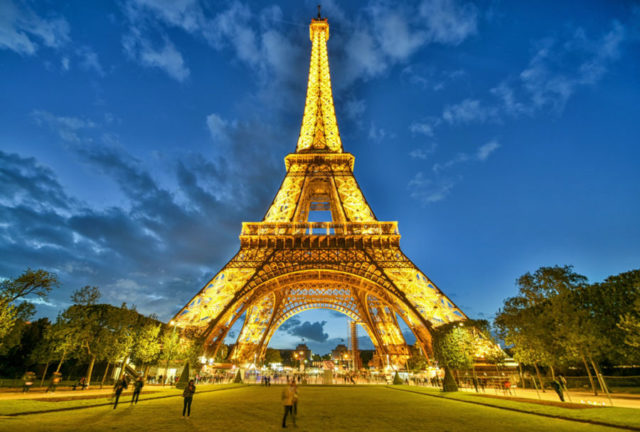
The one big sight in Paris I did not get to visit on this trip — even though I wanted to — was the Eiffel Tower. Why? Because I waited until I arrived in Paris to try to reserve a slot online. And by that time, even several days out, the only time slot available was to enter at 11 p.m. I consoled myself by taking lots and lots of photos of that Parisian icon…from the ground.

In other places, booking ahead is more “optional,” depending on the crowds from day to day. When it’s quiet, reserving is not necessary. But given the unpredictability of crowds, prebooking can still be very smart…just in case.

For example, a big trend in London is that major sights — including  Westminster Abbey, Houses of Parliament, Churchill War Rooms, St. Paul’s Cathedral, Tower of London, London Eye, and Windsor Castle — are encouraging visitors to prebuy tickets online. This usually saves a couple of pounds off your admission cost, and it also lets you skip the ticket line when you arrive at the sight.

One afternoon, I tried to swing by the Churchill War Rooms — the underground warren of offices where the UK engineered its victory in the Battle of Britain. But even late in the day, a couple of hours before closing time, there was a one-hour line to buy tickets. I missed out on that particular sight — and as I stood there, watching people breeze right past the long line because they’d prebooked tickets (at a discount, no less), I wished I’d done the same.

Won’t this cramp your style? Look — I respect spontaneity in travel. But the stakes are very high these days. If you enjoy being spontaneous on vacation, then you can be as spontaneous as you want to be — except when it comes to avoiding exhausting lines at major sights. Think of it this way: If you save an hour in line, that’s an entire hour of priceless serendipity that you can spend however you like.

2. Some combo-tickets and sightseeing passes let you skip the line.

My all-time favorite line-beating tip remains the same: At Rome’s Colosseum, you can join the excruciatingly long ticket line. Or you can walk five minutes up the street, to the ticket office for Palatine Hill (which is included in your Colosseum combo-ticket  — regardless of whether you wind up visiting that sight). You can walk right in, buy your ticket, then head back down to the Colosseum and stroll past the long line and into the world’s greatest ancient amphitheater. Other sights all over Europe have similar combo-tickets.

Another “oldie-but-goodie” tip — which has gotten even better with the increase in crowds — is to buy a Paris Museum Pass. Not only will this save busy sightseers money; it also lets you skip right past the long ticket-buying line at major sights all over the city. I visited most of Paris’ top sights — Versailles, the Orsay, the Arc de Triomphe, Sainte-Chappelle, Rodin Museum, the Orangerie, and more — and rarely waited more than a few minutes at any of them (at the security checkpoint). For example, at the Arc de Triomphe, my Paris Museum Pass let me walk right past the long ticket line in the underpass below the arch. By the time the folks at the end of that underground ticket line had even cleared security, I’d already climbed the 284 steps to the top and back.

However, before buying a sightseeing pass, be aware of which sights let you skip the line — and which ones don’t. For example, in London, Westminster Abbey has some of the longest lines in town. I saw would-be visitors walk up to the security guard, show their London Pass, and be sent back to the end of the line with an apologetic shrug. The London Pass does include “fast track entry” at some sights — but mostly ones with shorter lines to begin with (and not Westminster Abbey).

Also, be aware that even if you can skip the ticket-buying line, you may still have to wait in a security line. For example, at Windsor Castle, I was told that when it’s very busy, even people who prebook may have to wait an hour (or more) to get through security.

That’s why — even if you prebook tickets — it’s always a good idea to…

3. Know exactly when sights are the most (and least) crowded.

At most major sights, crowds peak from just after opening time until around lunchtime, and then crowds gradually taper off until late afternoon.  Early risers show up shortly before the sight opens, so they can be in the first wave of visitors. People like me, who prefer to sleep in, find it’s best to go late in the day.

On principle, I never, ever show up at a major sight mid-morning. Instead, I use that time to visit lesser-known sights, explore lively neighborhoods and parks, or seek out crowd-free experiences.

For example, on this trip, my Rome hotel was a couple of blocks from my favorite sight in town, the Pantheon — the best-preserved temple from the ancient world. I was sorely tempted to visit when I left the hotel in the morning. But I resisted that instinct, knowing I’d be sentencing myself to an unpleasantly crowded experience. Instead, I circled back in the late afternoon — around 3:45 — and was able to walk right in.

Later, I stopped by Rome’s Colosseum at 5 p.m. Even though I could have gotten a ticket with no wait just up the street (see that tip earlier), as an experiment, I joined the quickly shrinking ticket-buying line. In about 25 minutes, I was inside, snapping photos of the place where gladiators fought for gore and glory. When I was done there, I walked across the street and slipped in the gate for the Roman Forum just before they closed it, at 6:15. In the 45 minutes before they kicked me out, I had the Forum almost to myself — strolling amid the ancient ruins, feeling the breeze, and listening to the birdsong.

On the other hand, be careful not to cut it too close. The next evening, I was feeling overconfident at the Vatican. After snapping some photos around St. Peter’s Square, I joined the security line to enter the greatest church in Christendom at about 6:20 p.m. (hoping to squeeze in for a peek before the 7 p.m. closing time). The line moved quickly, but after about five minutes — when I was maybe 10 people away — the security guard slammed the gate shut with a decisive clang! The people ahead of me in line gestured frantically, begging the guard to let them slip in. He simply pointed to his walkie-talkie and shrugged. He’d been told it was time to close the gate — and when you work at the Vatican, you don’t mess with authority. (I imagine he didn’t want to have to answer to his boss’s boss’s boss.)

Sometimes it’s not just the time of day that matters, but the day of the week. Visitors to Paris who do their homework know that the Orsay — with Europe’s greatest collection of Impressionist artwork — is open late on Thursdays. After walking past that museum at other times, and seeing lines out the door, I waited until the time was right to visit. Then I showed up around 6:30 p.m. on a Thursday — and breezed right in.

At Windsor Castle outside of London, the ticket-sellers warned me that on Tuesdays, Thursdays, and Saturdays — when there’s a Changing of the Guard at 11:00 — everybody shows up around 10:30 in the hopes of entering the castle grounds to watch the ceremony. But many of those people are still stuck in the security line when the ceremony begins. If you’re determined to see the Changing of the Guard from inside the castle, arrive plenty early. But also be aware that the guards march up the main drag on their way to the castle. As an alternative, you could arrive outside the castle just before 11:00, watch that parade, then chill out, visit the rest of the town, and have a relaxed lunch. Then enter the palace in the early afternoon — when the lines are almost nonexistent.

4. Take breaks from the crowds — and find alternatives to major sights.

Trying to sprint through three or four big-name sights in one day, back to back to back, is a recipe for exhaustion and frustration. As travelers, all too often our eyes are bigger than our stomachs, sightseeing-wise. Don’t over-program your time in Europe’s big, intense cities. I’d aim for just one or two major, crowded sights per day. Then take a break — check out a bustling local market hall, nurse a coffee at a sidewalk café, go for a walk in a park or along a scenic riverbank, or explore an up-and-coming neighborhood. Or visit a lesser-known sight that’s almost as good, but much less crowded than the biggies.

In Paris, it’s understandable that people want to see the Orsay — the planet’s greatest collection of Impressionist works (and much more). But the Orsay can be jammed. If you’re a fan of Claude Monet, consider heading across the river to the Orangerie, displaying massive canvases of his transcendent Water Lilies, and — in the basement — a concise collection of works by many of the same artists you’ll find in the Orsay. But the Orangerie, too, can be quite busy. Parisians I talked to said that if it’s Monet you want to see, you can skip both the Orsay and the Orangerie and instead visit either the Marmottan Museum or the Musée Maillol — both of which are never crowded.

In Rome, instead of braving the lines to enter the Colosseum, satisfy yourself with snapping photos from the outside. Then walk 15 minutes to the Baths of Caracalla, which — like the Colosseum — beautifully illustrate the majesty of ancient Roman engineering…but are always completely empty. For aficionados of ancient Rome, the baths are arguably even more interesting than the Colosseum. (Rick recently visited the Baths of Caracalla with our Roman friend, tour guide Francesca Caruso.)

In London, I waited in moderate lines to tour both the Tower of London and Windsor Castle. And both were well worth the wait. But I also ventured out to a lesser-known royal residence, Hampton Court Palace — and I found it captivating. The onetime home of King Henry VIII (and his many wives), Hampton Court Palace is perhaps even more impressive, architecturally, than the Tower and Windsor. And, thanks to the excellent, included audioguide, it comes with fascinating historical insights and vivid stories of larger-than-life monarchs. Best of all, I had the place virtually to myself.

It’s hard to convince travelers to not visit those world-famous sights. And if the only way you can be satisfied with your visit to Rome is by standing in the Sistine Chapel, then by all means, do it. But don’t do it just because it’s on someone else’s list of what you’re “supposed” to see. If you know a sight is going to be jam-packed, ask yourself — honestly — how important it is for the success of your trip. Maybe you can settle for some “also-rans.” You may well discover that — when taking the misery of crowds and long lines into the equation — you’ll enjoy those “lesser” sights even more than the biggies.

5. Expect challenging crowds…and be zen about it.

The hard reality is that, these days, even “A+” travelers who do everything just right must simply accept the fact that Europe is at capacity, and some lines are unavoidable. You don’t have to like it, but you will need to pack a little extra patience.

Every savvy traveler in Paris knows to avoid Versailles on a Tuesday — because the palace’s Monday closure, combined with the Tuesday closure of the Louvre, create a perfect storm of demand. Unfortunately, the week I visited, I had to go to Versailles on Tuesday — since Wednesday was a holiday. Visiting one of Europe’s busiest sights on the one day out of three that it’s open is a recipe for frustration.

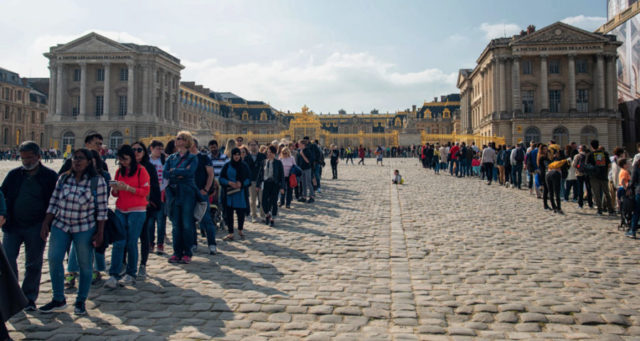
I did my best to beat the crowds — arriving at the château later in the day, about an hour and fifteen minutes before closing time. My Paris Museum Pass let me skip the ticket-buying line. However, the (obligatory) security line filled the entire grand courtyard — twisting back on itself four times, in a serpentine zigzag, with hundreds of fellow latecomers. I had finally been beat by Europe’s crowds. I hung my head in shame, found the end of the line, and joined the masses.

And do you know something? It was just fine. Although the line looked comically long, it moved fast, and I was inside within about a half-hour. That left me just enough time to follow Rick’s Versailles Audio Tour through the château’s highlights — set to double-time, with Rick chattering like a chipmunk in my ear as I walked briskly through the sumptuous halls.

Inside, the crowds were intense. There was no choice but to go with the flow. To pass from room to room, everybody had to be extruded through the same narrow doorways. Competition was fierce for the best vantage point for selfies. I witnessed a few photographers virtually come to blows, jockeying for a clear shot of Louis XIV’s toilet. I was worried someone would get jostled over the flimsy guard rope and go careening into a priceless vase or piece of furniture. It was unpleasant.

But I decided not to let the crowds ruin my enjoyment of Europe’s grandest palace. I just went numb and went with the flow, making a point to ignore the crowds and focus instead on the lavish details. By the time I reached the Hall of Mirrors, the crowds were clearing out, and I was able to linger amid the ghosts of 18th-century courtly life.

I always get a kick out of being one of the last people at a great sight. By the end of my visit, they were flushing out us final stragglers by closing the big shutters — plunging each successive room into darkness, in a not-so-subtle hint that closing time was nigh. After being essentially kicked out of the château, I headed to the gardens — which stay open later than the palace itself — and had a relaxing early evening stroll there before heading back to Paris.

I could have decided to be miserable in that line, and once inside those mosh-pit hallways. But instead, I told myself that’s the price I had to pay to visit the greatest palace on earth. I decided to enjoy it…and I did. (And the people-watching was marvelous.)

The Final Word (tl;dr)

So, in short: Accept that it’s going to be crowded…but do your best to beat the crowds by doing your homework. Know which sights let you reserve tickets ahead, and consider combo-tickets or museum passes that let you skip the line. Be aware when big sights are going to be more and less crowded, and plan your day accordingly (hitting less popular sights at the most crowded times, and vice versa). Take breaks to recover from the mob scenes at Europe’s great sights, and consider replacing some of the “must-sees” on your list with less crowded, more intimate, more purely enjoyable alternatives.

And…don’t forget to have fun and take it all in. I don’t care how crowded it is — if you’re standing in front of a painting that gives you chills, savor it. Take a deep breath and settle in. Stand like a stone in a rushing river of humanity, and commune with the majesty of Monet or Michelangelo. Just check out those brushstrokes.


You’ll find specific, detailed, carefully updated advice for beating the crowds at the big sights in all of our Rick Steves guidebooks: London, Paris, Rome, and many more.

If you’re heading to any of “The Big Three” — London, Paris, Rome — stay tuned to my blog this summer. I’ll be posting frequently about these three classic European destinations. (Or follow me on Facebook.)


London’s Best Undiscovered Street Food Market

It’s Saturday morning in London. I’m headed to my favorite, undiscovered street market — Maltby Street Rope Walk — to assemble a progressive brunch. As usual, it’s cold and drizzly. And, as usual, I have an empty coffee cup in my pocket.

The weather can’t be helped — it’s a late-spring day in a city synonymous with fog. As for the coffee cup, this is my routine in London. Caffeine is required to simply move around this sprawling metropolis. And when I’m done with my takeaway flat white, it’s impossible to find a place to throw away the cup — because city leaders have, quite reasonably, removed garbage cans from major landmarks and Tube stations as an anti-terrorism measure.

For this I cannot fault them. But it means that when I’m done with my coffee, I’m stuck with the cup. Londoners have improvised a solution to this: They arrange neat little rows of discarded cups and bottles on curbs and other flat surfaces, as if improvising altars to present their offerings to the garbage-collection gods. But I’m too much of a rule-follower to leave my garbage just sitting there in the street. Instead, I stuff the cup into my jacket pocket until I reach a less target-rich corner of the city.

But I digress. After 10 minutes of shivering in a bus shelter, the red double-decker bus finally pulls up. I hop on, ride it a few stops through a nondescript neighborhood, and hop off at a grubby, yellow-brick railroad viaduct. It’s a bus stop that few tourists would find their way to. But I know what’s just around the corner.

I walk under the bridge — feeling the ground shake as an express train rumbles overhead — and pass a graffiti mural and a tidy pile of garbage bags, stacked for collection. Rounding the bend, I reach my destination.

London is blessed with an abundance of wonderful street markets. But the Maltby Street Rope Walk is far and away my favorite. I love its variety, and I love that it’s just far enough off the tourist trail to remain predominantly local. Mixed in among the London trendsters are a few visiting international foodies who’ve done their homework.

This short-but-sweet food bazaar bustles every Saturday and Sunday morning. I always make a point to show up as hungry as possible, and before long, I’ve grazed my way to an incredibly satisfying brunch.

From the horizon rockets up the jagged glass pinnacle of The Shard, Europe’s tallest building. Just a 15-minute walk away, The Shard also marks the boundary of the tourist’s London — not to mention the Borough Market. I love the Borough Market, too. It’s historic and a delight to explore. But it’s also bourgeois and a bit too pleased with itself.

Rope Walk, on the other hand, revels in its lack of pretense. It’s burrowed deep in Bermondsey, a lowbrow but emerging neighborhood. Bermondsey is the kind of place where rustic microbreweries are tucked between self-storage shops and auto-repair garages.

The Rope Walk is simple: Two dozen vendors fill a narrow corridor squeezed alongside the rail viaduct — about as long as a football field, and maybe 30 feet wide — with a festival of artisan food carts, each one offering a bewildering array of Instagram-ready taste treats: succulent Scottish salmon mounted on little slices of dark bread, Venezuelan arepas, Vietnamese banh mi, fresh-pressed juices, Spanish jamón carved right off the hock, a creative array of scotch eggs, Brazilian steak wraps, Middle Eastern flatbreads with savory toppings, German-style sausages, gyoza steamed in wicker baskets, slabs of grass-fed, dry-aged, rare-grilled hanger steaks, and much more. London’s many hipsters — with their perfectly coiffed beards and chunky eyeglasses — think they’ve died and gone to heaven.

Under the arches are lumber warehouses, some of which are home to rustic brick-and-mortar restaurants. One seemingly high-end seafood place (The Walrus & Carpenter) feels genteel…except that its secondhand tables are squeezed between stacks of two-by-fours.

The drizzle intensifies. I pop up my hood and do another lap — still deliberating which combination of street food nibbles will add up to my dream Rope Walk lunch.

On a rickety table in front of Tozino tapas bar, I spy calçots— giant green onions charred on a grill. My colleague Robyn was just telling me she’d finally tried this springtime delicacy in Barcelona. And ever since, I’ve been dying to try it. I have no trips to Spain planned anytime soon, but no matter — in London, the world’s food comes to you.

Through broken English (with lots of Spanish), the vendor hands me a little newspaper-wrapped bundle of blackened spring onions and explains how to eat it: carefully peel back the charred outer layer of the onion, revealing a sweet, slimy, tender cooked stalk in the center. Dip it into Romesco sauce, and munch. File this one under “Looks weird; tastes amazing.”

Now on to the main course. After doing a couple more indecisive laps, I finally settle on a tried-and-true favorite: The Cheese Truck, with a carefully curated menu of melted English cheese sandwiches. I opt for the flavor bomb: Cropwell Bishop Stilton cheese (imagine a fearless mashup of gorgonzola and cheddar) with pear chutney and bacon.

I stand patiently in the drizzle while they griddle up my sandwich to order. When it’s finally ready, it’s every bit as decadent, melty, and delicious as you’d dare to dream. The cheese itself packs a punch, balanced and mellowed by the chutney. The bacon may be gilding the lily a bit, but I can live with that. Just the right amount of cheese has oozed out the side and gotten crispy and salty against the grill.

To wash it down, I head to the Sicilian lemonade stall. You have to be careful in Britain, where “lemonade” usually means “sicky-sweet lemon-lime soda.” But this is a true Sicilian lemonade, as authentic as the guy from Catania who pours it for me: Fresh-squeezed lemon juice, sprightly and not too sweet.

The sun is breaking through the clouds. And, while I’ve had the place largely to myself, now Londoners are emerging like earthworms and filling the pavement. Things are getting crowded.

It’s time for dessert. I swing by the Bad Brownie table and buy a salted caramel brownie. It’s rich, decadent, and gooey — dripping with thick, salty-sweet caramel, and topped with crunchy crystals of solid caramel. A couple of bites is enough for now. Fortunately, by this time I’ve found a place to get rid of that coffee cup. I wrap the brownie in a bag, jam it in my empty pocket, and begin walking toward Tower Bridge.

As a train rumbles overhead, I start whistling a tune. I have a busy day of guidebook work ahead of me. But no matter. As usual, Maltby Street Rope Walk Market has provided me with one of my favorite meals of the trip.


Maltby Street Rope Walk Market is described in our Rick Steves London guidebook — which I was in town to update for our upcoming 2020 edition.

If you like this place, you’ll love the other nine places I wrote up in my recent post on Europe’s best markets.

Maltby Street Rope Walk Market takes place every Saturday from 9:00 until 14:00 p.m., and Sunday from 11:00 to 4:00 p.m. It’s about a 15-minute walk from the Borough Market and London Bridge Tube station, or 10 minutes by foot from Tower Bridge. You can also ride the Tube to Bermondsey, turn left out of the station, and catch bus #188 toward Russell Square; ride just a few minutes to the Tanner Street stop, get out, hook around the corner, go under the rail bridge, and look left.

And don’t forget to come hungry.

What’s a Traveler to Make of Brexit?

In April of 2019, I traveled through an England in political purgatory: The “Brexit” vote to leave the EU had passed nearly three years earlier, but Britain seemed farther than ever from enacting it. While I was there, yet another Brexit deadline was deferred, and the Brits I asked was unsure whether, when, or how it could actually happen. And it seemed like everywhere I turned, Britain was determined to provide me with historical context for the moment it now faced. Today, several months later, Brexit is a done deal. On the occasion of Britain formally leaving the EU, I’m revisiting this chronicle of my visit during a surreal moment in history — a trip when Chaucer, Churchill, and the Chunnel were all driving home the same message: Britain and Europe have always been strange bedfellows.

On my first trip to Britain, 20 years ago, I visited some old, dear friends of my parents. Over my first-ever chicken tikka masala at the town’s finest curry house, I explained that I was excited to visit all the different parts of Europe — starting here in England. The awkward silence that ensued made it clear I had said something inappropriate. “Well, yes, but…” they finally said, kindly but firmly. “Britain is not Europe.”

Brexit may be dominating headlines today. But, as I learned on that first trip, Britain has long defined itself as something apart from Europe. I’ve just spent three weeks traveling in London and southeast England. And everywhere I go, I am reminded that Brexit is not a bold new idea. It’s the culmination of Britain’s centuries-long, love-hate relationship with the Continent.

The Chunnel

When planning my itinerary for this spring’s trip — linking guidebook research in England with a visit to Paris — nostalgia compelled me to book a ticket on the Eurostar train through the Channel Tunnel. On that first backpacking trip in 1999, I took the Chunnel between London and Paris. Open just five years at that point, the Chunnel seemed so exciting…futuristic, even. For the first time in history, there was a “land” connection between Britain and Europe. This was the heyday of European unity: A few years later, eleven European countries would voluntarily do away with their traditional currencies in favor of the simplicity of the euro. And a couple of years after that, the European Union would expand aggressively to the east — bringing a flood of Polish and Slovak and Lithuanian workers to British shores.

In retrospect, perhaps that was too much integration, too fast. Today the Chunnel tethers England to a continent a majority of its voters have decided they want no part of. And at Ashford International train station, it shows.

Ashford International — where I’m hitching my ride through the Chunnel — is sprawling, characterless, and drab. Nobody here seems to like it very much. The simple task of driving my rental car to the station proves to be an ordeal. Circling the station, eyes peeled for a Hertz sign that never materializes, I keep winding up on the parkway to the adjacent Ashford Designer Outlet. Many times the size of the station, it exerts a strange and inescapable gravity — as if everybody in town has quietly decided that the shopping mall, and not the station linking Britain to Europe, is what Ashford should be known for.

Like all avid travelers, I’m a connoisseur of train stations — especially here in Britain, where historic brick, steel, and glass architecture mingles with modern amenities. But Ashford International has no personality. It feels like a too-big boondoggle airport in a depressed city, whose developers are currently serving five to ten in minimum security prison. My warm, fuzzy, romantic notions of “taking the Chunnel to Paris” are facing a harsh reality check.

The concourse is a ghost town. In my imagination, tumbleweeds swirl past the shuttered newsstands. There’s a scrum of loud French teenagers, apparently returning home from a class trip. And at the opposite end of the concourse — conspicuously keeping their distance — are a few weary-looking Brits, sitting sourly as if in a backed-up NHS waiting room. All of this is starkly at odds with the many colorful, life-size Mickey Mouse cutouts with the message, “Disneyland is closer than you think!” and encouraging me to “Find all 10 of the hidden Mickeys!” (Apparently, the only entity still gung-ho about the Chunnel are marketers responsible for luring British families to Disneyland Paris.)

While most of the shops in the station are closed, two indistinguishable cafés are open. Comparing the two, I choose the farther one…if only because it’s easier than backtracking to the first one. The cashier — casting suspicious glances up the concourse — grumbles about the other café. “It’s Saturday!” she whinges. “And on Saturdays, only one of these two cafés is supposed to be open. And today is our turn. But this lot” — more accusatory glances up-concourse — “apparently decided to open anyway.”

“Um,” I say. I noticed, walking by earlier, that the offending café is French-run.

“Don’t worry,” she says with a satisfied wink. “I’ve already reported this to the supervisor.”

Duly relieved, I slink away with my mediocre, burned-tasting latte (a British specialty!) and my cheese and ham panini. I munch my sandwich, looking out over the heartbreaking mediocrity of the Ashford International platforms. The gray metal canopies over the tracks match the overcast sky. I think about how that very name — Ashford International — is infused with a cheeky optimism. Fancy that! An in-ter-na-tion-al train station — in England! This must have seemed thrilling when it opened. And yet, I can’t shake the feeling that the station is the embodiment of a deeply unsatisfying British-French compromise that made nobody happy — and, increasingly, feels like a regrettable albatross.

I’m probably overstating it. Maybe existential malaise is simply a prerequisite for working at a train station on a Saturday. But there’s no doubt that Brexit has stoked hard feelings on both sides of the English Channel. For most of my traveling life, Britain has prized its ties to Europe, but now the pendulum has swung back the other way — hard.

Looking over those gray tracks, I think back on what have, until now, seemed a random assortment of impressions that have stuck with me on this trip through Britain. Waiting for my train, I weave them together as strands of a thousand-year-long tale of Britain and Europe.

“NOOOOO BREXIT!”

My first night in London was just days before the EU-imposed Brexit deadline. Curiosity drew me to the Houses of Parliament. Big Ben was entirely covered with scaffolding — a too-on-the-nose symbol of Britain’s current “work in progress” approach to sensible governance. I happened to arrive at the fence just in time to see a gaggle of pro-EU protesters, waving flags and hollering. They huddled together and mustered all their energy for a chant: “No Brexit! No Brexit! NOOOOO BREXIT!” It seemed like they were just getting warmed up. But then, having said their piece, they dispersed just like that…wandering off in every direction, aimlessly, with their limp EU flags dragging on the pavement.

A few blocks up the street, I walked by one of my favorite monuments in London, which honors British women who died serving and fighting in World War II — many of them on European soil. It stands immediately in front of Downing Street, where, at Number 10, another exemplary British woman’s talents were being squandered trying to clean up the mess created by headstrong men. Theresa May already had one foot out the door; the pinnacle of her career, it seems, was to take the fall for David Cameron’s Brexit referendum, then quietly excuse herself for another headstrong man to take the reins.

A week later — after EU authorities extended the Brexit deadline for six months, extending May’s torture (I mean, tenure) — I sipped a burned latte with a Cornishman at café under London Bridge. I asked him to look into his crystal ball: What will become of Brexit? He shrugged. Like everyone — including (especially!) Theresa May and Brexit’s other supposed architects — he had zero clue whether and how Brexit will be implemented.

I asked why they didn’t just do another referendum, to clear up the confusion and ensure the true will of the people is being heard. (This was also my brilliant suggestion in Florida in 2000. Nobody listens.) He pointed out that many people in poorer parts of the country — especially in the industrialized North, sort of the “Rust Belt” of Britain, whose Thatcher-era economic struggles worsened with David Cameron’s austerity measures — are angry at the “Soft South” (as they call London and its posh satellite communities). And, just like a significant percentage of Donald Trump’s voters were simply disillusioned people who wanted to throw a live hand grenade into the hallowed halls of government, Brexit can be seen largely as a protest vote. The problem is, in both cases — like it or not — that vote is binding, and the consequences are real.

Throughout London, the effects of European integration are evident everywhere. London may well be the most cosmopolitan city on earth, and certainly in Europe — which is one of the things I dearly love about it. And yet, selfishly, I must admit that London’s international bent sometimes complicates my guidebook research. On several occasions, I stepped into a big chain hotel to update our book’s details, and the receptionist (in a thick Italian, Spanish, or Polish accent) explained — almost bragged— they had no idea how to answer my questions, because they had just started working there a week or two before. They struck me as freewheeling young people who’d come to London on a lark, to enjoy living in a big city for a few years before moving on to the next thing. While the “revolving door” culture of the EU has its benefits, I could imagine, if I lived in London my whole life, feeling a sense of loss for a time when I used to interact with people with a less transient connection to the city.

Hastings, Chaucer, Dunkirk, Churchill, and ABBA Too

Moving on from London, I did a little road trip throughout southeast England, from Brighton to Dover to Canterbury. Here, in the corner of Britain that’s closest to Europe, the air is thick with insights about Britain’s historical connections to Europe.

Brighton, just an hour south of London by train, fancies itself Britain’s Riviera — a beach break for those who don’t have the money to head to Nice or Mykonos or Dubrovnik or the Costa del Sol. On an unseasonably warm spring day, the beach’s chunky pebbles were filled with working-class Londoners trying to get comfortable on towels and sling-back chairs. Most people seemed to be staying well back from the actual water, with just a few kids dipping numb toes into frigid surf. This struck me as a poor substitute for balmy Adriatic or Aegean beaches — but at least it’s English, dammit!

On a walking tour, my guide pointed out the Brighton Dome, where ABBA’s “Waterloo” won the Eurovision song contest in 1974, vaulting the group to super-stardom. (Am I pushing it too far to point out that the winning song was, in a very roundabout way, about Britain’s defeat of Napoleon’s French forces? Yes? OK, never mind.) There was a time when Eurovision captivated all of Britain. It was the pop music equivalent of the Olympics or the World Cup. But these days, the Brits have grown hardened and cynical: “It’s not what it used to be. After the Iron Curtain fell, the Eastern Bloc broke into a million little countries that just vote for each other all the time. It’s not fair!”

An hour’s drive east, in the town of Battle, I trudged through the drizzle around the site of the Battle of Hastings — where, in 1066, the Norman (read: French) William the Conqueror defeated the Anglo-Saxon (read: English) Harold Godwinson with an arrow through the eye. Thus began centuries of French rule over Britain. While seemingly a loss for “England,” many credit this event with bringing the until-then-remote island more fully into the European fold. If not for the Norman Conquest, Britain might still loom on Europe’s distant periphery. The English language and culture not only survived, but were enhanced by their French connection. Most English-speakers don’t even realize how many words came into our language from French — including ones for fundamental concepts like art, money, justice, diplomacy, theater, cuisine, and many, many others.

In Canterbury, I found myself reciting the first few lines of Geoffrey Chaucer’s 14th-century masterpiece, Canterbury Tales (which I was required to memorize in college). A museum docent pointed out that Chaucer’s work was so influential, in part, because it was written in vernacular English, at a time when French was still the language of learning and literature. But things were changing. A few decades before, the Great Plague had cut England’s population in half — disproportionately killing off French speakers (who tended to live in cities, where the plague spread like a stomach bug on a cruise ship). And Chaucer was writing just as the conflict that would come to be known as the Hundred Years’ War was turning popular opinion even more strongly against French. Chaucer boldly asserted the worthiness of English as a literary language; two hundred years later, Shakespeare would cite his influence.

In Dover, peering across the English Channel, I could plainly see France despite the cloudy, drizzly, blustery weather. It’s right there, after all — just 20 miles away. Up at Dover Castle, I toured the secret tunnels from which British authorities orchestrated the “Miracle of Dunkirk” — rescuing 338,000 British troops who’d become stranded on a broad French beach after being boxed in by Nazi forces in some of the earliest fighting of World War II.

Standing atop a windy white cliff, looking across to France, I recalled the words of Winston Churchill’s most famous speech, delivered the day after Dunkirk to rally Britain for the coming winner-take-all war with Germany: “We shall defend our island, whatever the cost may be. We shall fight on the beaches, we shall fight on the landing grounds, we shall fight in the fields and in the streets, we shall fight in the hills; we shall never surrender.” Churchill — who knew his Chaucer — made a point to use exclusively words of Anglo-Saxon origin, with just one pointed exception that came from French: “surrender.”

And then, down on Dover’s waterfront, I stumbled upon a chilling monument: a panel (donated by Germany in peacetime) where Nazi artillery forces made a note of each one of the 84 shells they lobbed at Dover from their positions on the cliffs of Calais across the English Channel. Imagine: The Nazis were so close to Britain — on French soil — that they didn’t even need airplanes or rockets to bomb it.

Just four decades later, however, Britain was again moving toward Europe. Leaving Dover, I pulled off the highway at a quiet little park called Samphire Hoe, tucked away from the world through a tunnel at the base of some of Dover’s famous white cliffs. This artificial meadowland was created by dumping more than six million cubic yards of chalk left over from the construction of the Chunnel between 1988 and 1994. By the seaside, a poignant plaque lists the names of 11 workers who died during construction.

From Britain to Europe

Back at Ashford International, I’m jolted awake from my little history lesson zone-out by the announcement — first in English, then in French — that it’s time to head down to the platform and board the train that will take me through that tunnel.

Crossing from Britain to Europe proves anticlimactic. The train pulls up, I get on and find my seat, they serve a meal. A few minutes later, while they’re bringing around coffee, it grows abruptly dark. No “Cheerio, England!” No nothing.

Writing this, feeling my ears pop as I travel under the English Channel, the future of Europe, and of Britain’s place in it, feels uncertain. But looking back over the last millennium — and over my last few weeks of travel — I realize that’s nothing new. While Brexit adds a new wrinkle to the saga, Britain’s struggle to reconcile its relationship with Europe is as old as “British-ness” itself. My crystal ball is no better than anyone else’s. But I have a hunch that, as ever, Britain can’t live with Europe…but can’t live without it.

Several minutes later, it gets light again, and my phone jingles: “Welcome to France!”  (My cell phone company — eager to explain their roaming policy — seems to be the only one who cares that I’m in a new country.) And then, the loudspeaker: “Mesdames et Messieurs, nous approchons maintenant Paris.”