Photos Help Tell the Story

Wrapping up a great trip, a few photos add to the story. Note also a number of photos added to entries over the last two months.

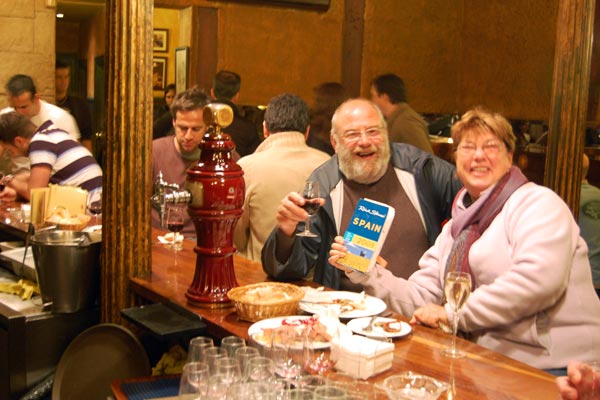
Travelers enjoying tapas and their guidebook. When blitzing tapas bars in Madrid’s best neighborhoods, it’s fun to find happy travelers putting their guidebook to good use.
Enlarge photo

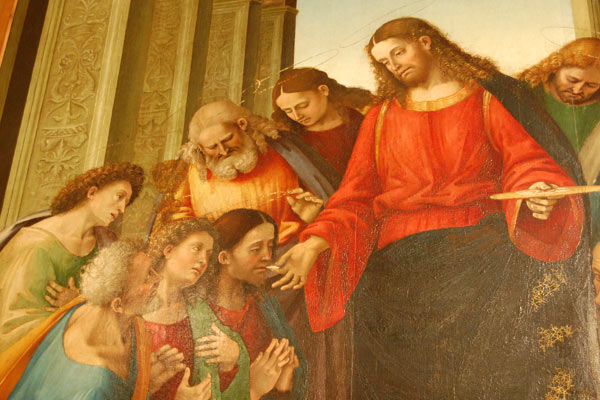
An amazing painting in Cortona.
Enlarge photo

Bright-eyed and bushy-tailed, I open the shutters and greet a new day in Volterra. In a week I meet the TV crew…
Enlarge photo

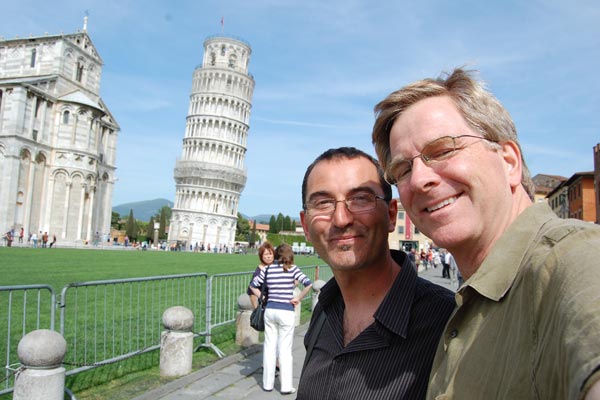
Dottore Vincenzo Riolo in Pisa taught me volumes about his town and is one of many excellent new local guides I met and will recommend in my guidebooks.
Enlarge photo

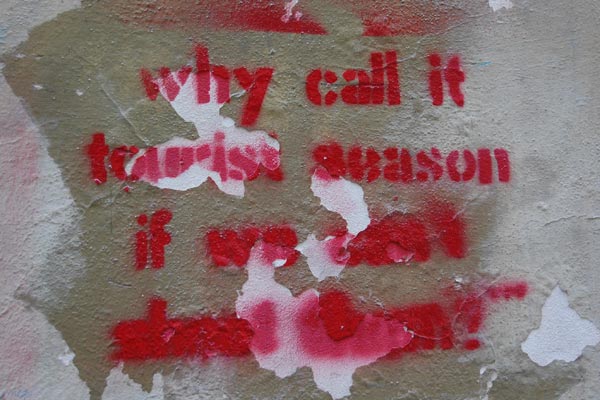
Why call it tourist season if we can’t shoot them? A scary welcome in Florence’s Oltrarno district.
Enlarge photo

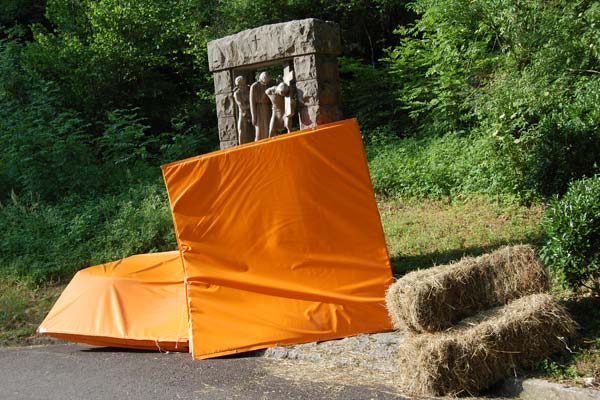
Station of the Cross, padded for protection, along the route of a bike race in Slovenia.
Enlarge photo

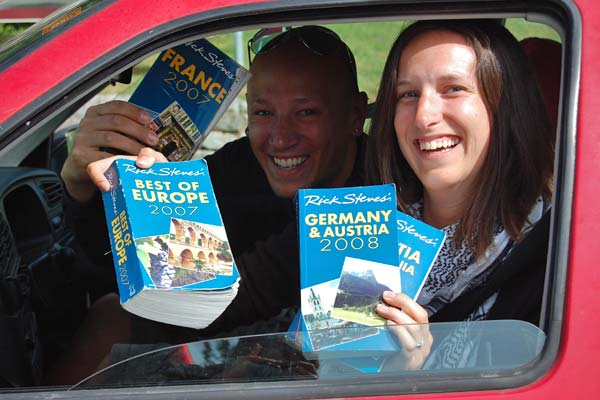
Happy road trippers with favorite guidebooks in Slovenia.
Enlarge photo

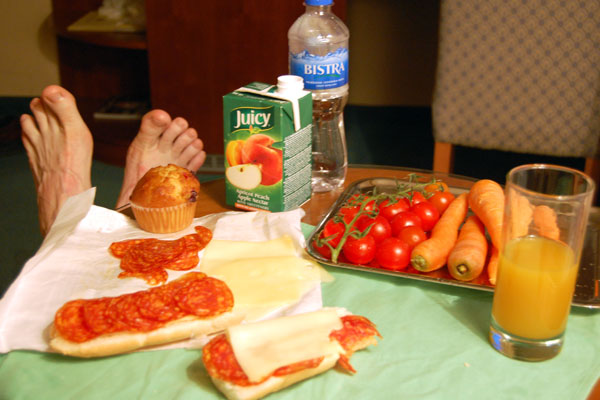
Cheap and delicious picnic, relaxing in my Zagreb hotel room.
Enlarge photo

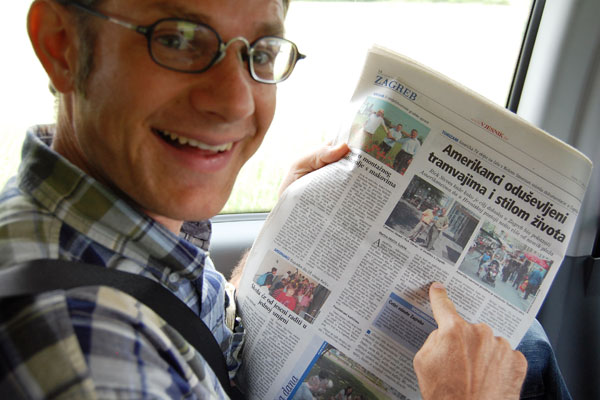
Cameron Hewitt (co-author of our Croatia & Slovenia guidebook) reads about himself, me, and our American film crew in a Zagreb newspaper. I guess an American film crew in Zagreb is newsworthy.
Enlarge photo

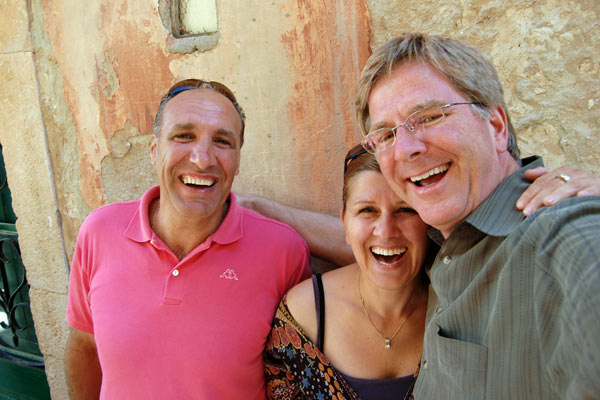
Croatian B&B hosts—clicking with new friends in Korcula.
Enlarge photo

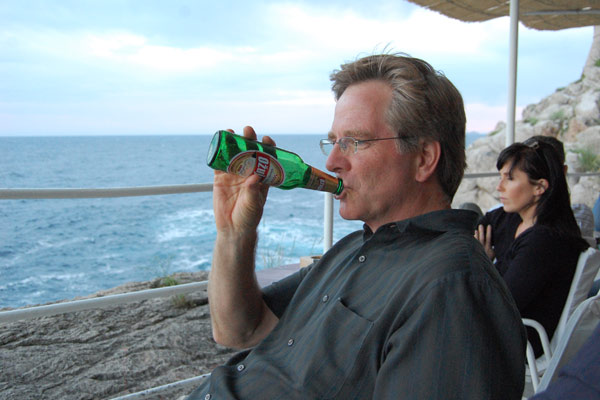
Day #70…Trip over, one last beer to enjoy a Dubrovnik vista and celebrate a smooth and productive trip before flying home.
Enlarge photo

AmExCo is a dinosaur


Enlarge photo

American Express was once the convivial, welcoming home to American travelers abroad. It was a gathering place for adventurers living far from the USA. In the 1970s and 1980s we’d meet here to collect mail from home, sell used VW vans, and reconfirm our flights home. When changing dollars into francs, it felt so good to lose money to that smiling, English-speaking person at American Express. Now with e-mail, ATMs, and the general shrinking of the world, AmExCo is a dinosaur. They are closing down shops right and left. And I realize they no longer merit the special paragraph between laundromats and post offices in my guidebooks. I feel almost guilty when I highlight an American Express listing and press delete.

But enjoying change is fundamental to good travel. Change is accelerated as once poor countries are thriving. Last week, zipping on modern freeway from Madrid to Segovia in a comfy air-con bus during the pre-scorch hours of the day, I was staring with pensive wonder out the window. The modern American-style suburban sprawl of Madrid reaches far beyond where any tourist ventures.

Suddenly, just a few minutes after wild scrub and farms replaced the car dealerships and furniture outlets, a towering concrete cross broke the horizon rising high above the hilly Castillian countryside. It marks the grave of Franco–a memorial church longer than St. Peter’s, carved out of solid rock entirely underground. It’s lined with towering angels glorifying Franco and those countless thousands on both sides of Spain’s Civil War who gave their life for “God and country.” Spaniards explain their “late start” in joining the rest of Europe in the remarkable affluence of this generation because they had to wait until the 1970s for freedom to replace Franco.

Later I met a man who looks like a medieval Kenny Loggins with a big grey beard, a toothy smile, and a battered bike. He didn’t speak a word of English. I tried to interview him but he looked at me as if thawed out of some glacier. He just smiled and pointed to his flag. It’s Latvia. He pulled out a magna-carta-like map with a red line tracing his route. His itinerary looks like the trip of a kid with ADD and a two month Eurailpass–but he did it all on a circa 1960 bike. I feel strangely honored to meet him….before Latvia, too, joins in the affluence.

The pipes and fiddles play on.

A few years ago, I submitted the Madrid chapter of my guidebook and a new TV show we produced on Madrid to the local tourist board for a tourism promotion contest. While I knew I was promoting tourism in Spain far more than any other participant, I also knew I wouldn’t win. That was a few years ago. Just yesterday, my local guide friend told an anecdote about how my writing was ridiculed by the panel of judges as being just “too full of Franco.” (Tourist boards are all about fun in the sun and duty free shopping.)

I don’t think you can tour Spain properly without an understanding of how a brutal civil war followed by half a century of dictatorship impacted the society and leaves it scarred today.


Enlarge photo

Now I’m in Ireland. I just watched a powerful movie (The Wind that shakes the Barley) in a small town (Dingle) theater filled with local farm kids whose grandparents could have been the stars of the movie showing how a heroic independence was won after a 700 year long battle with the world’s quintessential colonial overlord (Britain) and the battle then morphed almost immediately into a civil war (fighting over how to deal with a Britain-ruled north).

Walking a Dingle street the next day with the retired local police chief, Tim, I worked to bring to life Ireland’s history using insignificant bits of a small town a world away from Dublin as a rack upon which to hang this understanding. A century ago the town’s police station was the Green Zone of English imperialism here, housing the dreaded Black and Tan forces who kept any Irish insurgency under control. It was burned and today only the red brick wall at its gate survives. Across the street a big, white crucifix stands memorializing where local boys were executed (firing squad) by the English “in the glorious struggle for a free Ireland.” This was erected after the Free State was established, but even back then they knew the struggle was on-going. It is dated 1916 to 19__. Ireland remains divided and the date remains poignantly open ended.

I enjoy history–I actually got my history degree accidentally, it was so much fun. And the history that inspires me most is from the last century–heroic figures who people alive today still remember. Churchill, chomping on a cigar in his bunker, keeping England fighting. Ataturk, muscling medieval Turkey from the buffet line of Euro-imperialism into a modern democracy.

Turks still remember the George Washington of their young nation. I have a Turkish friend (Mehlika) who was so dedicated to Ataturk that as a young girl she believed she’d never be able to fall in love with another man. Her father died of a heart attack during a moment of silence at a Rotary Club ceremony to remember what Ataturk did for Turkey. Even today, Turks see Ataturk’s image floating by in the clouds.

The sights and stories of small people (young and old) fighting Hitler, Franco, the USSR, or the Queen carbonate my European sightseeing. And, to any student of history, two things seem very clear: we can learn valuable lessons from history; and the resilience of a people’s cause, while easy for an imperialistic power to underestimate, is an impressive force.

The English burned the harps here in Ireland centuries ago. But the pipes and fiddles play on as today the Irish culture thrives.

Holy Toledo, the devil’s licking his chops

After a week in central Spain (Madrid, Toledo, Segovia), I’m heading for Ireland.

I like to catch emerging neighborhoods in my guidebooks. Here’s a new listing for my 2007 Spain book: In Madrid, a neighborhood called Lavapies is emerging as a colorful magnet for people looking for the multi-ethnic tapestry of Madrid society enjoying pithy, cheap, seedy yet fun-loving life on the streets. As is the case with most neighborhoods like this, they experience an evolution: so cheap only the immigrants, down-trodden, counter-culture types can live there. The liveliness they bring attracts those with more money who like the diversity and color. Businesses erupt to cater to those bohemian/trendy tastes. Rents go up. Those who gave the area the color in the first place can no longer afford to live there. They move out and here comes Starbucks. For now, Lavapies is edgy, yet comfy enough for most.

This district has almost no tourists. Old ladies with their tired bodies and busy fans hang out on their tiny balconies as they have for 40 years watching the scene. Shady types lurk on side streets.

For food, you’ll find all the various kinds of tapas bars plus great Indian and Moroccan eateries. I list a couple of places that appealed to me…but explore your options. I’d recommend making the entire walk once, then backtrack and eat at the place or places that appeal.

From metro stop “Anton Martin” walk down Calle Ave Maria (on its way to becoming Calle Ave Allah) to Plaza Lavapies (old ladies hang out with the swarthy drunks here while a mosaic of cultures treat this square as a communal living room) and then up Calle Lavapies to Plaza Tirso de Molina (with a metro stop). This newly remodeled square was once plagued by druggies. Now with a playground and flower kiosks, it’s homey and inviting. This is a fine example of the vision for Madrid’s public spaces.

If traveling to Madrid, keep these places in mind: Bar Melos is a thriving dive jammed with a hungry and nubile local crowd famous for its giant patty melts called Zapatillas de Lacon y Queso (because they are the size and shape of a zapatilla or slipper, €7 feeds at least two, Ave Maria 44). Nuevo Cafe Barbieri is a dying breed of smoky mirror cafe with a circa 1940 ambiance playing classical music in afternoon and jazz in the evening and offering its coffee sippers a menu of loaner books (Ave Maria 45). At Calle Lavapies 44, consider a fun cluster of three places: Indian Restaurant Shapla (good €8 menu); Teteria Lakutubia (an atmospheric tea house); and Montes Wine Bar with countless wines open and served by the glass and good tapas (crawl under the bar to get to the WC).

With a good guide, art–even obscure art buried in side chapels–comes to life. In Segovia’s cathedral I found a fun piece in a side chapel. I added this to my guidebook:

The many side chapels are mostly 16th century and come with big locking gates–a reminder that they were the private sacred domain of the rich families and guilds who “owned” them. They could enjoy private Masses here with their names actually in the blessings and a fine burial spot close to the altar. Its many 17th century paintings hang behind a mahogany wood gate imported from colonial America. The center statue is Mary of the Apocalypse (as described in Revelations, standing on a devil and half moon–looks like bull’s horns). Mary’s pregnant and the devil licks his evil chops waiting to devour the baby Messiah.

By the way, only Americans say “Holy Toledo.” Spaniards and the English don’t recognize the phrase. Locals tell me it’s likely from Sephardic Jews (Spanish branch) who emigrated eventually to America. To their American ancestors, Toledo was the most holy Jewish city in Europe…Holy Toledo!

Whenever I find a new eatery with a business plan driven by a chef’s passion, I am one happy guidebook researcher. Here’s my favorite new find for my Toledo chapter:

Adolfo Vinoteca–The highly respected local chef Adolfo who runs a fine restaurant across the street, runs this wine bar in hopes of introducing the young generation to the culture of fine food and wine. The place offers super elegance without the pretension. You can’t go wrong with their short list of gourmet appetizers (€5 each) and fine local wines (€2 to €3 per glass). I’d just throw myself at the mercy of Jonathan, and enjoy the feeling of gourmet slaves in the kitchen bringing you your wildest edible fancies. If the Starship Enterprise had a Spanish wine & tapas bar, this would be it. Wine is sold at shop prices with a €6 cork fee (daily 12:00-24:00, across from the cathedral at Calle Nuncio Viejo 1, tel. 925-224-244).
Hot in the shade

Madrid is hot. People here say “be thankful you’re not in Sevilla.” I still have a headache from yesterday’s sun. I’ve never had a too-much-sun headache. But it is really hot here. I should break down and trade my headache for a little unsightly hat hair…but no.

I often think people who talk about the weather and traffic have nothing else of greater interest on their mind. (Talking about the weather and traffic in Seattle is tiresome.) But here in the lofty and over-heated interior of Spain, even people with plenty to say are talking weather these days. I can’t believe I am assessing restaurants by their air-conditioning. People who don’t have air-con are going to movies just to get a break from the heat. Poor locals, refugees from the heat, lay like lizards in the shade.

Maybe Americans who really believe there’s no climate change going on aren’t motivated by their economic self-interest. But I believe many deny the existence of global warming because it’s not good for the economy (in the short term) to deal with it. (That was, after all, the official US rationale for opting out of the Kyoto Accords.) Assuming the engines of the First World economies are driving global warming, any industrialist (or person holding their stock) sitting in air-con splendor while the poor world is getting the brunt of their greed is somewhere between wrong and evil. Many of these people (who have no idea what living poor in the sweltering developing world is like) can’t even consume what they have. What drives them? Call me a liberal, but I’m steaming like the rest of the world.

(Of course, me promoting air travel contributes to airplane emissions which add to the greenhouse problems. My goal this coming season is to find a creative way travelers can contribute to forests enough to negate their personal contribution to this inconvenient truth.)

Things are so hot in Spain that they’ve moved the times of bullfights two hours later…to 9pm…no more sun and shade tickets. Everything’s the same–hot in the shade…and I believe that’s where we’re all heading. (For the sake of those who follow us, this topic deserves thoughtful and respectful discourse.)