Habsburgs and Bourbons — So What?

As a travel writer and TV producer, I pride myself on not avoiding complicated history-teaching challenges. Anyone can throw out the name Joan of Arc — but so what? Anyone can reference Hannibal crossing the Alps with elephants — but so what? Anyone can say “The Thirty Years’ War” — but so what? Without having my readers’ and viewers’ eyes glaze over, I try to fill in the “so what’s.”

Doing this is always a challenge in the TV scriptwriting process, because I need to set the historic context up front, when a TV show is supposed to be fun and engaging. But with the good help of my staff, we keep the bar pretty high and enjoy having the best of both worlds.

This spring, I was in Madrid talking about new palaces, wars of succession, and Habsburgs and Bourbons, and it occurred to me that I didn’t understand how and why Spain’s two royal families came to power and – so what?!

With the help of my favorite Madrid guide, Federico Barroso, and Cameron Hewitt (here in our office), we just took my rough essay, which was filled with gaps, and honed it into what I think is a pretty tight little sidebar for the next edition of our Spain guidebook. In case you’ve been lying awake at night, thinking, “Habsburgs and Bourbons in Spain — so what?”…here’s that new sidebar from the 2013 edition of Rick Steves’ Spain:


Spain’s Royal Families: From Habsburg to Bourbon

Spain as we know it was essentially born in the 15th century, when Queen Isabel (who ruled Castile and León) married King Ferdinand (who ruled Aragon and Navarre), bringing these four long-established medieval kingdoms together (1469). The so-called “Catholic Monarchs” (Reyes Católicos) wasted no time driving the Islamic Moors out of Spain (the Reconquista). By 1492, Isabel and Ferdinand conquered Granada, incorporating a fifth kingdom (Andalucía) and establishing more or less the same borders that Spain has today (minus its breakaway regions that have struggled for autonomy to this day: Catalunya, the Basque lands, and Galicia).

This was an age when “foreign policy” was conducted, in part, by marrying royal children into other royal families. Among the dynastic marriages of Isabel and Ferdinand’s children, they arranged for their third child, Juana “the Mad,” to marry the crown prince of Austria, Philip “the Fair.” This was a huge coup for the Spanish royal family. A member of the Habsburg dynasty, Philip was the heir to the Holy Roman Empire, which then encompassed much of today’s Austria, Czech Republic, Hungary, Transylvania, Low Countries, southern Italy, and more. And when Juana’s brothers died, making her ruler of the Kingdoms of Spain, it paved the way for her son, Charles, to inherit all of the kingdoms of his four grandparents—creating a vast realm and famously becoming “the most powerful man in Europe.” He became both Charles I of Spain and Charles V of the Holy Roman Empire.

He was followed by Philip II, Philip III, Philip IV, and finally Charles II. Over this period, Spain rested on its Golden Age laurels, eventually squandering much of its wealth and losing some of its holdings. Arguably the most inbred of an already very inbred dynasty (his parents were uncle and niece), Charles II was weak, sickly, and unable to have children, ending the 200-year Habsburg dynasty in Spain with his death in 1700.

Charles II willed the Spanish crown to the Bourbons of France, specifically, his grand-nephew, Philip of Anjou (who was also the grandson of the “Sun King” Louis XIV of France). But the rest of Europe feared allowing the already-powerful Louis XIV to add Spain (and Spain’s vast New World holdings) to his empire. Therefore, Austria, the Germanic States, Holland, and England backed a different choice, Archduke Charles of Austria (grandson of Spain’s King Philip IV). So began the War of Spanish Succession (1700-1714), involving all of Europe. The war ended with a French victory. However, with the signing of the Treaty of Utrecht (1713), Philip had to give up his rights to the throne of France. This let him take the Spanish throne, but ensured that the future Spanish Bourbon dynasty could not merge with the French branch of that royal family — keeping Spain independent.

In 1714, the French-speaking Philip became the first king of the Bourbon dynasty in Spain (with the name Philip V). The Spanish throne, under the inbred Habsburgs, had grown ineffectual and corrupt, and Philip V breathed much-needed new life into the monarchy.

When the old wood-structured Habsburg Royal Palace partially burned down on Christmas Eve of 1734, Philip V (who had been born at Versailles) decided to build a new and spectacular late-Baroque-style palace as a bold symbol of the new dynasty. This is the palace that wows visitors to Madrid today. Construction finished in 1764, by which time Philip V’s son Charles III became the first to occupy the new palace. Charles III’s decorations are what you’ll still see inside when you visit.

The Bourbon palace remained the home of Spain’s kings from 1764 all the way until 1931, when Francisco Franco proclaimed the Second Spanish Republic, forcing King Alfonso XIII into exile. Although Franco originally chose to sideline the royals to make himself ruler-for-life, he later handpicked as his successor Prince Juan Carlos, a Bourbon by birth and Alfonso XIII’s grandson. Franco believed that Juan Carlos would continue Franco’s own hardline policies. But when Franco died in 1975, Juan Carlos surprised everybody by voluntarily turning the real power back over to the parliament. Today Spain is a constitutional monarchy with a figurehead Bourbon king — Juan Carlos I — at the helm.
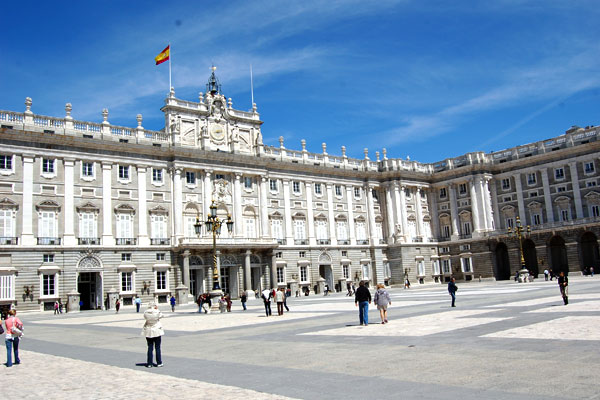
Madrid's remarkable Royal Palace wows tourists. But understanding its history — and the two royal dynasties that have shaped Spain, the Habsburgs and the Bourbons — make it even more compelling.

Porn Stars on Venetian Gondolas

Wrapping up my spring trip, I found a few stay observations and lessons gleaned from my time in Spain and Italy. When I’m researching my guidebooks, I pick up lots of fun bits, but they don’t all make it into the books. As I never know what will find a niche in a book until I work over the chapter, I tuck every thought that flutters by into my satchel. Here are a few fun fragments from the cutting-room floor:

Chatting with the owner of a thriving new eatery in Madrid, I commented on the speed at which the restaurant scene can change here. He noted, “Before the Internet, it took five years for a restaurant to get off the ground. Now, you can kick-start it with an Internet promotion, and it’ll be full in a month.”

Discussing the difficult aftermath of the Spanish dictator Franco and marveling at how everyone wasn’t against his fascist policies when it came to personal liberties, I asked my friend, “Who wouldn’t want freedom when Spain was evolving from fascism to democracy in the late 1970s?” The answer was brilliantly simple: “Only those who didn’t want others to have freedom.”

Flying from Madrid to Barcelona on Iberia Air, for the first time in my life, I was really mad at an airline. They had configured the seats so tight that I literally couldn’t fit my knees into my space. The experience reminded me of an evening I once spent alone with a wrench on a tour bus. I was meeting a tour group the next morning, and the bus I hired came with too many seats jammed into it. The seats slide on runners tightened into place by bolts. I spent several hours loosening each seat, taking out two sets, and rearranging the positions of the remaining seats. We did that tour with half our storage area under the bus filled with bus seats — but plenty of legroom for all on board.

Stepping off that too-tight Iberia plane in Barcelona, I realized I hadn’t even considered taking the Madrid-Barcelona train, which is now a nonstop bullet connection of less than three hours. In this case, the train would have saved me time, if not money, and given me plenty of stretch-out room…not to mention a delightful look at the countryside.

Even if I'm "full as an egg," there's always room for peppers in a Spanish tapas bar.

A good indication that a bar is a colorful local hangout is that it has the local football (soccer) team poster on the wall — a way for the staff to let customers know who they root for.

In towns with lots of foreign-study programs, you can see American teenagers poaching Internet signals on the sidewalk in front of American chains like Starbucks, KFC, and McDonalds. (These are more likely than European chains to offer free Wi-Fi for customers.) Students, who collect and share passwords and tips, are expert Wi-Fi poachers.

Riding out to the airport in Barcelona, my cabbie was pulled over and fined €50 on the spot for being slow to stop for an ambulance siren. He explained that, with the economic crisis, cops are coming down hard and fast on drivers in Spain.

I enjoy picking up little bits of folk wisdom in my travels. A local guide in Barcelona marveled at the low caliber of leadership in his country, saying, “En el país de los ciegos, el tuerto es el rey.” (In the land of the blind, the one-eyed man is king.) Talking about pain-pleasure ratios between cultures, another friend said, “He who gets up early is helped by God.” His wife countered, “No, getting up early doesn’t speed up the sun.” Later, in Italy, when a restaurateur wanted to give me more and more food, I said I was stuffed. He told me that in Italy, you say, “Sono pieno come un uovo” (I’m full like an egg).

After one of my researchers commented on how people were not that friendly in the Cinque Terre, I asked some locals about it. They talked about their experience in restaurants, saying, “Friendly is not the currency here. Waiters don’t want to know your name. They’re working hard. They’re grumpy to all. I just want them to get my food right.” The humor here is flavored with sarcasm, which can come off mean-spirited.

One year later, the cover of my Venice guidebook is still accurate — but there are plenty of changes inside.

I enjoyed more time than ever in Venice. And it occurred to me that you could pause anywhere in Venice, observe, and, from that single viewpoint, write an article. Leaning against a church’s leaning bell tower as a flock of birds flew just in front of my face, I jotted down a few notes: A group of Russians wandered by — rich men with their platinum-blonde trophies. They were silent but hooked up to their guide with ear buds and a “whisper system.” The crowd in the restaurant looked intentionally disinterested in the music as a roving Romanian accordionist pumped away while sussing out the potential of getting any tips. A solitary local waved his hands while pacing back and forth across a bridge and talking on his cell phone. Next to me, litter was growing out the top of a garbage can like a bum with a bushy head of hair.

As far as I can tell, there are no porn stars on Venetian gondolas. In fact, there are not even lovers on gondolas. Everyone is too busy reading their iPhones or looking into their cameras. Desperate to get someone kissing on a gondola for our TV show, I walked briskly along a canal to get ahead of what I thought was a potentially romantic couple. I got their attention, and motioned to our cameraman and did a charade of kissing as if to clearly ask them to give each other a little kiss as they approached. The man, pointing to the woman next to him, mouthed with silent yet exaggerated motions, “She’s my daughter.”

The Tooth Fairy (and Other Delights) of Madrid

In Madrid I love to have a room with a tiny balcony overlooking the Times Square of all of Spain, Puerta del Sol. This square, like so many in Europe, has gone from a traffic nightmare to a park-like people zone. Within a 10-minute walk I can (and did) visit the third greatest palace in Europe (Madrid’s Royal Palace), my favorite collection of paintings under any single roof in Europe (at the Prado Museum), and the ultimate town square (Plaza Mayor). And even more exciting, I went to a tiny museum busy with enthralled and wide-eyed little Spanish kids to meet their mystical little mouse, “Ratón Pérez.” This amazing little guy, a kind of four-legged tooth fairy, gives candies to Spanish kids when they lose a tooth and put it under their pillow. There was ample evidence of the little mouse Pérez everywhere in the museum, but the magical little rodent himself was nowhere to be found. (The Ratón Pérez museum is one of many fun new listings I’ve added to the upcoming edition of my Spain guidebook.)

If you can’t see the video below, watch it on YouTube.

Loin of Cod with a Nice Glass of Catalan Red

After a long and tasty evening of researching tapas bars in Madrid, our last stop was my favorite. At €18 the dinner we ordered wasn’t cheap, but when shared, and paired with wonderful €4 glasses of wine, it was both a great value and, it seems from this vantage point, may become a lifelong memory. I learned a good trick from Jorge, my guide: In a tapas bar, order your glass of wine first, before ordering any food, and wait as if expecting a free treat (which is expected by locals but often not given to clueless tourists) — and you’ll get a small plate of some delicacy for no extra cost. Then order your food. This stop (where we shared the dinner, and had two glasses of fine wine and the small starter plate) cost us about $15 each.

If you can’t see the video below, watch it on YouTube.

Pondering the Societal Big Four at Madrid’s Royal Palace

Standing on the square of the Royal Palace in Madrid, it occurs to me that there was a master plan to its layout. I consider it Europe’s third greatest palace (after Versailles, near Paris, and Schönbrunn in Vienna) — over the years, while updating my Spain guidebook, I’ve probably visited it at least ten times. And I always learn more to shuffle into the book, and find it a joy to see.

If you can’t see the video below, watch it on YouTube.