Here you can browse through my blog posts prior to February 2022. Currently I'm sharing my travel experiences, candid opinions, and what's on my mind solely on my Facebook page. — Rick
To follow up on my bureaucracy blog post from last Sunday: I noticed that in Italy, even the lowliest bureaucratic grunt takes no tips or bribes. I tried numerous times to round up little fees, and they strictly refused any extra money.
A crowning example of bureaucratic stupidity: Once we’d manage to get a paper giving us permission to film, we’d routinely need to find a tobacco stand, so that we could buy a tax stamp to make the paper official. Spending an hour of our precious filming time, and €10 on a taxi ride to pay €8 for a tax stamp ‘ all as a way to pay the tax for another piece of paper ‘ tried my patience.
I enjoyed a Florentine guide’s philosophy that “Good guides need to understand the unexpressed needs of their clients.”
I’ve noticed that a bag of carrots has become my favorite hotel room snack: cheap, crisp, tasty, and light after all the cooked restaurant food.
Many old Italian women cringe at the sound of a pope with a German accent. And many call Pope Benedict “The German Shepherd.”
While the casual visitor wouldn’t notice, I heard that in small towns a lot of jealous rivalries fester among relatives who are disgruntled about not getting a fair shake in a family will. Because of inheritance squabbles, the restaurateurs of Monterosso (in the Cinque Terre) are considered some of the best clients of the lawyers in nearby La Spezia.
American travelers may be notorious for traveling too fast, but they’re turtle sightseers compared to Japanese big-bus tourists. I was running around with Paola, a guide friend of mine in Assisi, until she had to meet a Japanese bus group for a tour. Paola illustrated how fast they blitzed her town by making the Road Runner cartoon sound while her hand zipped by like a rocket. Just for fun, I followed her as she worked. Getting off the bus first, the Japanese tour escort greeted Paola by saying they had 65 minutes. Paola bowed, said “konnichiwa,” and off they went. The tour leader translated Paola’s commentary through their whisper system (now standard among bus tours ‘ a guide talks into a mic, and the entire group hears her in their wireless earpieces). Barely stopping on their rushed march through town, entering nothing but one church, they motored through Assisi, managing to finish up well within their 65 minutes.
Paola said Japanese groups prefer to hear their historical information without dates ‘ they’d rather just get the era (Baroque, Gothic, Renaissance) and the numbers (a town’s population, how many meters high a tower is). She opined that the groups often speak better English than their translator, and noted that the women laugh freely when in pairs, but much less when they are with their men. And they are extremely polite, she says. How polite? On a famous wall designed for graffiti, along the Cinque Terre’s Via del Amore, Japanese tourists love to leave notes, but are loathe to deface the wall with actual graffiti ‘ so they scrawl on Post-it notes.
We can laugh at people from different cultures struggling to experience far-away places. But whether we are American, Turkish, or Japanese, it’s almost always a constructive exercise. Even on a blitz tour that gives Assisi just 65 minutes, even for people who seem to do little more than mug in front of famous monuments with their giddy peace signs and seemingly mindless smiles, travel teaches lessons and leaves memories that will contribute to a broader perspective.
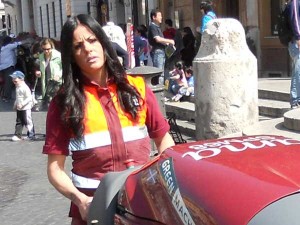
In the last month I’ve produced five TV shows in Florence and Rome. In the process we’ve worked with wonderful people, without whose help we’d never have been able to do our work. To each of them I am very thankful.
During the filming process, I gained a respect for the cost to a society of a business environment encumbered by a bulky bureaucracy. Italians must be wired differently than Americans because they live and work in a society almost crippled by a cancer-like bureaucracy. I worked with many good people during the process, and don’t mean to complain about them personally. But the system they work within is, as they themselves kept saying while trying to work with their counterparts in other wings of the bureaucracy, “incredibile” (pronounced “een-kred-EE-bee-lay,” while shaking a hand in the air).
Bureaucrats kept saying to me, “I know you don’t have to deal with this in America” ‘ and then would soldier on, producing a fraction of what they might have if they’d simply been able to stand up and reinvent things in the interest of productivity. Here’s my take on it as an observer (who’s thankful to work in the efficient business environment we enjoy in the USA):
Within Italy’s bureaucracy are many zones of responsibility that are separate and equal, mutually dependent but unable to communicate efficiently, if at all. Each apparatus has legions of people working within it, but is hierarchical to the degree that people on a lower level are frightened into inaction if the senior person, called the “responsabile,” is not present. And it is the higher-ups who seem to be important enough to be not at their desk, for various reasons. Responsabiles seem disinclined to empower people below them to make decisions, as they think this would take authority away from them. No one below would dare question the way this throws a monkey wrench into the hope of getting anything done, so they just keep treading water on the government dole. Therefore, if one person is out of town, out to lunch, at a meeting, on vacation, or whatever, a simple decision cannot be made. Like a strange and nightmarish rash, the bureaucracy grows and grows.
In the last month, while trying to get permission to film in a particular place, I would often need to list exactly which pieces of art we hoped to photograph. Since branches of a hopelessly bureaucratic system ‘ almost by definition ‘ do not communicate with each other, we would need to repeat the process of making this list several times. Then, when we’d finally get to a sight, the responsabile there would sit down and scour our paper for something out of order. Typically, we could photograph whatever we wanted as long as it was on the list. If we neglected to add something ‘ even as simple as an extra portrait bust or case of jewelry ‘ we would not be allowed to photograph it. If we asked why, the answer didn’t take logic into consideration. It was just a matter of what the paper said. End of story.
Anyone with a degree is referred to respectfully as “doctor” (dottore or dottoressa). Directors of one sight would complain about not getting any media promotion…and then people at the same sight would refuse to let it be featured in a TV show. And getting the two decision-making arms (which didn’t realize that they were at odds with each other) to talk to each other was not an option.
I found the bureaucracy so pervasive that people with initiative have become demoralized, which is understandable among people whose initiative gets them nowhere. This results in an internal brain drain. I asked a very impressive and well-off parent what he aspired to for his kids, and he said, “To get a government job.” Why? “Because they’ll have job security and a paycheck at the end of the month.”
I rarely dream about my work. But for the last month, my frustrations with the Italian bureaucracy have worked their way into my dreams.
You know I love Italy. And because of that, its exasperating bureaucracy and inability to purge corruption from its civil servants “cuts my heart” (as people say here). The current scandal rocking the Cinque Terre National Park is a good example of persistent corruption. (I’ll talk bureaucracy in my next post.) Here’s a sidebar I just added to the next edition of my guidebook on the region:
Since its creation in 1999, the Cinque Terre National Marine Park has brought lots of good things to the area: money (visitors pay about €5 a day to hike the trails), new regulations to protect wildlife, and improved walkways, trails, beaches, breakwaters, and docks. There are park-sponsored information centers and even tiny folk museums.
The vision of the park was exciting ‘ everyone united and thinking creatively for the good of nature, the local communities, and their many visitors. The park administrators were well on their way to creating something truly unique in Europe. But, as is so often the case in Italy, the men entrusted to lead were corrupted by power and money. And, rather than stop them, many of those under the park leaders scrambled to win their favor and get in on the job security and easy money. The result is a vision in shambles and a park in disarray.
The park was run by its president, Franco Bonanini, a powerful man ‘ nicknamed “The Pharaoh” for his grandiose visions. In a personal visit a couple years ago, he conned me into thinking he really was a visionary committed to the region and its precious park.
But Bonanini created a medieval-style system of favorites and enemies, with the help of Riomaggiore’s mayor, and others. Starting and stopping construction projects, funneling money here and there, and extorting people to preserve their power, this cabal derailed the park vision. In 2011 they were removed from power, but the damage had been done. The good ideas of the park (info offices, baggage deposits, mountain-bike opportunities, little museums, elevators for the infirm, and even maintenance of the trails) have been scuttled.
Today, Bonanini is out of power, and the park’s run by a man from the central government whose vision for a fix, it seems, is to run the park as a business. But a park is a park, not a business. Ironically ‘ and sadly, for the residents ‘ using the park to wring money out of visitors while giving little back is not good for the livelihoods of the region’s hard-working residents. So, for 2012, no one knows exactly how the park will or will not be functioning. Thankfully, the villages and dramatic land between them are bigger than any corrupt modern-day pharaoh. For the latest on the park, see www.parconazionale5terre.it.
What does all this mean to the visitor? Not much. The Cinque Terre is still my favorite stretch of Mediterranean coastline. The people are endearing. The food, culture, and nature are uniquely enjoyable. I just thrill at the thought of people working together for a grand and noble vision that helps a community’s economy by wisely treating a park as a park, rather than making a park a business. And so far, the Cinque Terre has failed in that regard.
Dear Back Door travelers,
While in the Cinque Terre the other day, as I was enjoying a Mediterranean sunset with a bunch of happy travelers from all over our beautiful country, it occurred to me that my Facebook friends and blog followers could help me make a travel-teaching dream of mine come true. In March of 2012 I hope to take my Europe Through the Back Door travel lecture on the road, visiting 20 cities in 20 days as I drive diagonally across the USA, from Seattle to Florida. I’m looking forward to exploring my own country along the way, and in my three weeks on the road I want to meet as many people as possible in towns I’ve never seen. I’ve been giving my talks in the country’s biggest cities for 20 years. Now I’d like to meet travelers in the Spokanes, Fresnos, Peorias, and Charlottes of our country ‘ provided they’re roughly on my diagonal route. Would you like me to stop in your city or town? If so, pass this idea on to an organization that could put together an event with at least 800 attendees. Universities, city lecture series, town halls, libraries, civic organizations, churches ‘ I’d love to meet you in any of these spots. If you think such an event would be doable in your hometown, send your suggestions to my publicist at media@ricksteves.com.
Thanks, Rick