Here you can browse through my blog posts prior to February 2022. Currently I'm sharing my travel experiences, candid opinions, and what's on my mind solely on my Facebook page. — Rick

Highlights from the Fabled Island of Malta

Malta has long been on my wish list, and I’m so thankful our cruise itinerary included the fabled island, standing like a fortified rock between Sicily and Africa.

With the help of the wonderful Malta guide Amy Pace (pacee@vol.net.mt), my TV crew and I blitzed the island and produced a great little video. In fact, it turned out to be too good to cut down and add to our Greek Isles episode, as I had originally expected to do. So, now I have a strong mini-show about Malta — and the challenge of finding a good way to share it.

Here’s the (still rough) script we ended up writing and covering (“OC” means I’m speaking on camera):

[1, Malta] We’re leaving the Ionian Sea and sailing past southern Italy and Sicily to our final stop: Malta.

[2] The captain advised being up early to enjoy the entry to the Grand Harbour of Malta — the historic heart of the island serving three cities, including the capital city of Valletta. Clearly, this port was well-worth some serious fortifications. We’ll have a busy day to explore it. Our ship just squeezes into its spot and, in moments, we’re in the old center of town.

[3, OC] Malta is a tiny independent county set midway between Sicily and Africa. With a culture enriched by a long parade of civilizations, it’s a strategically placed island nation with an extraordinary history.

[4] The grid plan of streets was laid out with the first fortress. After the Turkish threat passed, the city was ornamented with delightful architecture, including characteristic enclosed balconies (called “gallarija” here). Massive fortress walls incorporate existing limestone cliffs.

[5] Of the many cultures that shaped it, perhaps most obvious is the 150 years Malta was part of the British Empire. In World War II, it was a key Allied naval base and, as it suffered horrible bomb damage by German planes, much of it has been rebuilt in recent years. The mighty harbor survived and you can tour it in a little boat called a “dgħajsa” (a Maltese gondola). The navy is gone, replaced by tourism. Here, a cruise ship dwarfs my dgħajsa.

The city of Vittoriosa is just across the bay, or you can just hang out with the local gang, fishing. The Upper Barrakka Gardens offer commanding views.

[6] While it gained its independence in 1964, the island retains its British flavor: English-style pubs and food, statues of queens, and red phone booths. While the official language is a Semitic language called Maltese, English is virtually universally understood.

[7] Valletta’s stately Grandmaster’s Palace is a reminder that most of the stonework in this stony city dates to the era called the Knights’ Period — 1530 to 1798.

After being beaten by the Ottoman Turks in Rhodes, the Knights of Malta (also known as the Order of St. John) retreated here in 1530 and built a huge fortress in anticipation of a Turkish attack. And in 1565, the stout walls survived a siege of 40,000 Ottoman invaders.

[8] Like much of Valletta, St. John’s Cathedral dates from the Knights’ Period. While austere outside, it is fabulously Baroque inside. Inlaid marble slabs honor several hundred Knights of Malta — each listing that aristocratic knight’s accomplishments. The Order of St. John was represented by eight countries — and each had a chapel here at the Order’s high church.

[9] Paintings tell the story, illustrating how the Knights were “servant knights” whose mission was to care for pilgrims venturing to the Holy Land, how they evolved into a maritime power with a mighty navy, and how Christianity ultimately would triumph over the Muslims.


[10] A highlight is the largest canvas ever painted by Caravaggio, The Beheading of St. John the Baptist. He gifted the cathedral with this in 1608. You’ll notice his signature mastery of the play of light.

[11] The knights wore the iconic Maltese cross on their chest on a black robe — it represented the four cardinal virtues and its points the eight Beatitudes as well as the eight countries making up the multinational order.


[12] Within a short drive from the main city are plenty of Malta sights, from charming towns with oversized churches (towering over locals who seem oblivious to the crush of cruise tourists) to tiny and remote harbors and a dramatic and rugged coastline. Local boaters take tourists to numerous nooks and crannies…including blue, blue grottos.

[13] The land, which can seem timeless, is dotted with prehistoric ruins dating back 5,000 years. Megalithic sites like Ħaġar Qim are evidence that, in roughly 3000 BC, settlers from Sicily arrived in search of arable land. While the humble, mud-brick village that once surrounded this temple is long gone, stones from the temple still stand. Archaeologists believe this was a temple to a fertility goddess that functioned as a celestial calendar.


[14] Malta — with plenty of small family farms — has been terraced since ancient times. Rock walls defend against erosion: The thin layer of topsoil is exposed to the steady Mediterranean breeze. It feels burned off — locals are nostalgic about the days, just a few years ago, when it used to rain.

[15] The fisherman’s harbor of Marsaxlokk, a favorite with visitors, is home to a vast fleet of typically Maltese fishing boats. While Marsaxlokk has a fine main square and church, the action is along the harbor — especially on a Sunday, when it’s all about fish. Tradition says that the shape of the boats goes back eight centuries before Christ to when Malta was a Phoenician colony, and the colors indicate the fisherman’s home village. Marsaxlokk must be blue.

[OC] Thanks for joining us. I hope you enjoyed our look at fascinating Malta. I’m Rick Steves. Until next time, keep on travelin’!

Three Great Islands: Rhodes, Santorini, and Mykonos

I just wrapped up a shoot for a new show about three Greek islands in the Mediterranean: Rhodes, Santorini, and Mykonos. Here are a few highlights.

St. Paul's Bay on the island of Rhodes

St Paul’s Bay, Lindos

The whitewashed town of Lindos is the top side-trip on Rhodes — and the only place in the world where I’ve sunburned my penis. In the 1970s, it was a desolate hideaway, completely wild, and known as a place where backpackers enjoyed the freedom to do a little nude sunbathing. Today, it’s a sleepy little resort, and no one is risking such an intimate sunburn. (That said, just driving around these islands in an open Jeep at midday was brutal under the fierce sun. At one point, I felt like an Arab sheik, hiding under whatever shelter from the sun I could find.)

Rick hiding from the sun under a towel

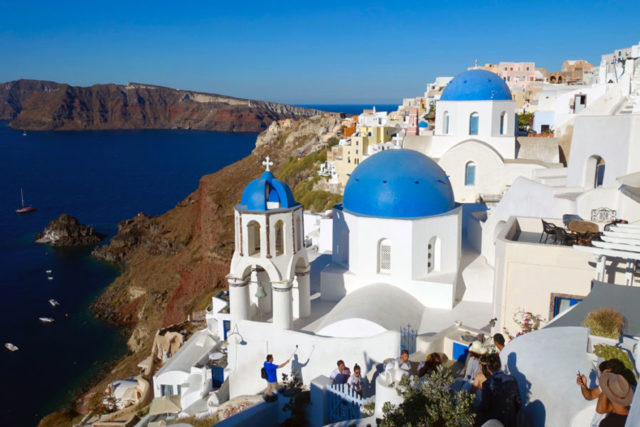
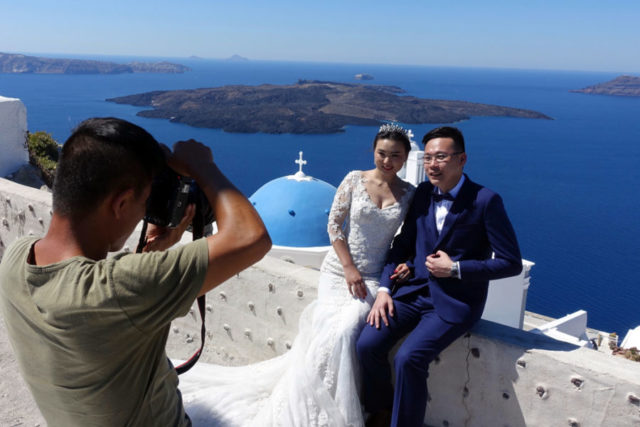
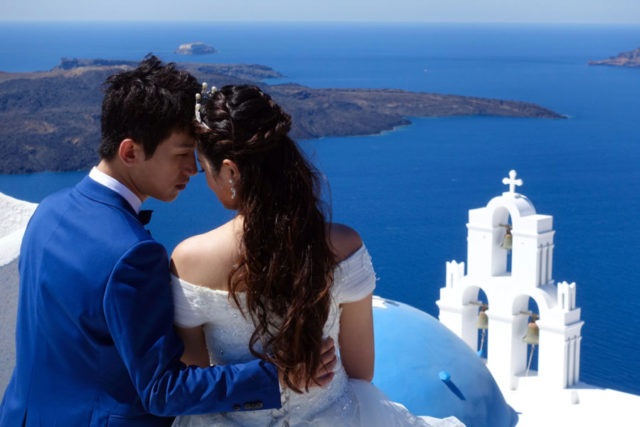
Oia is every shutterbug’s favorite village on Santorini. It’s also a huge hit with Asian brides. It’s trendy in Asia for couples to fly to Santorini for romantic wedding portraits…months before their wedding. My crew and I must have seen 20 brides and grooms — none of them married yet — getting iconic, Greek Isles wedding shots done for their big day.

Best Santorini viewpoint

A wedding portrait with a view over Santorini

An engaged couple sweetly bumping heads looking out over Santorini

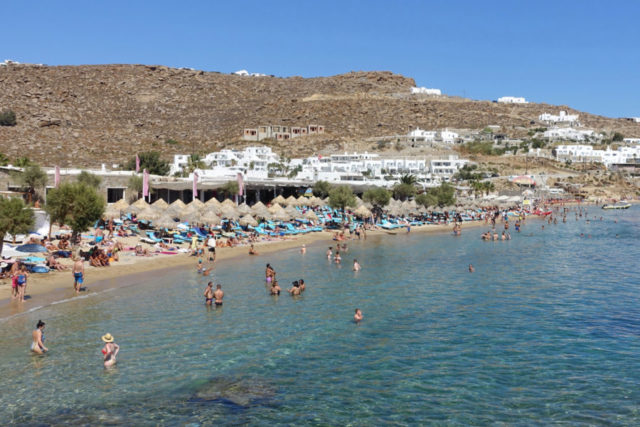
Paradise Beach, on Mykonos, may be the ultimate party beach of the Greek Isles. I spent time there as a student — and I think it’s been thumping ever since. While very youthful at night (and likely less welcoming), during the day I found it enjoyable for people of all ages.

Paradise Beach on Mykonos

Treasure Islands: Filming in the Mediterranean

My TV crew and I just spent two busy weeks on a Mediterranean cruise. While our primary goal was to shoot a one-hour documentary about how to cruise smartly, we also used our shore time to shoot a new episode about islands in the Mediterranean.

Our four days on Santorini, Mykonos, Rhodes, and Malta were filled with intensive filming. We were always among the first people off the ship and the last ones back on, 10 hours later. It is amazing how much you can accomplish during one day on shore (whether sightseeing or producing a TV show about that sightseeing) when you’re well organized.

I don’t know these islands very well (and I’d never even been to Malta) — so the filming experience was a bit different than usual. On each island, we would meet our local guide, show them my rough script, do a little scouting, consider the reality of our sail-away time, and then sit down and make a smart schedule to cover the sights. It was like a game: If we were smart, our guide was good, and the weather was clear, we could get what we needed. Fortunately, the weather was always good (they haven’t had rain since May) — and our guides were all excellent and excited about the project.

Reviewing footage on camera

A local guide would meet us at each port. They would bring their car literally onto the pier, in the shadow of our massive ship. (By the way, you can hire your own local guide with a private car for the cost of about four seats on one of the cruise line’s shore excursion bus tours).

Car pickup at cruise ship

At each port, we’d chart out our options, needs, OCs (the “on-camera” bits when I talk directly to the camera), and all the content I wanted to work into the script. With our time limits, this was an exhilarating challenge for me — kind of a speed-chess version of script writing.

Rick's notes on Santorini

My messy scribbling from Santorini.


We intended to make a show about all four of the islands we visited, but the shooting went so well — and there was so much we wanted to share — that I decided to feature just the three Aegean Islands (Santorini, Rhodes, and Mykonos) in this show and save Malta for a future project. (It’s always nice to have something new and exciting available for a TV pledge special.) This way, we can do each island justice while still sticking to our limit of 3,000 words for a half-hour script.

On each of the islands, we worked with a local guide who I really enjoyed. All of them make a living off cruise traffic and can be booked directly with ease: Nick Rhodes in Rhodes (request@rhodesprivatetours.com); Antonis Pothitos in Mykonos (info@delosguide.com); Dimitrios Nikolaidis in Santorini (info@oceanwavetours.com); and Amy Pace in Malta (pacee@vol.net.mt). Thanks Nick, Antonis, Dimitrios, and Amy for making us at feel home on each of your islands.

Guide Antonis Pothitos with Rick on Mykonos

Me and my Mykonos guide, Antonis Pothitos.


Working at a Floating Party

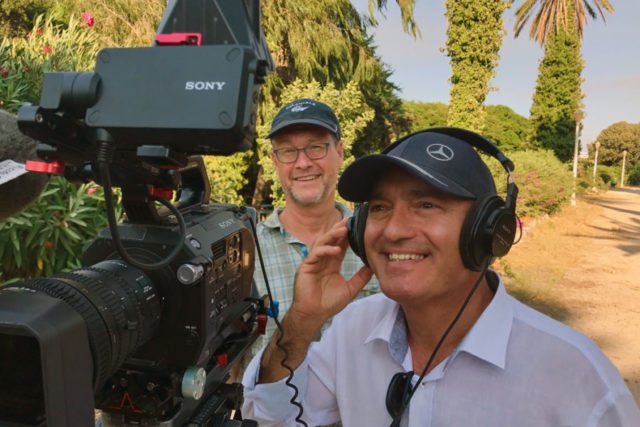
My TV crew and I just spent two weeks in the Mediterranean, filming a one-hour special about cruising that will air on public television in January 2019. It was strange to be working on the ship. At dinner, I would sit down with Simon and Karel (my producer and cameraman), and the servers didn’t quite know what to make of us. We attended most of the on-deck parties, but we were there with an agenda: Film the fun.

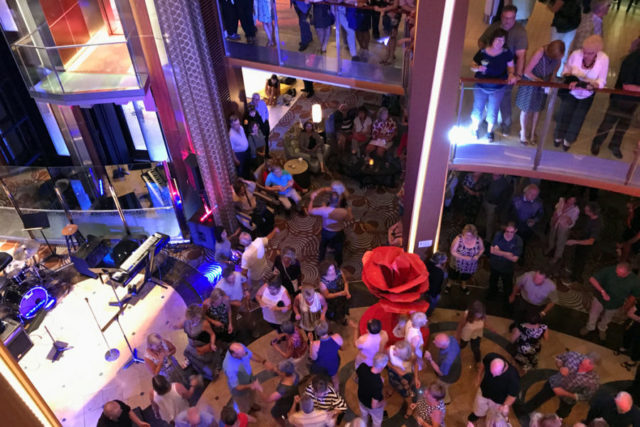
There were activities all day and all night. Most evenings, there was live music and dancing in the ship’s Grand Foyer, with its Vegas-style staircase and eight glassy elevators constantly zipping up and down. This was the center of the action on formal nights.

Dancing and live music on a cruise ship

At one particularly fun poolside event, a “silent disco,” everyone on the dance floor got wireless headphones which they could tune to music that fit their taste.

Silent disco

In order to film people up close (and respect their privacy), I had to meet them first and make friends. That was no problem on the ship — I had plenty of new friends to dance with.

Rick's disco friends

Cruise Crew Add to the Fun

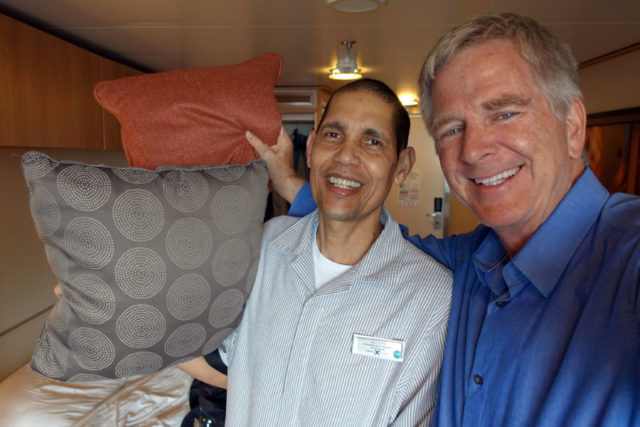
Rick and his stateroom attendant, Adolfo

I’ve taken at least a half-dozen cruises, and the connection with the crew has always been a highlight.

On my last cruise, there were over a thousand crew members from 60 different (mostly developing world) countries on board. Each of these hard working people had a story to tell and was cheery and helpful — almost to a fault. (At dinner, we joked about how many people would come by and ask if everything was to our liking.) Everyone was just so happy. In fact, I overheard crew members sharing an inside joke about it, egging each other on with whispers of “happy, happy.”

My cabin attendant was a wonderful man from Nicaragua named Adolfo. I like my stateroom to stay the way I leave it, and it was tough for him to realize that I didn’t need all those pillows and so on. Thank you for everything, Adolfo — and happy travels!