Rick Steves Guides’ Marketplace

Let the Rick Steves Guides’ Marketplace bring a little Europe to you!

As long as the COVID-19 crisis continues, travelers have no way to enjoy Europe in person and our Europe tour guides have no income. But our guides are wonderful teachers, bursting with energy and information to share.

This little market square is designed to connect our guides with our homebound travelers, sharing their creative projects with everyone who’s hungry for “travel experiences” — even if they’re just virtual for the time being.

I know that many of our travelers care as deeply as we do about our guides. We are friends. And supporting them in their creative business ventures during this crisis, as we await the day we can all travel again, is a wonderful way for friends to help friends.

Enjoy this marketplace. We hope it will bring you a little taste of “happy travels” to tide you over until Rick Steves tours are running again and the amazing guides our travelers so appreciate are back at work.

Browse virtual experiences, blogs, and more on the Rick Steves Guides’ Marketplace.

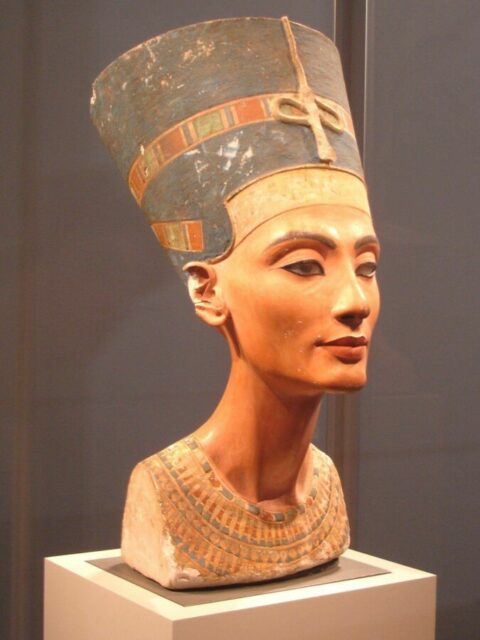
Daily Dose of Europe: The Bust of Nefertiti

The most famous piece of Egyptian art in Europe is this 3,000-year-old bust of a Queen of Egypt named Nefertiti.

As America continues to suffer crisis upon crisis, it has never been more important to broaden our perspectives and learn about the people and places that shape our world. And for me, one of the great joys of travel is seeing art masterpieces in person. Learning the stories behind great art can shed new light on our lives today. Here’s one of my favorites.

Nefertiti has all the right features of a classic beauty: long slender neck, perfect lips, almond eyes, symmetrical eyebrows, pronounced cheekbones, and a perfect spray-on tan.

Her pose is perfectly symmetrical from every angle — front, back, and side. From the side, her V-shaped profile creates a dynamic effect: She leans forward, gazing intently, while her funnel-shaped hat swoops up and back. Her colorful hat is a geometrically flawless, tapered cylinder.

And yet, despite her seemingly perfect beauty, the real person shines through. In real life, Nefertiti was born a commoner and renowned for her beauty. Her name means “the beautiful one has come.” She married the pharaoh, Akhenaton, and soon became the most powerful woman in the land. The newlyweds moved into a large palace and had six daughters. (Nefertiti became the mummy-in-law of Tutankhamen, the famous “King Tut” whose tomb was unearthed in 1922, sparking a worldwide fascination with Egypt.) During the reign of the dynamic power couple, Egypt’s 1,000-year-old traditions were challenged, and the once-stiff art styles broke out of the rigid mold.

Unlike earlier statues of generic gods, Nefertiti’s bust has unique human details. Looking close, you can make out fine wrinkles around the eyes — these only enhance her beauty. She has a slight Mona Lisa smile, pursed at the corners. Her eyebrows are so delicately detailed, you can make out each single hair. From the back, the perfection of her neck is marked with a bump of reality — a protruding vertebra. And because she’s missing the quartz inlay in the left eye, it gives the impression she’s winking at you. Her look is meditative, intelligent, lost in thought. Like a movie star discreetly sipping a glass of wine at a sidewalk café, Nefertiti seems somehow more beautiful as a real person with real flaws.

The bust is made out of limestone, with a stucco surface. This bust served as the master model for countless other portraits of the queen scattered across the kingdom.

Today Nefertiti’s bust is displayed in a room all her own in a museum in Berlin. How the queen arrived in Germany is a tale straight out of Indiana Jones. A German archaeologist uncovered the bust in the Egyptian desert in 1912 and spirited it out under questionable circumstances. Since her arrival in Berlin, she’s been surrounded by controversy. Some scholars condemned the bust as a fake. Meanwhile, the masses adored Nefertiti and made her a virtual symbol of Germany itself — Germany’s “queen.” Hitler promoted her as a pagan symbol of his new non-Christian Reich. When Germany was split in the Cold War, both sides fought to claim her. Today Nefertiti’s timeless beauty has come to represent the aspirations of the reunited German people. And around the world, her intriguing allure has made her Egyptology’s cover girl.

This art moment — a sampling of how we share our love of art in our tours — is an excerpt from the full-color coffee-table book Europe’s Top 100 Masterpieces by Rick Steves and Gene Openshaw. Please support local businesses in your community by picking up a copy from your favorite bookstore, or you can find it at my online Travel Store.

Understanding Islam with George Gorayeb

Islam, which is practiced by a quarter of humanity, is the fastest-growing religion on earth. Any well-educated person should understand the Muslim faith. That’s why, when an email hit my inbox suggesting that I watch this video, I decided to give it a few minutes. I could not stop watching. It’s a simple and straightforward lecture by a caring person who has done a masterful job of explaining Islam in 75 minutes.

This video was produced by Anne Arundel Community College in Arnold, Maryland. It was written and presented by George Gorayeb, a former Peace Corps Volunteer in Morocco, and now a realtor in Annapolis. George is an Arab-American Christian whose family emigrated from Syria. He produced this video simply because he cares. And that’s why I’m recommending it to you.

If your traveling spirit is eager to get out, give this an hour and a quarter. I’d love to read your comments—but only after watching George’s lecture. (Thanks, George!)

Daily Dose of Europe: Munch’s The Scream

I can’t help but see world events through the lens of Europe. And with all of the turmoil in our world recently, I keep flashing on a universal image of anguish: Edvard Munch’s The Scream.

As America continues to suffer crisis upon crisis, it has never been more important to broaden our perspectives and learn about the people and places that shape our world. And for me, one of the great joys of travel is seeing art masterpieces in person. Learning the stories behind great art can shed new light on our lives today. Here’s one of my favorites.

On a lonely bridge, an emaciated figure (man? woman? fetus?) claps his hands to his face, opens his mouth and eyes wide, and…screams. The sound swirls up through his whole body and bleeds out his terrified skull, echoing until it melts into a blood-red sky. We can “hear” this soundless scream in the wavy lines that oscillate like sound waves.

In this famous work, Edvard Munch captured the anxiety of modern life. In fact, it’s angst literally personified.

While some see this as a man screaming, others think he’s covering his ears to avoid hearing a scream. Or it’s both, like hearing some infernal, never-ending noise — the voices in your head — until you just want to scream.

Munch (pronounced “moonk”) said it was inspired by an actual event. While walking with friends, he was suddenly overcome with the sensation that all of nature was forever screaming. In the painting, the two other men walk on, seemingly oblivious to the noise only he can hear. Munch communicated this inner sensation with snaking lines and shrieking colors. He enhanced the thick soup of paint by mixing in pastels.

Norway’s long, dark winters and social isolation have produced many gloomy artists, but none gloomier than Munch. Many see the screaming figure as autobiographical. It’s the scream of a man who’d seen his mother and sister die young, failed in love, drank too much, flew into rages, heard voices in his head, failed in the art world, and ended up living alone surrounded only by his “children” — hundreds of unsold paintings.

The Scream is actually quite different from Munch’s other work, where he followed traditional Nordic themes of doom and gloom in a realistic style. Like the Norwegian Romantics, he saw nature as charged from within by an awe-inspiring life force.

But The Scream was groundbreaking. Where others captured terror on canvas with realistically gruesome events (hunger, disease, murder), Munch did it by distorting an everyday scene. He bends and twists it into a landscape of unexplained terror. Any sense of normal 3-D depth created by the bridge gets compressed into a claustrophobic wall of swirling colors.

Just five years after painting The Scream, Munch suffered a nervous breakdown and entered a mental clinic. He emerged less troubled…and less creative. His later paintings were brighter, but less daring. He labeled The Scream “the work of a madman.”

But this innovative painting rippled out, like the echoes of a scream. By fusing the bold colors of Fauvism, the curved lines of Art Nouveau, and the emotional intensity of Van Gogh, Munch had pointed the way to a new style — Expressionism. Later artists used such lurid colors, distorted figures, and troubled imagery to “express” their inner turmoil and the angst of the modern world.

The Scream even entered pop culture. The horrified face was used in ads, Halloween masks, and emojis. In many ways, we have Munch to thank for the end of pretty, realistic paintings, and the emergence of the distorted, confrontational, and often ugly style we call modern art.

This art moment — a sampling of how we share our love of art in our tours — is an excerpt from the full-color coffee-table book Europe’s Top 100 Masterpieces by Rick Steves and Gene Openshaw. Please support local businesses in your community by picking up a copy from your favorite bookstore, or you can find it at my online Travel Store. To enhance your art experience, you can find a clip related to this artwork at Rick Steves Classroom Europe.

Daily Dose of Europe: Goya’s Third of May

The protests of the last two weeks have been fueled by visibility and exposure: Cell phone footage, social media, and TV news have documented and broadcasted both the spirit of the protesters, and, at times, the violence they are met with. If it weren’t for this, many people still wouldn’t grasp the severity of what the protests are all about.

This got me thinking about popular cries for justice before photography and modern media. Artists and writers courageously raised their brushes and pens for justice. A great example of that is a powerful and important painting from Spain, which, in its own way, shed light on a crisis that might otherwise have gone unseen. Just like the brutality of those who killed George Floyd was exposed by someone with a camera phone, the brutality of those French troops was exposed by Goya.

As court painter to Spain’s kings, Francisco de Goya (1746–1828) spent his career dutifully cranking out portraits and pretty pictures. But inside, he chafed at the arrogance of kings and tyrants, and eventually became a champion of the oppressed.

Goya’s problem with authority came to the fore on one watershed day in Spain’s history — the third of May, 1808. France had invaded Spain. When the proud Spaniards confronted them on Madrid’s main square, Puerta del Sol, the French brutally crushed the protest and started rounding up the ringleaders.

Goya’s Third of May shows the reprisals. It’s the middle of the night, and the rebels have been secretly dragged before a firing squad. They plead for mercy and get none. The soldiers are completely in charge, well-equipped, and well-organized. The rebels are a motley group of grubby workers, scattered and confused. It’s a total mismatch, a war crime. The soldiers — a faceless machine of death — start cutting the men down with all the compassion of a lawnmower. The Spaniards topple into a mass grave. A kneeling man spreads his arms, Christ-like, and asks, “Why?” We can see the whole grim assembly line: those waiting their turn, the victims, the lifeless executed. Next.

If it wasn’t for Goya, who would ever have known about these nobodies? Goya places a big lantern in the middle of the scene and literally shines a light on this atrocity for the whole world to see. It’s a harsh prison-yard floodlight that focuses all the attention on this one man with his look of puzzled horror. The distorted features, the puddle of blood, the twisted bodies, the thick brushwork — all of these were unheard of at the time. Goya helped lay the foundations for a shocking new style — Romanticism — that emphasized strong emotion over idealized beauty.

Because of Goya’s artistic innovations and his social conscience, many consider him to be the last classical and the first modern painter. And thanks to Goya, even today we can remember these anonymous martyrs of freedom.

This art moment — a sampling of how we share our love of art in our tours — is an excerpt from the full-color coffee-table book Europe’s Top 100 Masterpieces by Rick Steves and Gene Openshaw. Please support local businesses in your community by picking up a copy from your favorite bookstore, or you can find it at my online Travel Store. To enhance your art experience, you can find a clip related to this artwork at Rick Steves Classroom Europe