This painting captures the joyful beauty of France’s belle époque, when Paris was a global center of prosperity, technology, opera, ballet, and high fashion. Artists flocked there to catch the magic on canvas.
As America continues to suffer crisis upon crisis, it has never been more important to broaden our perspectives and learn about the people and places that shape our world. And for me, one of the great joys of travel is seeing art masterpieces in person. Learning the stories behind great art can shed new light on our lives today. Here’s one of my favorites.
On Sunday afternoons, working-class Parisians would dress up and head for the bucolic hill overlooking Paris called Montmartre. They’d gather in outdoor cafés to dance, drink, and eat little crêpes (called galettes) until dark. Renoir would go there, too, to paint the common Parisians living and loving in the afternoon sun.
In Renoir’s glowing scene, the sunlight filters through the trees, creating a kaleidoscope of colors, like a 19th-century disco ball throwing darts of light onto the dancers. Renoir conveys the dappled light with quick blobs of yellow paint. The light speckles the ground, the men’s jackets, and the sun-dappled straw hats. You can almost smell the fragrant powder on the ladies’ faces. The painting glows with bright colors. Even the shadows on the ground, which should be gray or black, are colored a warm blue. The paint is thin and translucent, and the outlines are soft, so the figures blend seamlessly with the background. Like a photographer who uses a slow shutter speed to show motion, Renoir paints a waltzing blur.
Along with his good friend Claude Monet, Renoir embraced Impressionism. Stifled by the stuffy atmosphere of the conventional art scene in Paris, they took as their motto, “Out of the studio and into the open air.” They grabbed their berets and scarves (and their newly invented tubes of premixed paint) and set up their easels right on the spot — on riverbanks, hillsides, cafés…or in the fields of Montmartre. Gods, goddesses, nymphs, and fantasy scenes were out. Common people in their everyday lives were in. The result? Light! Color! Vibrations! You don’t hang an Impressionist canvas — you tether it.
Renoir features Impressionism’s trademark bright colors, easygoing open-air scenes, spontaneity, broad brushstrokes, and the play of light. He made this canvas shimmer with a simple but revolutionary technique. Look at the dancing woman to the left, in a “pink” dress. If you look real close, you’d see that the dress is actually a messy patchwork of individual brushstrokes of different colored paint. But as you back up…Voilà! The colors blend in the eye. So while your eye is saying “pink,” your subconscious is shouting, “Red! White! Gray! Blue! Yes!”
Renoir always painted things that were unabashedly pretty — happy scenes of rosy-cheeked women, rendered in a warm, inviting style. As Renoir liked to say, “There are enough ugly things in life.”
This art moment — a sampling of how we share our love of art in our tours — is an excerpt from the new, full-color coffee-table book, “Europe’s Top 100 Masterpieces,” by Rick Steves and Gene Openshaw. Please support local businesses in your community by picking up a copy from your favorite bookstore, or you can find it at my online Travel Store. To enhance your art experience, you can find a clip related to this artwork at Rick Steves Classroom Europe; just search for Renoir.
As long as we can’t travel, our guides can’t lead our tour groups. But until things open up again, our European friends are still guiding virtually. And that’s what our new Rick Steves Guides’ Marketplace is all about.
All across Europe, our guides are harnessing their positive attitude, creativity, and passion for teaching in new ways. Even with no tours, our guides remain determined to teach and preach the joys of Europe. To help them out, we’ve created our Guides’ Marketplace, which showcases some of the innovative ways that they’re staying busy and, in some cases, trying to generate a little income. This is also a great source for getting a European perspective on what’s going on in the world today, as several of our guides are actively blogging with their spare time.
As we wait for a day when we can all get back on the bus together, here are a few highlights from the Guides’ Marketplace.
The British do like their pubs and generally have a ‘local’ where they can relax, drink their beer (other tipples are available) and enjoy the company. This local pub may be The Red Lion or The Royal Oak, said to be the two most common pub names in Britain, or it could be The White Hart, Queen’s Head, The Bell, The Plough, or Rose & Crown, all quite common names throughout Britain. Or it could a pub with a very strange name indeed.
After years of dedicated research, these are my favourites. They are all real pubs and I have enjoyed all of them.
The Three-Legged Mare, High Petergate, York: It is not describing a disabled horse, but a rather macabre reference to gallows with 3 uprights and crosspieces, that could hang multiple felons at one time.
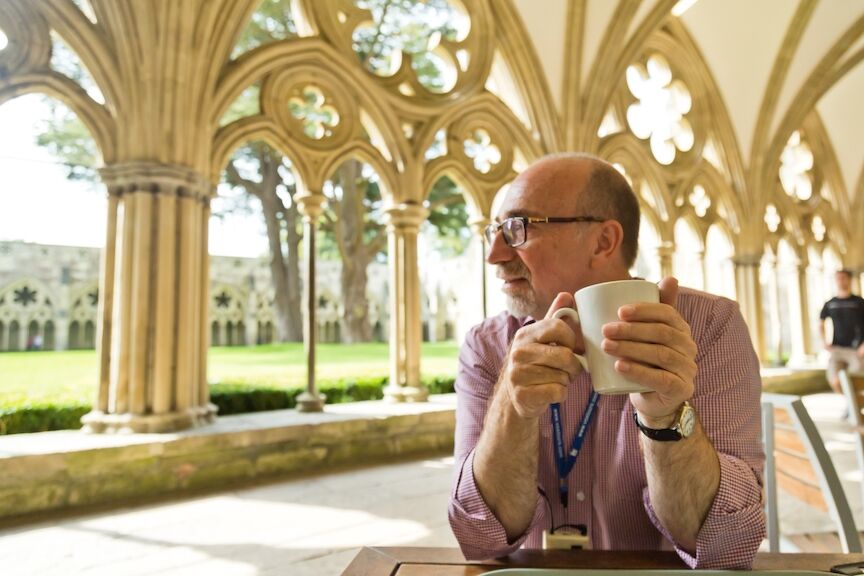
The Nobody Inn, Doddiscombeleigh, Devon: On Dartmoor, in the little village of Doddiscombsleigh, there is a pub called the Nobody Inn. Apart from being a terrible pun, the story is that this pub takes its name from the unfortunate moment during a former landlord’s wake when his coffin was brought back to an empty pub.
The Drunken Duck Inn, Barngates, Cumbria: In the Lakes District, at Barngates just outside Hawkshead, is The Drunken Duck. In the 19th century the landlady discovered that her flock of ducks had got into the beer cellar, gorged themselves on spilt beer and were apparently dead on the floor. Not wanting to waste them, she started to prepare them for the oven, only to have them waken from their drunken stupor and flap away!
On her blog Margaret Traveling, Margaret Cassady reflects on what it was like guiding Rick Steves Tours back in 1991. Here’s an excerpt:
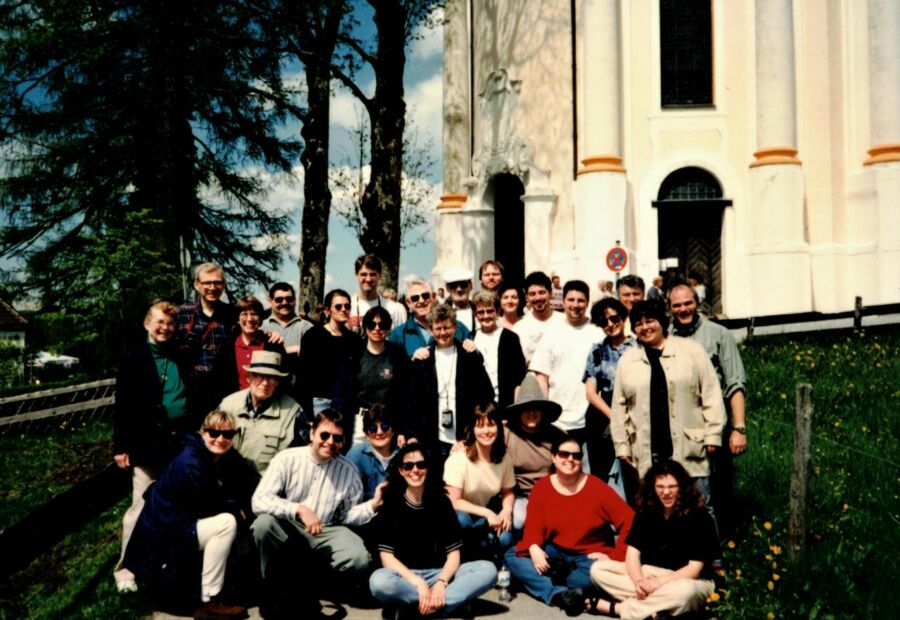
In my early years, Europe Through the Back Door was still very much a small local operation. Before Rick’s PBS series aired, raising his visibility across the country, most of our customers were from the Seattle area. In fact, the office hosted a pre-tour potluck dinner for each group so we could meet before the trip. And most tour members were able to come. …
In those days it was even more vital: young or old, we all carried Rick Steves convertible suitcases on our backs, and oh, the sweaty backpack outline that would be revealed when we shucked them off!
And we carried those bags up many flights of stairs. It was a rare luxury to stay in a hotel with an elevator. Air conditioning was unheard of, too. When I returned to guiding in 2011, after a 10-year break to raise my kids, I was astounded when my first hotel room had A/C. I thought the front desk had assigned me the wrong room, since I always ask for the worst one. (Tour members get the nicer ones.) But no! And I thought it was an anomaly — but then we got to the second hotel. And the third. And so on. Still a backpacker and “hosteler” at heart, I was floored by such luxurious upgrades. …
The trepidation of Americans: a shared bathroom. But they weren’t uncommon in our hotels back in 1991. In fact, one of my (and countless tour members’) favorite hotels was the Hotel Mittaghorn in Gimmelwald, in the Swiss Alps. Not only did it have just one shower that most of the rooms shared (I’d post a shower-time sign-up sheet on the door to avoid lineups), but it was coin-operated. The chalet’s big loft would invariably be assigned to the solo women in the group — including me — with beds lined up like the orphans’ in “Madeline.” …
In that pre-euro era, I couldn’t arrive in each country and just take my group right out to explore. First I had to read any notes my colleagues on previous tours had left for me at the hotel’s front desk. No internet then, of course — if a guide had news of an impending strike, a change in local museum hours, or a tip about a great new restaurant, we’d just leave a hand-scrawled note at the hotel for the next guide who’d check in. (No cheap, quick way to communicate with home, either. After I married, my husband tried to mail cards to me en route, but they’d invariably arrive too early or late. Eventually he resorted to pre-writing notes for me to take along, labeled with the date I should open each one, and guessing at what he’d be doing and feeling on that day. “Today I went to the Mariners game…unfortunately, they lost again.”)
And then we had to convert our money. Cash was much more widely used, and ATM’s weren’t prevalent. Europe Through the Back Door actually provided tour members with a starter sampler pack of European bills (I remember helping with office assembly lines, stacking up guilders, marks, lire, and Swiss and French francs), but it was necessary to take my groups to an exchange office soon after we arrived. We’d spend precious sightseeing time standing in line at Thomas Cook, waiting to hand over a stack of travelers’ checks in exchange for local currency.
These days I sit in comfort on our tour bus or in my hotel room, using my cell phone and laptop to make reservations and confirm appointments for my tour’s upcoming stops. But that wasn’t possible back then. Instead, I’d buy a prepaid phone card (and each country had its own system), and at our highway rest stops, I’d have to find — and figure out — a pay phone and make a breathless series of calls to my next destination. …
Laundry was a source of both stress and hilarity for us assistant guides. Believe it or not, it was our duty to wash the tour members’ laundry midway through the tour. Many hours of my first-ever visit to Rome on that 1991 tour were spent dealing with the giant Santa-esque garbage bag full of their dirty clothes. I managed to find a laundromat, and wash and dry it all, but then I spent hours wandering the unfamiliar streets, near tears, in search of my group (this was pre-cell phones, of course). The upside: my every visit to Rome since then has been an improvement. Sorry, tour members now have to wash their own clothes. Back at the hotel, I’d dump all the clean laundry in a pile on my bed (no, we didn’t go so far as to fold it), and let the tour members paw through it to reclaim their pieces. …
Thirty years ago, our tour operation was a little rougher around the edges, a little more seat-of-the-pants, a little less polished. But my tour members’ delight in their discoveries, the friendships and memories created, the lifelong travel dreams come true, were just as precious and meaningful then as now. Hundreds of tour members later, I still get immense joy and satisfaction from each European tour I lead.
Check out the full blog post for more of Margaret’s stories.
Several of our guides are also doing video blogs, with clips featuring cultural insights and up-to-date information. For example, in Oslo, Pål Bjarne Johansen has been taking virtual visitors around his home city — including its famous Holmenkollen Ski Jump and Museum:
Other guides are offering paid virtual classes for those who want a deeper dive into European history and culture. For example, Anna Piperato in Siena:
And David Tordi in Orvieto:
There’s much more to discover. At Moon in Spain, Margaret Monnier offers video reports from southern Spain and a rundown of her favorite beach tapas places in the region. At Berlin Perspectives, Torben Brown and Carlos Meissner view the German capital through the lens of history. And Slovenian guides Tina Hiti and Sašo Golub blog about their beautiful home country at Private Guide Slovenia.
If you’re missing your favorite Rick Steves guide, now’s a great time for some virtual travel. See what they’re up to in our Rick Steves Guides’ Marketplace…and reach out to say hello.
Even though we’re not visiting Europe right now, I believe a daily dose of travel dreaming can be good medicine. This week I published a collection of my favorite stories from a lifetime of European travels. My new book is called “For the Love of Europe” — a fun-to-read, “greatest hits” collection, and this story is just one of its 100 travel tales.
I miss eating well in Europe. But I also miss eating quirky. Because Europe has some of the most unusual foods I’ve ever encountered.
My palate has come a long way from my early “Europe through the gutter” days, back when my travel diet consisted of cheap baguettes spread with peanut butter and strawberry jam packed from home. Now one of my favorite parts of travel is sampling local specialties. And I do it with abandon. From pigs’ ears in Spain to horsemeat in France and spicy sheep intestines in Turkey, I make it a point to try dishes that make a menu unique — no matter how unappetizing they sound. Think of it as sightseeing for your palate.
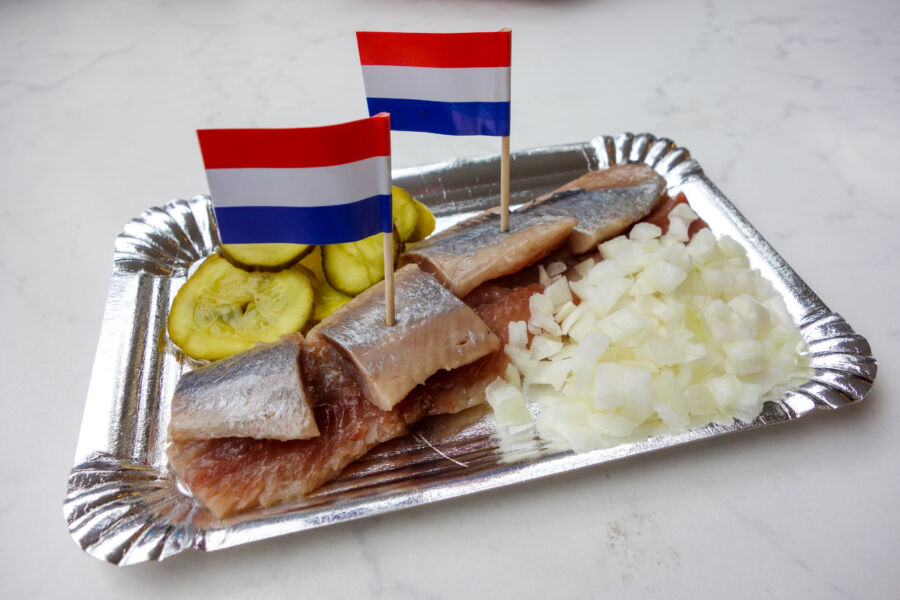
How much you enjoy the experience depends on your attitude. “Weird” is subjective. Countries with a seafaring heritage, like the Dutch, embrace herring as a vitamin-rich food. Pickled herring is considered a classic. Having tasted this delicacy, I can say it’s something you won’t soon forget (no matter how hard you try).
I still remember the first time I tried pickled herring in the town of Haarlem. It was on market day at a herring stand — the Dutch version of a hot-dog stand — with a big sign that advertised “lecker en gezond” (delicious and healthy). The fish looked more like bait than lunch. Sensing my hesitation, Jos, the friendly herring vendor, demonstrated how to eat it. “I give you the herring Rotterdam-style. You eat it like this,” he said, miming swallowing a sword. “If I chop it up and give you these,” he said, pointing to the toothpicks “this is Amsterdam-style.” After my first bite, the only polite comment I could muster was, “It’s salty.” But the taste grew on me. As I wandered through the market, taking Amsterdam-style bites of my Rotterdam-style herring, I felt a fishy kinship with the Dutch. As I passed his herring stand again a few minutes later, Jos hollered, “Lecker?” I responded, “En gezond!”
Most Scandinavian nations have one seafood dish that, while inedible to many people, is still cherished with a perverse but patriotic sentimentality. In Norway that’s lutefisk — dried cod marinated for days in lye and water. My theory is that it’s still served today to remind young Norwegians of their ancestors’ suffering.
Local specialties often come from a challenging history and then become tradition. Roman cooking didn’t originate in the kitchens of emperors or popes, but from the cucina povera — the home-cooking of the poor, common people. This may explain the Romans’ fondness for meats the wealthy didn’t bother eating. Known as the quinto quarto (fifth quarter), these were pieces like tripe, tails, brains, and pigs’ feet.
Scotland’s national dish, haggis, also began as peasant food. Unwilling to let any part of a sheep go to waste, cooks would create a hearty meal by boiling scraps of heart, liver, and lungs with herbs in stomach lining. The trick to appreciating such dishes is to think of how they taste, not what they’re made of. Just like with caviar, hot dogs…or foie gras.
Foie gras is one of France’s most expensive indulgences. Because it’s made from fattening the livers of geese through force-feeding, it has attracted controversy. The dish is most popular in the Dordogne region, where ages ago, locals caught geese on their migration — and found the goose livers were enlarged for the long journey (like traveling with a topped-off gas tank). And you know those French: Mix those innards into the cuisine and create a new taste treat.
Speaking of innards, Turks are serious about their kokoreç: chopped-up sheep intestines, often served on a sandwich as fast food. Several years ago, a rumor flew through the streets that stringent new European Union regulations would outlaw the beloved dish. Before the story was debunked, many Turks did some soul-searching and decided that if they had to choose, they’d gladly pass up EU membership for their kokoreç.
Wherever I go, I find the food that inspires such nationalism is worth a try. Eating these unusual dishes — from Iberia’s percebes (barnacles) to Venice’s seppia (squid served in its own ink) to Norway’s geitost (goat cheese that resembles earwax) — not only helps me feel like a temporary local, but also gets me treated like one.
This story appears in my newest book, For the Love of Europe — collecting 100 of my favorite memories from a lifetime of European travel. It’s available in our online Travel Store and in bookstores across the US. Pick up a copy and enjoy 400 pages of happy travels. You can also find clips related to this story at Rick Steves Classroom Europe; just search for Food.
Happy Fourth of July! Like most Americans, I’m having a subdued, socially distanced celebration at home. For patriotic Americans like me, this is a poignant Fourth as our country faces unprecedented challenges. I’m hopeful that the second half of 2020 will see America making real progress in the fight against both the coronavirus pandemic and racial injustice. I love the USA. And it’s clear that, together, we have a lot of work to do.
On this holiday weekend, I’m also mindful of the EU’s understandable decision to hold off on allowing American travelers to enter Europe for now. I have spent a third of my adult life in Europe, but it’s increasingly clear that I won’t set foot there in 2020. In fact, just this week my tour company cancelled all of our remaining 2020 departures. We are hopeful for a return in 2021.
When I think about what I miss most about Europe in 2020, one thing rises to the top: the people. Wherever I go, I love making connections with Europeans. So many of my friends — whether guides, hoteliers, or restauranteurs — earn their living from tourism. And 2020 is a very tough year for them. I look forward to the day when we will be back stoking their business as they stoke our travel experiences. This post — an excerpt from my new travel memoir, For the Love of Europe, which arrives in bookstores next Tuesday — shares a few examples.
On the Irish island of Inishmore, I stayed at a farmhouse B&B. At breakfast, I told the farmer of my plans to visit the island’s main sight, Dun Aengus. It’s an Iron Age fortress that hangs spectacularly on the edge of a cliff above the ocean. He nodded, saying, “The fort is so popular with visitors that we plan to build another 2,000-year-old fort next year.”
He excused himself to do some farm chores and I asked to join him. Soon, we were working in tandem, putting out the hay. Pointing out that there were no gates on the stone fences that divided his land, he showed me how, when the sheep needed to pass, he’d simply unstack the rocks and then stack them back up. It worked for his father and it works for him. I asked about the weather and he said, “We wouldn’t be putting out the hay if the weather wasn’t going to be good.”
The essence of good travel is connecting with people. If I’m leading a tour or writing a guidebook, the mark of a job well done is how well I connect people with people. If I’m making a TV show and it doesn’t have a local voice, the show will be flat. When I’m enjoying a European vacation, my journal is more interesting when it includes stories of people I met. And yes, in reading through my new book, the essays I like the best are the ones enriched by connections with people.
Developing a knack for sparking such experiences is our challenge as good travelers. I like to take it a step further — to be a keen observer, able to connect experiential dots that may seem random by putting them into cultural and historic context…and then to learn from them. As a travel writer, that’s my challenge. And that’s my mission, whether it’s explaining the rationale behind the Dutch tolerance of marijuana, or celebrating the refreshing transparency of Berlin’s glass dome over its parliament.
While memories of palaces toured and castles climbed fade into a jumble, it’s the people, experiences, and cultural connections that stay vivid for decades…
In a pub in the Czech town of Olomouc, egged on by a local friend, I ordered the country’s infamous stinky cheese, listed on the menu as the “Guttery Breath of the Knight of Lostice.” It was served with a lid, mints, and the offer of a toothbrush. (The fun-loving menu noted they only have one toothbrush, so please leave it.)
At a bar in Brussels, I met Belgians who complained about their Lowland neighbors: “The Dutch have the worst beer, Heineken — but sell it all over the world. We Belgians make far better beer, and it is barely exported. Those Dutch are clever business people — they can sell anything.”
In Italy, people from Siena hold a medieval grudge against the people of Florence, who defeated them centuries ago. Walking with my friend in Siena, I barely missed a dog mess. In a disgusted voice, he playfully showed his Sienese pride saying, “Those Florentines are everywhere these days.”
One time in Austria, I lingered in a tiny village church. It was as quiet as a tomb. Suddenly the dozen or so visitors around me burst into a rich, Slavic hymn filling the sanctuary with life. They were a folk group from Slovakia whose director whispered to me, “We can’t be in a church without singing.”
Each of these moments is a connection, offering new insights into these places and the people who call them home. Gathering moments like these into my new book, I realized the most memorable travel moments aren’t accidents. You create them consciously by being a free-spirited extrovert. Start conversations and then let serendipity lead you astray. (Who knows? You may find yourself drinking homemade limoncello with a Franciscan friar in his abbey overlooking the Italian Riviera.) Let surprises waylay your careful plans.
While some people count the countries they’ve visited, marking them off on a checklist, that number means nothing to me. Count instead the friends you’ve made while far from home. Packing that attitude, you’ll realize the world is a welcoming place…a place filled with joy, love, and wonderful people.
(This story appears in my newest book, For the Love of Europe — collecting 100 of my favorite memories from a lifetime of European travel. Please support local businesses in your community by picking up a copy from your favorite bookstore on Tuesday, July 7th. Or you can pre-order For the Love of Europe online.)
As of today, the European Union has controlled the coronavirus well enough to open its doors to travelers from a list of countries that have been patient and disciplined in responsibly quelling the outbreak. Nearly all European countries, plus Canada, Japan, Australia, and even China, have qualified. Sadly, a few countries lacking in discipline, national leadership, and an embrace of science are not welcome — including Brazil, Russia, and the USA.
The permitted nations employed strict lockdowns, compulsory use of masks, and a careful and gradual reopening dictated by testing and contact tracing. In the United States, many individuals, mayors, and governors did their best to do the same. But nationally, we’ve had a patchwork response with virtually no federal leadership and a too-fast reopening driven more by impatience and economic concerns than by public health. And now, as Europe has things under control, in much of the US new cases are surging.
On the same day the EU announced their reopening plans, my tour company cancelled all remaining 2020 departures. We had been hoping that autumn might bring a return of Americans to Europe…but now it’s clear that we’re not yet ready for that privilege.
We’re still dreaming of Europe in 2021. But to make that happen, Americans need to come together and act more conscientiously and collectively to get our outbreak under control. The EU will reconsider which nations are welcome for non-essential visits every two weeks by measuring cases per 100,000 of population. Currently the EU reports 16 cases per 100,000, while rates in the US are 107 per 100,000 (nearly 7 times as high).
Happy travels, Canadians, Australians, Japanese, and Europeans! (And as for Americans…until we take this virus more seriously, we’ll have to settle for “visiting” Europe by streaming episodes of my TV show.)
For more details and commentary, my co-author Cameron Hewitt recently shared his perspective on how the coronavirus has impacted travel for Americans in Europe.