This has been a rough year. For many of us, it’s been the most challenging of our entire lives. But this morning, we finally got news of a brighter future. Joe Biden and Kamala Harris are moving into the White House.
It’s been a hard-fought, and unprecedentedly ugly, campaign season. But I have supported Joe and Kamala because I am inspired by their persistence in keeping a hopeful eye to the future, with a realistic and patient view of the present.
Rick Steves’ Europe has a full slate of European tours all locked, loaded, and ready to book for 2021. But we’re holding off on taking sign-ups…because, like the president-elect (and unlike the president-unelect), we recognize that we’re not yet out of the woods of this pandemic. Anyone who knows me can tell you that I am not a patient person. But, like so many other things in 2020, being patient is something I am discovering for the first time…and I find that patience feels right.
COVID-19 cases, hospitalizations, and deaths are going up across the USA. And they’re going up across Europe, too. Europe is responding thoughtfully, with tightening restrictions and strong public messaging. America’s response has — so far — been no response at all…or flat out denial. If we want to get traveling in 2021, we have to hunker down and be safe over the next few months. Obviously, we all want our economy to be open and to thrive. Artful, smart, and temporary degrees of “shut down” may well be our best path to that open and thriving economy. Our soon-to-be-former president has made no indication of understanding that. But our next president certainly does. And that’s just one of many reasons I’m happy with the results of this election. And why, if you’re hoping to go to Europe any time soon, you should be, too.
One more note: I am sure many of you disagree with my politics — and I may disagree with yours. But, if you follow me on Facebook, I assume we are united by a love of travel. If you feel I’ve abused my “bully pulpit” the last month or so, I hope you’ll understand it’s because I love this country and desperately want to see us back on an equal footing with the rest of our planet. Every election, I have a strong preference of candidate — though normally I respect the other guy. (And, it must be noted, it’s always been a guy.) But this year, it was personal. I felt that supporting the Biden/Harris ticket was a nonpartisan act of patriotism. It was for the resilient (yet, as we’ve learned, not indestructible) ideals of what America stands for — ideals that inspire lovers of freedom and democracy and justice throughout the rest of the world.
While millions more voted for Biden, about 48% of our country did vote for Trump. One of my many dreams for 2021 is that the GOP can be reclaimed from the hateful, chaotic fringe of the Trump movement and restore respect and civility to our national discourse. Even as a proud Democrat, I have always respected Republicans. (And, as I recently confessed, I even voted for Ronald Reagan in 1980.) I have many Republican friends who I consider good people, admirable patriots, and great travelers. We’ve always found plenty of common ground, even if we agree to disagree on the issues. And I’m hopeful that the Biden Administration will be a time of national reconciliation — an opportunity to recognize that far more unites us than divides us. That’s especially important during a crisis.
And so, congratulations to Joe and Kamala! Now…get to work. Keep us safe. Spearhead the building of a sustainable and just economy. Make us proud. With your leadership, America’s gonna keep on travelin’!
While I freely share my political opinions on this page, I’ve tried to stick to issues and have not explicitly supported one candidate…until now. Today, I’m voicing my support for Joe Biden.
My politics are pretty clear. I have a European-style appreciation for good governance, and I see government as a way for a citizenry to work together for the collective good. Americans are often told there are two choices: big, bad government or good, small government. But Europe has taught me that there’s a third option: big, good government.
I love capitalism (and I’m pretty good at it). And I believe capitalism needs a chaperone, in the form of thoughtful regulation that protects the rights of individuals from the priorities of corporations.
I believe education and health care are as important as our military when it comes to budget priorities to make us safe and strong.
I also understand that, as a country, even in good times, we will always have people on the left and on the right when it comes to debating the role of government. And I believe that the only way to govern effectively is to respect those differences and find workable compromises.
I miss a Republican Party that I can respect. (I voted for Ronald Reagan in 1980.) While I’m a liberal, I love sparring with (and learning from) a principled conservative. For me, the greatness and strength of our country and our democracy is possible only with real, independent journalism and strong governmental institutions led by caring, committed, non-partisan public servants. But our president has identified those very pillars of American life — what he calls “fake news” and the “deep state” — as his worst enemies.
As a traveler and a student of history, I’ve seen how strong societies can fray. And I fear for our democracy. It’s more fragile than we realize. And it is at risk.
That’s why, this year, I believe our choice is more fundamental than partisanship. Four years ago, Donald Trump pledged to “Make America Great Again.” When I survey our national life today, it’s clear to me that we’ve lost so much more than we’ve gained in that time.
If we truly want to make America great again, we need to elect Joe Biden to the White House on November 3. Please join me.
One thing I miss about Europe is driving along roads less traveled —where distances are measured in cultural encounters rather than miles. On a road trip a few years back, I crossed Slavic borders on twisty mountain roads, heading inland from the Adriatic coast — and racked up lots of learning along the way.
Even though we’re not visiting Europe right now, I believe a daily dose of travel dreaming can be good medicine. I recently published a collection of my favorite stories from a lifetime of European travels. My new book is called “For the Love of Europe” — and this is just one of its 100 travel tales.
Looking for a change of pace from Croatia’s touristic Dalmatian Coast, I’m driving from Dubrovnik east to the city of Mostar, in Bosnia-Herzegovina. Almost everyone making this trip takes the scenic coastal route. But with a spirit of adventure, I take the back road instead: inland first, then looping north through the Serbian part of Herzegovina.
Bosnia-Herzegovina’s three main ethnic groups — Serbs, Croats, and Bosniaks — are descended from the same ancestors and speak closely related languages. The key distinction is that they practice different religions: Orthodox Christianity (Serbs), Roman Catholicism (Croats), and Islam (Bosniaks). For the most part, there’s no way that a casual visitor can determine the religion or loyalties of the people just by looking at them. Studying the complex demographics of the former Yugoslavia, I gain a grudging respect for the communist-era dictator Tito — the one man who was able to hold this “union of the South Slavs” together peacefully.
Bosnia-Herzegovina is one nation, historically divided into two regions: Bosnia and Herzegovina. But the 1995 Dayton Peace Accords gerrymandered the country along sectarian lines, giving a degree of autonomy to the area where Orthodox Serbs predominate. This “Republika Srpska” rings the core of Bosnia on three sides. When asked for driving tips, Croats — who, because of ongoing tensions with the Serbs, avoid this territory — insist that the road I want to take through their country doesn’t even exist. From the main Croatian coastal road just south of Dubrovnik, directional signs would send me to a tiny Croatian border town — but ignore the large Serbian city of Trebinje just beyond.
And yet, Trebinje more than exists…it is bustling and prosperous. As I enter the city, police with ping-pong paddle stop signs pull me over. I learn that you must drive with your headlights on at all hours. My “dumb tourist” routine gets me off the hook. Parking the car, I head to an outdoor market to get cash at an ATM to buy some produce.
Bosnia-Herzegovina’s money is called the “convertible mark.” I don’t know if they are thrilled that their money is “convertible” into other currencies — but I remember a time when it wasn’t. I stow a few Bosnian coins as souvenirs. They have the charm of Indian head pennies and buffalo nickels back in the US. Some bills have Cyrillic lettering and Serbian historical figures, while others use the English alphabet and show Muslims or Croats. Like everything else in Bosnia-Herzegovina, the currency is a careful balancing act.
Later, after a two-hour drive on deserted roads through a rugged landscape, I arrive at the humble crossroads village of Nevesinje. Towns in this region all have a “café row,” and Nevesinje is no exception. It’s lunchtime, but as I walk through town, I don’t see a soul with any food on their plate — just drinks. Apparently, locals eat economically at home, then enjoy an affordable coffee or drink at a café.
A cluttered little grocery is my solution for a quick meal. The old man behind the counter seems happy to make me a sandwich. Salami, which looks like Spam, is the only option. I take my sandwich to an adjacent café and pay the equivalent of a US quarter for a cup of strong Turkish (or “Bosnian”) coffee, with highly caffeinated mud at the bottom. Then I munch, drink, and watch the street scene. It’s like seeing a play.
Big men drive by in little beater cars. High-school kids crowd around the window of the photography shop, which has just posted their class graduation photos. The flirtatious girls and boys on this cruising drag prove you don’t need money to have style. Through a shop window, I see a young couple picking out a simple engagement ring. One moment I think that Nevesinje is very different from my hometown…but the next, it seems just the same.
Looking at the curiously overgrown ruined building across the street, I notice its bricked-up, pointed Islamic arches and realize it was once a mosque. Its backyard is a no-man’s-land of bombed-out concrete and glass, where a single, turban-topped tombstone still manages to stand. The prayer niche inside, where no one prays anymore, faces east…to another empty restaurant.
After an hour’s drive over a twisty mountain road, I leave the Republika Srpska and arrive at the city of Mostar. Pulling into town, I’m exhausted yet exhilarated with the experience I gained by taking the road much less traveled.
This story appears in my newest book, “For the Love of Europe” — collecting 100 of my favorite memories from a lifetime of European travel. Please support local businesses in your community by picking up a copy from your favorite bookstore, or you can purchase it at my online Travel Store. You can also find a clip related to this story at Rick Steves Classroom Europe; just search for Mostar.
The far fringes of Europe are rich with vivid memories. I was planning a trip back to Helsinki this summer. While that trip will have to wait, I’m enjoying reliving some Finnish memories.
Even though we’re not visiting Europe right now, I believe a daily dose of travel dreaming can be good medicine. I just published a collection of my favorite stories from a lifetime of European travels. My new book is called “For the Love of Europe” — and this story is just one of its 100 travel tales.
There’s a definite energy on the streets of Helsinki tonight. My friend Hanne explains, “We call Wednesday our ‘little Friday.’”
People are filling up the city’s main boulevard, named Boulevardi. (It was given that grandiose title 200 years ago, when the concept of a grand boulevard in Helsinki, then Europe’s newest capital, was somewhere between wishful thinking and absurdity. But the name stuck.)
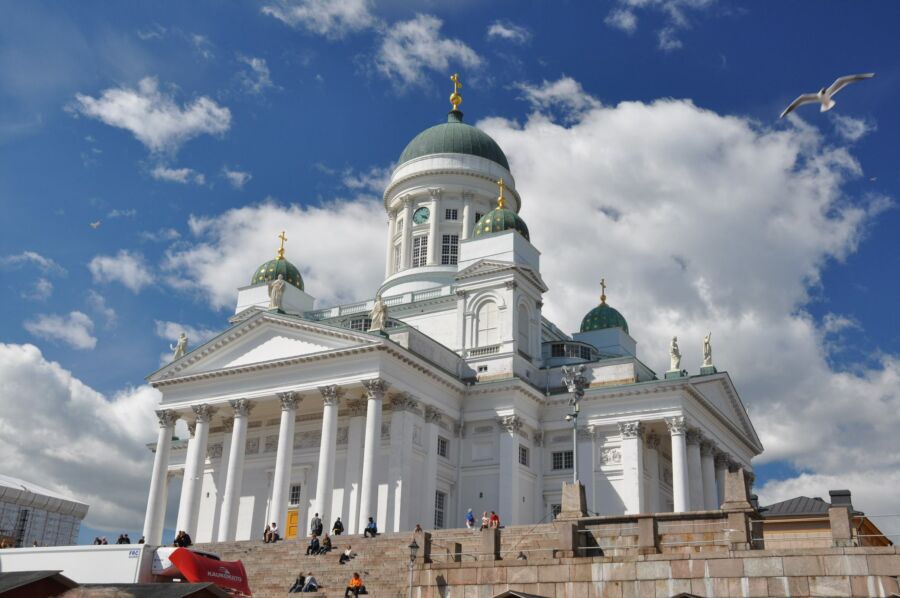
There are so many people that I wonder if it’s some kind of demonstration. Then I see their robes and sheets of music and realize that these are choral groups, each represented by a placard. From all corners of the country, some 800 singers converge on the massive steps of the Lutheran Cathedral, overlooking the Neoclassical Senate Square. Crowds gather, enthusiastic to hear this annual massing of the choirs.
The crowd quiets and the singers begin a rousing series of hymns. While I can’t understand a word, the songs are sung with such a stirring air that I imagine they tell both of their hard-fought history, their solid faith, and their gratitude to be who they are — the people of Finland. As the last hymn ends, balloons are freed, and the singers disperse, kicking off a festive initiative called “Art Goes to the Pubs.” The city’s watering holes are about to be filled with song.
Leaving the square, Hanne and I pass a poster of a demonic-looking rock band. “Hell froze over that year,” she explains. Europe’s biggest TV event is the annual Eurovision Song Contest, most famous as the event that launched ABBA in 1974 with their breakout song, “Waterloo.” Perennial losers in the event, Finns have long said, “Hell will freeze over before Finland wins the Eurovision Song Contest.” In 2006, Finland’s Kiss-inspired heavy-metal band Lordi won with a rocking, gravelly voiced number called “Hard Rock Hallelujah.”
At the curb, there’s no traffic, so I jaywalk across the street. I get halfway across Boulevardi before looking back for Hanne, who is still waiting for a walk signal. In defeat, I return to the curb. She says, “In Finland, we wait. It can be two in the morning and not a car in sight, but we wait.”
I note that Germans respect authority, too. Hanne says it’s different in Finland. “We buck authority. But we follow the laws…even little ones. That’s why we have such low crime.”
Hanne points out an elegant restaurant with a dining hall that was perfectly preserved from the 1930s. Its Alvar Aalto-designed Functionalism is the kind of straight design and practical elegance Finns love. A private office party is raging — specifically, a crayfish party. Crayfish are in season, but at $10 each, they are hardly a budget meal. But all over town Finns are doing the crayfish tango: Suck and savor a red mini-lobster, throw down a glass of schnapps, sing a song, and do it again. The “99 Bottles of Beer” repetition just gets more fun with each round.
Hanne shows me the table where Gustaf Emil Mannerheim always sat. He was the heroic George Washington of modern Finland, who led the feisty resistance against the USSR. Many Finns consider him personally responsible for keeping their country free during and after World War II. No Finnish military leader will ever again hold Mannerheim’s rank of “Field Marshal.” But anyone can sit at his favorite table…and suck a crayfish.
We continue walking, ending up back on the grand Senate Square. The city seems a tale of two cultures. The late-setting sun gleams on both the Lutheran Cathedral and the golden onion domes of the Russian Orthodox Church. They seem to face off, symbolizing how east and west have long confronted each other here in Finland. Europe’s second-mightiest sea fortress — after Gibraltar — fills an island in the harbor…which allowed the village of Helsinki to grow into a booming capital.
Finns have a fun-loving confidence and seem to live well. I ask how Nordic Europe can be so prosperous when only Norway has oil.
Hanne responds, “Norway has oil — Finland has Nokia. It’s like Microsoft for you in Seattle.”
“So what’s Sweden’s trick?” I ask.
Hanne sighs, showing the standard Scandinavian envy of the regional powerhouse. “They never get in a war. They’re always rich…just collecting money all the time. The Swedes are like our big brother. They always win. Like in ice hockey. We won only once…back in the 1990s. The Swedes — assuming they’d win — had already written their victory song. But we won. We Finns still sing this song to give the Swedes a hard time. It’s the only song Finns know in Swedish and every Finn can sing it…even today.”
Our conversation is interrupted by a different song — a rousing hymn. Across the square is a church choir, marching to yet another Helsinki pub as if going to battle in a war for music.
This story appears in my newest book, “For the Love of Europe” — collecting 100 of my favorite memories from a lifetime of European travel. Please support local businesses in your community by picking up a copy from your favorite bookstore, or you can purchase it at my online Travel Store. You can also find a clip related to this story at Rick Steves Classroom Europe; just search for Helsinki.
As we wait for travel to open up again, our European tour guides are finding creative ways to share their passion for teaching. We’re highlighting these opportunities — many of them free — on our Guides’ Marketplace, a little “market square” that connects homebound travelers with our team of talented guides. Each week we’re highlighting the delicious variety of cultural fun, storytelling, and other forms of travel inspiration available from our guides. Our goal: to connect travelers with tour guides who are bursting with energy and eager to share, even if those experiences are just virtual for now.
Mark Seymour runs tours in the United Kingdom and writes stories of British life on his blog, Seymour Travels. Mark often shares magical travel moments as well, such as this one from North Wales:
“Sometimes as a tour guide, you can make something magical happen. On a beautiful evening, several years ago, I climbed the mountains overlooking the Menai Straits of North Wales, with a man who has become a good friend, since then. His name is Gareth Wyn Jones, a local farmer with an intense passion for his lifestyle and his land. He wanted to show me (and my tour members) the wild horses that roam freely in the mountains That was an intense moment. But then we drove up to the cliffs and it occurred to me that we needed a song, and what better song than the Welsh national anthem. I didn’t know the words and I can’t sing, but knowing that every Welshman who was ever born has a magnificent voice, I encouraged Gareth to sing out loud…he did! And the reason why I fell in love with Wales was created.
“Over the years, I’ve stayed in contact with Gareth, his wife Rhiann and their family. I even take Rick Steves groups up there for a barbecue and a sheepdog exhibition, but for me the enjoyment comes when he and I or a couple of other friends take off over the hills with a bottle of Penderyn and enjoy the spectacular views as the sun sets.
“I’m very privileged to be a guide, and I love every minute of it, but these magical moments are the fuel that keeps me going and the fire that keeps me burning.”
Heading south across the English Channel, we rendezvous with two France guides — Véronique Savoye and Arnaud Servignat — in Cergy, less than an hour north of Paris by train.
Before returning to Europe in 2019, Véronique (or Véro for short) spent many years in the United States, calling Seattle home. She now lives in Paris, and her blog, French Girl in Seattle (Takes France), shares fun stories of getting reacquainted with life in her native France. Recently, Véro described her visit with friend and fellow Rick Steves tour guide, Arnaud, in his hometown of Cergy on the river Oise:
“When you have been confined in 265 square feet with no social interaction for several months, you want that first weekend out of town to be a special one. I was lucky: More than 100 days after my last adventure (a birthday celebration in Bourges), I headed out to meet a friend north of Paris. Better yet, that friend lives on a houseboat.
“Cergy is a town that ranges from ultra-modern architecture and grands ensembles (large developments) to the quaint and peaceful village and port de Cergy, the harbor where Arnaud’s boat is docked.
“Arnaud and I rode bikes around the Cergy-Pontoise Ile de Loisirs. From water sports to picnic areas, an accrobranche (tree climbing) course, miles of scenic trails along local ponds or the Oise river, there’s plenty there to keep locals entertained in the great outdoors.
“When I was on my own, I loved exploring Cergy-Village. There, I had another one of my ‘I-am-back-in-France’ moments: The main square is named ‘Place de la République.’ The Café-Tabac faces the memorial honoring locals fallen during WWI. Nearby, Saint Christophe church and its magnificent Renaissance gate greeted me on my way to the local boulangerie. Peaceful streets are lined with former farms, village houses or more affluent homes telling stories of a (not so) recent past.”
When Arnaud isn’t skippering his wooden houseboat, the Actarus, he leads Rick Steves tours in France and offers accommodations and customized cruises. This summer, Véronique continues to share her love of France and documents her travels in Western France daily in social media while teaching French online from the road.
Rick Steves tour guide and Stockholm native, Åsa Danielsson, is not in France…though from this photo, you might think she was:
“Lavender fields somewhere in Provence, France?” Åsa asks readers of Åwesome Travels with Åsa on Facebook.
“Nope, by the ruins of Alvastra abbey, founded 900 years ago when the Swedes had recently turned away from the old Norse gods to become Catholic. Saint Birgitta (Bridget), Patron Saint of Europe and Sweden’s only approved saint, received many of her visions here in the middle of the 1300s. Two centuries later the abbey was closed when the reformation came in 1527, and Sweden became the first Protestant Lutheran country in the world. A beautiful and evocative place!”
Åsa leads Rick Steves Scandinavia tours and offers trip-planning services for Sweden and throughout Scandinavia. She shares local insights as well as an inviting gallery of photos on her website, Åwesome Travels.
From Europe’s far north to its far south — just beyond the toe of Italy’s boot — we meet Tomasso Pante. Tommaso leads Rick Steves Sicily tours and offers accommodations, trip planning, and genealogy research services in Sicily. He’s also found a way to give homebound travelers a taste of Italy, by sharing some traditional Sicilian recipes from his “Mamma Pina”:
“Three thousand years, three thousand delights — Sicily is an island of great allure, fertile and sun-drenched in the heart of the Mediterranean. The island possesses all the colors in God’s creation: from the green of the coast, to the yellow of the countryside, to the blue of the sea, to the black of the lava and obsidian. Its history speaks the languages of the Greeks, Arabs, Normans, Spanish, and Italians who came here, willingly and not. They were brought by wars, shipwrecks, commerce, or a desire for knowledge, and all gave their colors and flavors to the cuisine.
“I have the honor of introducing Real Sicilian Cuisine with these delicious and simple recipes, with easy-to-find ingredients. All of these recipes are from the kitchen of Mamma Pina, my mother. Surely you know that we Sicilian men never cook because our mothers always cook delicious food for us (and also for our sisters, those modern young women). Yes, we are spoiled!”
On Tomasso’s website, you can explore recipes for all sorts of Sicilian dishes. Arancini (deep-fried rice balls), anyone?
Some of our guides are doing video blogs. For example, Pål Bjarne Johansen, Scandinavia guide and blogger, creates videos featuring his life and travels in Norway. After a month-long sailing trip in Scandinavia, from Norway to Sweden to Denmark and back again, Pål created this short and sweet montage:
Spain-based bloggerMargaret Monnier recently shared this visit to small-town Portugal:
And in Bulgaria, Stefan Bozadzhiev guides you through the many layers of the historic Boyana church, on the outskirts of Sofia:
I know that many of our travelers care as deeply about our guides, as we do. We are friends. And supporting them in their creative business ventures during this crisis, as we await the day we can all travel again, is a wonderful way for friends to help friends. That’s what our Guides’ Marketplace is all about.