Euro Experiences from NW to SE — Part III

Let me stoke your travel dreams for 2009 by sharing some of my favorite European experiences, roughly from northwest to southeast. Maximizing the experience is a dimension of smart budget travel that’s just as important in challenging times as saving money. Imagine these…

High above Interlaken in the Swiss Alps, hike the narrow ridge from Schynige Platte to Faulhorn. As you tightrope along the ridge, lakes seem to stretch all the way to Germany on your left, and the Eiger, Mönch, and Jungfrau cut like broken glass into the sky on your right. Listen for the haunting legato tones of an alphorn just ahead, announcing that the helicopter-stocked mountain hut is open. It’s just around the corner, and the coffee-schnapps is on. That’s enough to make a Lutheran raise his hands and holler hallelujah.

Pump up your adrenalin in the same Swiss Alps on a rented mountain bike. Tiny service roads, paved smooth as a mansion’s driveway, are designed for the little hay wagons of farmers. While these scenic lanes are off-limits to cars, they are wide open for (and a hit with) bikers.

At the bottom of the Lauterbrunnen Valley (just south of Interlaken), drop by the rough and not-very-inviting Pub Horner. It’s the unofficial clubhouse for base jumpers—the hangout for those daredevils who exasperate local farmers by jumping off sheer cliffs, miscalculating with their little parachutes, and smashing messily into the fields below. Have a beer with these guys, begin to understand their passion for an adrenaline rush, and gain some appreciation that life may be short, but it’s not cheap for these amazing thrill-seekers.

Get as high as you can mechanically in Europe, riding the cable car from the French alpine resort of Chamonix to Aiguille du Midi. Up there, at 12,600 feet above sea level, just climbing a few steps gets you winded. The air is thin. Perfect strangers do the halfway to heaven tango, and people are giddy as they marvel at Europe’s tallest peaks around them. You can almost reach out and pet the white head of Mount Blanc just across the way.

Euro Experiences from NW to SE — Part II

Enlarge photo

Enlarge photo

Enlarge photo

Let me stoke your travel dreams by sharing some of my favorite European experiences, roughly from northwest to southeast. Maximizing the experience is a dimension of smart budget travel that’s just as important in challenging times as saving money. Imagine these…

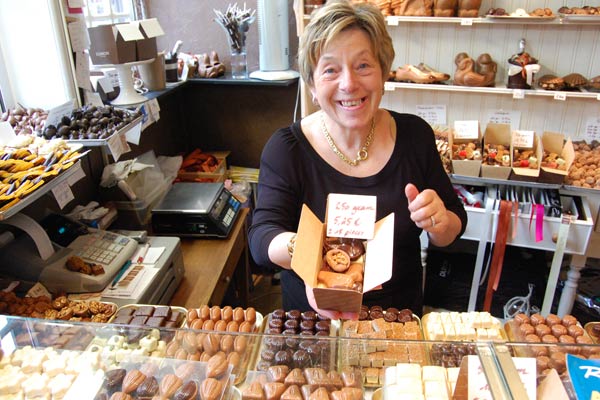
Nobody does chocolate like the Belgians. There’s something elegant about dropping in on the most expensive chocolate-maker in town—there’s one in every Belgian burg. Find a place that’s family-run, where locals buy their chocolate fresh, and people expect the shop to close on hot days because quality chocolate can’t survive the heat. Skip trendy “gourmet chocolatiers” who serve their chocolates with gimmicky flavors from gorgonzola to ginger—go for the purists.

A big percentage of American tourists visit Belgium as pilgrims…beer pilgrims, traveling all the way to that country to savor its plush and creamy beer. Hang out with devotees for a few nights and became a believer. My favorite Belgian evening is spent in an upscale pub, savoring a monk-made Trappist Blauwe Chimay (for example) with a rustic plate of bar food with locals who are both patriotic and evangelical about their Belgian brew.

In Holland, the “pilgrims” are more likely focused on the marijuana scene. Even if you’re not interested in smoking, drop by a “coffeeshop” for a whiff of its ambience. Baristas are patient in explaining to awkward Yankees how things work. Then, make an education out of the experience—talk to a local policeman, getting his take on why the Dutch stopped arresting pot smokers in 1976 and why this approach works. (I know, I just can’t pass up an opportunity to talk drug policy. To see the interesting “America’s Top Ten” list I just made in Coed Magazine, click here).

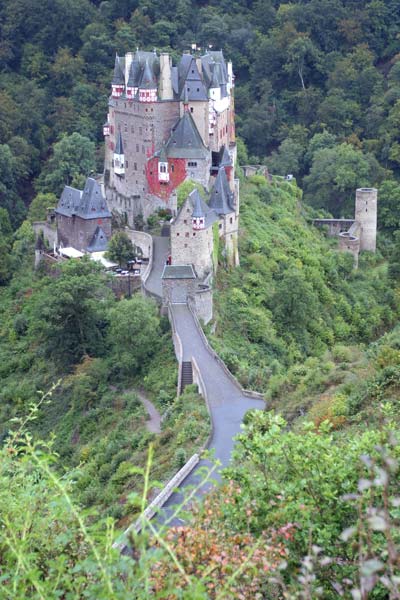
In Germany, my favorite castle experience is at Burg Eltz. Nestled in an enchanted forest just above the Mosel River, the Eltz castle is lovingly cared for by the aristocratic family that has called it home for centuries. The noble lady still puts out fresh flowers for her many visitors. Hike in from the train station and the experience gains a kind of magic. After an hour climbing under gentle trees through an ancient forest where you’d expect Friar Tuck and Martin Luther to be hiding out, the castle of your fantasies suddenly appears.

Every traditional German beer hall or Bierstube has a table for regulars—just look for the Stammtisch sign. To sample German conviviality at its best, make friends with the Stammtisch gang and get invited to join them at their table. Alternate between sniffing snuff (snorted from the “anatomical snuffbox” created by lifting your thumb high above your first finger) and drinking local schnapps. Before you know it, you’re leading the gang in a rousing rendition of “Country Roads.”

While perhaps the most touristy thing to do in Germany’s most-touristy town, following Rothenburg’s Night Watchman around on his evening rounds is a medieval hoot. Walk the town’s dark and evocative back streets with Georg Baumgartner, the wildly entertaining character whose delivery makes you forget what century you live in. While mobbed with tourists in mid-day, Rothenburg empties at night, when its flood-lit ramparts are all yours.

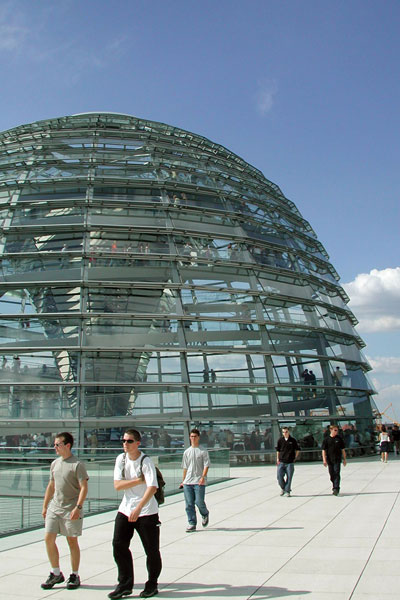
Climb the shiny glass dome that now caps the Reichstag (parliament building) in Berlin—for me, the most energizing thing to do in Germany’s most-energized city. From the top, look down on Germany’s legislators at work. You’re surrounded not by tourists but by Germans, who are determined to get politics right from now on.

Bungled Risk Assessment and Tragic Road Trips

Having a daughter studying at Georgetown means I have a steady stream of interesting reading coming into my email box. Jackie loves studying in Washington DC. Here’s an excerpt from something Jackie just sent that is thought-provoking:

This is from her psychology textbook, Psychology: A Concise Introduction, Second Editionby Richard A. Griggs:

“Availability in memory also plays a key role in what is termed a dread risk. A dread risk is a low-probability, high-damage event in which many people are killed at one point in time. Not only is there direct damage in the event, but there is secondary indirect damage mediated through how we psychologically react to the event. A good example is our reaction to the September 11, 2001, terrorist attacks. Fearing dying in a terrorist airplane crash because the September 11 events were so prominent in our memories, we reduced our air travel and increased our automobile travel, leading to a significantly great number of fatal traffic accidents than usual. It is estimated that about 1,600 more people needlessly died in these traffic accidents (Gigerenzer, 2006). These lives could have been saved had we not reacted to the dread risk as we did. We just do not seem to realize that it is far safer to fly than to drive. National Safety Council data reveal that you are 37 times more likely to die in a vehicle accident than on a commercial flight.”

Maslow’s Hierarchy, Wall Street Journal, and a Travel Writer

Two weeks ago in NYC, I was busy giving talks at the New York Times Travel Show. I made time for an interview at the request of the Wall Street Journal. They put me in a car and took me to a rough “but emerging” neighborhood in Brooklyn under the Williamsburg Bridge, and I shivered through an interview.

Reviewing this interview, I see the accidental evolution of my passion for teaching travel. After a decade of travel-on-the-cheap, I wrote my handbook on travel skills, Europe Through the Back Door. Then, after a decade of tour-guiding, my buddy Gene Openshaw and I wrote Europe 101: History and Art for the Traveler. And now, a decade later, with my focus on travel as an invaluable, perspective-broadening experience, I’ve written my latest book, Travel as a Political Act(at the printer now, in the bookstores in early May).

These three guidebooks provide a pyramid…a kind of Abraham Maslow’s Hierarchy of Needs for a thinking traveler. You start off with the basics: Pack light, stay safe, catch the train, and eat and sleep well. When those needs are met, you can appreciate the art, history, and culture. And then, reaching the goal of self-actualization, you gain a deeper understanding of our place on this delightful planet.

Put on a scarf and check out this interview. (video no longer available)

Travel Writer Meets Publisher, Plans Takeover of Guidebook World

I have a great relationship with my publisher. I’ve been with them from the start (1984). They like what I do, and I couldn’t do it without their support. A few days ago, they brought their staff who works most closely with mine to Seattle for our big annual review.

As the scope of our coverage has ballooned and the economy makes it more difficult to visit every place in every book in person every year (as I’d like to do), we have maintained that standard — unmatched in the publishing world — for our lead guidebooks. And the books covering less-visited destinations (with correspondingly lower sales) have become “biannuals,” which means they’re lovingly updated in person only every two years. (That’s why some of my books no longer have the year printed on the front cover.)

An advantage of the biannual plan, along with the obvious savings in research expenses, is that we don’t need to let the shelves go empty each winter. It used to happen that, due to the time constraints of our production schedule, the new annual editions of our less-selling books wouldn’t come out until springtime. Many booksellers took the previous edition off the shelves in December, when their year was up…leaving those books in sales limbo for peak sales months. Ironically, this made it easier to retail books that were not updated annually (i.e., no date on the cover) than the yearly editions. We’ve done biannuals long enough now to have hard sales results, and — as my all-knowing publisher predicted — sales didn’t go down with the biannual approach.

With the financial situation we’re all in, we are concerned with trends. Sales are down about 25 percent overall, but our market share continues to grow. I made the point that as a businessman/writer, I see sales totals as outside of our control. But as long as our market share is holding or growing, I’m satisfied. With the drop in sales and increase in costs to actually update with in-person visits, we need to be as smart as possible to maintain our high guidebook standards and stay in the black.

Every year I am pressured (for my own good) into producing more titles. My publisher has a huge appetite for getting more titles to sell. This is the only thing I dread about these meetings. This year (with the arrival of our new Athens & the Peloponnese guidebook in a few weeks), we have Europe pretty well covered. My publisher supports my priority to maintain the unique quality of our existing guidebooks before adding new destinations.

Bill Newlin, the boss at Avalon, is the ultimate guidebook publishing wonk. He internalizes all the sales data and lives and breathes ways to meet the market’s always-changing demands. I’m glad he’s on my team. He uses sales figures to make his case like a lawyer uses evidence. Back when we had a “Spain & Portugal” guidebook, he convinced me that the book would actually sell better if it were just Spain. We separated the two countries, and sure enough, Spain sales took off…and I had another book, to boot: Portugal. Two years ago, Bill said there’s a big appetite out there for Istanbul. I believed him. And now Istanbul is a solid part of our program.

Avalon would like guidebooks covering Barcelona and Scotland. But their new enthusiasm is for “full-color pocket guides.” Sales figures make it clear that customers want smaller books. Our competition is finding that the slimmed-down, pocket-sized, full-color versions of their established beefy country and city guidebooks are selling at least as well as the big books themselves.

As I begrudgingly accept this reality (I don’t want to enable travelers with a short attention span to base their trips on “lite” versions of my carefully researched books), I realize that the “lite” approach is already in my publishing DNA. A decade ago, my books were small and light — exactly what people are demanding today. In fact, on the back cover of each book, it said, “Don’t be fooled by overweight guidebooks.” Eventually these morphed into the full versions — Paris is now 570 pages rather than 200. While I’m satisfying the needs of people who want it all, I’m losing sales to people who like my work…but want a pocket guide more. They’ll pick up a lite version of the competition rather than a Rick Steves’ heavy. I’m now convinced that offering a small version won’t cannibalize sales of my big versions; it will just let me compete better in that new niche. So we are exploring ways to produce a parallel series of slimmer, more portable, full-color versions of some of my city guidebooks.

Another issue on the agenda was digital publishing. Sony and Amazon (Kindle) are battling it out for the electronic book market. E-books are already great for novels, but still clunky for reference works (such as guidebooks). I think guidebook information will eventually be used via digital screens. The iPhone format may eclipse the e-book format. My eyes glaze over whenever we get too deep into this, but I’m glad Bill is a futurist. I just repeat my mantra: “Content is king.” I will stay focused on creating the actual content…and let my publisher keep up with trends.

One digital opportunity that I am enthused about is iPhone apps. We agreed to aggressively come up with a way to design and share our various types of content (audio, video, and written). This will supplement our guidebooks and will be helpful to our travelers via their iPhones. Because of our archive of very practical podcasts, vodcasts, radio shows, and audio tours, we have a wealth of material to share with travelers who don’t even realize how helpful it would be…until they’re in Europe, confronted with all that potential experience and joy, and wishing they had a little direction. I am determined to make our audio and video material available for free to anyone who can figure out the latest applications.

We are well into a long and costly revamping of all our maps, which makes them computer-generated but keeps the personality and user-friendliness that my talented map man, Dave Hoerlein, gives them. (I have over 70 work-mates at ETBD, and Dave was the first to join me back in about 1980. He knows Europe intimately from top to bottom and makes all our maps.) Computerizing our maps is necessary because when we morph into future digital applications, we don’t want to be caught flat-footed with hand-drawn maps that can’t be manipulated for various emerging electronic platforms.

I asked Avalon about how my odd products are doing. Journals? I’m not talking about them enough, so, while nifty, they aren’t doing as well as they might. Maps? Borders carries them. Barnes & Noble does not. Phrasebooks? Hot, hot, hot. DVDs? Big hit with Costco.

What other European guides is my publisher also selling? They just partnered with the Let’s Go series for student travelers. Let’s Go will maintain the Harvard student researcher formula. I love the series, see it not as a threat but as complementary to mine, and wish it well. Time Out guidebooks are distilled from a series of entertainment magazines produced by Europeans. It’s top-notch and just right for a sophisticated European traveler or the American who wants that style of coverage. The Moon guidebooks, while still strong on the Americas and Asia, are pulling back on their Europe coverage.

According to the industry sales numbers, I’m happy with the way our books are doing. Our Rick Steves’ Italy, Paris, Ireland, Spain, and London — in that order — are in the top dozen best-selling travel books. They are the leading guidebooks to foreign destinations. The books that beat us are guides to Hawaii and Disney, and specialty/trendy titles like 1,000 Places to See Before You Die, The Sex Lives of Cannibals, and Getting Stoned with Savages(which I imagine would be a very good read). The first non-Hawaii/Disney guidebooks to make the list (after mine) are Fodors Italy, Lonely Planet Costa Rica, Dorling Kindersley’s Top Ten Paris, and Frommer’s Washington DC, in that order.

Thanks for your interest in our work as we continue gathering, organizing, and sharing all that information that helps us all travel smarter. Happy travels.