Traveling — and Learning — in the Developing World

smiling rick steves with two school-aged girls who are laughing


Tena yistilign!  I’m kicking off a special trip through Ethiopia and Guatemala, and I’m excited to bring you along.

I’m traveling here to learn about the fundamentals of extreme poverty and smart development — and to scout locations for a new one-hour public television special about world hunger. I plan to return to film the show in April, and then release it about a year from now. All along, I’ll be connecting with smart and passionate people working on the ground in the developing world, where economies are kindling like never before. (And I’ll also be getting to know regular people, like these two delightful school girls in Ethiopia’s Tigray region, who showed me, in an unforgettable way, the fruits of a developing nation that is committed to providing education for all its children.)

There’s a lot to learn and a lot to share, so stay tuned for much more over the next few weeks.

Join our traveling community — connect with me on Facebook and Twitter.


When Fascism Feels Normal…It’s Too Late


As a child traveling in Europe, I met a piano player who was a concentration camp survivor. I remember watching the serial number tattooed on his wrist sliding in and out of his sleeve as he played. He told me stories of his experience…stories that I would never forget.

Nearly 50 years later, as the firsthand memory of Europe’s fascist nightmare in the 20th century is dying along with the last survivors of the Holocaust and Nazi Germany, I felt a responsibility to produce a documentary on the topic. So, I did. “Rick Steves’ The Story of Fascism in Europe” is airing now across the USA on public television (check your local listings) and streaming online for free. I’d like to challenge you to watch just five minutes of it right now…and see if you can then not watch the rest.  

I’ve long had an ethic as a tour guide: Never take a group to Germany without a pilgrimage to a concentration camp. Today, I believe history is speaking to us. And, as a historian, tour guide, and public television host, I hear it, and I embrace the challenge of sharing its lessons.

Protecting our democracy is a matter of stewardship. Sometimes you need to go into the past to understand the present. And sometimes you need to leave your country to understand the importance of dealing smartly with the challenges it faces.

Germany possesses massive depots of swastika banners. These banners still exist — but they are kept locked up, for fear of stoking hateful rage at a rally. Germany understands that the ideology of fascism never dies. They need to be vigilant in keeping it down. And Germany knows that when fascism feels normal, it’s too late.

Please. Vote.


Video: Looking Back at my Response to Governor LePage About Pot

I was traveling through Michigan and North Dakota last week, on a mission to help legalize, tax, and regulate marijuana — and I felt like I was in a parallel universe, where this is still a controversial topic. Back home in Washington State, which voted to legalize six years ago, marijuana is old news. I don’t even bother going to Hempfest anymore. It’s just not the same. There’s nothing sexy about pot. Grandma’s rubbing it on her elbow.

Meanwhile, regressive politicians elsewhere are still mouthing the same “Reefer Madness” propaganda, as they fall farther and farther behind the public’s sensibility about the prohibition on marijuana. In 2016, I enjoyed rebutting drug warriors like Maine Governor Paul LePage, point-per-ridiculous-point — as you can see in this clip. And last week, I was doing the same in Michigan and North Dakota.


(By the way, Maine rejected LePage’s ideas…and legalized marijuana.)


Barnstorming My Way Through North Dakota and Michigan

Photo via the Forum News Service.

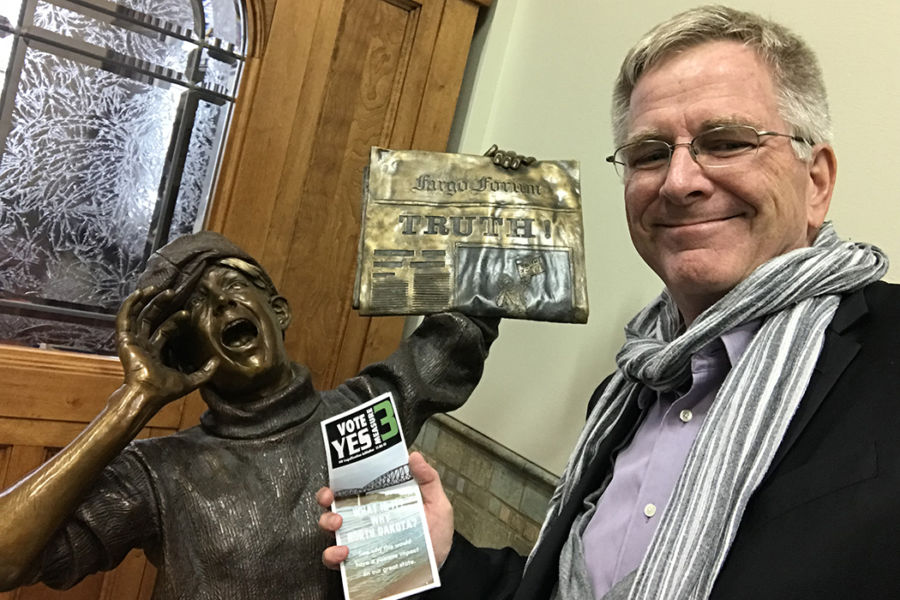
What am I doing toting my hemp bag through Fargo, North Dakota? Helping that state realize that our wrongheaded laws against marijuana are causing more harm to our society than the plant those laws were designed to protect us from.


rick steves holding a "yes on 3" pamphlet in front of a bronze statue that is of a newspaper boy who is hollering and holding a newspaper that has the word "TRUTH" written on it very largely


I spent last week in North Dakota and Michigan, barnstorming for campaigns to legalize marijuana — just as I did in 2012 in Washington State, in 2014 in Oregon, in 2016 in Massachusetts and Maine, and earlier this year in D.C., Maryland, Delaware, New Jersey, and Vermont. And just like usual, I was met with opposition by what I call the “PPP,” or “Pot Prohibition Profiteers”: corporations that make money when pot is kept illegal (pharmaceutical companies, big beer conglomerates, and so on). They help fund campaigns that have goofy names (“Healthy and Productive Michigan”) and share messages that confuse and deceive voters.


anti-rick steves michigan ad marijuana


Even the name “Healthy and Productive Michigan” is deceptive, as it implies that states that legalize are less healthy and less productive — which makes no sense, when you consider that Washington and Colorado have two of the hottest economies in the USA. The group also claimed, dishonestly, that I’m representing the “Big Marijuana” industry. That’s simply a lie. I’m traveling on my own dime and promoting civil liberties, the end of a failed prohibition, and a non-racist public safety approach to drug policy. (I am no friend of “Big Marijuana.”)

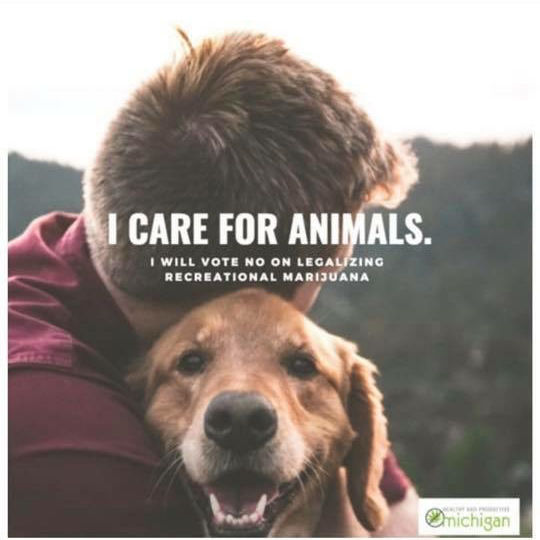
And if you’re not convinced by the eight states that are happy they legalized marijuana for human beings…you can always point to the dogs and cats that might get high eating their owners’ edibles as a justification for locking up poor people and people of color for nonviolent marijuana possession “crimes.”


ad that says "I care for animals. I will vote no on legalizing recreational marijuana" and a boy is holding a dog


Video: Road-Tripping Through the Upper Midwest to Help Legalize, Tax, and Regulate Recreational Marijuana

I just spent a week in Michigan and North Dakota, advocating for the end of the expensive, racist, and counter-productive prohibition on marijuana.

Back in 2012, we voted to legalize recreational marijuana in Washington State. I’m proud of that vote and what it has meant for social justice, civil liberties, and public safety. And so, every election cycle since then, I’ve gone on a barnstorming tour to help other states end our country’s prohibition on marijuana. In 2014, it was Oregon. In 2016, it was Massachusetts and Maine. This past spring, I traveled to D.C., Maryland, Delaware, New Jersey, and Vermont. And last week, I headed to the Upper Midwest.

I met a lot of good people in Michigan and North Dakota, and I worked very hard to share with them what we’ve learned in the six years since we legalized the adult recreational use of marijuana in Colorado and Washington State. In 2012, the governors of both of those states opposed the bills to legalize marijuana — but today, after six years of legal sales, both states are doing great, and those same governors (Hickenlooper and Inslee) support the laws. And that’s because we now have a track record. The numbers are in: When you legalize marijuana smartly, adult use stays roughly the same, teen use does not go up, DUIs do not go up, and crime does not go up. What does go up are civil liberties and tax revenue. In Washington State, we no longer arrest 10,000 pot smokers a year. And a billion dollars a year in illegal sales is now a billion dollars a year in legal sales — generating over $300 million a year for Washington State to use for education, health care, and drug treatment programs.  

My hope is that this November, the people of Michigan and North Dakota will see the sense in taking crime out of the equation and vote to end prohibition. It’s time to get smart on drug policy.