Just standing on a curb in a city where the police department was recently sent packing, you see a thunderous commotion that somehow works, and that locals learn to live with.
If you can’t see the video below, watch it on YouTube.
Just standing on a curb in a city where the police department was recently sent packing, you see a thunderous commotion that somehow works, and that locals learn to live with.
If you can’t see the video below, watch it on YouTube.
A part of any visit to a poor country like Egypt is aggressive hustling when exploring a tourist market. Cairo’s Khan el-Khalili market eagerly awaits your visit. Just so you’ll know what to expect, walk with me for a few minutes down its main drag.
If you can’t see the video below, watch it on YouTube.
While Cairo has modern suburban malls as glitzy as anything in Houston, and it has its 20th-century attempt at a European-style downtown, I like the dusty, donkey-cart world of the old Islamic city center. Khan el-Khalili, one of the largest markets in the Arab world, is a tourist magnet. And even today — with almost no tourism — it still feels touristy.
The market’s main drag is a gauntlet of hungry merchants. They drape you with a headdress or a bracelet, and you can’t give it back. I’m a sucker for the charming English lines they toss my way with the grace of fly fishermen casting:
“You’re breaking my heart.”
“How many camels for your woman?”
“Just look. No problem.”
“Can I sell you something you do not need?”
“No charge for looking.”
“Special price… 90 percent discount.”
“Come upstairs where we make things.”
“You are back! How can I take your money?”

But Khan el-Khalili is just a springboard for wandering deeper into Islamic Cairo. (That’s “Islamic” as opposed to the more European-feeling, French- and British-designed streets that make up the modern downtown.) My favorite areas to explore were along Souk el-Selah street, the “Street of the Tentmakers” (Chareh el-Khiamiah), and the gate named Bab Zuela.
Simply walking down the streets — dodging families riding motor bikes as if skewered on kebabs, rambling shipping dollies slaloming through browsers, and boys on bikes balancing rustic racks of bread on their heads — is treacherous. I duck to avoid being scalped by a rack of government-subsidized baladi bread (crispy little wheat balloons of feed-the-poor nutrition). The new government (as governments have done since Louis XVI lost his head to hungry peasants a couple of centuries ago) provides bread to its struggling masses at about a quarter its actual cost — the equivalent of a penny each.
I spent the last month explaining to friends why I’m traveling to Egypt. I’m here for lots of reasons. While letting my staff carry more of the updating burden with my existing guidebooks, I’m taking this chance to spend some steep learning-curve time in a country I don’t know well. At the same time, I’ll do some scouting for a TV special I plan to produce in the next year. Also driving this trip is my concern that the American public’s fear of traveling here is an overreaction. A firsthand experience will help me knowledgably advise people on Egypt’s merits and relative riskiness. One thing is certain: Egypt will be in the news a lot during the coming months. After ten days here, I think I’ll better understand the context of whatever the future brings. And finally, I have always liked the people and culture of this nation that’s as great as it is misunderstood and underappreciated.

I’m taking notes constantly for my TV project. For example, thinking about returning with my crew to this particular market street, I noted to film these things: towering stacks of rat traps, motorcycle minibuses (ride one, shoot point-of-view), bread boys on bikes, chiselers engraving grave stones, and the shop making shredded wheat kind of like cotton candy; avoid market streets on Friday and Saturday, when they are too crowded.
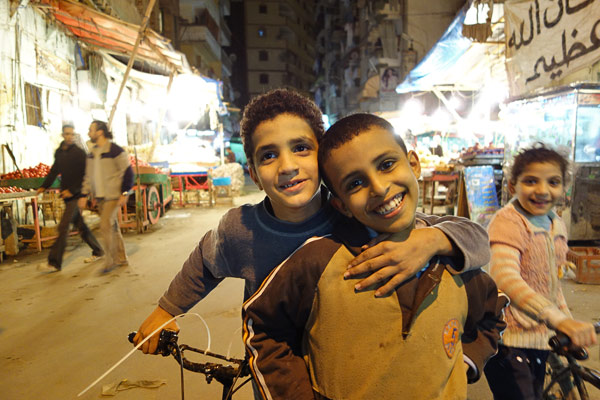
People are absolutely everywhere. While we have the refuge of our hotel, many people here have no escape. They seem to be out, in part, because it’s just better than being in. Egyptians are good-humored. They don’t stare. They’re generally friendly to my camera. I sensed absolutely no anti-Americanism. Children everywhere are ready to steal your heart with a warm and gentle smile.
Vast as Cairo is, it’s a small world for the traveler when it comes to sights and tourist-friendly stops. Local guides, local friends, and both guidebooks I’m using all dip into the same tiny pool of a handful of sights, restaurants, cafés, parks, concert venues, and hotels in this teeming city of 17 million. Every time my guide takes me somewhere, I check my guidebook…and it’s there. Every time I see something in my guidebook I want to visit, my guide is taking me there anyway.
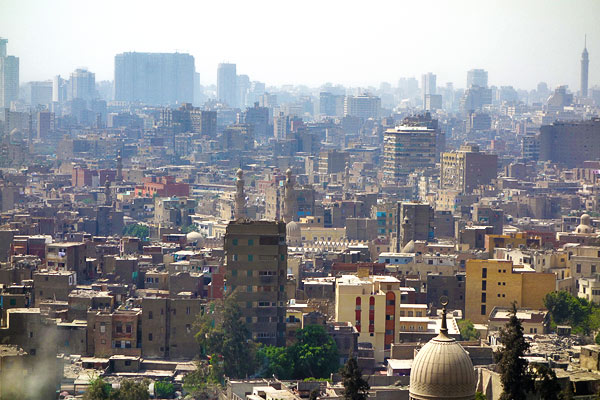
Cairo’s grand sights — the pyramids and the Egyptian Museum — are magnificent…absolutely world-class. Those are enough in themselves to make the long trip to Egypt worthwhile. But the other sights in Cairo are humble. Mosques, while historic, feel forlorn except when filled with worshippers on Friday. Oddly, in the National Museum — with the most beautiful things I saw, the treasures of ancient Egypt — photos are strictly forbidden.
Egypt is 10 percent Coptic Christian, and the history of Christianity in Egypt goes back to the first-century visit of St. Mark (whose bones rested in Alexandria until stolen by Venetian merchants in the ninth century to put their city on the pilgrim map). But the Christian presence is small and low-key.
With the rise of Muslim power (a persistent dimension of the nascent democracies of the Arab world), Christian communities throughout Islam lay low, build taller fences, and come with lots of police security. Just this week, several Christians were killed in a small riot here in Cairo. (I know that might sound shocking. But during the same week, several Christians were also killed in Chicago — a city with half of Cairo’s population.)
Cairo’s Coptic Museum, set in the restored walls of the ancient Roman fort, is charming, if humble. It seems the scant surviving artifacts of a rich heritage speak to centuries of edgy coexistence (alternating with periods of plunder) with the dominant Muslim society. The narthex of the Coptic church was lined with photos of Coptic patriarchs through the ages powwowing warily with Egypt’s various Muslim political bosses.

Any person in Cairo with 5 Egyptian pounds (about a dollar) can buy entrance into Al-Azhar Park, the only park in the center — an oasis of green where young couples enjoy a respite from the intensity of the city and a stroll through a rare garden with ponds and fountains and shade. Sitting in circles, friends giggle and flirt. Joining them for the standard tourist-meets-locals conversation, I pondered the downside of population density and the upside of population sparsity.

With the revolution in Egypt, freedom can be misunderstood. Locals are learning that on a busy urban street, unbridled freedom can become a straitjacket for all.
Video by Trish Feaster (For her Egypt blog, see http://thetravelphile.com/.)
If you can’t see the video below, watch it on YouTube.