While in Amsterdam, I always rent a bike for the duration of my stay and lock it to a “staple” (as the bike hitching racks here are called) in front of my hotel. A three-minute pedal away from the busy center puts me in the lazy, scenic, and mellow Jordaan district.
If you can’t see the video below, watch it on YouTube.
Nurseries promise you can take most of their seeds back into the USA. An exception is this marijuana starter kit.
Dutch pot smokers are complaining that the generation that was running naked on acid around Amsterdam’s Vondelpark during the Sixties is now threatening the well-established, regulated marijuana trade in the Netherlands.
Responding to international pressure and conservatives in rural and small-town Holland, the federal government is cracking down on coffeeshops (which legally sell marijuana). But big-city mayors, like Amsterdam’s, will fight to keep them open. Amsterdam’s leaders recognize that legalized marijuana and the Red Light District’s prostitution are part of the edgy charm of the city; the mayor wants to keep both, but get rid of the accompanying sleaze. The Dutch have learned that when sex and soft drugs are sold on the street (rather than legally), you get pimps, gangs, disease, hard drugs, and violence. Amsterdam recognizes the pragmatic wisdom of its progressive policies and is bucking the federal shift to the right. Locals don’t want shady people pushing drugs in dark alleys; they’d rather see marijuana sold in regulated shops.
While in Amsterdam, I took a short break from my guidebook research to get up-to-speed on the local drug policy scene. I find this especially interesting this year, as I’m co-sponsoring Initiative 502 in Washington State, which is on track to legalize, tax, and regulate the sale of marijuana for adults (on the ballot this November).
The Netherlands’ neighboring countries (France and Germany) are complaining that their citizens simply make drug runs across the border and come home with lots of pot. To cut back on this, border towns have implemented a “weed pass” system, where pot is sold only to Dutch people who are registered. But the independent-minded Dutch (especially young people) don’t want to be registered as pot users, so they are buying it on the street — which is rekindling the black market, and will likely translate to more violence, turf wars, and hard drugs being sold. The next step: In January of 2013, this same law will come into effect nationwide — including in Amsterdam, whose many coffeeshops will no longer be allowed to legally sell marijuana to tourists.
Locals point out that the Dutch are not more “pro-drugs” than other nations. For example, my Dutch friends note that, while the last 20 years of US Presidents (Clinton, Bush, Obama) have admitted or implied that they’ve smoked marijuana, no Dutch prime minister ever has. Many Dutch people are actually very anti-drugs. The Dutch word for addiction is “enslavement.” But the Dutch response to the problem of addiction is very different from that of the US.
Being a port city, Amsterdam has had its difficult times with drug problems. In the 1970s, thousands of hard-drug addicts made Amsterdam’s old sailor quarter, Zeedijk, a no-go zone. It was nicknamed “Heroin Alley.” To fight it, they set up coffeeshop laws (allowing for the consumption of pot while cracking down on hard-drug use). Today Zeedijk is gentrified, there’s no sense of the old days, and various studies indicate that Holland has fewer hard-drug users, per capita, than many other parts of Europe.
From the mid-1980s to the mid-1990s, the number of coffeeshops exploded. The Dutch observed that marijuana use rates increased, too, so they made changes, closing shops that ignored rules or generated neighborhood complaints. Now, new coffeeshop licenses are no longer being issued, and the number of coffeeshops in Amsterdam has declined from a peak of over 700 to about 200 today. With the movement afoot to crack down on things, coffeeshops are trying harder than ever to be good citizens and to nurture good relations with their neighbors.
While most Americans like their joints made purely of marijuana, the Dutch (like most Europeans) are accustomed to mixing tobacco with marijuana. There are several reasons: Back in the 1970s, most “pot smokers” here smoked hash, which needs to be mixed with something else (like tobacco) to light up. Today, more Dutch prefer “herbal cannabis” — the marijuana bud common in the US — but they still keep the familiar tobacco in their joints. Tobacco-mixed joints also go back to hippie days, when pot was expensive and it was simply wasteful to pass around a pure marijuana joint. Mixing in tobacco allowed poor hippies to be generous without going broke. And, finally, the Dutch don’t dry and cure their marijuana, so it’s simply hard to smoke without tobacco. Any place that caters to Americans will have joints without tobacco, but you have to ask specifically for a “pure” joint. Joints are generally sold individually (for €3 to €5, depending on the strain you choose).
Coffeeshops are allowed only half a kilo (about a pound) of pot in their inventory at any given time. On a typical day, a busy shop will sell three kilos (and, therefore, take six deliveries). Very little marijuana is imported anymore, as the technology is such that strains from all over the world can be grown in local greenhouses. (And the Dutch wrote the book on greenhouses.) “Netherlands weed” is now refined, like wine.
The Dutch hemp heritage goes way back in this sailing culture. In the days of Henry Hudson, hemp was critical for quality rope and for sails. The word “canvas” comes from the same root as “cannabis.” In fact, there was a time when tobacco was the pricey leaf, and sailors mixed hemp into their cigarettes to stretch their tobacco.
Tourists who haven’t smoked since they were students are famous for overdosing in Amsterdam, where they can suddenly light up without any paranoia. Coffeeshop baristas nickname tourists about to pass out “Whitey” — because of the color their face turns just before they hit the floor. The key is to eat or drink something sweet to stop from getting sick. Coca-Cola is a good fast fix, and coffeeshops keep sugar tablets handy.
No one would say smoking pot is healthy. It’s a drug. It’s dangerous, and it can be abused. The Dutch are simply a fascinating example of how a society can allow marijuana’s responsible adult use as a civil liberty, and treat its abuse as a health-care and education challenge rather than a criminal issue. They have a 25-year track record of not arresting pot smokers, and have learned that if you want to control a substance, the worst way to do it is to keep it illegal. Regulations are strictly enforced. While the sale of marijuana is allowed, advertising is not. You’ll never see any promotions or advertising in windows. In fact, in many places, the prospective customer has to take the initiative and push a button to illuminate the menu in order to know what’s for sale. And, surprisingly, marijuana is just not a big deal in the Netherlands — except to tourists coming from lands where you can do hard time for lighting up. A variety of studies have demonstrated that the Dutch smoke less than the European average — and fewer than half as many Dutch smoke pot, per capita, as Americans do.
Amsterdam is more of a melting pot than ever, as this remarkable tapestry — featuring panels for each of the 180 nationalities that are represented in the city — attests.
If you can’t see the video below, watch it on YouTube.
After years of reshuffling and rebuilding, Amsterdam is coming together — and 2013 is shaping up to be a big year for finally completing ambitious projects. On the day of my visit, newspapers reported that the curator of the Rijksmuseum had just been given the keys to his museum by the construction boss. Dutch art lovers are thrilled that in April of 2013, the new, much-improved Rijksmuseum will reopen.
As of September 24, 2012, the Van Gogh Museum will close. The top 75 Van Gogh masterpieces will be on display in the more central Hermitage Amsterdam museum until late April of 2013, when the Van Gogh Museum will reopen to kick off its 40th birthday celebration.
About 1.5 million people tour the Van Gogh Museum annually. Many of them visit on hallucinogenic mushrooms (sold at street-corner “smartshops”). But a 2008 law now prohibits selling ‘shrooms. So now, instead, the smartshops sell hallucinogenic truffles (technically not “mushrooms” because they grow underground)…and those wanting to trip out on Vincent do so on ‘ruffles.
Along with the reopening of the refurbished Rijksmuseum and Van Gogh Museum, Amsterdam’s many characteristic canals will get in on the 2013 action. Next year they’ll be celebrating their 400th birthday, with concerts, swimming, skating, and even fashion catwalks.
As usual, I picked up a bike for my entire stay in Amsterdam. The city is a delight on two wheels. The clerk at the bike-rental shop explained why they don’t carry mountain bikes in this very flat country: “Mountain bikes in the Netherlands make no sense at all. When a dog takes a dump, we have a new mountain.”
There are not many museums in Europe that are the creation of a single person, who personally guides every visitor through. Nike Padalino created “Electric Ladyland: The First Museum of Florescent Art,” filling it with samples and artifacts both historic (florescent crayons used by California church groups in the 1950s) and natural (glow-in-the-dark stones scavenged from high in the Himalayas). Nick even gave himself a tattoo that is invisible until you shine a blacklight on it.
While there’s lots of news for travelers in Amsterdam, one thing that’s changed very little is the energy of the crowds that throb all along the city’s main drag, Damrak.
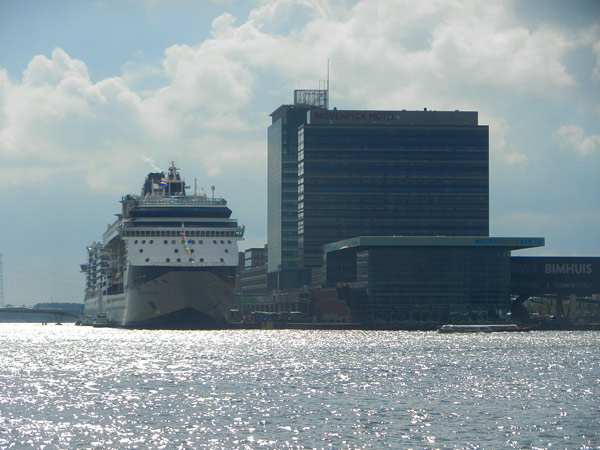
Ports like Amsterdam and Hamburg are seeing a big spike in cruise business. As throughout Europe, cruising is on the rise.
I was just in the Netherlands researching the new edition of my guidebook on Amsterdam and getting up-to-date on the “coffeeshop” (i.e., marijuana) scene. Regardless of how you might hate or love marijuana and what you think about American laws, it’s fun to try to understand the Dutch system. Here’s what I learned just last week.
When tourists call an ambulance after smoking too much pot, Dutch medics just say, “Drink something sweet and walk it off.” Amsterdam, Europe’s counterculture mecca, thinks the concept of a “victimless crime” is a contradiction in terms. Drive under the influence of anything and you’re toast. Heroin and cocaine are strictly illegal in the Netherlands, and the police stringently enforce laws prohibiting their sale and use. But, while hard drugs are definitely out, marijuana causes about as much excitement as a bottle of beer.
Throughout the Netherlands, you’ll see “coffeeshops” — pubs selling marijuana, with display cases showing various joints or baggies for sale. The minimum age for purchase is 18, and coffeeshops can sell up to five grams of marijuana per person per day.
Because of laws prohibiting the advertising of marijuana, you need to take the initiative and ask to see the menu. In some places, there’s actually a button you must push and hold down to see the menu illuminated. And the menu looks like the inventory of a drug bust.
Americans with no reason for paranoia play hide and seek in an Amsterdam coffeeshop. Enlarge photo
The big news on the coffeeshop scene is the new nationwide smoking ban. These laws pertain to tobacco smoke, but not marijuana smoke. But the Dutch, like the rest of Europe, mix their marijuana with tobacco. It might seem strange to an American, but if a coffeeshop is busted…it’s busted for tobacco. Shops are mixing a kind of herbal tea as a tobacco substitute for joints. Coffeeshops with a few outdoor seats have a huge advantage, as their local customers can light up outside. And shops without the outdoor option are in for an extra challenge, as many local smokers would rather get their pot “to go” than smoke it without tobacco at their neighborhood coffeeshop.
Pre-rolled joints are now sold pure, with the non-tobacco “hamburger helper” herb mix, and with tobacco. The pure marijuana joints are much easier to buy now than just a year ago. Some shops sell individual joints (€2-5, or about $3-7.50). Others sell only small packs of three or four joints. Shops sell marijuana and hash in pre-rolled joints and in little baggies. Shops have loaner bongs and “smoke-free” inhalers, and dispense cigarette-rolling papers like toothpicks.
While Dutch law allows for shops to keep an inventory of up to 500 grams, the wholesale dimension is the famous “grey area” in the law. It’s just left out of the equation. Most shops get their inventory from the pot equivalent of home brewers or microbrewers. Shops with better “boutique suppliers” get the reputation for having better-quality weed (and regularly winning the annual Cannabis Cup). The tax authorities don’t want to see more than 500 grams (about a pound) on the books at the end of each accounting cycle, and shops lose their license when found with too much in stock.
A shop could retail a ton of pot with no problem, as long as it maintains that tiny stock and refills it as needed. Amsterdam’s mayor, understanding that this just has the city busy with small-time deliveries, has proposed doubling the allowable inventory level. The reason the inventory level is kept so small: They want shops to stay small and not become bases for exportation. Providing pot to neighboring countries would bring more international pressure on the Netherlands to crack down on its coffeeshop culture.
The other legal trend is that licenses are not being renewed in some neighborhoods as the city wants to maintain a certain smattering of shops and not have too big a concentration in any one area.
The Dutch are not necessarily pro-marijuana, but they do believe that a prohibition on marijuana would cause more problems than it solves. Statistics support the Dutch belief that their system works. They have fewer hard drug problems than other countries. And they believe America’s policy is based on fear, misinformation, and electoral politics, rather than rationality. And, after a 10-year track record, the Dutch have found that their drug policy does not result in more pot smoking. Statistically, Americans smoke twice as much pot as the Dutch (per capita).