Daily Dose of Europe: Rembrandt’s Night Watch

The Night Watch is Rembrandt’s largest and most famous — though not necessarily his greatest — painting.

As America continues to suffer crisis upon crisis, it has never been more important to broaden our perspectives and learn about the people and places that shape our world. And for me, one of the great joys of travel is seeing art masterpieces in person. Learning the stories behind great art can shed new light on our lives today. Here’s one of my favorites.
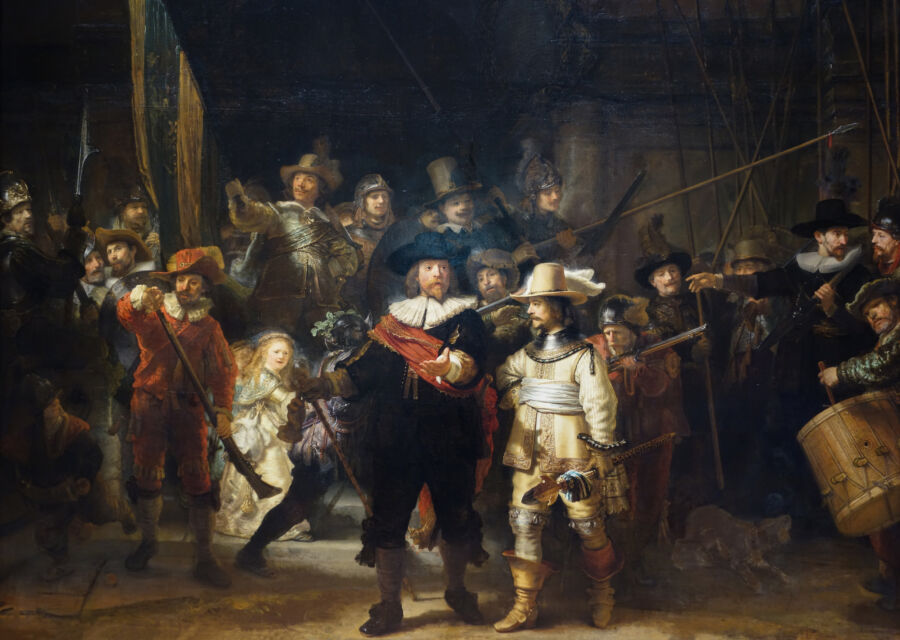
Created in 1642, when he was 36, The Night Watch came from his most important commission: a group portrait of a company of Amsterdam’s Civic Guards to hang in their meeting hall.

It’s an action shot. With flags waving and drums beating, the guardsmen spill onto the street from under an arch. It’s “all for one and one for all” as they rush to Amsterdam’s rescue. The soldiers grab lances and load their muskets. In the center, the commander (in black, with a red sash) strides forward energetically with a hand gesture that seems to say, “What are we waiting for? Let’s move out!” His lieutenant focuses on his every order.
Why is The Night Watch so famous? Well, it’s enormous, covering 170 square feet. The guards are almost life-size, so it seems like they’re marching right out of the frame and into our living room.

In its day, The Night Watch was completely different from other group portraits. Until then, subjects were seated in an orderly group-shot pose with each face well-lit and flashbulb-perfect. The groups commissioning the work were paying good money to have their mugs preserved for posterity, and it was ego before artistic freedom.

By contrast, Rembrandt got the Civic Guards off their duffs and showed them doing their job — protecting the city. He added less-than-heroic elements that gave it a heightened realism, like the dwarf and the mysterious glowing girl holding a chicken (the guards’ symbol). Rembrandt’s trademark use of a bright spotlight to highlight the main characters made it all the more dramatic. By adding movement and depth to an otherwise static scene, he took posers and turned them into warriors, and turned a simple portrait into high art.

OK, some Night Watch scuttlebutt: First off, the name “Night Watch” is a misnomer. It’s actually a daytime scene, but Rembrandt finished his paintings with a preserving varnish. Eventually, as the varnish darkened and layers of dirt built up, the sun set on this painting. During World War II, the painting was rolled up and hidden for safekeeping. Over the years, this stirring painting has both inspired people and deranged them. In 1911, a madman sliced it with a knife, in 1975, another lunatic cut the captain’s legs, and in 1990, it was sprayed with acid.

The Night Watch was a smashing success in its day. Rembrandt had captured the exuberant spirit of Holland in the 1600s, when its merchant ships ruled the waves, and Amsterdam was the center of the first global economy. These guardsmen on the move epitomized the proud, independent, and upwardly mobile Dutch. On an epic scale, Rembrandt created the definitive “portrait” of that single generation of people that re-invented the world — the era we call the “Dutch Golden Age.”

This art moment — a sampling of how we share our love of art in our tours — is an excerpt from the new, full-color coffee-table book “Europe’s Top 100 Masterpieces” by Rick Steves and Gene Openshaw. Please support local businesses in your community by picking up a copy from your favorite bookstore, or you can find it at my online Travel Store. To enhance your art experience, you can find clips related to this artwork at Rick Steves Classroom Europe; just search for Night Watch.
Daily Dose of Europe: Vermeer’s Kitchen Maid

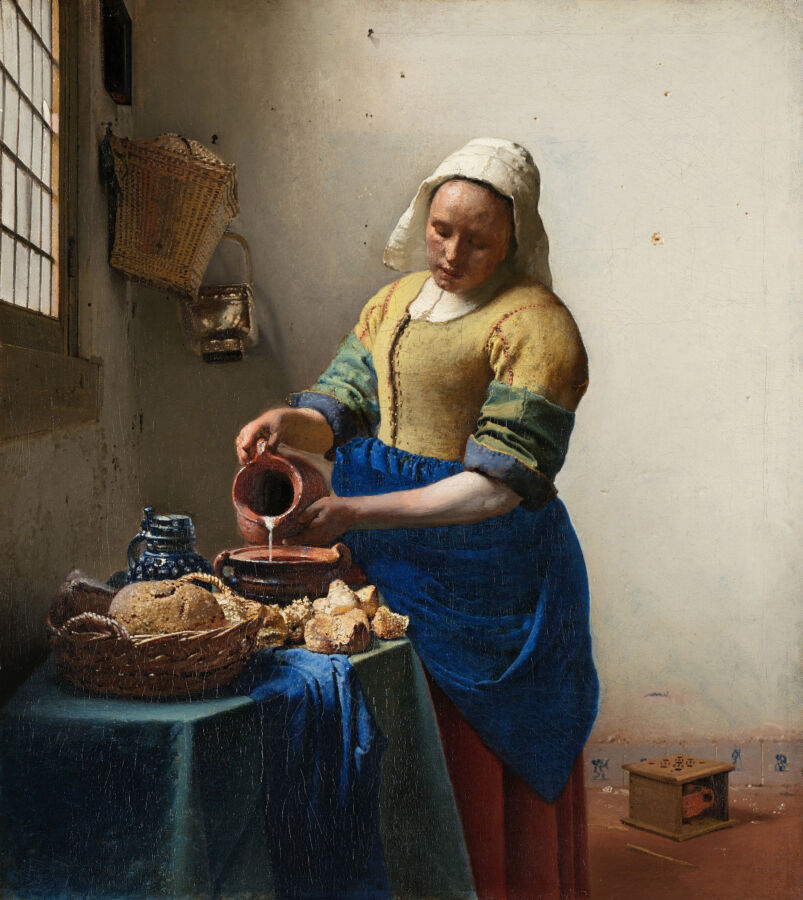
In our tumultuous world today, when I crave tranquility, I enjoy paintings like this one. A maid pours milk from a pitcher into a bowl. She looks down, focused intently, performing this simple task as if it’s the most important thing in the world. Vermeer has captured a quiet moment in Holland.

As America continues to suffer crisis upon crisis, it has never been more important to broaden our perspectives and learn about the people and places that shape our world. And for me, one of the great joys of travel is seeing art masterpieces in person. Learning the stories behind great art can shed new light on our lives today. Here’s one of my favorites.

In Vermeer’s day, maids were generally portrayed as luscious objects of desire surrounded by mouthwatering foods. Though Vermeer keeps some of that conventional symbolism — cupids in the baseboard tiles, uterine jugs, erotic milk-pouring, and a heat-of-passion foot warmer — the overall effect here is quite the opposite. Rather than a Venus, this is a blue-collar maid, a down-to-earth working girl…working. She’s broad-shouldered and thick, balanced on a sturdy base. Because of the painting’s lines of perspective, we the viewers are literally looking up at her. Vermeer’s maid embodies that most-prized of Dutch virtues: the dignity of hard work.

While the painting’s subject is ordinary, you could look for hours at the tiny details: the crunchy crust of the loaves of bread, the broken window pane, the shiny brass basket, even the rusty nail in the wall with its tiny shadow.

Vermeer frames off a little world in itself. Then he fills that space with objects for our perusal. Vermeer silences the busy world, so that every sound, every motion is noticed. It’s so quiet you can practically hear the thick milk hitting the bowl. You can feel the rough crust of the bread, the raised seams of her blouse, and the thick material of her apron.

Vermeer (1632–1675), from the picturesque town of Delft, was only 25 when he painted this, but it set the tone for his signature style: interiors of Dutch homes, where Dutch women engage in everyday activities, side-lit by a window. While Vermeer’s Baroque contemporaries painted Greek gods and idealized Madonnas, he specialized in the daily actions of regular people.

Like many Vermeer paintings, there’s an element of quiet mystery. Is the faint smile of this “Dutch Mona Lisa” happy or sad? The portrayal subtly implies a more complicated story than we’ll ever know.

Vermeer was a master of light. His luminous paintings radiate with a diffuse lighting, with minimal shadows. He makes simple objects glow. He could capture reflected light with an artistry that would make the Impressionists jealous two centuries later.
Vermeer presses the pause button on daily life and gives us the time to really see it. He invites you to slow down, probe deep into the canvas, and immerse yourself in his world. Through Vermeer, we can learn to appreciate the beauty of everyday things.
In all, only 37 Vermeer paintings survive — each is a small jewel worth lingering over.

This art moment — a sampling of how we share our love of art in our tours — is an excerpt from the new, full-color coffee-table book, “Europe’s Top 100 Masterpieces,” by Rick Steves and Gene Openshaw. Please support local businesses in your community by picking up a copy from your favorite bookstore, or you can find it at my online Travel Store. To enhance your art experience, you can find clips related to this artwork at Rick Steves Classroom Europe; just search for Vermeer.

Daily Dose of Europe: Dutch Tolerance — Red Lights and Pot Shops

Homebound now rather than exploring Europe, I’ve been thinking a lot about places that pry open my hometown blinders…places that rearrange my cultural furniture…that make me a bit less self-assured about the best ways to run a society. You actually realize smart and caring people deal with the great moral challenges that confront us all differently. And while for some, that is a good reason to stay home, for me, that is one of the great joys of exploring our world. In so many ways, when we leave home and are exposed to other cultures, we actually learn more about our own homes. We see our hang-ups, taboos, and “self-evident truths” in a broader perspective. This lets us reaffirm our stances…or reconsider what we always thought was “normal.” Imagine being changed by our travels. Now that’s my kind of souvenir!

With all that in mind, let me steer your daily dose of Europe to the Netherlands and to Amsterdam: a laboratory of progressive living, bottled inside Europe’s finest 17th-century city.

Even though we’re not visiting Europe right now, I believe a daily dose of travel dreaming can be good medicine. I just published a collection of my favorite stories from a lifetime of European travels. My new book is called “For the Love of Europe” — and this story is just one of its 100 travel tales.

Like Venice, Amsterdam is a patchwork quilt of elegant architecture and canal-bordered islands anchored upon millions of wooden pilings. But unlike its dwelling-in-the-past, canal-filled cousin, Amsterdam sees itself as a city of the future, built on good living, cozy cafés, great art, street-corner jazz…and a persistent spirit of live-and-let-live.

During its Golden Age in the 1600s, Amsterdam was the world’s richest city, an international sea-trading port, and a cradle of capitalism. Wealthy burghers built a planned city of tree-shaded canals lined with townhouses topped with fancy gables. The atmosphere they created attracted a high-energy mix of humanity: Immigrants, Jews, outcasts, and political rebels were drawn here by its tolerant atmosphere. Sailors — so famously hard-living and rowdy — were needed to man the vast fleet of merchant ships. And painters like young Rembrandt found work capturing that atmosphere on canvas.

I approach Amsterdam as an ethnologist observing a unique culture. A stroll through any neighborhood is rewarded with slice-of-life scenes that could rarely be found elsewhere. Carillons chime from church towers in neighborhoods where sex is sold in red-lit windows. Young professionals smoke pot with impunity next to old ladies in bonnets selling flowers. Each block has a quirky and informal custom of neighbors looking out for neighbors, where an elderly man feels safe in his home knowing he’s being watched over by the sex workers next door.

Prostitution has been legal since the 1980s (although streetwalking is still forbidden). The sex workers are often entrepreneurs, running their own businesses and paying taxes. They usually rent their space for eight-hour shifts. A good spot costs $150 for a day shift and $250 for an evening. Popular prostitutes charge $50-70 for a 20-minute visit. Many belong to a union called the Red Thread.

The rooms look tiny from the street, but most are just display windows, opening onto a room behind or upstairs with a bed, a sink, and little else. Sex workers are required to keep their premises hygienic, avoid minors, and make sure their clients use condoms. If a prostitute has a dangerous client, she pushes her emergency button and is rescued not by a pimp, but by the police.

The Dutch are a handsome people — tall, healthy, and with good posture. They’re open, honest, refreshingly blunt, and ready to laugh. As connoisseurs of world culture, they appreciate Rembrandt paintings, Indonesian food, and the latest French films, but with a down-to-earth, blue-jeans attitude.

While smoking tobacco is not allowed indoors, the Dutch seem to smoke more cigarettes than anyone in Europe. Yet somehow, they are among the healthiest people in the world. Trim and wiry Dutch seniors sip beers, have fun blowing smoke rings, and ask me why Americans have a love affair with guns and kill themselves with Big Macs.

While the Dutch smoke a lot of tobacco, they smoke less marijuana than the European average. Although hard drugs are illegal, a joint causes about as much excitement here as a bottle of beer. Still, following an ethic of pragmatic harm reduction rather than legislating morality and pushing incarceration, the government allows the retail sale of pot. The Dutch think the concept of a “victimless crime” is a contradiction in terms. If a tipsy tourist calls an ambulance after smoking too much pot, medics just say, “Drink something sweet and walk it off.”

Throughout Amsterdam, you’ll see “coffeeshops” — pubs selling marijuana — with menus that look like the inventory of a drug bust. Most of downtown Amsterdam’s coffeeshops feel grungy and foreboding to American travelers who aren’t part of the youth-hostel crowd. But the places in local neighborhoods and small towns around the countryside feel much more inviting to people without piercings and tattoos.

Paradox is the most gezellig (cozy) coffeeshop I’ve found in Amsterdam — a mellow, graceful place. The managers, Ludo and Wiljan, and their staff are patient with descriptions. With each visit, they happily walk me through their menu. The juice is fresh, the music is easy, and the neighborhood is charming.
It’s become a ritual for me now to drop by Paradox and check in with Ludo and Wiljan with each visit to Amsterdam. I grab a wicker chair just outside their door. Framed in the jungle of lush vines that decorates the storefront, I sit and observe the metabolism of the neighborhood. I think about how challenging societal norms — with a pinch of shock here and a dash of tolerance there — leads to progress. I’m grateful that this city’s bold experiment in freedom continues.

This story appears in my newest book, “For the Love of Europe” — collecting 100 of my favorite memories from a lifetime of European travel. Please support local businesses in your community by picking up a copy from your favorite bookstore, or you can purchase it at my online Travel Store. You can also find a clip related to this story at Rick Steves Classroom Europe; just search for Amsterdam.

Daily Dose of Europe: Pedaling Through Amsterdam

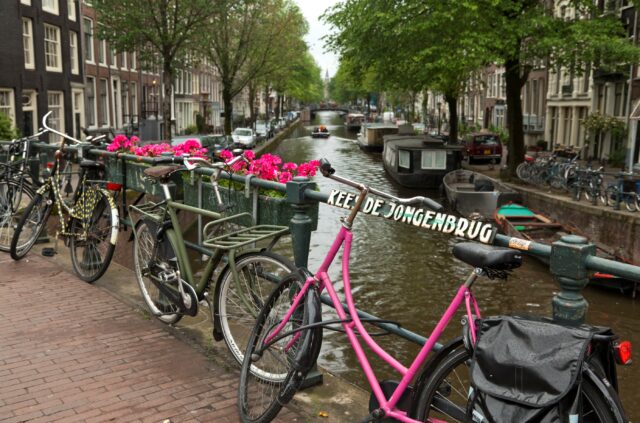
I love Amsterdam. And I love it even more from the seat of a bike.

Because of the coronavirus, Europe is effectively off-limits to American travelers for the next few weeks (and likely longer). But travel dreams are immune to any virus. During these challenging times, I believe a daily dose of travel dreaming can actually be good medicine. Here’s another one of my very favorite travel dreams-come-true…a reminder of what’s waiting for you in Europe on the other end of this crisis.

Sightseeing isn’t just seeing. To get the full experience of a place, you need to feel, hear, taste, and smell it. On this visit to Amsterdam, I’m making a point to focus on sensual travel. It’s a city made to engage all of the senses.

I always rent a bike here. I want to feel the bricks and pavement beneath two wheels. The lack of hills and the first-class bike-lane infrastructure makes biking here a breeze. The clerk at the rental shop must be tired of explaining why they don’t carry mountain bikes in this flat land. When I ask, he responds — in classic Dutch directness — “Mountain bikes in the Netherlands make no sense at all. When a dog takes a dump, we have a new mountain. You pedal around it…not over. It’s no problem.”

I ride off along the shiny wet cobbles, my Amsterdam experience framed by my black bike’s handlebars. I get pinged by passing bikes and ping my bell to pass others. When it comes to bike bells, there’s no language barrier. For my own safety, I wish I had a bigger periphery, as cars, trams, bikers, and pedestrians seem to float by from all directions in silence — their noise lost in the white noise of breezing through this dreamy city on two wheels.

Reaching the Red Light District, I stop to use a classic old street-corner urinal. It’s painted a deep green and designed to give the user plenty of privacy from the neck down and a slice-of- Amsterdam view at the same time. The pungent smells of pot smoke and someone else’s urine compete with the dank smell of the canal. I remember one of the new Amsterdam facts I’ve learned: A handful of people drown in the canals each year. When their bodies are finally dredged up, very often, their zippers are down. They were very drunk and, rather than using the civilized urinal as I did, they used the canal…their final mistake. Across the lane, a woman in a cliché of lingerie eyes me seductively from a window, framed in red. I think to myself, “This is probably the most unforgettable trip to a urinal I’ll ever have in my life.”

Pedaling on, I notice that the Red Light District is now a little more compact than I remember. Spliced in among the windows displaying enticing women are other windows promoting fashion and contemporary art. Amsterdam’s leaders recognize that legalized marijuana and prostitution are part of the city’s edgy charm, but are also working to rein in the sleaze. They’re not renewing some Red Light District leases, instead giving them to more preferable businesses.

Continuing on my ride, it strikes me that much of Amsterdam still looks like it did three or four centuries ago, during the Dutch Golden Age, when this was the world’s richest city.

I continue on to a square called Museumplein where Amsterdam’s three, big art museums are gathered — and selfie-crazed tourists gather around the red-and-white “I AMsterdam” letters, which are as tall as people.

I stop a moment to take in the square. Long lines plague the Dutch Master-filled Rijksmuseum and Van Gogh Museum — both understandably popular. There’s rarely a wait at the Stedelijk Museum, nicknamed “the bathtub” because of the striking shape of its modern architecture. Inside are 20th-century favorites (Dalí, Picasso, Kandinsky) and crazy contemporary art. I’m not a big fan of the abstract style, but the artwork at the Stedelijk is really fun (perhaps really, really fun if you’re into marijuana — sold with a smile in the city’s many “coffeeshops”).

The sounds of Amsterdam’s knack for good living seem to surround the museum district. Underneath the Rijksmuseum, in a public passageway, street musicians seem to be performing everything from chamber music to Mongolian throat singing. Around the corner, a man in a top hat cranks away on his candy-colored street organ. Mesmerized children watch its figurines jingle and jangle to the jaunty music as it slowly grinds through its perforated song boards.

The city’s biggest green space, Vondelpark, is just a short pedal away. I roll by snippets of Dutch conversation — families with kids, romantic couples, strolling seniors, and hippies sharing blankets and beers.

By now my sense of taste is ready for a little attention. Thinking about the options, I consider rijsttafel (literally “rice table”), a ritual dish for tourists in Holland. Not a true Indonesian meal, it’s a Dutch innovation designed to highlight the best food of its former colony — specifically to show off all the spices that in some ways originally motivated the colonial age. The dinner includes 20 dishes and a rainbow of spices with white rice to mix and mingle on your plate and palate. Working your way through this tasty experience, it’s clear why the Dutch called Indonesia “The Spice Islands.”

In the mood for something more historically Dutch, I opt instead for a snack of herring with pickles and onions. Later, I indulge my taste buds at a cheese-tasting class. After a short video that’s somewhere between a cheese commercial and dairy soft porn, I guillotine six different local cheeses studying, smelling, and tasting them with a wine accompaniment.

My final experience: some Dutch booze. While the 20-somethings line up for the Heineken Experience — a malty, yeasty amusement ride of a brewery tour — I join an older crowd at the slick House of Bols: Cocktail & Genever Experience. Here, I learn about the heritage of Dutch gin (genever), and test my olfactory skills at a line of 36 scents. I fail miserably, my nose identifying only one scent: butterscotch. I console myself by designing the cocktail of my dreams at a computer kiosk and taking the recipe printout to the nearby barista, who mixes a Dutch gin drink that’s uniquely mine.

Pedaling back to my hotel, rattling over those shiny cobbles just inches from the murky canals, I’m thankful I turned down that one last gin.

(This story is excerpted from my upcoming book, For the Love of Europe — collecting 100 of my favorite memories from a lifetime of European travel, coming out in July. It’s available for pre-order.)

The Story of Fascism: “Never Again”

Memorials across Europe remind us of the unthinkable horrors of 20th-century fascism — and compel us to never let it happen again.

https://www.facebook.com/ricksteves/videos/474532753061336/


This clip is excerpted from my new one-hour special “Rick Steves’ The Story of Fascism in Europe.” Check your local listings for air times — and if you don’t see it, please ask your public television station to add it to their schedule.