Building a Home in Amsterdam

Anyone who’s built a home knows about soils and foundation concerns. Imagine building a home in a place like Venice or Amsterdam. Watching construction people dam, drill, fill, and build here, it just seems routine. This video clip gives a peek at the watery process.

If you can’t see the video below, watch it on YouTube.

Eating Local in Tasty Amsterdam

If you want to eat local in Amsterdam, remember three things: cheese, herring, and Indonesian rijsttafel. What are your favorite Amsterdam edibles?


Colonial cuisine is fun. And just like England loves its Indian food, the Dutch hunger for Indonesian. The ritual dish for tourists in Holland is rijsttafel  (literally "rice table"). While not a true Indonesian meal, it’s a Dutch innovation designed to highlight the best food of its former colony, especially all the great spices that were a big part of what originally motivated the colonial age. For around $40 you’ll get about 20 dishes and a rainbow of spices with white rice to mix and mingle on your palette. More casual Indonesian restaurants allow you to split this meal.
Colonial cuisine is fun. And just like England loves its Indian food, the Dutch hunger for Indonesian. The ritual dish for tourists in Holland is rijsttafel (literally “rice table”). While not a true Indonesian meal, it’s a Dutch innovation designed to highlight the best food of its former colony, especially all the great spices that were a big part of what originally motivated the colonial age. For around $40 you’ll get about 20 dishes and a rainbow of spices with white rice to mix and mingle on your palette. More casual Indonesian restaurants allow you to split this meal.


With its seafaring heritage, Dutch cuisine embraces herring. The local version of a hot-dog stand is a herring stand where variations on fresh herring are dished up--most are not cooked but pickled. For a memory you won’t forget (no matter how you try), don’t miss a little paper plate of herring with pickles and onions.
With its seafaring heritage, Dutch cuisine embraces herring. The local version of a hot-dog stand is a herring stand where variations on fresh herring are dished up–most are not cooked but pickled. For a memory you won’t forget (no matter how you try), don’t miss a little paper plate of herring with pickles and onions.


Each day my wandering was made much more fun and educational because I hired a local guide to join me. It’s basically like renting a friend who’s really smart. Then, everything I do, I’m doing with a coach and partner. My guide Frank Sanders and I spent an hour enjoying the Reypenaer cheese tasting.


At the Reypenaer cheese-tasting class we tried five or so Dutch cheeses with three different wines and charted our experience. If you happen to like cheese and wine, this is a very fun class. As I recommend it in my Amsterdam guidebook, I wanted to be sure I was describing it correctly--and you can’t do that without actually enjoying the experience.
At the Reypenaer cheese-tasting class we tried five or so Dutch cheeses with three different wines and charted our experience. If you happen to like cheese and wine, this is a very fun class. As I recommend it in my Amsterdam guidebook, I wanted to be sure I was describing it correctly–and you can’t do that without actually enjoying the experience.

What are some fun, organized, and educational food-tasting experiences you’ve enjoyed in your travels?


Biking in Amsterdam

A key for really enjoying Amsterdam is to go local…on two wheels. The city is designed for bikers, and I feel so right pedaling around town throughout my visit. I always rent a bike upon arrival and keep it at my hotel for the duration of my stay. Behind the train station, free ferries shuttle commuters back and forth across the IJ on Amsterdam’s waterfront. From the other side you can pedal down a canal and, literally within minutes, be in the wide-open polder land and among windmills.

If you can’t see the video below, watch it on YouTube.

Amsterdam’s Eye on the IJ

All over Europe, great cities are adding great new buildings to their skylines. And great cities are taking old industrial zones — left derelict when shipping moved out to more modern quarters — and gentrifying them. I’ve noticed that what we call “the wrong side of the tracks” is, in Europe, often the wrong side of the river (think London, Rome, Florence, and Sevilla). Amsterdam is digging up its center to build a new north-south subway line which will move much of the transportation clutter across the IJ River to its (until now) undeveloped North Bank. And this side of the river — which will get a huge new boost when the new transit hub opens — is on its way to becoming a smart, new people zone. Free ferries shuttle mostly bikers back and forth from immediately behind Amsterdam’s big central train station. Now when you look over the river you see a striking new building — the Film Museum on the IJ. Here’s my new guidebook listing:

This striking new building on Amsterdam’s skyline is a complex of theaters in an edgy structure overlooking the IJ River. (IJ is pronounced “eye.”) That makes this the Eye on the IJ.

The Film Museum on the IJ
The big news for the skyline of Amsterdam is the arrival of the new Film Museum on the IJ, nicknamed “The Eye.” This striking, sleek modern building heralds the coming gentrification of the north side of the IJ River, immediately across from Amsterdam’s Central Station. The building is a complex of four theaters playing mostly art films with a particular theme that changes throughout the year. There’s also a monthly program of silent films with live musical accompaniment and exhibitions on film-related subjects, a free permanent exhibit in the basement, a gift shop, and a trendy café with great riverside seating on its terrace. Helpful attendants at the reception desk can get you oriented (Free entry, movies-€10, exhibit-€10, credit/debit cards only; daily 10:00-24:00, exhibits open daily 11:00-18:00; from behind the Central Train Station catch the free ferry labeled “Buiksloterweg” across the river and walk 200 yards, www.eyefilm.nl).

More Sex and Drugs in the Low Countries

On my research trip through the Low Countries, I discovered several examples of the bold Dutch and Belgian approach to challenging social issues.


Dutch Pot Smokers Are Pro-Choice
“Coffeeshops” throughout the Netherlands sell a variety of perfectly rolled marijuana joints. With their Dutch green thumbs and state-of-the-art greenhouse technology, the pot sellers no longer need to import their exotic strains. It may be called “Thai” and it may smoke like Thai… but it’s Dutch-grown, Dutch-taxed, and Dutch-smoked.

Needle Bridge Has Lost Its Edge
Amsterdam once had the grittiest, most disgusting, and most dangerous sailors’ quarter you could imagine: Zeedijk street, right where the city hits the harbor. I remember venturing in here in the 1970s, when shady characters seemed to support every streetlamp and where the police just kept their distance. It was sex and hard drugs and wandering lonely souls. The Dutch decided to do something about this problem to take back this potentially wonderful corner of their city. Forty years ago, they decided to decriminalize the sale of marijuana (in “coffeeshops”), and then clean out the hard drug trade. Reviewing the policy recently, the Dutch have found that pot smoking has not gone up, the population of hard drug users is smaller and aging, and street crime has diminished. Whenever reactionary forces push lawmakers to change this pragmatic approach to drug abuse and tighten up on pot laws, gangs and criminals reappear in the streets, violence and turf wars ensue, and recreational soft drug users need to do business with criminal hard drug pushers. Today, throughout the Zeedijk zone, restaurants flourish — and what was nicknamed “Needle Bridge” is a delightful place to stop for a photo.
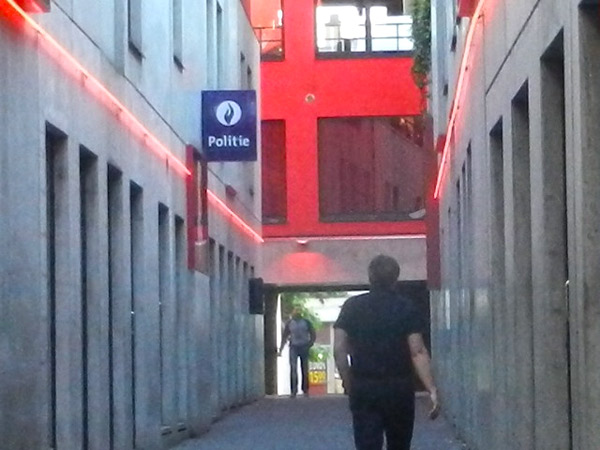
Red Light Antwerp — Just a Trip to the Mall
Many American tourists find Europe’s red light districts titillating. There was a time when ladies of the night were loitering around train stations and on the wrong side of the tracks in every sizable city. With stricter law enforcement, modern affluence, and the advent of easy access to porn on the Internet, the tourist rarely sees prostitutes on the street in Europe anymore. In many countries, brothels are allowed and limited to a certain zone. Amsterdam’s Red Light District is shrinking, as city officials are not renewing leases to red light landlords — or are giving them to other, more preferred businesses. Ports (like Hamburg and Amsterdam) are known for their red lights. The most impressive I’ve seen is in Antwerp. About four city blocks are pedestrianized and feel almost like a shopping mall. Here you can see the police station parked right in the middle of all that glowing red. I did notice that, while Antwerp has the biggest and slickest red light district, unlike other big cities, it has almost no sleaze elsewhere in town. In a sense, they cleaned the city up by sweeping it all into a small pile.