Dinner with Franklin

Enlarge photo

I love the way Italians enjoy their food. After visiting all my recommended restaurants in Verona, I sat down at my favorite place, Enoteca Can Grande, with my friend and guide, Franklin. We let the chef, Giuliano, bring us whatever he wanted. Franklin’s a local. He knows the cuisine. And just to see Franklin swoon over the food made the evening even better than the impact of Giuliano’s fine food and wine. Here are a few of Franklin’s comments as the food came and we ate (perhaps some a bit impolite, but all from the stomach end of the heart):

With the first of many small plates, Franklin is delighted. “Raw Piedmont beef, carne cruda. It is like seeing the smile of a beautiful woman after ten years. You never forget her.”

I ask, “Sublime is an Italian word, no?” He says, “Yes, soo-blee-may…this is sublime.” The wine is Amarone della Valpolicella. It is sublime.

Giuliano brings a plate of various cold cuts — glistening in a way that lets you know it’s nothing but the best — and we ponder: If you had to choose between salami and cheese in life, which would you choose? Both agree that it would be a terrible choice…but cheese. Then we nibble the mortadella with truffle, and it complicates the matter. Mortadella is the local baloney — not a high-end meat. But with the black truffle, it’s exquisite. Imagine calling spam exquisite…just add truffle.

And if you had to choose between white and red wine? Franklin says, “I used to smoke, and I compared white wine and red like cigarettes and a good Cuban cigar. And I enjoyed my Cuban cigars.” Then he gets distracted by the herb decorating the next little mozzarella dish. After tasting a sprig, he says, “Yes, fresh… It’s normally served dried. The chef is a genius, brilliant with mozzarella.”

Then comes the best polenta I’ve ever tasted. Italian cuisine is like a religion — and it’s the quality of the ingredients that’s most sacred. Polenta comes in varieties, like white bread and whole-grain bread. This is the darker polenta integrale, using the entire corn. And it comes with anchovies. Anchovies and polenta go together…a good marriage. It’s the simple things — the anchovies, the olive oil, the polenta integrale, and the proper matching of flavors — that can bring the most joy at the table.

Noticing how Franklin polishes every plate, I say, “You even eat the speckles.” He says, “Yes, I would feel like a sinner not to.” And, sipping his wine, he adds, “And to not finish the Amarone — Dante would have to create a new place in hell. Mortal sin.”

Then comes the pumpkin ravioli. I hold the warm and happy tire of my full tummy and say, “Basta.” Giovanni, looking at my Amarone, realizes we need another bottle. He warns us, “Next I bring you a small cheese course.”

Franklin says, “I’m not so religious, but for this cheese, with Amarone, I fall on my knees.” I agree, saying, “In cheese we trust.” He compliments my economy of words and repeats, “Yes, in cheese we trust.” I say, “This cheese plate takes dessert to new heights.” Franklin, playing with the voluptuous little slices, says, “Even if we do not talk, with these cheeses we have a good conversation.”

I support my happy head with my hand as Franklin pours the last of our second bottle into my glass and we move into the parmesan and the gorgonzola. Franklin, taking the last dribble into his glass, says, “If this was my only wine, I could be monogamous.”

It occurs to me we must have tasted thirty different ingredients — all of them top-quality and in harmonious combinations. Franklin again marvels at how the chef was creative and unpredictable without garish combinations — no gorgonzola ice cream.

Giuliano asks if I’d like anything else. I ask, “Dov’è il letto?” Franklin agrees and says, “Yes, a good restaurant should come with a bed.”

Venice: Where Stuck Is a Blessing

Being in Venice with Europe’s airports shut down is like the art/cuisine/history equivalent of being snowed in at the cabin. The city is filled with two kinds of travelers — those who weren’t flying anywhere anyway, and those stuck. And those stuck are of two sorts — those anxious and upset, and those resigned to the fact that there’s nothing they can do about it…and are thankful that at least they’re in a great place to be stuck.

Imagine the clumsy flip-flopping going on, with all the people without hotel reservations who are stuck here filling in rooms for people with reservations who are not showing up. The train station was mobbed with poor souls waiting to buy tickets somewhere — long lines that hardly moved.

I’m having such fun here, and such a rich research experience, that I still shudder to think I missed being stuck in London by less than a day when I flew out just before the Iceland eruption.

I’ve met lots of Americans on the streets here. I enjoy reminding them that if they make the most of this opportunity to make their predicament a blessing, in five years they’ll remember the eruption as the reason they had such a great experience in Venice.

I spent my first two full days here not laying eyes on St. Mark’s Square. It’s the back lanes where this enchanting city is most enchanting. Today I needed to go to the place where the causeway from the mainland hits the island to check out the parking garage situation and see the new “People Mover” monorail (which opens this week and will shuttle people from the big car park to Piazza Roma). The traffic on Piazza Roma hit me like a big fart. As I dodged traffic on Piazza Roma, the contrast hit me. I realized what a charming world the Venetians enjoy, with no traffic noise and completely owning their byways as pedestrians.

I’ve spent three days pounding what must be my favorite pavement in Europe. Guides are sharing insights: Donkey meat sausage, asino, is a local treat. A many-generations-old sign cut into the fish market wall reminds merchants that sardines must be 7 centimeters long and Peocio (mussels) must be 3 cm long. Then someone graffitied Il Mio 3.7 cm (I’m sure it’s a rude joke, but I’m not that good with metric to know). Benetton just purchased the huge post office fronting the Grand Canal near the Rialto Bridge and will turn it into some kind of shopping mall.

There are now too many hotels in Venice, and prices are going down. With big hotels having to deeply discount rooms with Web booking services, most of my recommended hotels are lowering their guidebook prices for 2011. But prices are actually meaningless because things will fluctuate with demand, and demand is so unpredictable these days. While in the past I was quite exacting on getting the price, now I’m getting a ballpark price and encouraging travelers to email several and see who’s giving the best deals.

There’s a new “historic play” in town called the Venice Show. My hunch was that it was cheesy, but I needed to see some of it (as it’s heavily advertised, and hotels will push anything that nets them a kickback) to give it a yea or nay in my guidebook. My guide friend and I talked the girl at the desk into letting us pop in free for a bit of the $50 performance. She asked the woman who owned the show for permission, and she said in Italian (not knowing my friend spoke it), “I hope they’re not trying to screw us.” Not letting that sway my critique of the show, we watched half an hour of it and left thinking that it is she (with such lofty promotions) who is trying to screw tourists out of $50 for 80 miserable minutes of cheesy theater.

The buzz among music-loving travelers here is that the €25 Baroque music concerts performed by musicians in black-and-white suits (Intrepreti Veneziani is the best ensemble) are great — and those performed by musicians in powdered wigs and leotards are more spectacle.

My work highlight so far in Venice has been trying out two of my audio tours. I got out my iPhone and let myself guide me down the Grand Canal and through the Frari Church. Each tour worked perfectly — better than I dared to hope. In fact, sitting on the front seat of the vaporetto enjoying the narration of the palaces floating by was a delight. (It reminded me of how I used to commandeer the front view seats of the same slow boat down the Grand Canal back in the 1970s as a young tour guide and bark out a cruder version of that same narration to my groups.) And it was also a treat to jump off the boat to tour the Frari Church — so rich in art still exactly where those Venetian artistic superstars designed it to be enjoyed centuries ago — and enjoy it for my first time without needing to read from a guidebook.

In the Frari, I met a couple from California with iPhone buds and me in their ears, too. They had used my audio tours in Rome, Florence, and now here, and reported they worked great. Considering that we just released eight new tours (for Rome and London), I’m relieved the vision of these free tours being a big help to travelers is now a reality.

My new taste treat: Sgroppino, a traditional Venetian drink of squeezed lemon juice, lemon gelato, and vodka designed to finish off a meal. I hope all the people stuck in this town can find a new favorite local drink. And I hope those at home with trips threatened have happy news in the coming days.

Barefoot in Venice

Enlarge photo

It’s 1:00 in the morning. I’m in Venice and I’m a bit drunk. I feel like talking, but since there’s no one here but me in this room, I’ll blog. Yesterday I was in London. Today I researched the Venetian Lagoon (Murano and Burano) and spent the evening updating a dozen or so of my guidebook’s restaurant listings. In London, I spend my evenings visiting restaurants, then grab a sandwich and go home. In Venice, I spend my evenings visiting restaurants, then return to my favorite for a 10 p.m. dinner. This dining derby is my nightly ritual in Italy. When Pino, who runs the Antica Sacrestia, asked me how I like my wine, I said, “Complicato” — and he served up his house Amarone. I drank it like a monkey climbs a tree. Just when the branches were getting pretty bendy, he capped the meal with a glass of Sgroppino (a local cocktail specialty of squeezed lemon juice, lemon gelato, and vodka). “Sgroppino” comes from the Italian word for “to clean” (as in your palate).

One of my favorite Venetian guides (Michael from Venicescapes) spent the evening with me visiting eateries in two neighborhoods. We found a few to add to my book, and cut out far more. I’ve been cutting lots of places lately, determined to find truly unique eateries for my guidebook. Michael asked me what the standard was. I acknowledged it was a bit arbitrary but, beyond the obvious location and value concerns, I want a place that’s personality-driven, with a staff that will likely be there year after year. The place should have roots in the neighborhood, respect the local cuisine, and be accessible to travelers.

We spent most of the dinner talking about Venetian connections with the Reformation. More than “saved by grace” alone, there was plenty of economics and politics. (According to Michael, before the Reformation, the Vatican States had the lowest tax rates in Europe. After the Reformation — as German tithers could no longer be counted on to subsidize the Papal States — the Pope’s domain became the most highly taxed part of Europe.) It’s the theme of one of his new tours.

Finally, a couple from Austin sitting a few tables away came by to say hello. It turns out they are staying at Hotel Campiello — the place I wanted to stay, but (in part, due to them) was booked out this week. They shared their experience with my guidebook and explained how they were fascinated by our conversation. The result: Michael just got a job. He’ll meet them at 8:45 tomorrow morning at their hotel for a $275, six-hour historic Venice walk.

When you know where to look, there’s so much to see in Venice. An inverted corner of a beautiful church had an ugly iron fence cutting across it. Why? So people won’t pee there. In Gothic times, the architect couldn’t have imagined someone would urinate against the corner of his church. But this is a different age. Later we were walking on an unusually wide street. Oh…a filled-in canal.

Earlier today, on the island of Burano (famous for humble fishermen’s homes and squinting lace-makers), I noticed how the pastel colors of the homes are getting more and more vibrant. The place is just darling (an adjective I’ve never used to describe a town before).

In Burano, the rising sea forced the raising of the canal-side pavement. I could see a strip of fresh bricks above the water line. Some houses had a new step added from the sidewalk down to their door, while others just had a shorter door. Houses that could be made higher just got their ground floors raised — leaving them with shorter ceilings. Those that couldn’t were more susceptible to floods and stayed just as high, but now had a step down. St. Mark’s Square is about to have its pavement raised for the third time in history.

Last night, I flew out of Heathrow Airport. At dinner tonight, I learned Heathrow is closed today with the eruption in Iceland. Travel is like that. I’m giddy here in Venice.

After a sunny week in London, I landed last night here in a thunderstorm. Riding the boat from the airport through the dark lagoon into Venice, I hurriedly typed up the last of my London notes. Stepping ashore at Fondamenta Nuove, I noticed everything seemed particularly vivid in this beautifully decrepit cityscape: Pilings rotten at the waterline. Funeral boats with the iron casket rack on wheels lashed to the center of the hull. Chandeliers lighting top-floor ceiling frescoes of private mansions that would go unseen during the sunlit day. The white marble inlay that made the edge of the stairs over the bridges pop.

Once in my hotel room, my bare feet were greeted by the speckled “Venetian pavement” — that characteristic floor made of a broken hodgepodge of marble fragments, then polished. While some might mistake it for cheap linoleum, it’s far from that — it’s treasured here, and quite expensive. It flexes with the settling of the buildings…so costly to maintain, but so characteristic. My feet connected with the flooring in a way my feet have never before connected with flooring…happily grounding me with Venice.

Europeans Share Their Healthcare Experience, Part 3: Italy

To bring some diverse experience into the discussion on health care reform here in the USA, I’ve asked my friends in Europe to share how health care works in their lives. In this third of four entries, here are comments from my Italian friends:

From Susanna in Italy:

The system in Italy is faaaaar from being perfect, but the idea behind it is the right one: Everybody has the right to have health care — it’s really one of those things that makes a democracy, a real democracy.

In Italy, I pay for the national health care system through taxes. The rate depends how much you make per year (there are income brackets to determine how much you are going to pay). Recently, the government decided to ask for a payment for examinations or medicines (we call it a “ticket,” in America you call it a “co-pay”). There are some categories — such as retired people with low income, people with chronic diseases, and the unemployed — who don’t have to pay.

What I really dislike about the system is the long lines to get appointments for any kind of tests (from basic to more complex). It depends on the region, but it’s a problem all over the country.

Italy is a country of paradoxes. We have, on one side, excellent doctors with incredible training, and, on the other side, we have “scandals” involving important Italian hospitals in which the hygienic conditions are poor and dangerous. The other problem is that Italy has an “aging” population. We have fewer people working to support the retired population, which is living longer and longer. Because of that, health care costs to our society as a whole have gone way up, while tax revenue has not.

Overall, I’m satisfied with the system, but it must be said that I’m in good health. When my father had cancer and later died from it, I have to say that we were so lucky to meet such fantastic people (doctors, nurses, and volunteers) that it made this traumatic experience less severe. Moneywise, we didn’t have to pay a penny for all the treatments he went through.

From Donald in Italy:

The Italian health system has the usual diversity of standards from north to south. In my tour guiding over the years, I have assured dubious tourists in Sicily that the hospital we were in was perfectly competent (whilst hoping they did not notice the crunch of the cockroach I had just stealthily stood on). But I have also been hospitalized in an institution in the Italian Alps where I was given a private room with balcony and mountain view, four-star meals with my choice of dishes, and treated with medical equipment worth thousands — all on national health. In the end, I would rather have national health care than be without it.

In Italy, you have to know how to work the system. A few years ago, I was spending a fortune at a private optician in Milan, who kept trying to convince me to have laser surgery costing thousands of euros per eye. I didn’t have much confidence in him, so I did the Italian thing — I talked to everyone I knew until I found a friend of a friend who knew a brilliant Russian optician working nearby. A couple of phone calls and a couple of days later, I found myself in the Russian’s office where, in half an hour, I was given excellent, unbiased, and free advice about laser surgery and a prescription for contacts and glasses. When in Rome…

I know critics will say that there is less inefficiency in a private system. Would the critics of nationalized medicine advocate the privatization of other government departments such as the ministry of defense? Might that not lead to a series of business-driven wars being fought…ooops! Call me naive, but I would rather support a country which spends more money on inefficiently curing its citizens rather than on inefficiently destroying its perceived enemies.

From Nina in Italy:

I have dual citizenship and have lived abroad for 13 years. I have experienced health care systems in the US and Italy. For me, one particular misconception about the US system is the notion of choice. It seems to be a topic that elicits such strong emotions. In the US, we are led to believe that buying into a private insurance plan means that as consumers we have more choices. In reality, the choice of care is never ours, and not even left to our doctors to decide. More often than not, it is insurance companies that decide when, where, and for how long we can receive treatment.

Here in Italy, everyone has access to a government-run system that is funded through taxes, with some private alternatives for those who want to or can afford to go beyond our public service. Health care decisions are not made by someone worried about making a profit. Even the language we use to discuss health care in America (patients are “consumers”) echoes the fact that in the US we rely on a system meant to generate profits — whereas in Italy health care is viewed as every person’s right.

It seems impossible to me that a country as wealthy as the US cannot find a way to guarantee access to health care for everyone. There are so many ways to cut costs, including eliminating all of the frills. In the US, when you walk into a hospital or doctor’s office, you are greeted by a nice reception area with art on the walls, plants, matching chairs, etc. In Italy the paint may be peeling off the walls, and the chairs in the waiting room may not be the most comfortable — but the care you get is good and thorough.

Photos Help Tell the Story

Wrapping up a great trip, a few photos add to the story. Note also a number of photos added to entries over the last two months.

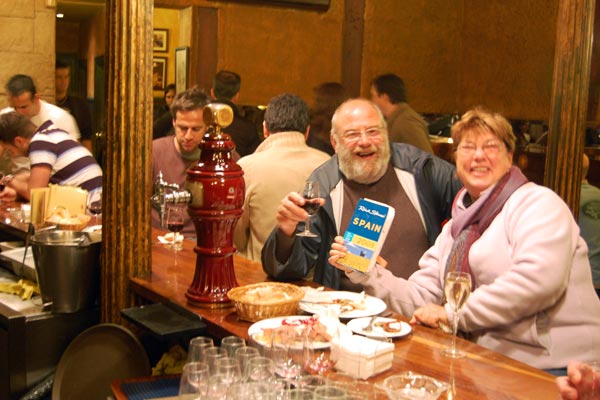
Travelers enjoying tapas and their guidebook. When blitzing tapas bars in Madrid’s best neighborhoods, it’s fun to find happy travelers putting their guidebook to good use.
Enlarge photo

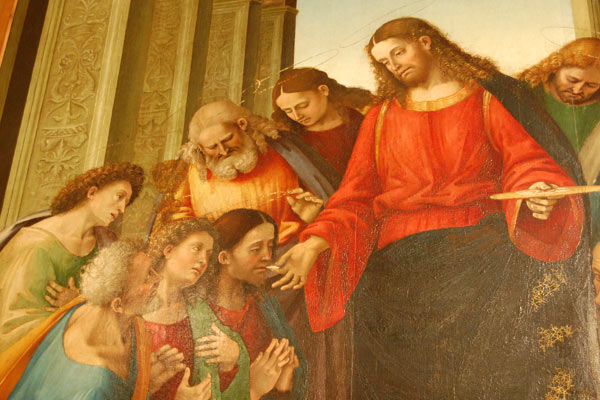
An amazing painting in Cortona.
Enlarge photo

Bright-eyed and bushy-tailed, I open the shutters and greet a new day in Volterra. In a week I meet the TV crew…
Enlarge photo

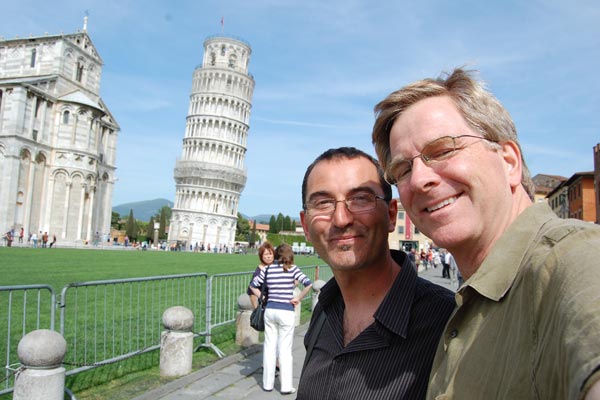
Dottore Vincenzo Riolo in Pisa taught me volumes about his town and is one of many excellent new local guides I met and will recommend in my guidebooks.
Enlarge photo

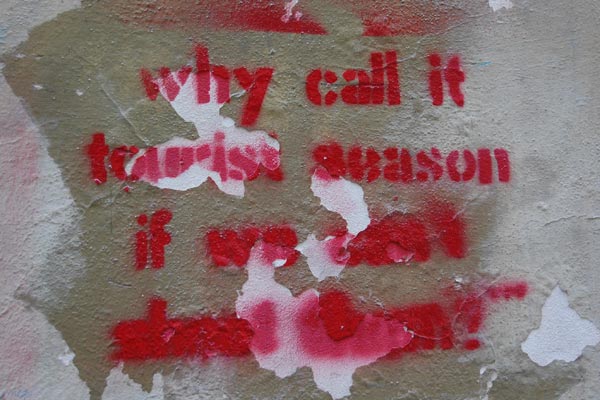
Why call it tourist season if we can’t shoot them? A scary welcome in Florence’s Oltrarno district.
Enlarge photo

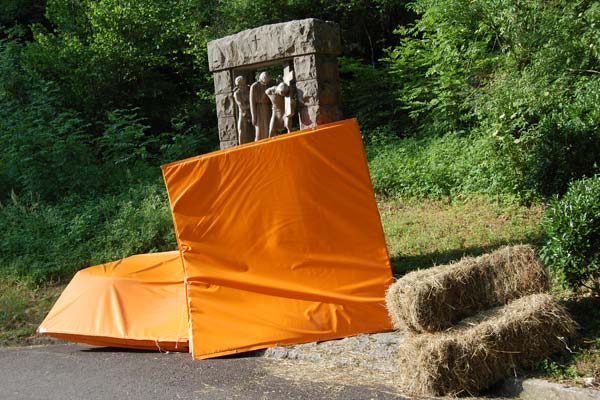
Station of the Cross, padded for protection, along the route of a bike race in Slovenia.
Enlarge photo

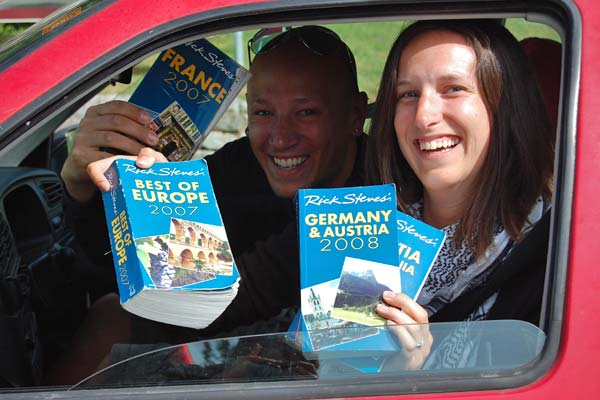
Happy road trippers with favorite guidebooks in Slovenia.
Enlarge photo

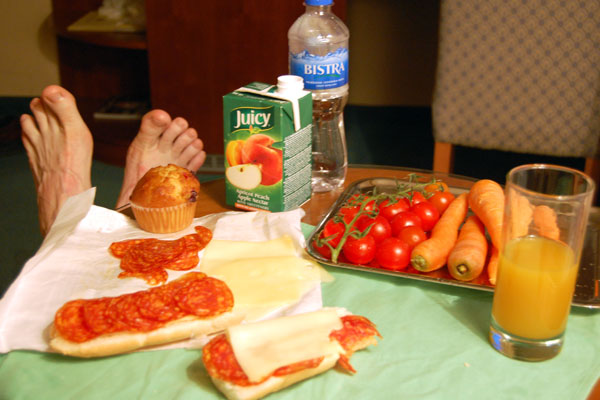
Cheap and delicious picnic, relaxing in my Zagreb hotel room.
Enlarge photo

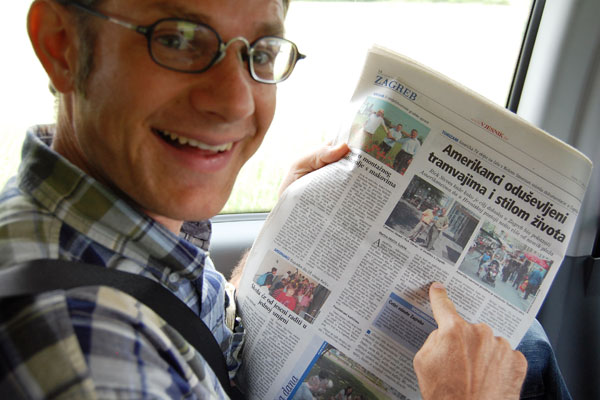
Cameron Hewitt (co-author of our Croatia & Slovenia guidebook) reads about himself, me, and our American film crew in a Zagreb newspaper. I guess an American film crew in Zagreb is newsworthy.
Enlarge photo

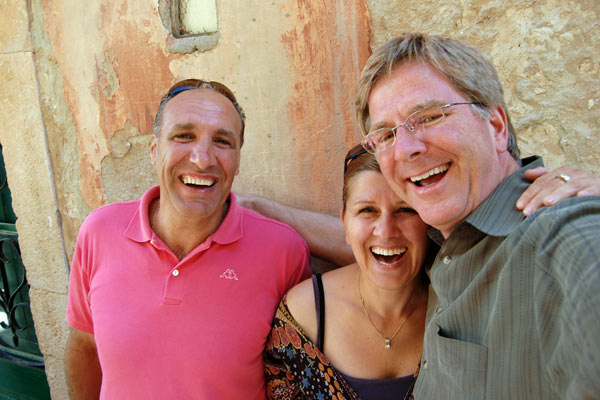
Croatian B&B hosts—clicking with new friends in Korcula.
Enlarge photo

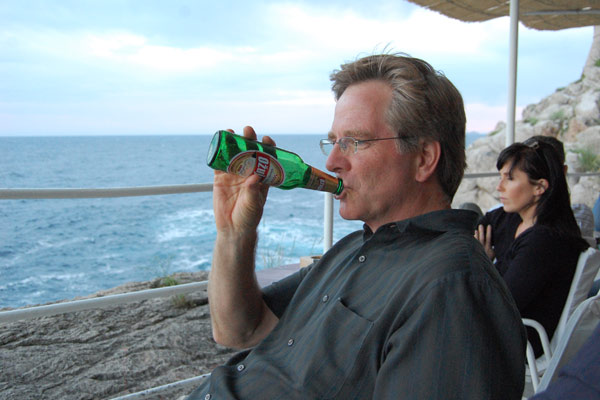
Day #70…Trip over, one last beer to enjoy a Dubrovnik vista and celebrate a smooth and productive trip before flying home.
Enlarge photo