Mama’s Boys in Venice

Enlarge photo

To commemorate the Smithsonian Presents Travels with Rick Steves magazine — now on sale online, and at newsstands nationwide — Rick is blogging about the 20 top destinations featured in that issue. One of those destinations is Venice.

The challenge when visiting Venice is to see a community beyond the “adult Disneyland” quality of the experience for most tourists. If you know where to look, it’s not hard. Whether in the practical issues of actually living here, or in the unique characteristics of the people who make up the Venetian community, the city is more than postcard views and old buildings.

The cheapest place to moor your boat in Venice is a place without easy access. Boat owners climb along walls above canals like Italian cat-men to get to their private boats — the vessels that give them a parallel world apart from the tourist bustle.

If you’re excited about witnessing a high tide in Venice, be warned — the high waters bring out the elevated walkways and some fun memories…but they also force the city’s huge rats out of their secluded dens and into the open.

Handy signs on building corners let anyone who simply looks up know where they’re going, anywhere in town. But keep in mind that locals aren’t above using these signs to direct traffic to the seemingly logical route, while those in the know can get around quicker by unsigned, less congested alternate routes.

While Italian men in general can be mammoni (mamma’s boys), reluctant to leave the nest — to cut the cordone ombelicale (umbilical cord of a mama to cook and wash for them) — Venetians take this trait to unrivaled heights. Many men stay at home until their thirties. They leave only when they marry and are able to have another woman steer them through life.

I was talking with my Venetian friends, Antonella and Piero, over a glass of wine. The topic of conversation: macho and mammoni in Venice. I was impressed by the strong feelings Antonella had about the matter.

“What is macho?” she says. “There are no macho men in Venice. They are mama’s boys. We call this mammoni.”

Piero, as if he’s heard the complaint a thousand times, cries, “Ahhh, mammoni.” Pulling an imaginary cord from his belly and petting it rather than cutting it, he says, “It is true. I cannot cut the cordone ombelicale. I love my mama. And she loves me even more.”

Antonella says, “The Italian boys, 95 percent stay at home until they find a wife to be their new mother. Thirty, thirty-five years old, they are still with their mothers. Even if they move out, they come home for the cooking and laundry. This is not macho…this is ridiculous. ”

“Aaan-duh,” she continues, lighting a cigarette, “they want a wife exactly like their mother. If they find a woman like me, independent, with some money, perhaps beautiful, this is a problem.”

Piero nods like a scolded puppy. “Yes, this is true.”

Antonella says, “If I make my hair special and wear strong makeup, they will take me to dinner and take me to bed. But they will not look at me to make a family. They want to be sure their wife won’t leave them. A woman like me…it is too risky.”

Vernazza: Barnacles, Lorenzo, and a Scraggly Vagabond

To commemorate the Smithsonian Presents Travels with Rick Steves magazine — now on sale online, and at newsstands nationwide — Rick is blogging about the 20 top destinations featured in that issue. One of those destinations is the Cinque Terre, on Italy’s Riviera.

When I first described and recommended Italy’s Cinque Terre in the late 1970s, there was almost no tourism here. The economy was sluggish…and so were the people. Sitting in doorways seemed to be a major pastime. Menus were humble and in one language. I remember local wine sold in bottles without labels — very cheap and not very good. (And back then, “very cheap and not very good” was just fine with me.) It was a world apart, where few spoke English and the American traveler was rare. Its remoteness was the foundation of its poverty.

Today its remoteness is a draw. The five (cinque) towns are affluent, and the region is a national park. Now it seems to be on the itinerary of almost every tourist in Italy. Fancy restaurants abound, as do boutique hotels. There’s a fascinating metabolism here — because of the prime location, tourism brings locals their livelihood as reliably as the tides bring nourishment to barnacles.

Many Cinque Terre seniors who can afford to live elsewhere, do. They see the rustic nature of the towns as more of a negative than a positive. In fact, a big trend in the Cinque Terre is elderly apartment-owners moving into the big city for a more comfortable place to live out their golden years. They hire Eastern Europeans to manage their apartments, renting to tourists who arrive with each train.

On my first visit to the Cinque Terre town of Vernazza, I couldn’t afford a good restaurant meal. But I met a gentle restaurateur named Lorenzo. I’ll never forget how he looked at me, a scruffy backpacker who rarely was served a hot meal. Knowingly, he said, “Sit. You must be hungry. I’ll feed you.” I sat. And he did. Caring strangers I met in my vagabond days of travel, like Lorenzo, left a lasting impression on me. I think I see people more positively than I otherwise would have, if I had never been in need and never ventured far from home. In fact, perhaps being in need far from home is something more risk-averse people should let happen once in a while.

Shortly after my visit, Lorenzo died — in the prime of his life — a victim of cancer. For twenty years, his daughter Monica has been my best friend in Vernazza. When I look into her piercing eyes, I see Lorenzo’s compassion and love. And I’m happy to bring my groups to Monica’s family restaurant — to eat on the same castle-view perch I did back when Lorenzo wore all the hats in his little restaurant and fed scraggly vagabonds.

Every year, we need to update our guidebook listings on the five Riviera ports that make up the Cinque Terre. Because locals are so eager to get into our guidebook (considering all the business it brings), the Cinque Terre assignment can be a challenge. Like, I imagine, a boxer finds going 12 rounds exhilarating, I find it exhilarating to fend off the wanabees and collect the gems of the Cinque Terre worth recommending.

The powerful appeal of these five unique villages gives an intensity to everything about tourism here. Locals need to make their money (they shut down in the winter), travelers need to have the time of their lives, and I need to get it right for the guidebook. With my hectic research schedule and the busy lives of local chefs, one of my favorite moments is around 11 p.m., when both the chefs and I have finished our work for the day. They sit at bars with small tables facing the sea, having a strong drink and a cigarette. I take a slow walk without an agenda, no camera or notepad…just being in the Mediterranean town of my dreams. All of us are savoring the place we work to share with travelers…a little chunk of Europe that we love, season after season, as much as anyone.

Living with David

Enlarge photo

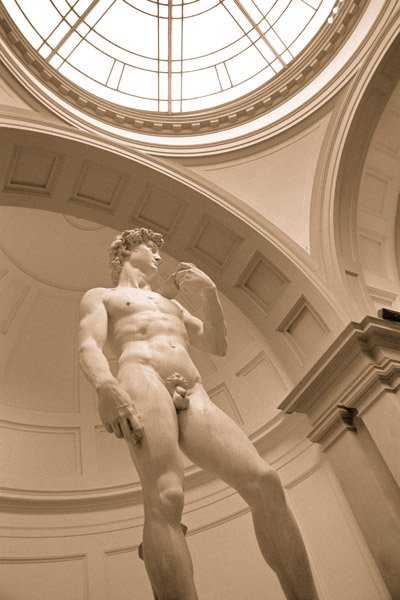
To commemorate the Smithsonian Presents Travels with Rick Steves magazine — now on sale online, and at newsstands nationwide — Rick is blogging about the 20 top destinations featured in that issue. One of those destinations is actually a work of art: Michelangelo’s David, in Florence.

Some people are not impressed by beauty. They can still enjoy art. I love the thought that art is more than beauty. It’s the closest thing to a time-tunnel experience we can have in our travels. Really. It can take you back. But only if you know the context in which it was created. Who paid for it and why? What was going on at the time? Was the artist just earning a paycheck, or did he have something to say? Were he and his patron in synch or at odds?

Of course, when you look into the eyes of Michelangelo’s David, you’re looking into the eyes of Renaissance Man. Sizing up the giant of medieval darkness, man at the turn of the 16th century had decided he could triumph and step into the modern age. It’s humanism, and it’s also local pride. Michelangelo sculpted David in a time when city-states were proud. Florentines were a particularly proud bunch. While the people of Siena might take a statue they believed brought them a plague, break it into bits, and bury it all around the city of Florence, people in Florence would urinate into the river as if they were peeing on Pisa — a rival town just downstream. David was an apt mascot for proud and confident Florence. God blessed David, enabling him to slay the much stronger giant. And God blessed Florence, enabling it to rise above its crude city-state neighbors.

Other art also takes you traveling and takes you back. Albrecht Dürer’s Self-Portrait, the first of its kind, is of a proud dandy — a cultural leader who deserved respect and good pay. He had just traveled to Italy, where painters were better respected than in his homeland Germany, and where they were given more esteem and more money.

Vincent van Gogh’s Potato Eaters takes you to a humble home of a farm family in 1885 in Belgium. Five salt-of-the-earth peasants with bony fingers share a lamp and a plate of potatoes. Van Gogh knew these people. Before being a painter, he tried to be a pastor. He lived, worked, and clearly empathized with poor miners and farmers. He cared about their lot in life, portraying them gnarled and ugly…but noble at the same time. And with this painting, his first masterpiece, he takes us there.

A helpful mindset when enjoying art in your travels is to imagine the reality of the artist and of the people for whom the art was created. If they had never seen a photograph, a movie, or never traveled. If they believed that God threw lightning bolts when he was angry. If they thought women were evil, Caesar was God, or pewter goblets represented the good life. Munch’s Scream doesn’t just scream. It screams for a reason.

Rome by Night

To commemorate the Smithsonian Presents Travels with Rick Steves magazine — now on sale online, and at newsstands nationwide — Rick is blogging about the 20 top destinations featured in that issue. One of those destinations is Rome after dark.

Once you’ve been out on the town in Rome after dark, going out for the evening in a big American city is never quite the same. Rome has a few fast-food joints, but they’re held at bay by a stony cityscape that celebrates slow food instead. Waiters have worked so long together that they seem to communicate on their own frequency as they scurry their dishes back and forth. Scruffy boys selling single roses circulate among sidewalk tables, testing a wary truce they’ve worked out with the restaurateur — and finessing sales pitches that almost add charm to the ambience. Cars are lodged sloppily on curbs, and black-and-white notices announcing the newly dead are pasted haphazardly to walls.

Each slice of downtown Rome changes throughout the day and evening. What might be a tiny vegetable market in the day (Monet painting) becomes a destination for dressy couples going out to eat in the evening (how do her high heels work on the cobbles?)…and then, late at night, an edgy gathering place for those who ate at home and are now all about drinking. Squares enlivened by fountains shine after dark. While the architect who designed those Baroque fountains had no inkling of electronic illumination, the fountains seem made-to-order for thoughtful floodlighting.

Back in 1999, I went to Rome ready to make a TV episode entitled “The Best of the Eternal City.” But as the millennium approached, the best of the Eternal City was all still under scaffolding. I was traumatized. I remember sitting down with my producer and cameraman at the hotel’s breakfast table and exploring our options. Half the visual icons of the city were marred by scaffolding. Not only would the show be ugly if we shot it as planned; but by the time it aired, all the scaffolding would be down, and the famous sights would be better-looking than ever — and just perfect for a TV crew like ours.

We considered going home; heading for Sicily to film a program there; or rewriting the script to give Rome a new angle. I had never done this before (and I hope to never do it again), but we decided to salvage something out of Rome and come up with a new script. The show was called “Rome: Baroque, After Dark,” and shooting the city after dark turned out to be a delight. Rather than arenas and temples, we enjoyed convivial piazzas with kids who kick soccer balls until midnight, hand gestures that mean “absolutely delicious,” and men fawning over their neighbors’ Vespas.

The shoot worked out fine. And two years later, in the next millennium, we came back and shot the show we had intended to shoot in 1999. The scaffolding was all down, and the Eternal City was spiffed up fit for a caesar.

Dinner with Franklin, Part 2: Italy’s Violent Love of Tomatoes

Enlarge photo

Enlarge photo

I like eating in a tiny restaurant because you have contact with the chef. It’s like talking to your masseuse as she works. After a day of sightseeing, I sit down to my favorite enoteca in Verona with Franklin, my guide. Our chef consults with us, and we encourage him to bring us whatever he’s most excited about today. Pleased with the freedom to dazzle us, he goes to work.

Just after the antipasti arrive, Franklin’s wife calls and says, “Don’t eat too much cheese or dessert.” Franklin, who’s not thin, surveys our table and considers enjoying with anything less than abandon the enticing parade of food that has just begun. Then he sighs and tells me, “Many people live their entire lives and they do not have this experience.” I say, “That’s a pity.” He says, “Yes. It’s like a man being born and being surrounded by beautiful women, and never making the love.”

I love the way Italians live life with abandon — and how they enjoy their food. As we eat and drink, Franklin opens up about his passion for good eating. He says, “In Italy, you don’t need to be high class to appreciate high culture, cuisine, opera. It’s the only culture I know like this. Here, a heart surgeon talks with a carpenter about cuisine.”

And, as guides tend to do — especially after a little wine — along with the commentary on cuisine, he mixes in culture, history, and politics. I find myself scribbling notes on the paper tablecloth.

Franklin is frustrated with how Italy’s north subsidizes the south. He complains that the south is “corrupt, inefficient, lazy, no organization.” I remind him, “They say here in Veneto, Lombardi, and the north, you are like the Germans of Italy.” He says, “Even today, the south still has its organized crime. With Fascism, the Camorra went to the USA. Mussolini had zero tolerance. And he got things done. That’s one reason why he was popular. And one reason why Mussolini is still popular. Then, after World War II, rather than tolerate communism, the government allowed the Camorra to re-establish itself in Italy.”

I ask him if he enjoyed The Godfather. Franklin says, “I watched The Godfather with a certain pride because of the importance of food in that movie. Especially the scenes with tomatoes. Marlon Brando watched tomatoes ripen. When he said something like, ‘Become red, you bastards,’ to the yellow tomatoes, that took me back to Sicily and the home of my father.”

Our conversation drifts to how modern societies mirror their ancient predecessors — or don’t. Comparing this historic continuity — ancient and today — of Rome, Greece, and Egypt, we agree the biggest difference is Egypt, a relatively ramshackle society that feels a far cry from the grandiosity of the pharaohs and pyramids. Greece, which wrote the ancient book on aesthetics, developed an unfortunate appetite in modern times for poorly planned concrete sprawl. But Rome has the most continuity. Today’s Romans, like their ancient ancestors, are still passionate about wine, food, and the conviviality offered by the public square.

Our chef, Giuliano, comes by, and I compliment him. He recalls my last visit, saying I sat at the same table. I’m always impressed by how people who care remember their clients. He serves thousands of people. Two years later, I come by, and he still knows just where I sat. It’s the same in hotels. I don’t remember which room I slept in last time, but so often the proprietor greets me saying, “I put you in your room…number 510.”

On my last visit to Milano, three years ago, I got a haircut. I remember really enjoying my barber. I needed a haircut on this visit, too, so I walked vaguely in the direction where I thought his shop was. Not sure whether I’d found the right place, I popped in on a barber. It seemed like the one, but I really didn’t know. Ten minutes into my haircut, the barber — having gotten to know my hair — realized he knew my hair and asked me if I hadn’t been here before. He had a tactile memory not of me…but of a head of hair he cut that happened to be mine.

I have a feeling Giuliano will remember my seat the next time I drop into Verona’s Enoteca Can Grande. And I’ll remember to invite my friend Franklin.