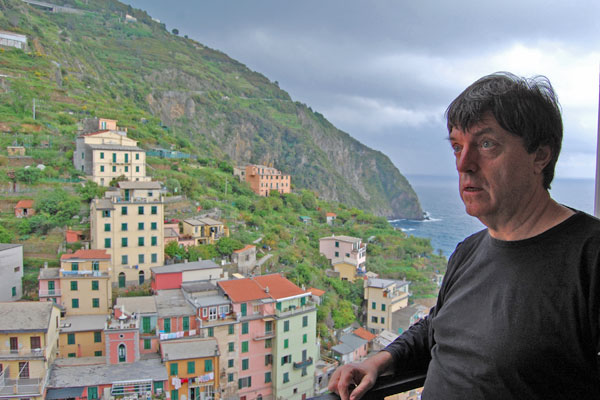
Discovered Vernazza — Conniving to Get into a Guidebook

The Cinque Terre ‘ a string of five remote and ramshackle port villages along Italy’s Riviera ‘ was once an undiscovered paradise. It’s still a paradise, but these days you can only call it “undiscovered” in a relative sense ‘ compared to, say, Venice. And I suppose it’s partly my fault. When I first described and recommended Italy’s Cinque Terre in the late 1970s, there was almost no tourism there. Now it seems to be on the list of almost every Italy-bound tourist.

Going from “sleepy” to “popular” changes a place, and every year we need to update our guidebook listings in the Cinque Terre. This is one gig my researchers don’t enjoy. They prefer leaving this region to me. Locals are too aggressive and scheme to get into the book. They orchestrate email campaigns to fake positive feedback. And, I assume, they create negative feedback about their competition.

When I drop someone’s listing from the book, they’re dark and brooding to me the next year. Others camp out at the station, asking me, “Why you don’t put me in your book?” One year, all the B&B owners wanted in. Then the notoriety of being in a guidebook became a red flag to the local tax police, and the next year those same B&B hosts ‘ or at least the tax cheats among them ‘ insisted on being taken out.

My friend Sergio, who seems to be more urbane and modern than most Cinque Terre locals, is my research “bodyguard” for my three-day visits. It’s when his cell phone rings like never before as people figure they must go through Sergio to get to me. He says, “Suddenly my enemies become my friends.” People hang out in front of a hotel I may be visiting, then when I exit, they just happen to be passing by. They say, “Buon giorno,” make their pitch, and give me a business card.

Troubled by reports from my readers that my recommended B&Bs were price gouging in busy times, I’ve struggled to impose some order. One year, I tried to establish the “Nuova Etica” (“New Ethic” in Italian). I would (with Sergio’s translating help) explain to B&B owners that they must charge no more than what’s listed in the book. I promised to encourage readers to report on any B&B host that gouged them. The owners would agree to my plan ‘ but this is Italy. The next season, all of their rates went up, and I really couldn’t drop them all. For my latest edition, I’ve reluctantly dropped the notion of a new ethic and just encourage travelers to shop around for the best deal on a room.

Things are changing here. The big trend in the Cinque Terre is elderly apartment owners moving into the big city for a more comfortable place to live out their golden years. They hire Eastern Europeans to manage their Italian Riviera apartments, renting to tourists who come in with each train. There’s a fascinating tourism metabolism here: The train brings locals their livelihood as reliably as the tides bring nourishment to barnacles.

On my first visit to my favorite Cinque Terre town, Vernazza, I couldn’t afford a good restaurant meal. But I met a gentle restaurateur named Lorenzo. I’ll never forget how he said, “Sit. You must be hungry. I’ll feed you.” I did. And he did. He died of cancer shortly after my visit. For 20 years, his daughter Monica has been my best connection with Vernazza. She has Lorenzo’s same love in her piercing eyes. And I’m happy to bring my tour groups to her family restaurant.

I wish I could say the Cinque Terre is a restful stop for me but, when here, I’m just too excited with the research challenge to relax. Still, it’s perfect as a break in an intense vacation. In fact, for two decades, the Cinque Terre was the “vacation from our vacation” on our Best of Europe in 21 Days tour. Like a seventh-inning stretch, our tours arrived here around day 14, just after we’d hit the biggies (Venice, Florence, Rome) and were in the mood for no museums. After our break on the Riviera, we’d be energized to do the Alps and finish with a climax in Paris.

While I rarely enjoy a free day in the Cinque Terre, I do savor a leisure hour at the end of an intense day of research here. My favorite time is at about 11 p.m. Like me, the local chefs have been scrambling all day. Now that the last guest has left, we’ve both finally finished our work day. They sit at a bar with tables for one facing the sea, and have a strong drink and a cigarette. I take a slow walk without agenda, camera, or notepad, just being in the Mediterranean town of my dreams. All of us are savoring the place we work hard to share with travelers…a place that we love season after season, as much as any of its countless guests.

I hope that, on your next trip, you can enjoy my favorite stretch of Mediterranean coastline (and get a fair deal on a room while you’re there).

Vernazza: Barnacles, Lorenzo, and a Scraggly Vagabond

To commemorate the Smithsonian Presents Travels with Rick Steves magazine — now on sale online, and at newsstands nationwide — Rick is blogging about the 20 top destinations featured in that issue. One of those destinations is the Cinque Terre, on Italy’s Riviera.

When I first described and recommended Italy’s Cinque Terre in the late 1970s, there was almost no tourism here. The economy was sluggish…and so were the people. Sitting in doorways seemed to be a major pastime. Menus were humble and in one language. I remember local wine sold in bottles without labels — very cheap and not very good. (And back then, “very cheap and not very good” was just fine with me.) It was a world apart, where few spoke English and the American traveler was rare. Its remoteness was the foundation of its poverty.

Today its remoteness is a draw. The five (cinque) towns are affluent, and the region is a national park. Now it seems to be on the itinerary of almost every tourist in Italy. Fancy restaurants abound, as do boutique hotels. There’s a fascinating metabolism here — because of the prime location, tourism brings locals their livelihood as reliably as the tides bring nourishment to barnacles.

Many Cinque Terre seniors who can afford to live elsewhere, do. They see the rustic nature of the towns as more of a negative than a positive. In fact, a big trend in the Cinque Terre is elderly apartment-owners moving into the big city for a more comfortable place to live out their golden years. They hire Eastern Europeans to manage their apartments, renting to tourists who arrive with each train.

On my first visit to the Cinque Terre town of Vernazza, I couldn’t afford a good restaurant meal. But I met a gentle restaurateur named Lorenzo. I’ll never forget how he looked at me, a scruffy backpacker who rarely was served a hot meal. Knowingly, he said, “Sit. You must be hungry. I’ll feed you.” I sat. And he did. Caring strangers I met in my vagabond days of travel, like Lorenzo, left a lasting impression on me. I think I see people more positively than I otherwise would have, if I had never been in need and never ventured far from home. In fact, perhaps being in need far from home is something more risk-averse people should let happen once in a while.

Shortly after my visit, Lorenzo died — in the prime of his life — a victim of cancer. For twenty years, his daughter Monica has been my best friend in Vernazza. When I look into her piercing eyes, I see Lorenzo’s compassion and love. And I’m happy to bring my groups to Monica’s family restaurant — to eat on the same castle-view perch I did back when Lorenzo wore all the hats in his little restaurant and fed scraggly vagabonds.

Every year, we need to update our guidebook listings on the five Riviera ports that make up the Cinque Terre. Because locals are so eager to get into our guidebook (considering all the business it brings), the Cinque Terre assignment can be a challenge. Like, I imagine, a boxer finds going 12 rounds exhilarating, I find it exhilarating to fend off the wanabees and collect the gems of the Cinque Terre worth recommending.

The powerful appeal of these five unique villages gives an intensity to everything about tourism here. Locals need to make their money (they shut down in the winter), travelers need to have the time of their lives, and I need to get it right for the guidebook. With my hectic research schedule and the busy lives of local chefs, one of my favorite moments is around 11 p.m., when both the chefs and I have finished our work for the day. They sit at bars with small tables facing the sea, having a strong drink and a cigarette. I take a slow walk without an agenda, no camera or notepad…just being in the Mediterranean town of my dreams. All of us are savoring the place we work to share with travelers…a little chunk of Europe that we love, season after season, as much as anyone.

Euro Experiences from NW to SE — Part V

Let me stoke your travel dreams by sharing some of my favorite European experiences, roughly from northwest to southeast. Maximizing the experience is a dimension of smart budget travel that’s just as important in challenging times as saving money. Imagine these…

In Padua, Italy, sip wine with college students at an outdoor bar in the market square. Pour some fine olive oil on a dish, season with salt and pepper, rip a long strip from your bread, dip it, and bite. A student explained I was making the scarpetta — the little shoes. Soaking up the oil along with the conversation, we travelers become human scarpette,sopping up culture as we explore Europe.

Borrow a good knife from a friendly restaurant and hike from village to village through the terraced vineyards of Cinque Terre — Italy’s most exotic stretch of the Riviera coastline. Climbing through ancient terraces, surrounded by twinkling Mediterranean views and castle-studded villages, you’ll work up a thirst. Then, using a big leaf as a protective mitt, break off a spiny cactus fruit, peel it with your knife, and slurp it — sloppily savoring the sun and the fun as you explore the best of the Riviera.

When in Rome, drop by St. Peter’s early or late for a Mass at the high altar. With the alabaster starburst of the dove symbolizing the Holy Spirit before you, the greatest dome on earth rocketing above you, and the nearly 2,000-year-old tomb of St. Peter below you, eat the bread and drink the wine of the Eucharist with worshippers from around the globe. On the way out, kneel before Michelangelo’s Pietaand ponder what humankind can do for the glory of God.

In Bosnia, at the crest of Mostar’s single-arched bridge, survey the town that just over a decade ago was a killing field of sectarian strife. Take in the cityscape of crosses, spires, and minarets. Ponder the tragedy of Mostar’s recent past and the hope symbolized by the bridge upon which you stand — once bombed and now rebuilt. Then pay the kid in the bathing suit to make the dizzying jump from there into the river way, way below.

In Istanbul, wander away from anything of interest to a typical tourist, and find a convivial bar filled with Turkish men sipping tea and playing backgammon. Ideally, the bar has classic inlaid game boards — where their softer light wood is worn deeper than the harder dark wood, and stained with generations of laughter and smoke — and the players use handmade dice with unruly dots. Challenge a local to a game and gather a crowd. Learn to count in Turkish and holler the numbers as the dice are rolled. Bir, iki, üç, dört…Let the kibitzers move for you whenever you wonder which move is best. Expect to lose the game and gain a lifelong memory

Every corner of Europe offers magic moments like these to good travelers. Opportunities are rich and the stakes are high. Wherever you travel, meet the people, and understand the historic and cultural context of your sightseeing. Equip yourself with the best information and expect yourself to travel smart. Take the initiative not to just see your destination, but to experience it.

The Pharaoh’s Buying Out the Nudists and Freak Waves Kill Tourists

Enlarge photo
Enlarge photo

Sleeping on the train from Salerno to the Cinque Terre, I couldn’t stop thinking what a great job I’ve got: I was on a natural high after enjoying a wonderful guided tour of the Greek ruins at Paestum (which will be hugely helpful in next year’s edition of my Italy guidebook), and I was about to wake up on my favorite stretch of Mediterranean coastline.

One of the joys of running my own company is that I get to choose my research chores each year. This year (along with my TV production work) I get to update the guidebook chapters on all of Portugal (except the Algarve), Naples/Sorrento/Amalfi Coast, Cinque Terre, Munich/Bavaria/Tirol, Paris, Amsterdam/Haarlem, Brussels, Bruges, Edinburgh, York, Bath, and London.

While the Cinque Terre is a huge favorite for my staff, no one wants to update the Cinque Terre guidebook chapter because the people here are so aggressive about staying in, getting in, or getting back in to the book. Every two years I grab the assignment, and it’s about my favorite four days of the season.

And with each visit, I meet with the director of the Cinque Terre National Park, a man nicknamed “the Pharaoh” for his grandiose vision and heavy-handed effectiveness. When I refer to him in passing by his nickname to people of the region, they do a double-take as if they never expected to hear this insider’s term uttered by a foreign tourist.

After hiking to the top of Riomaggiore, I sat in the Pharaoh’s grandiose office. It’s littered with plans for park development, awards, and tourist promotion gadgets. He surveys me and I survey him, as we each matter to the other’s work. I explain to him that the region would enjoy more overnight visits (to the profit of struggling local seniors and the benefit of euro-stretching visitors) if the chaotic apartments-for-rent business were coordinated by village clearinghouses. He tells me of a school in the village of Corniglia that’s being renovated to house a big new hostel for 2009. I compliment the wonderful manager of the Manarola hostel. I complain of the ridiculous fines train conductors levy on innocent tourists who board a Cinque Terre train not knowing to sign their park transit passes first.

The Pharaoh takes me out onto his big balcony, and with a sweep of his hand, we survey his domain. Seeing a tourist lugging a backpack across the way, I shame him into promising that next year the park will provide a place for day-trippers to check bags for a more comfortable visit.

A big question for the region is the future of the Cinque Terre’s quirky nude Guvano Beach. The Pharaoh, like many locals, considers Guvano an embarrassment for the region. He said the park has the legal right of first refusal for the purchase of any land that goes up for sale, and they hope to buy the beach and end the nudity in 2009. Hiking the trail from Riomaggiore to the next town, I’m nagged by the difficulty I have believing that my son could have hiked the entire trail from town #1 to town #5 in just over an hour and a half (as he claims, and I recount in my book). With several hikers I meet making the case that this would need to be done at a steady run without any other hikers congesting the trail, I decide to take out the reference. But Andy insists it’s true.

With this visit, I reinstate my sentimental first-ever recommended pension in the region — Pension Sorriso. I stayed here on my first visit in the mid-1970s. It was one of the very few places to sleep back before tourism hit the region. I’ll never forget the place, run by a family of huge people who seemed to spin and fill the kitchen like gears spin and fill an old-fashioned wristwatch. Dinners were a beggar’s banquet of fresh fish and cheap white wine.

For 15 years, Pension Sorriso was the home of our tours in the Cinque Terre. Then, after a too-honest write-up in my guidebook, Sr. Sorriso’s wife decided to hate me. She hated me with a fiery venom like no one else in Europe hated me. In my favorite little magic wonderland in Europe, their place was a 20-meter stretch of lane I dreaded passing. We took our tour business elsewhere, and she demanded to have her hotel’s listing deleted from my guidebook.

Only after Sr. Sorriso died did I learn that for 20 years I was calling him Sorriso, when that word (which means “smile”) was simply the name of his hotel. For two decades I greeted him with a name that only I called him…and he just smiled.

Now their children — who are so cool they remind me of Sonny and Cher — run the hotel. I drop in (making sure I won’t encounter their mom) and we click. We share some old stories, make some agreements for how they’d welcome my readers, and bam — I list 19 more good budget rooms in my book ($125 to $155 per double with breakfast, www.pensionesorriso.com).

That night I enjoy Miky’s, my favorite Cinque Terre restaurant in Monterosso, and the town doctor drops by to meet me. He’s beloved for happily hopping on his one-speed bike — with a virtual doctor’s clinic in his bag — and making house calls. He suggests I make a warning to tourists that freak waves kill. (In 2007, an American woman was swept from the top of a rocky breakwater to her death by one such wave.) I normally resist filling my guidebooks with motherly advice: be careful on the breakwater; don’t be on the trails after dark; don’t trust strangers; and so on. But this tip goes in.

After one of the best dinners of my trip and a quick blitz of the nightspots in Monterosso, I stroll back along the harborfront promenade to my hotel. There’s one soul still out. It’s Miky, the owner/chef of Miky’s. Still wearing his little white chef’s hat, he’s enjoying a cigarette and sipping a White Russian. Both of us are capping an exhausting yet gratifying day of work.

Can I cook you a good fish?

I discovered many of my favorite “back doors” thirty years ago. Back in the 1970s, places like Hallstatt (south of Salzburg, the gem town on the gem lake in a region of Austria where lakes and Alps are shuffled together like a game of 52 card pick up) were truly “Back Doors” – untouristed. Today, many have become not only touristy…but economically addicted to tourism. I’ve noticed, more than ever, they appreciate the business my guidebooks generate. In Paris, the mayor of my favorite Rue Cler neighborhood threw me a party in the local palace – all the hoteliers, restaurateurs, and shop keepers were there…best macaroons ever. In the Cinque Terre this spring, I was hanging out on the Vernazza harbor-front listening to the town troubadour sing a folk song – not knowing I was in the lyrics. When my name came around he turned to me and cranked up the volume. In Reutte, just over the border from Bavaria’s fairy tale castle of Neuschwanstein, I was recently invited into the local knighthood. (You must be present to be knighted…so it’ll have to wait.) And yesterday, here in little Hallstatt, another of my headliner “discoveries,” my friend who runs a restaurant there welcomed me with Hallstatt’s standard “let me cook you a fish” greeting.

I sat under his wall full of big fish heads mounted like deer – gills spread like antlers. I stared at a tour group from Yokohama which filled a restaurant that once fed only locals. As the group headed out (they’ll be in Vienna in 4 hours), the waiter – in his ancient lederhosen – (which always remind me of a permanent wedgie) said “Japanese groups are very big this year.”

My challenge these days, along with finding untouristed places, is to find vivid cultural traditions that survive in places now well-discovered…like Hallstatt.

The next morning, as the sun rose late over the Alps towering above Hallstatt, the guy in the nearly rotten leather shorts took me for a spin in his classic boat. It was a ‘fuhr,’ a centuries-old boat design – made wide and flat for shipping heavy bushels of salt mined here across shallow waters. As he lunged rhythmically on the single oar, he said “an hour on the lake is like a day of vacation.” I asked about the oar lock, which looked like a skinny dog chew doughnut. He said “it’s made of the gut of a bull…not of cow…but a bull.”

Returning to the weathered timber boat house, we passed a teenage boy rhythmically grabbing trout from the fishermen’s pen and killing them one by one with a stern whack to the noggin. Another guy carried them to the tiny fishery where they were gutted by a guy who, forty years ago, did the stern whacking. A cat waits outside the door, confident his breakfast will be a good one. And restaurateurs and home-makers alike – whose dining rooms are decorated with trophies of big ones that didn’t get away – line up to buy fresh trout to feed the hungry tourists, and a good fish to cook for a special friend.