Video: In the Hometown of Bartholdi, Who Gave Us the Statue of Liberty

Wherever you travel, there are artistic and cultural riches waiting to be appreciated. Just be there, take the time to notice it, add information, and shake. That’s our challenge as travelers.

I have spent 40 years teaching budget travel tips. But only recently have I discovered the most important budget tip of all: Understand what you are experiencing, and it becomes twice as rewarding. Think about it: If you equip yourself with good information and use it, a travel moment — for the same price —  is suddenly worth double. That’s been my theme this year as I’ve worked on my guidebooks from Sicily to Lisbon, Belfast to Orkney, and now here in France.

Join me in a quiet Colmar courtyard to simply appreciate a statue by Frédéric Auguste Bartholdi, the man who made our Statue of Liberty. He devoted much of his life to blessing our country with a statue that celebrates what he believed makes America great. And in this smaller statue — celebrating the great pillars of the world — Bartholdi trumpets many of the same values: hard work, education, justice, and patriotism.

Video: Pondering War and Peace at Alsace’s German Cemetery

I always wonder if politicians who talk loosely about going to war have given much thought to the human cost of war. I’m sure they’ve traveled. But country clubs and golf courses don’t expose you to lessons of history like actually “traveling on purpose” to places that know the heartache of war.

Most visit France’s Alsace for its charming towns and delightful vineyards. I also visit Alsace to remember World War I and World War II, because this is where what I think of as the “cultural tectonic plates” of Germany and France rub up against each other. And I take every chance I can to splice a little reality between the cute stuff.

Here, a 10-minute walk above the sleepy town of Bergheim, is a German war cemetery with the remains of thousands of young Germans. They weren’t necessarily ideological Nazis. These men — actually boys, as most of them were in their teens or early twenties — just had the misfortune of living in a country ruled by a madman.

A Warm and Fuzzy Day in Paris

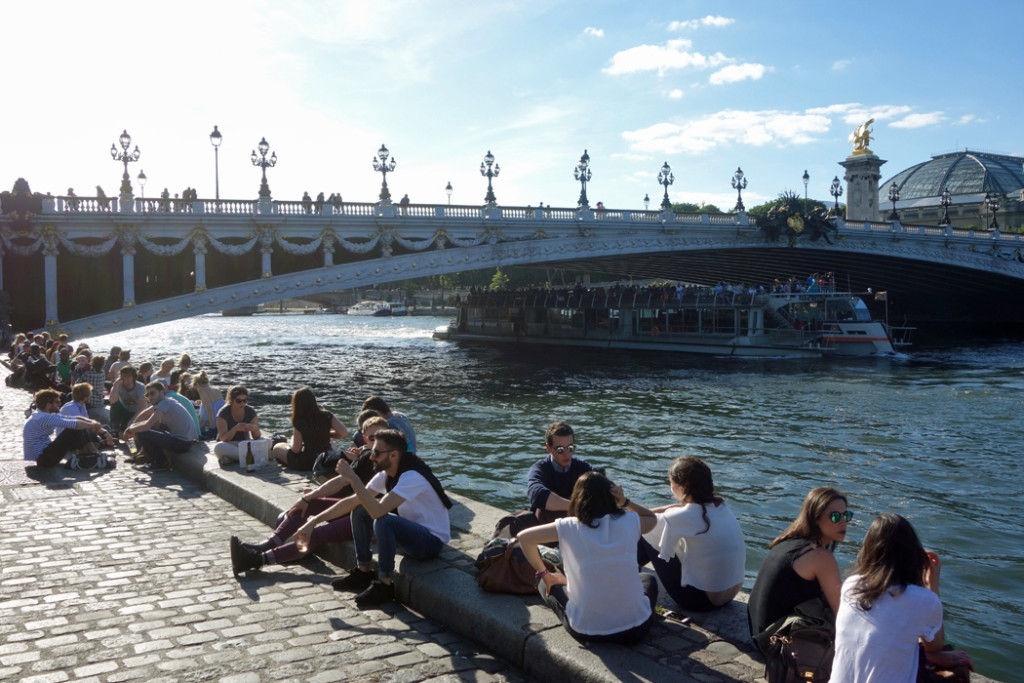
On my last day in Paris, I was met by my partner Trish (The Travelphile) — who took all the photos in this post — and we had a delightful afternoon simply enjoying the city’s hottest new spot: the pedestrianized embankment of the Seine.

We figured out Paris’ wonderful and popular Vélib’ loaner bike system (you join for a couple euros and then can pick up and drop bikes at any of over a thousand racks around town). Then we reveled in the scene on two wheels. We were completely immersed in an “in-love-with-life” Parisian ambience, joining thousands of happy Parisians simply out and enjoying their new people zone. There were pop-up bars, picnickers galore, rock walls for the kids to frolic on, and a laid-back vibe that made everything warm and fuzzy.

Enjoying a favorite restaurant with two great Francophile travelers: Steve Smith and Trish Feaster.

This is Day 61 of my “100 Days in Europe” series. As I travel with Rick Steves’ Europe Tours, research my guidebooks, and make new TV shows, I’m reporting on my experiences across Europe. Still to come: Ireland, England, Scotland, Germany, Switzerland, and more. Thanks for joining me here on my blog and via Facebook.

Video: Join Me for a Bike Ride on Paris’ Riverside Promenades

While Paris is crisscrossed with bike lanes, the most relaxing and scenic Parisian joy ride on two wheels is along its riverside promenades. A three-mile stretch from near the Eiffel Tower to a bit past Ile St. Louis makes a wonderful hour-long experience. (It could be much longer if you succumb to the temptations of the lounge chairs, hammocks, outdoor cafés, and simple delights of riverside Parisian life.) Start at the Pont de l’Alma near the Eiffel Tower on the Left Bank, then head east, crossing to the Right Bank at the Orsay Museum on Pont Royal. Continue east, passing the Louvre, until you pass the two islands. Your major hazard: avoiding pedestrians and not biking into the river, since you’ll be distracted by so many iconic buildings and sights as you pedal.

(By the way, the bike I’m using is one of the 20,000 Vélib’ bikes Paris scatters all across town to alleviate traffic congestion.)

This is Day 60 of my “100 Days in Europe” series. As I travel with Rick Steves’ Europe Tours, research my guidebooks, and make new TV shows, I’m reporting on my experiences across Europe. Still to come: Ireland, England, Scotland, Germany, Switzerland, and more. Thanks for joining me here on my blog and via Facebook.

How to Borrow a Bike in Paris

Paris scatters about 20,000 bikes at about 1,500 racks all across town so people (locals and tourists) can essentially borrow a bike for a quick one-way ride. Bikes are free for the first half hour, and you pay a small fee for longer rentals.  It’s designed to alleviate traffic congestion by giving people a reason not to drive their car for little trips.
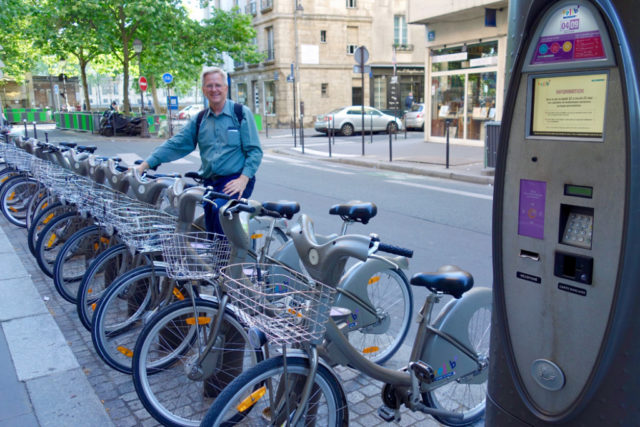
Photo: thetravelphile.com

To borrow a Vélib’ bike, download the free and easy-to-use Vélib’ app on your smartphone. This app knows where you are and shows the nearest rack locations — including which ones have loaner bikes available and which have parking spaces available. This is important information for Vélib’ users as racks are often completely full or empty.

Locate the nearest bike rack. At the payment machine, you’ll simply dial English, follow the prompts, and after inserting your credit or debit card, the machine will print out your one-day or seven-day membership ticket with your ID number. Once you have your Vélib’ ticket, you have access to any available bikes anywhere in the city. (There’s a more complete explanation of how to do this in our Rick Steves Paris guidebook.)

Picking Up a Vélib’ Bike: Survey the bike rack and decide which bike you want (note the number). Return to the machine and find the screen meant for bike rental (it’s the simpler panel, likely the one with the map). Click “other languages” then “English” and then “Short Term Ticket” (or some similar wording). Enter your 8- to 10-digit ID number, then follow with your four-digit PIN. Then enter the number of the bike you want. Wait for it to verify. When you get the OK on the screen, go get your bike. Press the grey metal button next to the bike to release it, and you’re ready to ride.

Returning Your bike: Refer to your Vélib’ app to find the nearest or handiest rack with empty stalls available. Simply plug your bike into an empty stall and be sure it engages.

Vélib’ Biking Tips: Bikes are accessible 24/7. Survey your bike carefully before choosing it (make sure it has its hand grips, etc). Remember that a seat turned backwards indicates a broken bike. If you get a bad bike, return it and take another. Adjust your seat for comfort. Take advantage of the three speeds and bike lock. You can check out a bike as many times as you want while your ticket is valid. There’s no charge for taking a bike for less than 30 minutes. Then charges start racking up: €1 for the first half-hour, €2 for a second half-hour, and €4 for each half-hour after that. So, a two-hour rental would cost €7 (in addition to the initial cost for your membership). Be careful riding in Paris traffic. Vélib’ provides no bike helmets (and I never saw anyone wearing one in Paris). Bon voyage.

___

This is Day 59 of my “100 Days in Europe” series. As I travel with Rick Steves’ Europe Tours, research my guidebooks, and make new TV shows, I’m reporting on my experiences across Europe. Still to come: Ireland, England, Scotland, Germany, Switzerland, and more. Thanks for joining me here on my blog and via Facebook.