As Europe continues to endure terrorist attacks, fear-mongering politicians and media seem eager for these to have a greater impact than they deserve. Sure, these events are tragic…but no more so than other equally-deadly non-terror-related tragedies.
Lately, I’ve been visiting sites where terrible terror events have occurred: London’s Westminster Bridge, Barcelona’s Las Ramblas, Brussels’ airport, and Nice’s Promenade des Anglais. At most sites of vehicle attacks, there are now bollards in place to stop murderous cars from entering.
I’ve been in Europe five months so far this year…and, clearly, Europe (while working on security) is embracing life, not fear. With this more reasonable and thoughtful response, potential terrorists become lowly criminals with intent to terrorize and do not get the hoped-for results they wasted their lives for. Join me in this clip for a stroll on Nice’s wonderful Promenade des Anglais.
Strasbourg is France’s seventh-largest city (with 275,000 people) and offers your best chance to experience urban Alsace. It feels like a giant Colmar with rivers and streetcars. Long a humanist and intellectual center, today it has a delightful big-city energy. Walking its people-friendly streets, you’ll find it progressive and livable, with generous space devoted to pedestrians and bikes, sleek trams, meandering waterways, and a youthful mix of university students, Eurocrats, and street people. With a name that means the “city of streets,” it’s the ultimate crossroads.
While the city dodged serious damage in both world wars, the people of Strasbourg have experienced a dizzying history. It was hit hard during the Franco-Prussian War, becoming part of Germany in 1870. After that, there was a period of harsh Germanization, followed by extreme Frenchification after World War I, a brutal period under Nazi rule during World War II, and then the strong need to purge all that was German after 1945. Now, while probably more definitively French than it’s ever been, you’ll feel a bi-cultural gentleness and see street names in both French and the Alsatian dialect. Bordering the west bank of the Rhine River, Strasbourg provides the ultimate blend of Franco-Germanic culture, architecture, and ambience.
After World War II, Churchill called for a union of European nations, with the goal of winning an enduring European peace by weaving the economies of France and Germany together. Noting that Strasbourg had changed hands between Germany and France so many times, it seemed logical that it be a capital (along with Brussels) of what would eventually become the European Union. And today, Strasbourg is home to the European Parliament.
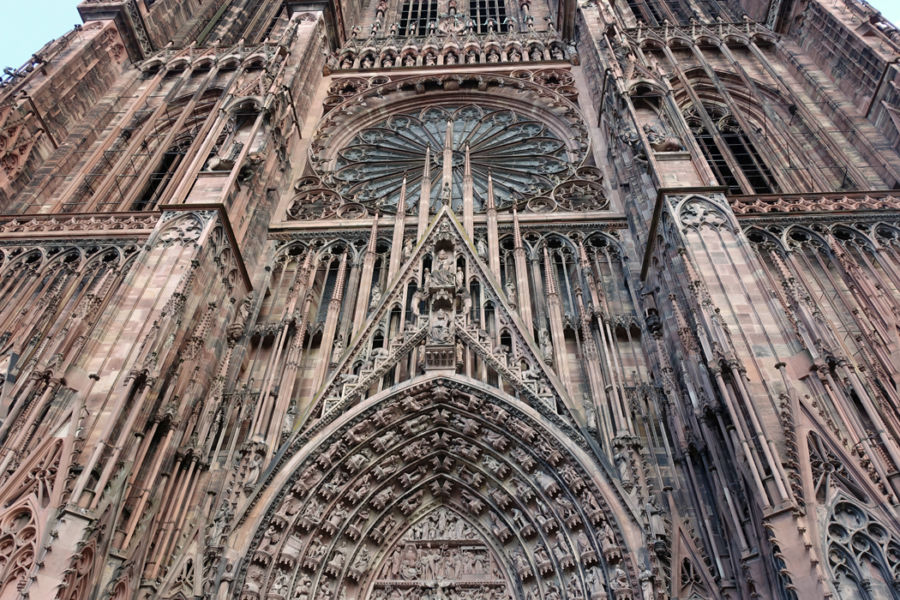
Most visitors come to Strasbourg to see its massive cathedral. Stand in front and crane your neck way back. I couldn’t fit it into my viewfinder. Noting how my jaw dropped, I tried to imagine the impact this unforgettable erection would have had on medieval pilgrims. The delicate Gothic style of the cathedral (begun in 1176, not finished until 1429) is the work of a succession of about 50 master builders. The cathedral somehow survived the French Revolution, the Franco-Prussian War, World War I, and World War II. Today, it’s the big draw of the city — and for good reason.
The year 2018 will mark the centennial of the conclusion of World War I, the war that was billed as “the war to end all wars.” While there are no more survivors to tell us their stories, WWI sights and memorials scattered around Europe do their best to keep the devastation from fading from memory.
Perhaps the most powerful WWI sightseeing experience a traveler can have is at the battlefields of Verdun, where, in 1916, roughly 300,000 lives were lost in what is called the “Battle of 300 Days and Nights.” The battle left a barren, lunar landscape. Today, it is buried under thick forests — all new growth — and the soldiers’ vast network of communication trenches is overgrown and haunted by their ghosts.
Plenty of rusty battle remnants and memorials to the carnage are still accessible. A string of battlefields lines an eight-mile stretch of road outside the town of Verdun. From here (with a tour, rental car, shuttle bus, or taxi) it’s possible to see the most important sights and appreciate the horrific scale of the battle in as little as three hours.
You can ride through the eerie moguls left by the incessant shelling, pause at melted-sugar-cube forts, ponder plaques marking spots where towns once existed, and visit a vast cemetery.
To get a good overview, start at the Verdun Memorial Museum. The museum is rich in artifacts and delivers gripping exhibits about the battle (with lots of information in English). It works to pair German and French artifacts — for example, you’ll see a circa 1916 German rucksack completely loaded up right next to a French one.
In the Verdun Memorial Museum, I learned that the vast majority of WWI casualties weren’t hit by machine gun bullets, but by shrapnel — every time an artillery shell exploded, jagged bits of the shell’s casing sprayed like buckshot.
Shrapnel
Another key sight for visitors is Fort Douaumont. First constructed in 1885, Fort Douaumont was the most important stronghold among 38 hilltop fortifications built to protect Verdun after Germany’s 1871 annexation of this area. Built on top and into the hillside, it ultimately served as a strategic command center for both Germany and France at various times. Soldiers were protected by a thick layer of sand (to muffle explosions) and a wall of concrete five to seven feet thick. Inside, soldiers were forced to live like moles, scurrying through two miles of cold, damp hallways. Visitors can still experience these corridors (enlivened by an excellent audioguide) today.
Climb to the bombed-out top of the fort and check out the round, iron-gun emplacements that could rise and revolve. The massive central gun turret was state-of-the-art in 1905, antiquated in 1915, and essentially useless when the war arrived in 1916. From the top, look out at fields leading to Germany. From this perch, imagining the carnage here in that horrible battle is an unforgettable experience.
There is a beautiful sight at Fort Douaumont today. German, French and European flags wave alongside each other, as if to exclaim, “We learned and we won’t do this again.” Say what you like about the European Union, but it’s hard to deny what a great accomplishment it has been to weave together the economies of two historic enemies — and to subsidize the humanization and empathy that comes with getting to know each other. In 1914, most French soldiers had never met a German, and vice versa — making it all too easy to carelessly kill each other. Thanks, in large part, to the EU, we live in a different world today, built on a solid foundation for maintaining European peace.
I visited Verdun this summer with my friend and co-author Steve Smith. We did it as a very long day trip from Colmar: three and a half hours each way, on the autoroute. The time went quickly on the freeway, in part because we listened to four hours of radio interviews about France, filling the drive with conversation from fascinating French experts. (We downloaded the interviews from the France playlist on the free Rick Steves’ Audio Europe app. If you download tracks while you still have a Wi-Fi connection, you can listen to them later offline.) We both learned something and the time zipped by. And, even though we spent seven hours in the car, we had six wonderful hours to explore Verdun’s WWI sites.
Want to experience classic, small-town, French culture? Head to Alsace, on France’s eastern border with Germany. I just returned from there and I have lots of travel lessons to share with you. In this little series of photos, I share the region’s art treasures, take you on a walk through an untouristy village on the Route du Vin, and point you to my new favorite restaurant in Colmar.
Let’s begin with a mesmerizing medieval masterpiece which I find to be one of the most exquisite pieces of art in Europe. Martin Schongauer’s angelically beautiful Virgin in the Rosebush is housed in Colmar’s Dominican Church. Dated 1473, it still looks as if Schongauer painted it yesterday.
We describe Virgin in the Rosebush this way in our France guidebook:
In Schongauer’s Virgin in the Rosebush, graceful Mary is shown as a loving and welcoming mother. Jesus clings to her, reminding the viewer of the warmth of his relationship with Mary. The Latin on her halo reads, “Pick me also for your child, O very Holy Virgin.” Rather than telling a particular Bible story, this is a general scene, designed to meet the personal devotional needs of any worshipper. Nature is not a backdrop; Mary and Jesus are encircled by it. Schongauer’s robins, sparrows, and goldfinches bring extra life to an already impressively natural rosebush. The white rose (over Mary’s right shoulder) anticipates Jesus’ crucifixion. Angels hold Mary’s heavenly crown high above.
Colmar’s top museum, the Unterlinden Museum, has been spiffed up and is now truly ready for prime time. Its centerpiece is Matthias Grünewald’s gripping Isenheim Altarpiece (c. 1515) — a many-paneled masterpiece. Taken apart and displayed in many sections, it fills a venerable chapel under Gothic vaulting.
The Isenheim Altarpiece is actually a polyptych — a series of two-sided paintings on hinges that pivot like shutters. As the church calendar changed, priests would change the painting by opening or closing its various panels. Designed to help people in a medieval hospital endure horrible skin diseases — long before the age of painkillers — it’s one of the most powerful paintings ever produced. Germans know this painting like Americans know the Mona Lisa.
Stand in front of the altarpiece as if you were a medieval peasant, and feel the agony and suffering of the Crucifixion. It’s an intimate drama. The point — Jesus’ suffering and then death — is drilled home: The weight of his body bends the horizontal bar (unrealistically, creating an almost crossbow effect). His elbows are pulled from their sockets by the weight of his dead body. People who are crucified die of asphyxiation, as Jesus’ chest illustrates. His mangled feet are swollen with blood. The intended viewers — the hospital’s patients — may have felt that Jesus understood their suffering, because he looks like he had a skin disease.
Alsace is known for its Route du Vin (Wine Road) and the many delightful (if touristy) towns along the way. While the most famous of these towns are over-the-top cute and inundated with tourists, I finally found the untouristy alternative…the little walled town of Bergheim, about half an hour north of Colmar.
A visit is quick and easy: Park on the uphill side of town and enjoy a fascinating stroll. The keen sightseeing eye will notice lots of fun bits of history. Here’s an example of what a tiny town like this can reveal:
Bergheim was contained within its medieval walls. Because of the value of the surrounding vineyards (worth more as grapevine plantations than as land that houses people), the town stayed small.
You’ll notice that two town walls were built in the 14th century — an inner and outer wall, between which was a moat (now a handy place for gardens). While these original walls were strong enough against arrows, more protection was needed with the advent of cannon fire. So, at the end of the 15th century, flanking towers were built outside the double walls as an extra defense.
From 1530 to 1667, Bergheim provided sanctuary to criminals who came to the town gates, on the run from the law. Only one of those gates survives today: The High Gate. A carved relief at the gate depicts a guy happily mooning his pursuers. Today, as you step inside the town walls, it seems like he’s mooning the modern world.
Bergheim’s main drag is lined by a small canal. You’ll notice a little iron dam. When lowered, the canal filled with water and the laundry women could do their work.
As you stroll, you’ll notice inns with gates and courtyards ideal for horse-drawn carriages. This town, unlike its more touristy neighbors, still has a real economy — there are enough locals to keep a newsstand in business and cars, rather than tour groups, on its streets.
Look up at Bergheim’s nondescript church — you’ll see a stork nest on the roof. The church is surrounded by gardens and there’s even an “insect hotel” at the far end.
And, once you leave town, a 10-minute walk will bring you to a German war cemetery. Notice that this war memorial is dedicated not to heroes who died for their country, but to the “victims of war.” In World War I, Alsace was part of Germany. After the war, it was returned to France…only to then be occupied by the Third Reich during World War II. As a result, 100,000 young Alsatian men were conscripted into Hitler’s army.
While I was in the region, I stopped at a port for river cruise ships on the Rhine River. It was fun to poke around and get a feel that booming industry. River cruising is quite popular, and we considered adding it to our tour program — we even sent one of our staffers on a river cruise — but we decided that it’s just not our kind of touring. One thing is for certain: Tour groups side-tripping by bus from river cruise ships are contributing to the crowding you find in cities all over Europe these days.
A big goal for me and my guidebook co-authors is finding the best restaurants for our readers — not the most expensive, but those offering the best value and experience. On this trip to Alsace, Steve Smith (my France guidebook co-author) and I found several good new places to recommend in Colmar.
Here’s a sneak peek (from the 2018 edition of the guidebook) at the entry for our new favorite restaurant in Colmar:
Restaurant L’Arpège offers a special experience — like eating in a Monet painting, where each waiter’s mission is to be sure you leave evangelical about chef Jean-Martin’s cooking. He gives classic French dishes a creative modern twist with seasonal and organic ingredients, always respects the vegetarians with a serious dish, and finishes with a delightful dessert. You’ll want to order family style for maximum experience. Inside, you’ll enjoy candlelight and sleek rocking chairs. Outside, you dine in a homey and thoughtfully lit garden. It’s romantic either way (€24 mains, closed Sun-Tue, 24 Rue des Marchands, tel. 03 89 24 29 64, reservations essentially required).
Each year, I look forward to a week or two of guidebook research in France with Steve. He is the ultimate Francophile who, for 30 years, has coached me in all things French. Steve’s labor of love is ourRick Steves France guidebook…and I’m honored to be his co-author.
Steve has also been a key player in the development of our tour program. We just found out that more than 24,000 travelers will join us on a Rick Steves tour by the end of 2017. And this week, we’ll be the busiest we have been all season — it will be all hands on deck, with a total of 100 guides leading great tours all over Europe on the same day.
After more than 20 years of building our amazing team of tour guides, Steve just retired from his role as Manager of Guide Services. But thankfully, he never wants to stop working on our France guidebook. If you’ve ever enjoyed our material on France or our tours anywhere in Europe, a good part of your travel joy is thanks to Steve Smith. Merci, Steve!
I make sure to spend some time in France every year with Steve Smith, my co-author and coach in all things French. Our mission: to update our France guidebook. This year, we’re double-teaming Alsace and the WWI sights, and I’m loving France more than ever.
This clip illustrates that France’s romantic, idyllic yesterday — as well as its vibrant today — is all yours when you know where to find it.