Lessons from Vienna

I’ve been in Vienna for 36 hours and, with all I’ve learned, I feel as excited as a kid sorting through his candy on the living room floor on Halloween.

I met a new guide named Gerhard Strassgschwandtner. I didn’t know you could have seven consonants in a row — that’s some kind of record. He runs Vienna’s “The Third Man” Museum, dedicated to a classic movie with a cult-like following that’s set in bombed-out, spy-ridden Vienna in 1945 (museum open Saturdays only, see www.3mpc.net).

Gerhard is passionate about history in all its marvelous complexity. Chatting with him, we imagined Vienna’s city wall back when the Austrian capital was the fifth largest city in the world. The core of the city was contained in a hulking, three-mile-long ring peppered with 2,200 cannons. The artillery was aimed across the 500-yard-wide “shooting fields,” as the stretch of land beyond the city wall was called in the 18th century. Napoleon destroyed much of the wall in 1809. It was replaced with only an iron fence — easy to shoot through but hard to shoot at. It seemed strong enough in the mid-19th century, as the greatest foe of “modern” governments was considered to be mobs of people in the streets.

It’s summertime, and the city’s museums are busy with students enjoying summer-camp-type activities. Austria provides a special kids’ summer pass — unlimited train travel anywhere in the country all summer long for young students for about €40 ($50).

As I update my Vienna guidebook, I’m discovering lots of sightseeing news. The Kunsthistorisches Museum, the city’s answer to the Prado and Louvre, is reopening its ground floor “Habsburg Kunstkammer” (or Chamber of Wonders) in 2013 to show off the lavish curiosities the emperors gathered to impress their friends. Also in 2013, Vienna will have a new Biedermeier exhibit in the City Palace of the Liechtenstein family.

For a rare bit of Prague-like ambience in Vienna, stroll through the charming Spittelberg district. Vienna’s population exploded from 1880 to 1910. Most of grand architecture and apartment flats that shape a visitor’s impression of the city date from this period. The Spittelberg district, just a 15-minute walk from the Hofburg in the city center, offers a rare enclave of pre-1880 Vienna.

Music lovers come to Vienna on a kind of pilgrimage to see the houses of composers who lived and worked here. The homes of Schubert, Brahms, Haydn, Beethoven, and Mozart all host museums — but they are small, forgettable, and pretty spread out. For the best music history experience, I like the Haus der Musik (www.hausdermusik.at) which honors the great Viennese composers with lots of actual historic artifacts on one fine floor. Vienna is still a thriving capital of classical music, with three local opera companies (including the world-famous Vienna State Opera putting on 300 performances a year). Its glorious music venues offer a total of 10,000 seats which are generally sold-out every night. (Even so, they run at a deficit — so they’re subsidized by a caring government, the general populace, and lineup of corporate sponsors.)

Stepping into St. Stephen’s Cathedral, I was invited into a new elevator to visit an attraction that just opened — the Cathedral Treasury (€4, daily 10:00-18:00, includes a fine audioguide). The substantial treasures of the cathedral were ignored in the nearby (and outmoded) cathedral museum. So they were moved into the church, filling an — until now — inaccessible space high above the nave on the west portal wall. The visit includes the “Portrait of Rudolf IV” (the earliest realistic portrait in German art), precious relics, and commanding views of the nave.

Next, I popped into the Augustinian Church, where each Sunday the 11:00 Mass is performed with a wonderful orchestra. There’s a Neoclassical memorial by Canova to Empress Maria Theresa’s favorite daughter, Maria Christina; next to it is a chapel dedicated to Charles I, the last Habsburg emperor, who ruled from 1916 to 1918. He’s on a dubious road to sainthood pushed by Habsburg royalists who worship here. His required miracle: The varicose veins of a Brazilian nun were healed after she prayed to the emperor.

Vienna is great for both art nouveau and early modern buildings by architect Otto Wagner, who played a big part in shaping the urban landscape. Wagner’s Postal Savings Bank (built 1904-1907) overlooks the Ringstrasse (a.k.a. the Ring) with a facade that looks as secure as a safety deposit box. Its slinky angels atop the roof proclaim a new age made with a new metal — aluminum. The plain, marble-sided panels with their aluminum bolts remind us of Wagner’s belief that, “What is impractical can never be beautiful.”

Stepping inside, you understand the value this bank had for the new working class. It offered workers an unintimidating way to save their earnings in a combination post office/bank, rather than in some palace for elites. Its form follows function everywhere, as “necessity is the master of art.” With white and gray efficiency, the aluminum fixtures are simple yet elegant. A glass roof lets in light, and the glass floor allows light into the basement. The strong, geometric elements dignify the technological — and celebrate it as cultural. Wagner — like his angels on the roof — was heralding a new age. Facing this masterpiece across the street is the Kriegsministerium (the former ministry of war building). Its style is Neo-Baroque Historicism; it’s actually a few years younger than Wagner’s building, but it’s way behind the times — fighting against modernity.

Many things in Vienna are named after Karl Lueger, the mayor of the city before World War I. A century later, his legacy is being reconsidered. While he did much to modernize Vienna, he’s now seen as an anti-Semite — a demagogue who was admired by a young student in Vienna named Adolf Hitler. Lueger, while being a strong leader, was also a right-wing fearmonger. The city has just decided that a stretch of Vienna’s elegant Ringstrasse named for Lueger will be renamed for the university instead.

The USA is hot this week. But as Americans swelter, we should remember we don’t swelter alone. The entire world is feeling what is delicately called “global climate change” in order not to offend the people who refuse to accept the reality of global warming. While the Dutch raise their dikes, the Viennese are also preparing for a warmer reality. As older people suffer most from the stifling heat, the city is providing more shady places with benches and public mist machines. And there are big, shiny, new water dispensers popping up with reminders to be sure to hydrate. It’s good advice for locals and tourists — young and old alike — as scorching summers become our new norm.

Vienna is gearing up for more sweltering summers as fancy new water dispensers are placed at key points around the city.

Sunday Morning, Vienna-Style

As I walked out of my hotel in Vienna on Sunday morning, I realized I was in a city with a rich culture you can almost inhale, and a vivid history you can almost touch. I decided to max out on culture.

At about 9:00, I dropped by the Hofburg’s Imperial Music Chapel. The Vienna Boys’ Choir was singing, as they do each Sunday morning throughout their season. I didn’t actually see the boys — no one in the church did — as they sang like angels from the loft in the rear. But, like you don’t need to look at the sun to know it’s there on a beautiful day, you don’t need to see the boys to enjoy their delicately beautiful music. Their voices blended perfectly with the scene in front of us, as sunshine streaming through the windows made the Baroque starburst of gilded statuary truly seem to burst over the altar.

Energized, I ducked through a royal passageway and paid about €20 for a standing-room spot to see the much-loved Lipizzaner Stallions prance to some more music in the Emperor’s chandeliered Baroque riding hall. (It occurred to me that they prance in 4:4 time, but not 3:4 — even though this is the city of the waltz.) I enjoyed the show as much — and with a view just as good — as those who booked far more expensive seats long in advance.

Ready for more music, I strolled a hundred yards to the Augustinian church for Mass, where I sat above silver urns containing the hearts of centuries of Habsburg emperors. This being Vienna, the service came with a complete choir and an orchestra, and today wowed worshippers with the spiritual confidence of Anton Bruckner’s Mass No. 3 in F Minor.

After lunch under palm trees in the emperors’ conservatory, I dropped into the adjacent hothouse, a wonderland of butterflies. Enjoying the fluttering antics of these butterflies — most of which seemed drunk on the fermented banana juice they licked from the brown and sweating banana slices in their breakfast dish — is a Vienna tradition for me.

Enlarge photo

Enlarge photo

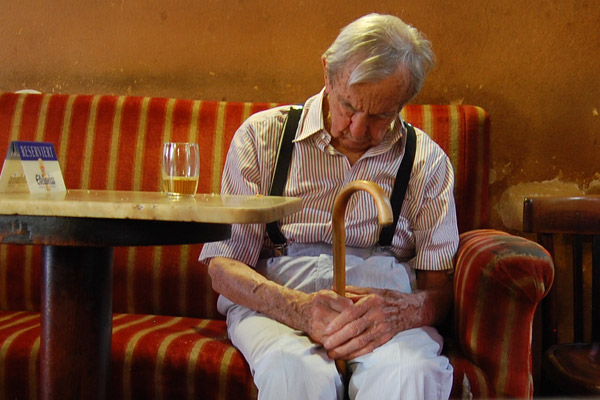
Then, for coffee, I pulled up a chair in the smoke-and-coffee-stained Café Hawelka, where intellectuals like Leon Trotsky once stewed. The decor was circa-1900. Old man Hawelka himself was snoozing on a Biedermeier chair near the bar. His granddad could well have served a Mélange (as they would have called their cappuccino) to Trotsky, Hitler, Stalin, Klimt, or Freud — all of whom were rattling around Vienna when the chair I was sitting on was made, bought, and put in this café. I pondered how, in the last days of the era of Europe’s family-run empires (essentially all of which died with the end of World War I), Vienna was a place of intellectual tumult.

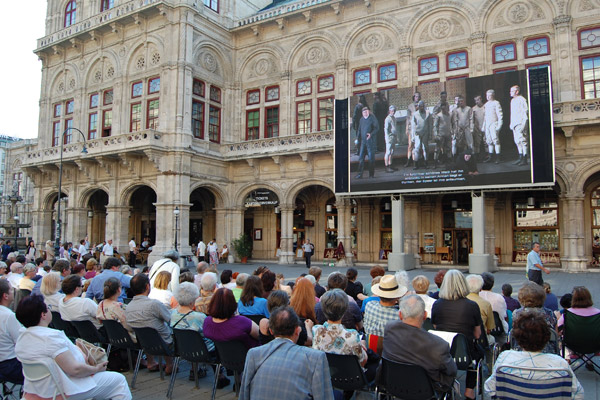
And my day was just half over. The Vienna Opera — arguably the world’s greatest — was performing Wagner’s Tannhäuser in the afternoon. No ticket? No problem. In good Vienna style, it was being projected outdoors for the rest of us in all its Teutonic glory, live on a huge screen. Arriving early to get a good seat, I waited with the people of Vienna — marveling at the potential richness of life, and how as I travel, I can experience much of its best.

Awaiting the start of Tannhäuser, I thought about how accessible all this was. Two musical Masses and this opera experience — free. Horses — $30. Butterflies — $6. Lunch under the palms — $20. Coffee and cake with sleeping Herr Hawelka — $7. As I reviewed all I had experienced today and the people I had rubbed shoulders with, I thought again — a theme for me this month — how much happiness there is in our world if you choose to see it. I’m not saying to ignore the problems. I’m saying to get out there, strive to keep things in perspective, and embrace not what turns you off, but what turns you on.

Sweet-and-Sour Lake Hallstatt

Enlarge photo

To commemorate the Smithsonian Presents Travels with Rick Steves magazine — now on sale online, and at newsstands nationwide — Rick is blogging about the 20 top destinations featured in that issue. One of those destinations is Austria’s Lake Hallstatt.

When I think of my favorite places in Europe (other than the great capitals), they are where both nature and culture mix. While big-time resorts with big-time promotional budgets look good on the Web, in reality they’re more concrete than charm, with jammed parking lots and cookie-cutter hotel rooms. I’ll take the offbeat places, where creaky locals walk gingerly on creaky floorboards, where each balcony has a lovingly watered and one-of-a-kind flowerbox, and where swans know just the right time to paddle by for scraps from diners at lakeside dinner tables.

I like to say that the town of Hallstatt, on the lake of Hallstatt (two hours south of Salzburg, in Austria), is “where locals commune with nature.” It’s rare that a town’s charm will get me out of bed early. But there’s something about the glassy waters of Lake Hallstatt viewed from the high end of town: The church spire is mirrored in the tranquil water, and then the shuttle boat from the train station across the lake cuts through — like a knife putting a swirl in the icing on a big cake.

Back in my rented room (Zimmer in German), my hostess is Frau Zimmermann. For years I stayed in her place mainly because I couldn’t get over the idea that her name meant “Mrs. Room-for-rent-man.” Her breakfast room is where I came up with the descriptor “well-antlered.” That means more than just lots of trophies on the wall. A well-antlered place creaks with tradition, from the homemade marmalade to the down-filled comforters, and from the apron that the hostess wears to the fact that you don’t email your credit card number to make a reservation…you just phone her, agree on a date and price for your room, give her your name, and then show up.

As I dine lakeside in Hallstatt, the swans crane their necks for bits of bread. With a generous basket to parcel out, I feel like I’m running an orphanage. As they stretch greedily, reaching for each bit of crust I loft, I think they do it well enough that if they were cranes, they’d be swaning. Free bread makes the once-graceful swans a flailing gaggle of hungry grubbers.

Traditional green felt hats distinguished by jaunty decorative feathers are big in Austria. On my first trip to Europe, when I was just a teenybopper, my Dad and I each bought one of these characteristic hats and had a friendly competition filling it with souvenir pins and fancy feathers. Now, 40 years later, I happen to be in town during the annual feather-in-the-hat party, and local men are all out with their finest Tirolean-type hats — each with a very proud feather sprouting from the rim. Many men have handlebar moustaches to match. Watching them strut around in their lederhosen worn shiny by a lifetime of such rituals, I consider life before tourism here in what would have been a remote community at the deepest point of a long, dead-end lake.

Facing the lake is the home of a man who fills his house with debris he’s collected from bottom of Lake Hallstatt. Of course, the history here goes back literally millennia. But the most fascinating treasure from the lakebed dates from just 65 years ago. It’s the trove of Nazi paraphernalia he’s gathered, including piles of war medallions. As I try to sort this out, his explanation makes perfect sense: When it became clear that Germany would lose World War II, throughout the Third Reich, anyone who had won any honors would chuck them any way they could. Lakes offered a perfect solution. In a post-Nazi world, who wants trophies honoring their heroic contribution to that regime on their wall or bookshelf?

As the swans grab their bread, as Frau Zimmermann hangs her comforters over view balconies to fluff up and air, and as the men display their hat-capping finery, I gaze out at the lake. I imagine a scene two generations earlier, when once-fierce Nazi heroes, now filled with fright, came to the lakeside under cover of darkness, and hurled their treasured medals — evidence of their complicity with Hitler — into Lake Hallstatt…my vote for the most beautiful lake in Austria.

They Still Birth Pianos in Vienna

As I ponder my passion for Europe and why I’m a Europhile, I’ve recently been writing about my experience as a schoolboy visiting the Vienna factory of the most luxurious and expensive pianos in the world, Bösendorfer. Two blog entries ago, I mused that the old-fashioned quality of those pianos, built so lovingly that they were almost birthed and each had its own personality, likely is no longer the case in our fast-food world.

It’s exciting (or perhaps scary) how one’s writing can spread these days. I just received this email from Rupert Loeschnauer in Vienna, who assured me that their pianos are made “faithful to their traditional heritage.” (I’ll have to take him up on his offer next time I’m in Vienna.) Here’s his letter:

Dear Rick,

I found your interesting article (October 18) on HeraldNet. With great curiosity I read about your visit to Bösendorfer in Vienna back in the late 1960s and early ’70s and about your fear that old-time quality might have gone.

Don’t worry, Rick, the loving care for making our wonderful grands and pianos hasn’t gone. The employees in Bösendorfer factory, who are without exception great masters of their trade, have remained faithful to their traditional heritage. Still more than 10.000 production steps – most of them still done by hand – are executed per instrument to create a true work or art. Still we use the best materials for our pianos. And when it comes to the unique singing tone: we still treat the entire instrument as a resonating body, thereby achieving Bösendorfer’s unique richness of tone color and its typical singing timbre.

We would be glad, Rick, if we could host you another time in Vienna and show you that within our fast moving, mass-produced modern world you still can find traditional quality: products that are not manufactured but being birthed. How I like your words!

With best regards from Vienna Rupert Loeschnauer

I have a habit when I travel that I must open the keylid on any piano I see. The make of the piano gives me an indication of the values and priorities and appreciation of quality an establishment will have. While cheap Asian pianos dominate these days (I remember doing the math once and finding that one big Asian piano company produces as many pianos in a month as Bösendorfer does in 30 years), I’m always pleased (and impressed) to open the lid and see that classic Bösendorfer emblem. (In case you wondered, the Beatles played a Blutner, from East Germany.)

Fine Pianos and Cheese

When you travel, enjoy the cultural wonders. I used to be put off by those sophisticates in Europe. They’re so into their fine wine and stinky cheese, and even the cultural soil that created it all. But now I love being the cultural bumpkin.

Sure, I’m simple. I was raised thinking cheese is orange and the shape of the bread. Slap it on and…voilà! Cheese sandwich. Over there, cheese is not orange nor the shape of the bread. In France alone, you could eat a different cheese every day of the year. And it wouldn’t surprise me if people did. These people are passionate about their cheese.

I love it when my favorite restaurateur in Paris, Marie-Alice, takes me shopping in the morning and shows me what’s going to shape the menu tonight. She takes me into her favorite cheese shop. It’s a festival of mold. Picking up the moldiest, gooiest wad, Marie-Alice takes a deep whiff, and groans ecstatically, “Oh, Rick, smell zees cheese. It smells like zee feet of angels.”

I’m her wide-eyed student. It’s fun to be on the receiving end of all that cultural, gastronomic, and regional pride. I see it as a learning opportunity. Thankfully people are sophisticated about different things, and when we have the opportunity to meet the expert, it can be good for all.

While my father doesn’t know the first thing about cheese, he is sophisticated about pianos. He was a piano tuner in Seattle, and he imported fine pianos from Europe. When I was young, he took me to the Bösendorfer factory in Vienna, where the world’s finest pianos were made. I remember thinking they weren’t made — they were birthed. Touring the factory, which fills a former monastery, we learned how the wood was aged and the imported felt was made from just the right sheep’s wool. In each of the former monks’ cells, they proudly produced only two pianos per worker per year. The result of this lovingly labor-intensive production process: each piano had its own personality.

I remember going to Vienna on those first trips with my dad. Back in the late ’60s and early ’70s, I’d join him on a flight to Vienna. They’d line up five or six of these grand pianos — the finest and most expensive in the world. I’d hop from bench to bench playing them as my dad would analyze the personality of each, matching it with his client’s taste back in Seattle. He’d make the selection, autograph the sounding board, they’d put it in a box, and ship it to some lucky American pianist. Bringing that Old World quality to the New World was the joy of my dad’s work.

While this old-time quality is gone — a casualty of our mass-produced modern world — perhaps having seen this is one of the reasons I’m enthusiastic about sharing the fine points of European culture. Bösendorfers may no longer be produced with such loving care. But, thankfully, the cheese still smells like zee feet of angels.