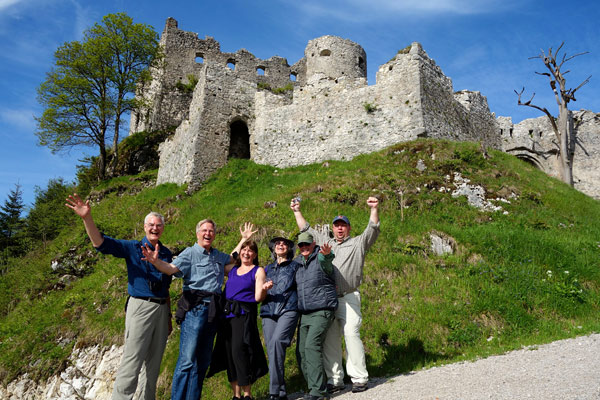
When I first hiked up to the Ehrenberg Castle ruins, it was overgrown with trees and entirely desolate. Today, it’s more welcoming for adventurous travelers thanks to a local archaeologist, Armin Walch.


P.S. I’m on a Best of Europe in 21 Days Tour.
When I first hiked up to the Ehrenberg Castle ruins, it was overgrown with trees and entirely desolate. Today, it’s more welcoming for adventurous travelers thanks to a local archaeologist, Armin Walch.
P.S. I’m on a Best of Europe in 21 Days Tour.
Way back in my student travel days, I discovered a handful of completely offbeat sights and experiences like the Ehrenberg Castle ruins in Reutte (in Austria’s Tirol), just across the border from the extremely popular and commercial “Mad” King Ludwig’s castles. To this day, we carefully balance the sightseeing on our tours, mixing the famous must-sees with undiscovered “Back Door” sights like these.


P.S. I’m on a Best of Europe in 21 Days Tour.

When I’m researching in Europe, the challenge is to stop my in-the-street work while there’s still enough time to input what I ‘ve learned, and then fine-tune the writing. From the first day of this trip, back in early July, I’ve been in a hole. I’m still digging out, as I’ve had so much fun traveling that it’s been impossible to completely keep up on the writing end of things.
With a hard-working crew of editors back home — and a publisher awaiting their work — I am but a happy cog in a wonderful guidebook-creating wheel. And if I miss a deadline, it’ll mess up a lot of people. With my Vienna text due this week, I’ve finally finished those chapters. Here are a few major new additions:
The Third Man: A Movie, a Museum, and a Cultlike Following
The Third Man is a classic film set in post-WWII Vienna. There’s a fascinating museum dedicated to the film and the story it tells (open only Saturday afternoons). The movie still plays regularly in Vienna — or you can see it before coming to town.
This is not just another movie. The British Film Institute voted The Third Man “the best British film ever produced.” It’s set in 1949 Vienna — when it was divided, like Berlin, between the four victorious Allies. (After the war, Austria was divided between the U.S., France, Britain, and Russia until 1955.) With a dramatic Vienna cemetery scene, coffeehouse culture surviving amid the rubble, and Orson Welles being chased through the sewers, this tale of a divided city rife with smuggling and under the threat of Soviet rule is an enjoyable, two-hour experience. The movie plays at Vienna’s Burg Kino (€8, in English; 3-4 showings weekly — usually Friday evening, Sunday afternoon, and Tuesday early evening; a block from the Opera at Opernring 19, burgkino.at).

The Third Man Museum is the life’s work of Karin and Gerhard Strassgschwandtner. They have lovingly collected a vast collection of artifacts about the film, Vienna in 1949, and the movie’s popularity around the world. (In 1999 Japan voted it the best foreign film of all time.)
Third Man fans will love the quirky movie relics, but even if you are just interested in Vienna at the start of the Cold War, this is worthwhile. Sections cover the 1930s when Austria was ripe for the Anschluss, the reality of 1.7 million “DPs” (displaced persons) in Austria after the war, the challenges of denazification after 1945, and candid interviews with soldiers. As a bonus, the museum also gives a fascinating look at moviemaking and marketing around 1950. Don’t be shy about asking for a personal tour from Gerhard or Karin (€7.50, Sat only 14:00-18:00, a long block south of Naschmarkt at Pressgasse 25, www.3mpc.net, Facebook: thirdmanmuseum).
Otto Wagner’s Postal Savings Bank
The Austrian Postal Savings Bank, built from 1904-1912, offers a fascinating look into the society as well as the architecture of that age. This was a bank for working-class people. The very concept of a postal savings bank makes storing your hard-earned income less intimidating for laborers than the palatial banks of the 19th century. The bank’s design makes the service it provides feel almost sacred. Wagner believed, “Necessity is the master of art.” He declared, “What is impractical can never be beautiful.” Everything about the design — so gray, white, and efficient — is practical. While it’s textbook “form follows function,” the form is beautiful nevertheless. A product of its age — so giddy with advancement — the building dignifies the technological and celebrates it as cultural.

Study the sleek, yet elegantly modern facade: Angles high above — made of an exciting new material, aluminum — seem to proclaim the modern age. The facade, with unadorned marble siding panels held on by aluminum-capped bolts, gives the impression that the entire building is a safety deposit box. The interior is similarly functionalist. The glass roof lets in light while the glass floor helps illuminate the basement. Fixtures, vents, and even the furniture fit right in — strong, geometrical, and modern. The main building is open to the public and still functions as a savings bank. In the back, a fine little museum is dedicated to the architect Wagner with a slideshow providing a visual review of his work (free entry to main building, museum-€6, Mon-Sat 9:00-17:00, just off the Ringstrasse near the Danube Canal at Georg-Coch-Platz 2, www.ottowagner.com).
The Museum of Military History
While much of the Habsburg’s empire was built on strategic marriages rather than war, a big part of Habsburg history is military. And the Heeresgeschichtliches Museum, a.k.a. HGM — built in 1860 by Emperor Franz Josef as an arsenal — tells the story well with a thoughtful motto (apparently learned from the school of hard knocks): “War belongs to museums.” You’ll wander the wings of this vast museum practically all alone. On two floors you’ll see a rich collection of artifacts and historic treasures from Empress Maria Theresa to military genius Prince Eugene to Franz Josef. I found the 20th-century section particularly interesting. It includes an exhibit on Sarajevo in 1914 (with the car Archduke Franz Ferdinand was riding in — and the uniform he was wearing — when he was assassinated). For WWII buffs, there’s a look at Chancellor Engelbert Dollfuss (and the pre-Hitler Austrian fascist party), the Anschluss when the Third Reich absorbed Austria, and the devastation of World War II (€5, includes audioguide, daily 9:00-17:00, located inconveniently outside the Ringstrasse, a 10-minute walk behind the Belvedere Palace near the new Central Station at Arsenal Objekt 1, www.hgm.or.at).
|
|
|
I love my guidebook research days. In Salzburg, I had no particular plan, and another action-packed day just unfolded. There’s always so much to do. My guide met me at 10:00 a.m. We popped into Mozart’s House to check out the new displays and audio tour. Then she drove me to a new Salzburg sight—Mr. Red Bull’s place. I wrote this entry:
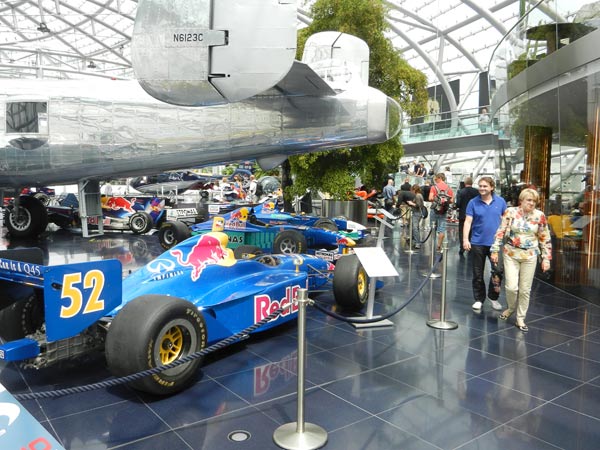
Red Bull Hangar-7 — Salzburg’s big personality these days is the tycoon founder of Red Bull energy drink, Dietrich Mateschitz. He has a mysterious mansion at the edge of town, sponsors the local “Red Bull” soccer and hockey teams, owns several chic Salzburg eateries and cocktail bars, and employs 6,000 mostly good-looking people. It seems his personality is like the energy drink that made him rich and powerful — a high-energy, anything’s-possible cultural Terminator.
Hangar-7, a renovated hangar at the Salzburg airport, celebrates Red Bull culture. Under its modern steel-and-glass dome are 20 or so glittering planes and racecars and several pretentious bars, cafés, and restaurants. While things are described in German, visitors can borrow an iPod Touch with English information (free, daily 9:00-22:00, bus #8 from Hanuschplatz to the Salzburg airport, hangar-7.com).
At Hangar-7, the Mayday Bar serves experimental food, and Restaurant Ikarus features a different well-known chef each month. Mateschitz’s Carpe Diem cocktail bar in the Old Town is also Red Bullish.
Then we popped by Hellbrunn Castle, with its fine gardens and famous trick fountains. For years, I’ve panned the palace. I revisited and, like so many sights, it’s much improved. I wrote this entry:
Hellbrunn Castle and Gardens — About the year 1610, Prince-Archbishop Sittikus decided he needed a lavish palace with a vast and ornate garden purely for pleasure (I imagine after meditating on stewardship and Christ-like values). He built this summer palace and hunting lodge, and just loved inviting his VIP guests from throughout Europe for fun with his trick fountains. Today, Hellbrunn is a popular sight for its palace, formal garden (one of the oldest in Europe, with a gazebo made famous by The Sound of Music), the tour of its famous trick fountains, and simply for a chance to get out of the city.
Upon arrival, buy your fountain tour ticket and get a tour time. Tours generally go on the half-hour. The 40-minute English/German tours take you laughing and scrambling through a series of amazing 17th- century garden settings with lots of splashy fun and a guide who seems almost sadistic in the joy he has in soaking his group. (Hint: When you see a wet place, cover your camera.) If there’s a wait until your tour, you can see the palace first.
The palace, inspired by the Venetian architect Palladio, was built in a style popular around 1600. It was a cultural destination back in the 1600s, when the ritual was hunting in the morning and enjoying an opera in the evening. The first opera north of the Alps, imported from Italy, was performed here. The decor is Mannerism (between Renaissance and Baroque), with faux-antiquities and lots of surprising moments — intentional irregularities were in vogue after the strict logic, balance, and Greek-inspired symmetry of the Renaissance. (For example, the main hall is not in the center, but at the far end.) With the help of the included audioguide, you’ll wander through the palace exhibit and — to the sounds of shrieking tourists below on the fountains tour — enjoy hunting themes and learn about the impressive 17th-century hydraulic engineering that let gravity power the intricate fountains.
You’re then free to wander the delightful garden grounds and pop out to see the gazebo made famous by the “I am 16 Going on 17” song in The Sound of Music.
Taking full advantage of my guide’s car, we then dropped by four countryside farmhouse B&Bs I recommend, each on a handy bus line into the center of Salzburg. Here’s an example:
Frau Ballwein rents 11 cozy, charming, and fresh rooms in a delightful and family-friendly farmhouse. Some rooms come with intoxicating-view balconies (Sb-€38, Db-€55, Tb-€75, Qb-€85, 2-bedroom apartment for up to 5 people-€95, €10 more during festival, no surcharge for one-night stays, cash only, farm-fresh breakfasts amid her hanging teapot collection, non-smoking, free Wi-Fi, 2 free loaner bikes, free parking, Moosstrasse 69a, bus stop: Gsengerweg, tel. 0662/824-029, www.haus-ballwein.at, or email haus.ballwein@gmx.net).
Saying goodbye to my guide, I popped back to my hotel, where Marianne and her wonderful family (who run the place) made me a schnitzel. Then, with Marianne tagging along, I zipped over to the main square in the Old Town to catch the daily walking tour. I’ve done tours like this one many times, but another guide told me the guides who did this particular tour were not good — and, because I recommend the company in my book, I needed to check. They didn’t know who I was; I paid the €9 and was one of three people on a great 90-minute walk. Even with just a handful of tourists, they split the German-speakers and the English-speakers into two groups, so we didn’t have to listen to two languages. Our guide was excellent.
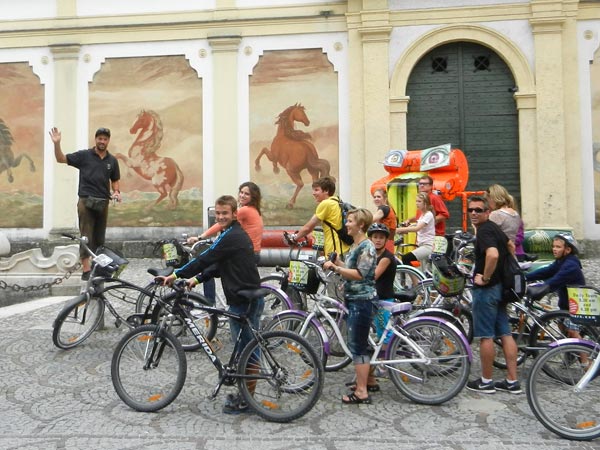
Marianne and I then zipped over to catch the 16:30 Sound of Music bicycle tour. It’s called “Fräulein Maria’s Sound of Music Tour,” but it’s run by a burly young man named Rupert. (As Austrians barely know what the Sound of Music is all about, getting a handle on this quirky touristic phenomenon was particularly interesting for Marianne.) It was a delightful tour, and now I can capably compare it to the Sound of Music bus tours.
We had to cut out half an hour early in order to catch the 19:30 marionette performance of The Magic Flute. Of all the musical venues in Salzburg that I recommend, this was one I’d never actually experienced. After the performance, I could write it up with more confidence:
Marionette Theater — Salzburg’s much-loved marionette theater offers operas with spellbinding marionettes and recorded music. A troupe of 10 puppeteers — actors themselves — bring the artfully created puppets at the end of their five-foot strings to life. The 180 performances a year alternate between The Sound of Music and various German-language operas (with handy superscripts in English). While the 300-plus-seat venue is forgettable, the art of the marionettes enchants adults and children alike (€24-35, May-Sept nearly nightly at 17:00 or 19:30, near Mozart’s Residence at Schwarzstrasse 24, tel. 0662/872-406, www.marionetten.at).
After the concert, we hopped into a taxi to go extremely local at the Augustiner beer garden (my favorite dinner in Salzburg), which is written up this way:
Augustiner Bräustübl, a huge 1,000-seat beer garden within a monk-run brewery in the Kloster Mülln, is rustic and raw. On busy nights, it’s like a Munich beer hall with no music but the volume turned up. When it’s cool outside, you’ll enjoy a historic setting inside beer-sloshed and smoke-stained halls. On balmy evenings, it’s like a Renoir painting — but with beer breath — under chestnut trees. Local students mix with tourists eating hearty slabs of schnitzel with their fingers or cold meals from the self-serve picnic counter, while children frolic on the playground kegs. For your beer: Pick up a half-liter or full-liter mug, pay the lady (schank means self-serve price, bedienung is the price with waiter service), wash your mug, give Mr. Keg your receipt and empty mug, and you will be made happy. Waiters only bring beer; they don’t bring food — instead, go up the stairs, survey the hallway of deli counters, and assemble your own meal. Classic pretzels from the bakery and spiraled, salty radishes make great beer even better. For dessert — after a visit to the strudel kiosk — enjoy the incomparable floodlit view of old Salzburg from the nearby Müllnersteg pedestrian bridge and a riverside stroll home (open daily 15:00-23:00, Augustinergasse 4, tel. 0662/431-246).
Marianne guided me deep into the local cuisine — all the way to horse-tongue salad (her favorite…I tried). We finished the day, after marveling at the beauty of floodlit Salzburg from the riverbank, checking out the bars on Steingasse. I’m not big on late-night listings in my guidebooks, but Salzburg is so accessible, and there’s a string of boomer-friendly cocktail and wine bars on a very characteristic old lane. Drinking there with Marianne, who pretended to be American, I had someone who could actually understand all the German being spoken as I made my rounds, giving me a wonderfully candid understanding of just how friendly they were to tourists.
I list all of this because, even though I enjoy the advantage of local friends, any traveler who equips himself with good information and expects to travel smart can amass plenty of lifelong memories in a single well-organized day.
Today I stood on Vienna’s Heroes Square where, in 1938, more than 200,000 tearfully happy Austrians gathered before Adolf Hitler. The Nazi dictator stood on the palace balcony and stated, “In front of German history, I declare my former homeland now a part of the Third Reich. One of the pearls of the Third Reich will be Vienna.” From that day on, Austrians were forbidden to say the word “Austria.”
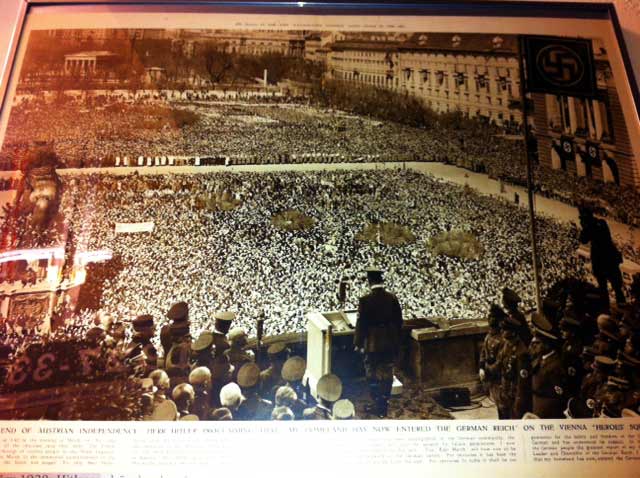
Americans often wonder how Austria could so eagerly embrace Hitler and the Anschluss (the notion that Austria was meant to be unified with Germany anyway). Let me hazard an explanation: Imagine post-WWI Austria. One of the mightiest empires on earth started — and lost — a great war. In a few bloody years, it went from being a grand empire of 55 million people to a relatively insignificant landlocked state of six million that was required to be nonaligned. The capital, Vienna, was left with little to rule, and now its population comprised a third of the country’s. With the economic crisis we know as the Great Depression (which swept the Nazis to power in Germany in 1933), Austria also got a fascist government complete with a dictator named Engelbert Dollfuss. He was as right-wing and anti-Semitic as the tyrant ruling Germany, but he was pro-Roman Catholic Church, pro-Habsburg, and anti-Nazi. When an Austrian Nazi assassinated Dollfuss in 1934, it was easy for the German Nazis to take over four years later. By that point, the Austrian fascists had already put down the leftists. The German Nazis just took over their Austrian counterparts’ file cabinets. And, Hitler promised greatness again…and jobs — something that has driven voters to support crazy political notions to this day.


