Museums are People, Too!

Every few days, it occurs to me that another industry is in crisis because of the COVID pandemic: tourism, concerts, restaurants, airlines…and museums.

A friend of mine who runs a museum in the USA confided in me that he thinks a third of the shuttered museums in our country won’t re-open. Knowing the passions and dreams that make museums — especially small mom-and-pop museums — possible, this breaks my heart.

I just received this uplifting video from my friends Karin and Gerhard Strassgschwandtner. Karin and Gerhard have invested their life savings in a lifelong passion: Vienna’s Third Man (Dritte Mann) Museum, which lovingly focuses on the cult 1949 Orson Welles film — while also offering a unique and fascinating look at Vienna during and after WWII. The museum is only open to the public on Saturdays, but they give private tours to Rick Steves tour groups by reservation. (And with their guidance, it’s a highlight of these tours.)

In this video, my friends Karin and Gerhard are dancing in their empty museum…as if to declare that even if it’s closed, it is still alive. Watching this, it hit me: Museums are people, too!

I hope you enjoy the clip twice: first to lap up Karin and Gerhard’s joy, and second for glimpses of their museum. And as you do, remember the many struggling museums that are powered by passion and love…and that without our patronage, they cannot survive.

PS: I’ve got to mention: Their surname, Strassgschwandtner, comes with seven consonants in a row!

PPS: Since I recommend Karin and Gerhard’s museum in my Vienna guidebook and they give private tours to Rick Steves tour groups, we stay in touch by email. And in their latest email, they shared the following news:

“The Third Man Museum becomes now even better than before, a real Rick Steves-style museum: Created by two obsessed but friendly persons and “over the top.” Our museum was awarded with the ‘Vienna Tourism Prize 2020’. That is a big thing here. Up to now, only four great museums — the Albertina, Schoenbrunn, Jewish Museum, and Belvedere — achieved that! Now, our little homemade museum is number five in Vienna. And I am very happy to announce that we will survive this pandemic, and we will be open on Saturdays and enthusiastically welcome Rick Steves tour groups at any time. We look to see you again soon. Many friendly greetings! And to a good 2021/2022 season! – Gerhard and Karin”

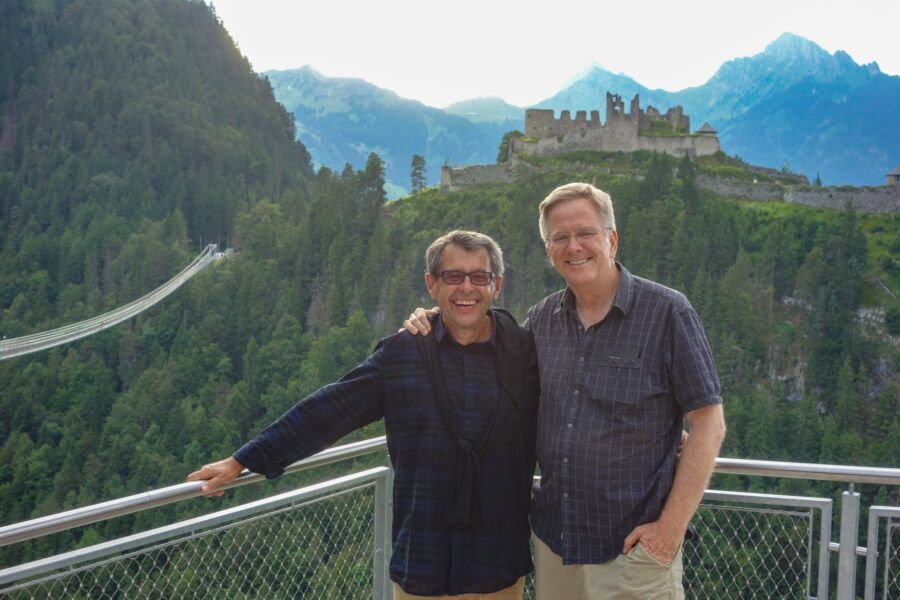
Here’s a shot of all three of us at the museum in 2018. See you soon, Karin and Gerhard!

Daily Dose of Europe: The Castles of Boyhood Dreams

The magic of Europe can make any traveler feel like a kid again. And one of my favorite places for that “king-of-the-castle” feeling is in the Bavarian and Tirolean Alps.

Even though we’re not visiting Europe right now, I believe a daily dose of travel dreaming can be good medicine. I just published a collection of my favorite stories from a lifetime of European travels. My new book is called “For the Love of Europe” — and this story is just one of its 100 travel tales.

South of Munich in the foothills of the Alps is Hohenschwangau Castle. It was “Mad” King Ludwig’s father’s castle — and Ludwig’s boyhood summer home. When his father died, Ludwig became king. He was just a boy, 19 years old. And rather than live with the frustrations of a modern constitution and a feisty parliament in Munich reining him in, King Ludwig II spent his next years lost in Romantic literature and operas…hanging out here with composer Richard Wagner as only a gay young king could.

The king’s bedroom was decked out like a fairy tale. The walls were painted in 1835 by a single artist, who gave the place a romantic, Tolkien fantasy feel. Lounging nymphs still flank the window and stars twinkle from the ceiling. A telescope stands as it did for the king, trained on a pinnacle on a distant ridge where Ludwig dreamed of building his ultimate castle fantasy: Neuschwanstein. On my first visit here, squinting through that telescope at Neuschwanstein (which had also inspired a boy named Walt Disney), I could relate to the busy young king. Bound by schoolwork and house rules rather than a constitution and parliament, with a stretched-out turtleneck and zits rather than crowns and composer friends, I too built a castle.

What I had that Ludwig lacked was a father who imported pianos. Shipped from Germany, they came encased in tongue-in-groove pine, sealed in a thick envelope of zinc sheeting. My wooden tree house was my castle: walls decorated with romantic 1968 magazines, the nails shining through the ceiling just long enough to bloody intruding bullies taller than me. Taking full advantage of those sliding pine boards, I could see who was coming. With a shiny zinc roof, my palace was the envy of other little kings. There was no tree house like it. Then, someone purchased the vacant lot next to our house, and I had to tear my tree castle down. At the time, I considered it the worst day of my life. Not long after, I embarked on my first no-parents trip to Europe. Touring Neuschwanstein, I relived my loss.

On that same trip, just over the border in Austria near the town of Reutte, I found another castle: the brooding ruins of the largest fort in Tirol — Ehrenberg. This impressive complex was built to defend against the Bavarians and to bottle up the strategic “Via Claudia” trade route that cut through the Alps here, connecting Italy and Germany. One castle crowned its bluff while another was high above on the next peak. Exploring the ruins, I climbed deep into a misty forest littered with meaningless chunks of castle wall — each pinned down by pixy-stix trees and mossy with sword ferns. This once strategic and powerful fortress had somehow fallen apart and was slowly being eaten by the forest.

My friend Armin Walch, an archaeologist who lives in Reutte, had a vision to bring these ruins to life. He was born the same year as me and pursued his project like the Indiana Jones of castle scholars. Today, with European Union funding, he’s cut away the hungry forest to reveal and renovate what he calls the castle ensemble. And it’s open for business, enabling countless children to live out their medieval fantasies, leaping from rampart to rampart with sword ferns swinging.

On my last visit, I was honored for bringing so many visitors to this remote corner of Austria over the years. With Armin as the jovial master of ceremonies, the town’s hoteliers and tourism folks gathered in the castle like a council of medieval lords. Together we ate smoked game and rustic cheese with coarse bread. We swilled wine and clinked pewter mugs. I gave an impromptu speech about the wonders of Americans climbing through history far from home. Then I knelt before a man in armor who drew a shiny sword with my name etched upon it, and was knighted — Sir Rick, first knight of Ehrenberg.

The sword was my gift. It was solid and sparkled with sentiment. I loved how it felt in my hand as I swung it back and forth, cutting through the air — and how it symbolically wove together my tree-house childhood, my love of history, my longtime connection with Reutte, and Armin’s vision. But the last thing I needed was to be packing a big sword through the rest of my trip. So I requested that my sword stay in the museum as a special exhibit on the castle-loving boy from Seattle who fell in love with the Ehrenberg ruins and then grew up to bring decades of American travelers to Reutte with his guidebooks.

On the way back to my hotel, Armin took me to his house for a drink. As a talented architect, he had cleverly hidden his sleek, futuristic, and creative pad behind a humble old-town facade. It was a royal domain for his family — two kids cozy on the carpet and a beautiful wife. Armin had bedazzled her at the university in Vienna and brought her here to remote Reutte with promises of a queenly life and a bitchin’ castle.

Armin and I climbed boyishly to his rooftop — a perch he designed to view Ehrenberg. Together we shared a glass of schnapps flavored with local herbs and peered through his telescope at our favorite castle complex — now illuminated by powerful floodlighting. In his youth — before he excavated it — almost no one knew about the fortress that hid beneath the trees on the mountain. Nudging me aside, Armin took his turn squinting through his telescope. Happy as two boys in a tree house, like two Romantic Age princes, we marveled at this castle of his dreams.

This story appears in my newest book, For the Love of Europe — collecting 100 of my favorite memories from a lifetime of European travel. Please support local businesses in your community by picking up a copy from your favorite bookstore, or you can purchase it at my online Travel Store. You can also find a clip related to this story at Rick Steves Classroom Europe; just search for Neuschwanstein and Ehrenberg.

Daily Dose of Europe: Klimt’s The Kiss

Need a break from the headlines? Spend a few moments lingering over this beautiful painting of a couple in love.

As America continues to suffer crisis upon crisis, it has never been more important to broaden our perspectives and learn about the people and places that shape our world. And for me, one of the great joys of travel is seeing art masterpieces in person. Learning the stories behind great art can shed new light on our lives today. Here’s one of my favorites.

A couple kneels on the edge of a grassy precipice. The man bends down to kiss the woman on the cheek. Their bodies intertwine: He cups her face in his hands; she presses against him and wraps one arm around his neck while touching her other hand to his. The two lovers are wrapped up in the colorful gold-and-jeweled cloak of bliss. It’s just the two of them, lost in the golden glow of the moment.

The Austrian painter Gustav Klimt was channeling the erotic spirit of turn-of-the-century Vienna. The city was wealthy and sophisticated, but also the capital of a fading Old World empire — making it a splendid laboratory of decadence and hedonism. To Klimt, all art was erotic art. He loved painting alluring women and embracing couples. (Some suggest the man in The Kiss is Klimt himself.) Though he gained a bad-boy reputation for wallowing in the degenerate side of sensuality, Klimt made The Kiss all about sweetness: the innocent affection of two people in love.

Klimt’s technique reinforces The Kiss’ romantic side. He used real gold and silver (along with traditional oil paints) to give it the radiant glow of desire. He emphasizes the man’s masculinity with a robe of sturdy geometrical shapes, while the woman is all flowery femininity. The couple comes together in a harmony of color. The shimmering patterns on the robes — flowers, vines, swirls, and rectangles — are similar to what Art Nouveau interior decorators were putting on chairs, dishes, and bedroom walls in sumptuous Viennese apartments. Klimt sets the whole scene of The Kiss inside a perfectly square frame, enclosing the lovers in a world of their own.

The Kiss stands on the cusp between traditional 19th-century art and 20th-century Modernism. On the one hand, it’s a pretty realistic scene of two people. But there’s no background giving it 3-D depth, and the whole scene flattens out into a 2-D cardboard-cutout of patterns and colors — foreshadowing abstract art.

But The Kiss is about passion, not analysis. The couple glows with an inner radiance, lost in a world full of pollen and pistils. The only thing that emerges from this 2-D pattern of paint is the woman’s face. She turns out, and we can see her reaction: Her eyes close, her cheeks flush, a faint smile paints her lips, and she squirms in pleasure, as she succumbs to the pleasure of The Kiss.

This art moment — a sampling of how we share our love of art in our tours — is an excerpt from the new, full-color coffee-table book Europe’s Top 100 Masterpieces by Rick Steves and Gene Openshaw. Please support local businesses in your community by picking up a copy from your favorite bookstore, or you can find it at my online Travel Store. To enhance your art experience, you can find a clip related to this artwork at Rick Steves Classroom Europe; just search for Klimt.

Daily Dose of Europe: Cafe Chitchat, Chocolate Cake, and the Vienna Opera

Viennese high culture may be on hold for now. But I’m savoring my memories of a city that knows how to live very, very well.

Europe is effectively off-limits to American travelers for the time being. But travel dreams are immune to any virus. And, while many of us are stuck at home, I believe a daily dose of travel dreaming can actually be good medicine. Here’s another one of my favorite travel memories — a reminder of what’s waiting for you in Europe at the other end of this crisis.

Munching Europe’s most famous chocolate cake — the Sacher torte — in Café Sacher, across from Europe’s finest opera house, I feel underdressed in my travel wear. Thankfully, a coffee party of older ladies, who fit right in with the smoked mirrors and chandeliers, make me feel welcome at their table. They’re buzzing with excitement about the opera they are about to see — even bursting into occasional bits of arias.

Loni, the elegant white-haired ringleader, answers my questions about Austria. “A true Viennese is not Austrian, but a cocktail,” she says, wiping the brown icing from her smile. “We are a mix of the old Habsburg Empire. My grandparents are Hungarian.” Gesturing to each of her friends, she adds, “And Gosha’s are Polish, Gabi’s are Romanian, and I don’t even know what hers are.”

“It’s a melting pot,” I say.

They respond, “Yes, like America.”

For 600 years, Vienna was the head of the once-grand Habsburg Empire. In 1900, Vienna’s nearly two million inhabitants made it the world’s sixth-largest city (after London, New York, Paris, Berlin, and Chicago). Then Austria started and lost World War I — and its far-flung holdings. Today’s Vienna is a “head without a body,” an elegant capital ruling tiny Austria. The average Viennese mother has one child and the population has dropped to 1.8 million.

I ask Loni about Austria’s low birthrate.

“Dogs are the preferred child,” she says, inspiring pearl-rattling peals of laughter from her friends.

Sharing coffee and cake with Viennese aristocracy who live as if Vienna were an eastern Paris, and as if calories didn’t count, I’m seeing the soul of Vienna. Vienna may have lost its political clout, but culturally and historically, this city of Freud, Brahms, a gaggle of Strausses, Empress Maria Theresa’s many children, and a dynasty of Holy Roman Emperors remains right up there with Paris, London, and Rome.

As far back as the 12th century, Vienna was a mecca for musicians, both secular and sacred. The Habsburg emperors of the 17th and 18th centuries were not only generous supporters of music but also fine musicians themselves (Maria Theresa played a mean double bass). Composers such as Haydn, Mozart, Beethoven, Schubert, Brahms, and Mahler gravitated to this music-friendly environment. They taught each other, jammed together, and spent a lot of time in Habsburg palaces. Beethoven was a famous figure, walking — lost in musical thought — through Vienna’s wooded parks.

After the defeat of Napoleon, the Congress of Vienna in 1815 shaped 19th-century Europe. Vienna enjoyed its violin-filled belle époque, which shaped our romantic image of the city: fine wine, cafés, waltzes, and these great chocolate cakes. The waltz was the rage and “Waltz King” Johann Strauss and his brothers kept Vienna’s 300 ballrooms spinning. This musical tradition created the prestigious Viennese institutions that tourists enjoy today: the opera, Boys’ Choir, and great Baroque halls and churches, all busy with classical concerts.

As we split up the bill and drain the last of our coffee, the women take opera tickets out of their purses in anticipation. “Where will you be sitting?” Loni asks.

“Actually I’ll be standing,” I say. “I’ve got a Stehplatz, a standing-room-only ticket.”

The women look at me kindly, perhaps wondering if they should have paid for my cake and coffee.

“A Stehplatz is just €4. So I have money left over for more Sacher torte,” I tell them with a smile. What I don’t say is that, for me, three hours is a lot of opera. A Stehplatz allows me the cheap and easy option of leaving early.

Leaving the café, we talk opera as we cross the street. The prestigious Vienna Opera isn’t backed in the pit by the famous Vienna Philharmonic Orchestra, but by its farm team: second-string strings. Still, Loni reminds me, “It’s one of the world’s top opera houses.” Even with 300 performances a year, expensive seats are normally sold out — mostly to well-dressed Sacher torte-eating locals.

Saying goodbye to my new friends, I head for the standing-room ticket window. Cackling as old friends do, they waltz through the grand floor entrance and into another evening of high Viennese culture.

(These daily stories are excerpted from my upcoming book,  For the Love of Europe — collecting  100  of my favorite memories from a lifetime of European travel, coming out in July.  It’s available for pre-order. And you can also watch a video clip related to this story: Just visit Rick Steves Classroom Europe and search for Vienna.)

Gemütlichkeit: A Cozy Moment Under the Chestnut Tree

Join me now for a magic moment in the little town of Hall, Austria — just enjoying good friends, some spaetzle and dumplings, and the mellow tempo of life. The locals here have a name for this cozy feeling: Gemütlichkeit. And right now, under this chestnut tree with old friends…it’s Gemütlichkeit. 

I’ve traveled to the Alps with my crew to film three new episodes of Rick Steves’ Europeand we’re off to a great start. We’ve traveled together for decades, and I’ve never seen my cameraman Karel dance — but just look at him now. This is joyful travel.