 |
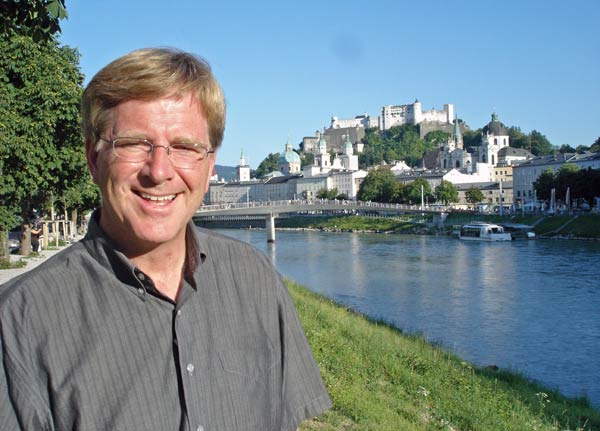
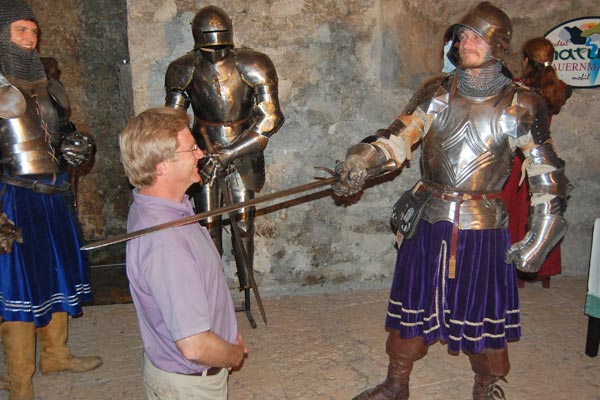
| Sir Rick, the first knight of Ehrenberg Enlarge photo |
 |
| The sword of Sir Rick in its museum display case, Reutte, Austria Enlarge photo |
 |
| Architect Armin and guidebook writer Rick celebrate atop newly excavated and restored castle ruins Enlarge photo |
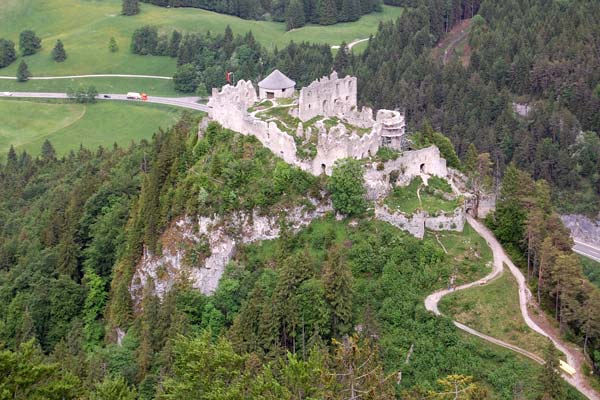 |
| The Ehrenberg castle ensemble once guarded the Tirolians from the Bavarians Enlarge photo |
I was in Hohenschwangau. It was “Mad” King Ludwig’s dad’s castle — Ludwig’s boyhood home. The walls were all painted in 1835 by a single artist, giving the place a Tolkien-romance-fantasy feel. Ludwig became king as a boy. And rather than live with the frustrations of a modern constitution and feisty parliament reigning him in, he spent his years lost in romantic literature and operas…chillin’ with Wagner as only a gay young king could.
Nymphs lounged on his circa 1835 walls. Stars twinkled from the ceiling over his bed. A telescope was set up in Ludwig’s bedroom, trained on a pinnacle on a distant ridge where he could watch Neuschwanstein, his castle fantasy, as it was being constructed.
On my last visit, I peered through that telescope at Neuschwanstein– the castle that inspired another boy named Disney. I could relate to this busy boy king. Bound by schoolwork and house rules, and with a stretched-out turtleneck and zits rather than crowns and composer friends, I, too, built a castle.
What I had that Ludwig lacked was a father who imported pianos. They came from Germany, encased in tongue-in-groove pine, sealed in a thick envelope of zinc sheeting. My treehouse was my castle: no parents reining me in, walls decorated with romantic circa 1968 magazines, nails sticking down through the ceiling just long enough to keep out bullies taller than me. With my sliding tongue-in-groove panels, I could see who was coming. With a shiny zinc roof, it was the envy of other little kings. There was no tree house like it.
On my first independent trip to Europe, I was 18. It was just after someone had purchased the vacant lot next to our house, and I had to tear down my tree house (epic bad day). I toured “Mad” King Ludwig’s Neuschwanstein — a medieval castle dream. Then, just over the border in Austria, I found the Ehrenberg ruins–a medieval castle reality.
Just a mile outside of Reutte, Austria, are the brooding ruins of four castles that once made up the largest fort in Tirol — Ehrenberg. This impressive castle ensemble was built to defend against the Bavarians and to bottle up the strategic “Via Claudia” trade route that cut through the Alps here as it connected Italy and Germany.
One castle crowned its mountain like an ornery barnacle. The others were lost in a thick forest. I hiked up into the misty mountain of meaningless chunks of castle wall pinned down by pixie-stix trees and mossy with sword ferns. It inspired yet confused me. The barnacle castle was below. The ruins were on the bluff above. Like a big, hungry starfish sits on its food, this rotten military fantasy was being eaten by the forest.
A decade ago I met Armin Walch — a Reutte man with a vision. He was born the same year as me and pursued his project like the Indiana Jones of castle archeologists. Today — with European Union funding — he’s cut away the hungry forest, revealed and renovated what he calls the castle ensemble, created an interactive museum, and is open for business as countless children with medieval fantasies can, in turn, leap from rampart to rampart…sword ferns swinging. (See www.ehrenberg.at for details and photos.)
With my 2008 visit, we celebrated. The Reutte hoteliers and tourism folks gathered in the castle like some old-time city council. We ate rustic cheese and smoked game with coarse bread. We swilled wine and clinked pewter mugs.
I was honored for bringing so many visitors to this remote corner of Austria, and gave a magnanimous impromptu speech about the wonders of Americans climbing through history far from home. I knelt before a man in a coat of mail who drew a shiny sword with my name etched upon it and was knighted — Sir Rick, first knight of Ehrenberg. (With uncharacteristic modesty and characteristic insistence on packing light, I requested that my sword stay in the museum as a special exhibit to the former castle-loving boy who brought American tourism to Reutte with his guidebooks.)
On the way back to my hotel, Armin begged me to stop by his house for a drink. Behind his humble old town facade, this dynamic architect hid a sleek, futuristic, and creative pad. It was a royal domain for Armin and his family — two kids cozy on the carpet and a strikingly beautiful wife who Armin bedazzled at the university in Vienna and took to remote Reutte with promises of a princely life and a bitchin’ castle.
With a schnapps from local herbs — unique to Reutte — in hand, we climbed boyishly to his rooftop, where Armin had designed and built a viewing perch. The floodlighting was on. The mountain overlooking his town was crowned by a castle that, in his youth, almost no one knew even existed. With his pretty blond wife suddenly romantic wallpaper, Armin took me to his telescope. We marveled at his castle ensemble.