“Democratic Socialism” is becoming a big factor in US politics, with key figures including Alexandria Ocasio-Cortez, Zohran Mamdani, Abdul El-Sayed, and Bernie Sanders embracing the term. Supporters explain that it’s modeled after the European approach to big, good government. Detractors claim that it’s just oppressive communism in disguise, and horrible for business. What’s the reality?
With our Midterms coming up soon, I’ve been thinking a lot about Democratic Socialism and how it relates to what I’ve experienced as a traveler in Europe — where many of those ideals have found real-world expression. As with so many topics, international travel can provide some insight. Here’s an admittedly oversimplified overview of what Democratic Socialism is —and isn’t — through the lens of a European traveler.
Democratic Socialism 101
Broadly speaking, Democratic Socialists in the USA believe that the private sector (in the form of large corporations and billionaire CEOs) wields too much power, often at the expense of the poorest members of society. Therefore, they propose increasing taxation — especially on the rich — to spread around the wealth more equitably and better care for the middle and lower classes. Democratic Socialists embrace well-run, typically state-managed initiatives to improve access to healthcare, higher education, childcare, retirement benefits, worker protections, public transportation and infrastructure, and other hallmarks of a high-functioning society.
The Nordic Model
Democratic Socialists often cite Europe’s “Nordic Model” as an inspiration. The Nordic countries of northern Europe — Norway, Sweden, Denmark, Finland, and Iceland — use progressive taxation (i.e., the richer you are, the more you pay) to generously fund a cradle-to-grave safety net for all its citizens. This delicate balance of free-market economy, government regulation, high taxes, and social trust has been successful: These are some of the most prosperous and (according to many studies) happiest countries on earth. While Scandinavian millionaires and entrepreneurs may chafe at their hefty tax burden, when you travel to these lands, you find that most people from all strata of society generally believe in their project to better care for everyone.

Europe’s Social Democratic Approach
Many other European nations — from Spain to Poland, from France to Greece, and from Germany to Italy — also embrace some version of this philosophy. Often described as the “Social Democratic” model, the specific approach varies from country to country, as each one adjusts the sliders of how high to tax and how generously to fund public services.
Over many decades, there has been a trend in Social Democratic countries toward privatization of formerly state-owned industries such as railroads, airlines, telecommunications, and post offices. The results have been mixed: In some sectors, increased competition has helped lower prices, while in others, prices have gone up, quality and service have gone down, and the inefficiency of multiple overlapping companies providing the same service has left customers disillusioned.
An essential component of Europe’s Social Democratic system and the Nordic Model is that they are unambiguously capitalistic: The social welfare network created by the government is built upon a strong foundation of free market economy. Just like in the US, private corporations power the European economy… but the government plays “referee” to judiciously regulate that economy. While corporations have individual shareholders, these European systems treat the public good as its shareholder.

Note that in Europe, the terms “Social Democrat” and “Democratic Socialist” are not interchangeable. Social Democrats are the widely supported, centrist mainstream, while Democratic Socialists are a minority, left-wing fringe movement that believes in collective ownership of resources.
And this is where these terms — especially on our side of the Atlantic — become conflated with “communism”… often incorrectly.
Communism and Socialism
“Communism” describes a system in which private ownership effectively does not exist; everything is collectively owned and managed, and every worker is paid according to their needs rather than their level of skill, expertise, or production. This is the system that was aspired to (if never quite attained) by the Soviet Bloc countries of Central and Eastern Europe and the USSR during the Cold War.
The terms “communism” and “socialism” are often used interchangeably, but there are critical differences between them. Most important: A socialist system includes some degree of capitalism, while a strictly communist system does not.
Much of the confusion stems from the fact that, historically and today, these terms have been applied in sloppy and inconsistent ways. Tito’s Yugoslavia was, and today’s China is, ruled by a “Communist Party” — but the economic systems in both states would more accurately be described as “socialist,” as they feature elements of a free-market economy. (This is sometimes called “market socialism.”) Meanwhile, systems closer to the ideal of communism, with full government control over both resources and society, have called themselves “Socialist” (that’s the second “S” in “USSR”).
The approach in much of today’s Europe has been termed a “social market economy” because it retains socialistic features (i.e., greater government control over resources and public benefits) while also featuring a free market.
If you’re getting lost in all of this, you’re not alone! The slipperiness of these terms explains why, back home in the US, the label “Democratic Socialist” causes misunderstanding, even alarm.

Applying These Terms to American Politics
Many American politicians who identify as “Democratic Socialists” belong to the Democratic Socialists of America (DSA), which — like Europe’s Social Democrats — favor higher taxes, regulation on corporations and the extremely wealthy, advocacy for workers’ rights, and greater spending on social programs such as single-payer healthcare and free higher education. Essentially, the DSA favors a more empowered “referee” for the American economy, with economic power wielded by the many rather than the few.
Formally, the DSA also believes in the long-term goal of establishing public or democratic control over large industries — in other words, the system that has long existed, to varying degrees, across much of Europe. But as a practical matter, many DSA-aligned politicians understand that this goal is a very tough sell in the United States, with its long tradition of unencumbered capitalism. But there are many intermediate reforms that can be undertaken that would, in practice, look something like the Social Democratic countries of Europe.
Socialism as a Spectrum
To better understand all of this, it may help to imagine these terms as dots on a sliding scale: Unfettered capitalism is at one end, true communism is at the other end, and the various shades of socialism fan out in the middle.
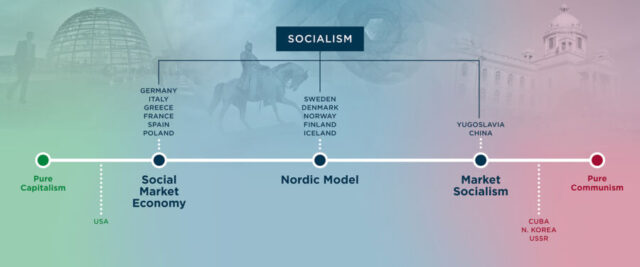
Our current US system is closer to the “pure capitalist” extreme. European nations, with their social market economy, are on “our” side of the spectrum, but closer to the socialist middle — with the Nordic lands edging farther along. With its strong central government control over an increasingly market-driven economy, China slides closer to the communist extreme — which is currently occupied by places like Cuba and North Korea.
Mainstream Democratic Socialist politicians in the US advocate for siding the US toward the socialistic middle of the spectrum, closer to the system that exists in much of Europe. Most of them are not proposing that we jam that slider all the way to communism — because, after all, that would be highly unsuccessful at the ballot box. To improve society and also win elections, they seek a balance.
Agree or Disagree… Vote!
Of course, you may not believe that moving toward a European approach is right for the United States. Critics of Democratic Socialism argue that increased taxation hampers entrepreneurship and spurs capital flight; warn that successfully introducing sweeping reforms like single-payer healthcare to the USA is far more complicated than it seems; and point out that a system that works well in a European country of 5 or 10 or 50 million people doesn’t necessarily scale to our giant country. These are important issues, worthy of serious discussion, upon which caring people can agree to disagree. But when a critic flatly dismisses a Democratic Socialist politician as a “communist,” it reveals that they are afraid to engage in an honest and healthy debate.
Politics can be complicated. And muddy definitions of terms don’t help. But hopefully this offers some insight into what is actually meant when an American politician talks about “Democratic Socialism” — and aspires to the system that much of Europe has found successful both for business interests and for the quality of life of everyday citizens. Ultimately, American voters will decide whether that’s the right step for the USA… starting on November 3.
Thanks for the thoughtful explanation Cameron!
Well thought out. There is too much jargonisim to confuse people.
No government can run anything well.
Well said!
I just spent 2 months in the Nordic countries and I can tell you they are way ahead of us in social well being; their countries are clean, the people happy and they don’t worry about going bankrupt trying to see a doctor. They have high trust amounst themselves and their government; Unlike the USA where people are discouraged and angry – and it shows in how we treat each other.
Excellent comment. I used to live in Europe and miss it very much!
True they can see a doctor for free but by the time they get the treatment they need they are dead. At least that’s what my European friends tell me.
Not true. Even my friends in London gets quick treatment and surgery. Myth. In France we have a shortage of doctors because the Ordre des médecins limited the number able to study medicine despite demographics showing boomers aging, but the same has been true with the AMA in the US.
This is a very popular, and misleading, line of reasoning among those criticizing single-payer healthcare. I have excellent health insurance. And yet, a few years ago, when my company switched insurance companies, it took me six months to get in with a new primary care doctor. Then, when that doctor moved offices, it took me another several months to get in with another one. I have acquaintances who waited a year or longer for a joint replacement or other serious medical procedure… all within the “superior” American medical system. Of course, publicly funded healthcare comes with its own challenges. But let’s be honest in comparing alapples to apples when looking at the highly flawed state of the American healthcare system. When I discuss the pros and cons of each system with Europeans, we all enjoy complaining about shortcomings. But in all honesty, I’ve never met a European who would willingly change systems with me. Frustrated as they may be, they simply can’t fathom the idea that healthcare is tied to employment. And most of them report generally good quality of care and reasonable wait times.
a real overstatement if ever I heard one. My son and family live in Norway and are healthy and quite happy with their healthcare.
When I was on an extended stay in Paris, I hurt my knee. I received prompt medical care (including MRI) with transparency of all costs.
I am not sure about that; but not much different than here. The ‘cure’ is worse than the illness-you get treated, are broke and still sick. Not sure what the answer is except to say its shameful that there is profit in pain.
My Social Security checks have arrived in my credit union account regularly for a quarter of a century, always the correct amount. But letters posted to Europe now take more than 2 months to arrive. Weather forecasts, especially about hurricanes, have gotten better and better, while public schools have constantly lost funding. State lotteries are run with skill, making the masses think they’re all going to be billionaires, while general revenues drop and potholes go unfilled. The government led us to victory in the biggest war in history, while making a sorry mess of many smaller wars. It’s a mixed bag.
May I add the thought that the Preamble of–not “to”–the Constitution lists six goals or purposes (Union, Justice, domestic Tranquility, common defence, general Welfare, and Liberty for all) describes social Democracy to a T? This is why the modern SCOTUS considers the Preamble merely a bit of rustic blether before the real Constitution starts.
All this discussion leaves a lot to ponder, but still, when international threats present themselves, it is the Capitalist United States of America coming to the rescue..
This is so helpful, Rick. And very important for today’s education and active discussion. I wish more everyday folks would travel and learn just as you do.
Thanks,
Arlene from Seattle
This is a very clearly written, thoughtful overview. It will be interesting to see whether our 40 year political swing toward pure capitalism will shift back toward a more equitable approach.
Ok with progressive taxation, but in the US there has never been an instance I can recall of an industry taken over and run by govt officials that came close to being as efficient and productive as the private sector.
Well they weren’t very efficient if they had to be taken over and or bailed out by the government; I’m thinking of the auto industry, the bankers after the housing crisis, and the Superfund sites where the corporations made piles of money and ran, leaving the government to clean up their messes. So government never does anything right? BS! Thank you Rick and Cameron.
What about Medicare?????
I lived in Denmark for 1.5 years. The citizens are healthy, happy, and productive. We could learn a thing or two from the Nordic countries.
I lived in Denmark and was not impressed by their system. My Danish friends tell me they get free healthcare but have to wait a very long to get the treatment they need, and by then their condition has advanced or they are dead.
Interesting because that is not what I hear from my Danish friends. I’m always amazed that their orientation really is toward the greater good whereas ours is encouraged to be individualistic dog eat dog.
Stick to travel and culture, and avoid economics and especially politics, which are way too loud from both sides of the spectrum. We don’t need more!
I majored in economics and earned a masters degree, which doesn’t make me an expert, but, these writings contain too
many superficial and inaccurate assumptions to list.
Stick to what you’re great at, and you are great at it!
Now that is well said, John. On top of that, Cameron left out way too many policy positions espoused by the DSA that make that party way left of center. I use Rick Steves because it’s a well run travel business, not because I want to hear his (or Cameron’s) particular political bent. I would much prefer not to hear his politics via channels that he has cultivated through his business and if it ever migrates to his tours so that I have to hear it on a bus ride or otherwise then I’m out and will use a competitor.
First, in what way is trying to better understand the European political system (and how it relates to the political debates we’re having in our country) anything other than “culture”? Travel isn’t just about pretty places, sightseeing, and good food. Thoughtful travel is also about trying to understand the ways other cultures approach the world.
Second, I would genuinely be interested to hear in what specific ways you think this piece is incorrect. Of course, as noted in the very beginning, there’s no way to cover a topic this complex without simplifying things. But I don’t think anything stated here is objectively false, even if you might not arrive at the same conclusion.
Amen!
My understanding is that the underpining concept of this company is that travel is a political act. Many of us who enjoy the great travel advice, understand this and appreciate it. Perhaps you should find another, less political, travel resource.
President Ronald Reagan stated in his 1981 Inaugural Address that “government is not the solution to our problem; government is the problem.” Best advice ever.
Follow up this article with how capitalism is beneficial to people and why it works in America. Your tainted, skewed article is very discouraging and we’re not buying what you’re selling.
Stick to travel tips.
I don’t understand the sharp rebukes of this being an “opinion” piece. It was presented as educational, trying to clarify the meaning of political/ economic terms used in Europe vs the US. The author listed potential problems with each system. So what’s the griping about? It sounds like critics wanted MORE complaints listed about the European systems. In that case, it WOULD become an opinion piece.
We can all guess where Rick and his staff lean politically. Perhaps people who disagree are reading into this what isn’t there. As someone who grew up during the Cold War with definite negative reactions to oppressive regimes, I appreciated the clarifications it provided.
Thank you for providing this analysis.
Great article and contrary to the above harsh and negative comments nothing was endorsed. No opinion was expressed. Information was presented.
As far as “sticking to travel” goes I would say part of the interesting and joyous aspects of traveling is learning how things are done in other parts of the world. Thank you for an informative article helping with that very thing.
I agree with you, Charley.
Thank you Cameron for this article. I appreciate when you help make travel thoughtful. No system is perfect and you are not making that claim. I am always interested in learning how Europe works.
Thank you for sharing this with us.
This is a very serious issue and while I appreciate your insight, I have traveled to many European places and the common folk I speak with are not happy with their level of taxes or healthcare. One of the bus drivers in Iceland we spoke with told us 46% of his salary is taken for taxes. This was not a man who was overly wealthy and in my opinion should have been able to retire at his age. There are two sides to every story and vary greatly in some instances. Every person should be doing their own research on this and coming to a solid conclusion personally. Thank you for taking the time to write about it.
Thank you for your essay Cameron. After having been on 14 RS tours, I can honestly say I’ve never met a European who would want to trade what their country offers in exchange for the American system when it comes to health care or education. I’m blessed to have worked in the public sector and I’m retired with an excellent pension and medical insurance. I wish everyone could be in my very fortunate position.
No government can be perfect (no matter the type) because they are all run by flawed human beings!
Remember, in addition to income taxes, in most of Europe a VAT is levied on most purchases. That applies equally to rich and poor alike. If the USA ultimately decides it wants a European system, everyone is going to have to pay for it.
That is the whole idea, T.J. Everyone pays a little more and nobody is bankrupted by unfortunate illness or accident. It’s a compassionate response to the idea “There but for the grace of God go I”.
Your sliding scale was so helpful in explaining the differences. The USA is so afraid of being communist that they are on the further end of the sliding scale from communism. And most people that are afraid do not understand at all.
My uncle aunt in Madrid spent so long for gall bladder surgery that she dipped into her life’s savings to travel to Miami sor surgery. I am not a selfish person however I don’t want to pay for your health care or education. Does this make me heartless?
I’m Canadian, currently spending 5 weeks in some Nordic countries so getting a superficial view and some impressions. I am impressed by the level of public infrastucture in remote regions, even with significant geographic and environmental challenges. The major cities I’ve visited don’t have anywhere near the obvious homeless population that we see in North American cities. I do understand that they have had issues with the manifestations of public drug use, but it appears they are having better success in addressing it. I was in Sweden for their recent federal election. Reading the platforms of the different parties, I was struck by some of the stated policies of the former governing centre right party. They’d be consdered off the charts left wing on our side of the moat so I can only assume that it’s reflective of a strong collectivist sentiment. Which brings me to your question about paying for someone else’s health care and education. If you believe in the concept of society (which is rejected by many neo-liberals such as the late Thatcher and Reagan) then these are considered to be in the public good, to be supported by taxation. Most wealthy western societies do so. The US is an outlier on universal public health care. Critics sometimes say that this reflects a fixation on individual rights vs. collective rights and obligations. These things are never absolute dichotomies. Thanks for the article, Cameron.
Holland is a great example. Their life expectancy exceeds the United States – largely due to their excellent health care system. I first learned about this from two USA doctors, Yale Medical Professors, when we were traveling together. I had a business that took me to The Netherlands every month for more than a decade. Their social safety nets, universal health care, care for their young and elderly, subsidized higher education – it was an underlying system that resulted in a society with far less anxiety about things Americans have to live with. Do I have good enough insurance, can I send my kids to college, will I be ok when I get older, what about long-term care? I would love if the USA had this. But, let’s be practical. All the above mentioned things are part of a larger difference in The Netherlands’ culture, their government, and their society. We can say, “we want that in the US,” but fail to consider that if we changed to have these things – we’d have to change many other things to how this small country does things to make it all work. It’s a recipe, not an ingredient that bakes the cake. Specifically, smaller European countries have more efficient governments. They have less medical litigation. They have far fewer kids falling out of the education system with no clear path on how to be contributing citizens. Before we balance the books on socialized medicine as NL has done, we have to make sure our society has enough contributing citizens vs. dependents. To be fair, we don’t have a great history for government programs actually working well, as Europe does. I mean, why do I pay UPS to deliver my package? We have a complicated drug approval system that is severely broken. We have attorneys posting highway billboards encouraging people to sue if they have a bad medical outcome. Until we dial back medical litigation to Europe’s level, change our educational system to the level of care and individual attention to each student, until we have borders and fair policies that define who can tap into our social safety net and who can’t – it just doesn’t work on paper. So while I’d love to have what the NL has, we have to talk about it as part of a broader landscape. I’d love to see the United States have a stronger social safety net, including a remake of our health care system. But I grow tired of tunnel-vision conversations about it.
And for what it’s worth, John Baranowski might be on to something when he said “Stick to Travel Advice.” I come from a marketing background. Research clearly shows that most people feel like John – they don’t want brands advocating their political POV’s. Recent surveys from Ipsos and Gallup show that at least half of consumers don’t want a brand to represent a political position to them. Some call it Epistemic trespassing. I thought the article was well-written and I learned some things, but at the end of the day, I’m with John on this one. Let’s talk about how to find public transportation for traveling in the Dolomites, shall we?
Stephen this is the most comprehensive and insightful comment on this entire chain. I’m with you. Cameron has a point that “culture” does entail political thought and he is entitled to share his thoughts on systems here and abroad but I honestly look to Rick Steves and his team for travel information, not political discourse
Very thoughtful reply. Thank you. I would push back a little bit on the argument that the U.S. has significantly worse health outcomes compared to some in Western Europe as a result of our healthcare system. There is a pretty good argument that mortality statistics are worse in the U.S. because of things that the healthcare system does not directly address. Automobile accidents, which are more likely and more likely to be fatal in the United States because we drive an awful lot more, shootings and other criminal violence, and a higher level of drug and other dependencies. Account for those, and our health outcomes are probably as good as Western Europe and even better in many respects. But the basic points you make, 1. Smaller European countries operate differently than the United States does, for better or for worse, and are not directly comparable.
2. I love Rick Steves, but isn’t there somewhere I can go to just read about travel?
Most European countries’ life expectancies exceed the US.
The US is number 55 behind Hong Kong, Japan, South Korea, French Polynesia, Andorra, Switzerland, Australia, Singapore, Italy,Spain, Reunion, France, Norway, Malta, Guernesey, Sweden, Macau, UAE, Iceland, Canada, Martinique, Israel, Ireland, Qatar, Portugal, Bermuda, Luxembourg, Netherlands, Belgium, New Zealand, Guadeloupe, Austria, Denmark,Finland, Greece, Puerto Rico, Cyprus, Slovenia, Germany,UK, Bahrain, Chile, Maldives, Isle of Man, Costa Rica, Taiwan, Kuwait, Cayman Islands, Faroe Islands,Oman, Czech Republic, Jersey,Albania, Panama, UNITED STATES.
2023 UN estimates of life expectancy.
Anything to be learned elsewhere?
Pick up one of Rick Steves’ excellent travel books for the Dolomites region, and you will find this information. If you don’t want to read an excellent article and discussion of different government systems in Europe as compared to the United States, don’t read the article.
Right on, Linda.
We were blessed with free will, don’t forget to use it when making even everyday decisions.
I found the article useful because of th3 use of data to support his POV.
Without data, we are someone simply offering a subjective opinion.
Choose wisely, Grasshopper ☯️
I appreciate the “simplified” explaination. I just returned from a trip to Spain that included using the railway and bus systems before joining a RS tour of Andulasian Spain
I think there is much we in the United States could learn.
I just got back from spending a month In Sweden and Aland Island in Northern Europe. I was visiting a number of my partner’s relatives who are still living there. Over the past 100 years or so large numbers of people from the nordic countries have moved to the US. My ancestors moved to the US from Switzerland, Germany, and Ireland. I am not aware of any of our relatives who have moved back to those countries for good. My point, If Europe is so great why is there not a big migration of Americans back there?
I have lived most of my life in California, the State many people say is so horrible for people to live. I have no plans to move back to where my ancestors came from?
So exactly why do we want to copy countries who have sent us millions of immigrants over the last couple of centuries?
At this moment there’s a very large exodus of Americans arriving in Europe to live. Where I live, I can no longer count all the newcomers. Americans now account for the highest number of NEW residence visas in many countries. I don’t know about visa renewals, but I’ve read headlines about highest first-year visas for a few years in a row.
An important consideration not mentioned is the huge cost of the military that US taxpayers have to support. What percent of GDP does Denmark devote to its military? Not much I’ll bet. No wonder they’re so happy, they let the US taxpayer shoulder that burden.
Understanding the culture, economic priorities, and political situations in countries I visit is important to me and provides context in order to understand. I appreciated Cameron’s well thought out and informative article.
Travel is more than “…Let’s talk about how to find public transportation for traveling in the Dolomites, shall we?” For that, you can ask a quick question on your phone.
What I value (and why I travel) is to learn more and understand better, and for that you have to be curious and keep asking why. Isn’t that the true value of travel?
Thanks for the explanations of the different systems, Cameron. I favor U.S. capitalism with continued study and consideration of the Nordic model.
All the folks complaining about this blog post being too political seem to have read it. If you’re only here for travel advice, you can click to another section. I thought the explanations here were clear and measured — and that’s all the author tried to convey.
Thanks for the thoughtful writing, Cameron.
I understand how people have divergent views but why the anger from many of the naysayers?
Thanks for the information and explanation of the spectrum. We just returned from a European trip. One night in Munich at a busy restaurant we were seated at a table with another couple. Lucky for us they spoke excellent English. He was French and she was from Taiwan also there on holiday. We had an interesting discussion about how so many countries, not just the U.S. and France, are experiencing such a loud political “right” and “left” that leaves little room for the “center” voices and ideas.
Thank you for this well written article. I have family in Spain and Germany and they get excellent healthcare and have a good quality of life. Plus I have respect for Rick and his political view of travel and his politics. He’s living his values. Keep it up.
Very good article! I am still digesting and discussing this 2 weeks later. I would love to join a discussion group on this one. Thank you, Cameron.
Well explained. Though I would argue that the US is not closer to pure capitalism. Pure capitalism would not bail out failing companies or industries. Our capitalism would not redistribute wealth upward and give massive tax rebates to corporations. We are also a “welfare state,” we just give welfare to corporations instead of people.
I firmly fall into rank of the Nordic Model or the Social Market Economy models after 36 years in the professional workforce and 44 years of working.
Though I can go on forever, a key one is that Europe now outpaces the U.S. in social mobility.
• World Economic Forum (WEF) Rankings: In global social mobility indexes, European nations take the top spots—led by Denmark at number 1—while the United States ranks 27th.
• Generational Timeframe: According to WEF data, it takes about 2 generations in Denmark and 3 generations in Nordic countries (Sweden, Finland, Norway) for a child from a low-income family to reach the median income, compared to significantly longer spans in lower-mobility countries.
• Bottom-to-Top Quintile Mobility: Harvard University studies (Alesina, Stantcheva, Teso) show that bottom-to-top income quintile movement is lower in the U.S. (7.8%) compared to European peers like Sweden (11.7%), France (11.4%), and Italy (10.0%).
Why does Europe outpaces the U.S. in Mobility?
Public Investments. Many Western European nations invest heavily in universal healthcare, low-cost or free higher education, and comprehensive social safety nets, which protect lower-income families from sudden bankruptcy due to medical or educational debt.
Perception vs. Reality: Research highlights a major gap in mindset. Americans strongly overestimate their actual chances of upward mobility (perceiving an 11.7% chance vs. 7.8% actual), whereas Europeans tend to be more realistic or pessimistic about class barriers.
Economic Inequality: The U.S. experiences higher overall economic inequality and less labor union penetration or social insurance compared to high-income peer nations, making the “American Dream” of climbing the ladder statistically harder to achieve than in Northern and Western Europe.
The biggest culprit in the U.S. is what is variously known as trickle-down “economics”, supply-side “economics” or Reaganomics. The upward shift of wealth to the upper clases — those least in need of it — has devastated the middle, working and working poor classes.
My dad’s family left Germany around 1820 and my mom’s family left what is now Slovakia because of the lack of social mobility. Today it would make sense for me and my family to emigrate to Europe, where there is more social mobility.
Another thing I might add but my comment disappeared. Europe literally would not exist in it’s current state without NATO upon which the largess of support and military backing is provided by the US. You literally can experiment and afford to live like you want and claim it’s a superior model all the while throwing darts at the US, the very country that is between you and being overrun by much more powerful aggressors. Ukraine today and Taiwan tomorrow as prime examples. Either of which will fall without the US. Taiwan may not matter to you but if Ukraine falls they’re on the doorstep of Europe. Boots on the ground would be the only solution, who would go, you? The US also exports more innovation in the world, food, medicine(COVID), etc. than any country and Europe. So enjoy your DS model just don’t pretend that either the US, Russia, China the world’s superpowers could survive and that you could if we abandoned our NATO commitments and other support. Just like when Hitler overran Europe there’s always wolves at the doorstep waiting all these years since 1945 to once again overtake you and others.