To celebrate the season, I’m sharing clips, extras, and behind-the-scenes notes from Rick Steves’ European Christmas. Today we travel to Austria, where the festive swirl of heartwarming sights, sounds, and smells of Christmas abound. This is where the season’s most-loved carol, “Silent Night,” was first performed over 200 years ago.
We knew that filming an intimate family Christmas feast would not necessarily come out natural and fun-loving on TV, so we filmed two and picked the best. The Bavarian family the German Tourist Board lined up for us tried hard. But the evening just felt stiff. We spent long hours feasting and filming with them, but ended up with nothing usable.
Thankfully, just over the border, the traditional Austrian family we filmed the next night exceeded all hopes. They took me dashing through the snow in a two-horse open sleigh. By the way, as you watch this clip, imagine the stress of knowing that in 15 minutes, the light will be gone and the delightful sleigh bit will become unusable. We scrambled to reach their home late after a long day of filming and had to really keep things moving along — cutting the friendly welcomes (without being rude to the kind and eager people who have no idea how critical the fading light is), and getting the horses all in gear and clip-clopping merrily past the cameraman.
Then, at the door of their gingerbread-cute yet massive home, the entire family greeted us with a Christmas yodel. Inside their time-warp home, a classic grandma was making cookies with children you just had to pinch, an old Habsburg grandpa played the zither, Mom lit the advent wreath while teaching her child the significance of each candle, and Dad blessed the house from the attic to the barn with incense as his daughter sprinkled holy water with a sprig of spruce. (Part of my goal with this program was to explain the meaning behind some of our rituals — like the Advent wreath — in a traditional European context.) The parents secretly decorated the tree, placed the gifts, and lit the real candles. They rang the bell, and the kids tumbled into the room, filled with wonder. When our cameraman smiles as he films, I know we’re getting good footage.
Austria had its musical ups and downs. I was excited to experience the ritual reenactment of the first performance of “Silent Night” in Oberndorf, the village where it originated. We scrambled to get out there on Christmas Eve and set up at the several spots where events were taking place. But it was basically a muddy, touristy mess, with underwhelming music and not a hint of the magic we had naively hoped for. I managed to persuade the musicians to perform a private little concert for us in the church, so we at least filmed “Silent Night” as it was first performed (two guitars and two singers). My Christmas Eve dinner was the last two bratwursts on the griddle with a stale roll, snapped up just as they were closing down the tent.
Racing back into Salzburg to salvage something of Christmas Eve, we hiked to the abbey where Maria of “The Sound of Music” caused her fellow sisters to sing, “How do you solve a problem like Maria?” The sisters had agreed to let our crew be present at their holy Mass, but I guess they didn’t understand we wanted to actually use the big camera we lugged up the hill. When we got there, they said no camera — just a microphone. Our soundman carefully set up the microphone stand to the side of the altar facing the choir of nuns (as I sat in the back, happily humming “Climb Every Mountain”). Suddenly, the old but very spry Mother Superior dashed across the altar in the direction of the out-of-sight nuns’ choir. Seconds later, our sound man was evicted — dragging all his gear, along with his tail between his legs, out of that restricted holy zone. He had to set up the mic farther back in the nave, making the recording unusable.
Thankfully, the next day — Christmas morning — we were given a royal perch from which to shoot in the Salzburg cathedral as a huge orchestra and choir filled the place with a glorious Diabelli Mass.
St. Sebastian Cemetery is a quiet oasis in Salzburg. Follow me for a little walk and enjoy a rare opportunity to drill deep into the mausoleum of a prince-bishop. All over Europe I enjoy evocative cemeteries. Do you have a favorite?
This is Day 56 of my 100 Days in Europe series. As I research my guidebooks and make new TV shows, I’m reporting on my experiences and lessons learned in Vienna, the Alps, the Low Countries, England, and beyond. Find more right here on my travel blog.
Cameron Hewitt (my wonderful co-author and fellow guidebook researcher) is at it again. He’s giving a sacred tourism cow a hard, non-dewy-eyed look: this time, it’s the Sound of Music tours. On assignment to update the Salzburg chapter of our Vienna guidebook, he was confronted with a classic guidebook researcher challenge: Two companies offer the same tour. Which is the better value for our traveling readers?
To find out, Cameron spent two half-days on buses surrounded by S.O.M. aficionados singing “Doe, a Deer.” In this take — or is it a “takedown”? — Cameron freely admits he’s not a fan of the movie…and it shows. S.O.M. fans, click through only if you have a sense of humor. Here’s the full report. (Full disclosure: The Sound of Music was so big in my family that my father actually named his piano business “Steves’ Sound of Music.”)
Cameron is reporting on his summer European travels on his blog. If you enjoy Cameron’s take on Europe, be sure to also “like” his Facebook page — he’s just wrapping up Austria, and will be reporting soon from Budapest, Bulgaria, and Romania. Don’t miss out on Cameron’s keen insights.
On my first solo trip to Europe, in 1973 — just after high school graduation — I wrote postcards home nearly every day. I packed so much information onto each card that it was a challenge to read them without a magnifying glass. Looking back on these exuberant little reports back to my family (42 years later!) I can see a travel writer in waiting. While the writing is pretty goofy and the spelling may be off, the passion for experience was solid. (I would even tuck a little piece of sauerkraut under the postage stamp in an attempt to share the wonder of my experiences.) Here’s a card from Austria.
7-29-73
Hi Grandma + everyone. I’m in the Salzburg Train Station now + we just finished a beautiful stay in the music capitol of the world. Well now – where was I? I think we were leaving Reutte. Well we got to lnnsbruck late + the hostels were all full so we decided to spend a free night on the porch of the hostel. We left our packs there + walked around the town, rather aimlessly, just killing time till it was dark + everyone was asleep. We saw the old + nice section of Innsbruck, bought their version of a hot dog + returned to our hard, cold, but FREE bed. We had some bouillon + then went to sleep. We got up around 6:00 + quietly packed + left. We checked our packs at the station + saw 3 more hours of Innsbruck. It’s a nice town but it didn’t deserve any more of our time. We bought another grocery store feast + caught the 9:30 train to Salzburg. The ride was a real experience. We snuck into the first class section + in our room we had a rich pansy stuck up lady from New York, a Vienna Monk trying to convert the world to the universal language of Esperanto + 2 nice Austrian girls who spoke a little English. The lady from New York was a real character to say the least (she told me I wouldn’t look so Bohemian if I’d cut off my beard + then she wanted me to carry her bags off the train for her! – No way.) Well we got to the Salzburg by 12:30 + that was lucky ‘cause the place was jammed. We found a nice double in the beautiful old part of town for $7.20 (That was the best price anywhere) + then we took off to take in the town. We tried to find out all about what concerts there were tonight + we were lucky to find a ticket to a chamber music concert in the palace at 9:15. It cost us 66 shillings or $4.50. Then we just strolled around one of the world’s neatest towns. We saw a Tyrolean band in the street + listened to music coming out of the walls everywhere. We went back to our hotel (must be a good 400 yrs old) + had a nice dinner in our room (bouillon, peanut butter + jam + Ginger Ale), dressed up the best we could + hobbled back to the center. We were doing so much walking that our feet rattle + legs are killing us. We walked around some more (that in itself is an experience) + then walked through some Royal gardens to the Palace + upstairs to a solid gold, fancy room where the chamber music takes place. We heard a sextet from Munich (2 horns, 2 clarinets + 2 bassoons) + they played Beethoven, Mozart, Haydn, another one + an encore. Whoever thought I’d spend $4.50 for a chamber music concert. It was really a thrill – one of the highlights of our trip + a cultural highlight of my life (along with Rod Stewart, Mick Jagger + The Who). It was just unbelievable how good they were. Then we walked home + I stopped by a discotheque for a few minutes to keep well rounded. We slept like logs + even overslept till 9:30. Then we gulped breakfast + dashed to the huge 1,200 yr old Salzburg Cathedral to see + hear a Mass. The music was a concert in itself. They had 3 choirs a pipe organ a brass ensemble + a small orchestra + the acoustics were heavenly. Ooo if our high school band director, Mrs. Dezzle, could see me now! Then we climbed to two castles to see two different + cool views + then we checked out of our hotel + headed to the station where we are now. The sun is finally out so everything’s cool. It’s back to Germany tonight (Passau) + then Rödhammers (Jan’s ski teacher’s parents) + then Vienna. Ooo ooo Tuttie! Have fun + see ya in 4 weeks. Love – RICK.
I love my guidebook research days. In Salzburg, I had no particular plan, and another action-packed day just unfolded. There’s always so much to do. My guide met me at 10:00 a.m. We popped into Mozart’s House to check out the new displays and audio tour. Then she drove me to a new Salzburg sight—Mr. Red Bull’s place. I wrote this entry:
Fast living and high energy at Salzburg's Red Bull Hangar 7
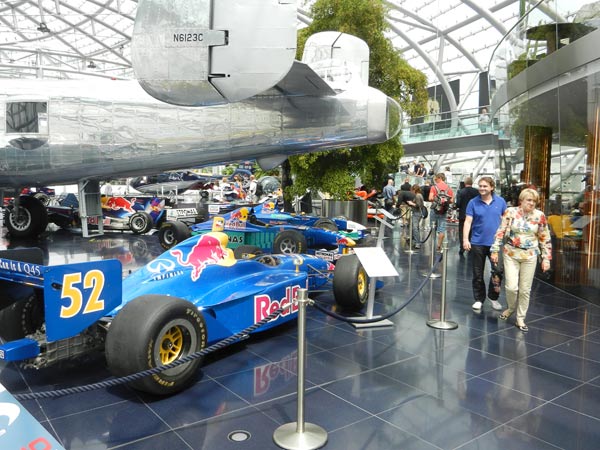
Red Bull Hangar-7 — Salzburg’s big personality these days is the tycoon founder of Red Bull energy drink, Dietrich Mateschitz. He has a mysterious mansion at the edge of town, sponsors the local “Red Bull” soccer and hockey teams, owns several chic Salzburg eateries and cocktail bars, and employs 6,000 mostly good-looking people. It seems his personality is like the energy drink that made him rich and powerful — a high-energy, anything’s-possible cultural Terminator.
Hangar-7, a renovated hangar at the Salzburg airport, celebrates Red Bull culture. Under its modern steel-and-glass dome are 20 or so glittering planes and racecars and several pretentious bars, cafés, and restaurants. While things are described in German, visitors can borrow an iPod Touch with English information (free, daily 9:00-22:00, bus #8 from Hanuschplatz to the Salzburg airport, hangar-7.com).
At Hangar-7, the Mayday Bar serves experimental food, and Restaurant Ikarus features a different well-known chef each month. Mateschitz’s Carpe Diem cocktail bar in the Old Town is also Red Bullish.
Then we popped by Hellbrunn Castle, with its fine gardens and famous trick fountains. For years, I’ve panned the palace. I revisited and, like so many sights, it’s much improved. I wrote this entry:
Hellbrunn Castle and Gardens — About the year 1610, Prince-Archbishop Sittikus decided he needed a lavish palace with a vast and ornate garden purely for pleasure (I imagine after meditating on stewardship and Christ-like values). He built this summer palace and hunting lodge, and just loved inviting his VIP guests from throughout Europe for fun with his trick fountains. Today, Hellbrunn is a popular sight for its palace, formal garden (one of the oldest in Europe, with a gazebo made famous by The Sound of Music), the tour of its famous trick fountains, and simply for a chance to get out of the city.
Upon arrival, buy your fountain tour ticket and get a tour time. Tours generally go on the half-hour. The 40-minute English/German tours take you laughing and scrambling through a series of amazing 17th- century garden settings with lots of splashy fun and a guide who seems almost sadistic in the joy he has in soaking his group. (Hint: When you see a wet place, cover your camera.) If there’s a wait until your tour, you can see the palace first.
The palace, inspired by the Venetian architect Palladio, was built in a style popular around 1600. It was a cultural destination back in the 1600s, when the ritual was hunting in the morning and enjoying an opera in the evening. The first opera north of the Alps, imported from Italy, was performed here. The decor is Mannerism (between Renaissance and Baroque), with faux-antiquities and lots of surprising moments — intentional irregularities were in vogue after the strict logic, balance, and Greek-inspired symmetry of the Renaissance. (For example, the main hall is not in the center, but at the far end.) With the help of the included audioguide, you’ll wander through the palace exhibit and — to the sounds of shrieking tourists below on the fountains tour — enjoy hunting themes and learn about the impressive 17th-century hydraulic engineering that let gravity power the intricate fountains.
You’re then free to wander the delightful garden grounds and pop out to see the gazebo made famous by the “I am 16 Going on 17” song in The Sound of Music.
Taking full advantage of my guide’s car, we then dropped by four countryside farmhouse B&Bs I recommend, each on a handy bus line into the center of Salzburg. Here’s an example:
Frau Ballwein rents 11 cozy, charming, and fresh rooms in a delightful and family-friendly farmhouse. Some rooms come with intoxicating-view balconies (Sb-€38, Db-€55, Tb-€75, Qb-€85, 2-bedroom apartment for up to 5 people-€95, €10 more during festival, no surcharge for one-night stays, cash only, farm-fresh breakfasts amid her hanging teapot collection, non-smoking, free Wi-Fi, 2 free loaner bikes, free parking, Moosstrasse 69a, bus stop: Gsengerweg, tel. 0662/824-029, www.haus-ballwein.at, or email haus.ballwein@gmx.net).
Saying goodbye to my guide, I popped back to my hotel, where Marianne and her wonderful family (who run the place) made me a schnitzel. Then, with Marianne tagging along, I zipped over to the main square in the Old Town to catch the daily walking tour. I’ve done tours like this one many times, but another guide told me the guides who did this particular tour were not good — and, because I recommend the company in my book, I needed to check. They didn’t know who I was; I paid the €9 and was one of three people on a great 90-minute walk. Even with just a handful of tourists, they split the German-speakers and the English-speakers into two groups, so we didn’t have to listen to two languages. Our guide was excellent.
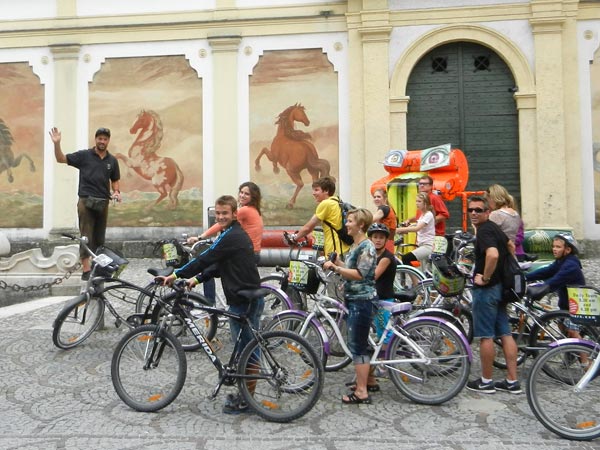
Enjoying some Sound of Music nostalgia on two wheels with Herr Rupert
Marianne and I then zipped over to catch the 16:30 Sound of Music bicycle tour. It’s called “Fräulein Maria’s Sound of Music Tour,” but it’s run by a burly young man named Rupert. (As Austrians barely know what the Sound of Music is all about, getting a handle on this quirky touristic phenomenon was particularly interesting for Marianne.) It was a delightful tour, and now I can capably compare it to the Sound of Music bus tours.
We had to cut out half an hour early in order to catch the 19:30 marionette performance of The Magic Flute. Of all the musical venues in Salzburg that I recommend, this was one I’d never actually experienced. After the performance, I could write it up with more confidence:
Marionette Theater — Salzburg’s much-loved marionette theater offers operas with spellbinding marionettes and recorded music. A troupe of 10 puppeteers — actors themselves — bring the artfully created puppets at the end of their five-foot strings to life. The 180 performances a year alternate between The Sound of Music and various German-language operas (with handy superscripts in English). While the 300-plus-seat venue is forgettable, the art of the marionettes enchants adults and children alike (€24-35, May-Sept nearly nightly at 17:00 or 19:30, near Mozart’s Residence at Schwarzstrasse 24, tel. 0662/872-406, www.marionetten.at).
After the concert, we hopped into a taxi to go extremely local at the Augustiner beer garden (my favorite dinner in Salzburg), which is written up this way:
Augustiner Bräustübl, a huge 1,000-seat beer garden within a monk-run brewery in the Kloster Mülln, is rustic and raw. On busy nights, it’s like a Munich beer hall with no music but the volume turned up. When it’s cool outside, you’ll enjoy a historic setting inside beer-sloshed and smoke-stained halls. On balmy evenings, it’s like a Renoir painting — but with beer breath — under chestnut trees. Local students mix with tourists eating hearty slabs of schnitzel with their fingers or cold meals from the self-serve picnic counter, while children frolic on the playground kegs. For your beer: Pick up a half-liter or full-liter mug, pay the lady (schank means self-serve price, bedienung is the price with waiter service), wash your mug, give Mr. Keg your receipt and empty mug, and you will be made happy. Waiters only bring beer; they don’t bring food — instead, go up the stairs, survey the hallway of deli counters, and assemble your own meal. Classic pretzels from the bakery and spiraled, salty radishes make great beer even better. For dessert — after a visit to the strudel kiosk — enjoy the incomparable floodlit view of old Salzburg from the nearby Müllnersteg pedestrian bridge and a riverside stroll home (open daily 15:00-23:00, Augustinergasse 4, tel. 0662/431-246).
Marianne guided me deep into the local cuisine — all the way to horse-tongue salad (her favorite…I tried). We finished the day, after marveling at the beauty of floodlit Salzburg from the riverbank, checking out the bars on Steingasse. I’m not big on late-night listings in my guidebooks, but Salzburg is so accessible, and there’s a string of boomer-friendly cocktail and wine bars on a very characteristic old lane. Drinking there with Marianne, who pretended to be American, I had someone who could actually understand all the German being spoken as I made my rounds, giving me a wonderfully candid understanding of just how friendly they were to tourists.
I list all of this because, even though I enjoy the advantage of local friends, any traveler who equips himself with good information and expects to travel smart can amass plenty of lifelong memories in a single well-organized day.