Appreciating Touristy Rothenburg

Rothenburg is one of Germany’s most touristy towns. And I absolutely love it.

For years I searched for the elusive “untouristy Rothenburg.” There are many contenders, but none holds a candle to the king of medieval German cuteness. Even with crowds, overpriced souvenirs, Japanese-speaking night watchmen, and, yes, even Schneeballen, Rothenburg is best. Save time and mileage and be satisfied with the winner.

I just finished my research visit to Rothenburg (updating my Rick Steves’ Germany guidebook for 2015), and today and tomorrow, I’ll share a few thoughts, along with a handful of photos.

One thing I added to our Rothenburg chapter was a fun little shopping walk, which leads down the charming main drag, Spitalgasse. I always like to give a new walk I’ve written one last run-through before leaving town. Fun things always happen, and I can add them to my chapter.

Strolling through town as I followed my own tour, I met the owner of an etching shop I mentioned. What I learned from him let me bring more life to his listing:

“At Kunsthandlung Leyrer, Peter Leyer would love to show you his etchings. He’s one of the last artisans using the copper plate technique of Albrecht Dürer to print his art. (After Peter retires in 2017, his 3,500 copper plates from all over Germany will go to a museum.) Peter and his wife print the black-and-white etchings, and then watercolor them in.”

When you travel for several decades, as I have, you see the slow churning of traditions and lifestyles as small family-run enterprises give way to the rising tide of giant corporations. Small hotels, shops, pubs, and so on simply don’t have the economy of scale to compete, and eventually they get washed away. (Particularly insidious are giant chains faking like they’re one-offs that care about their communities; English pub chains are expert at this.) Shops like Peter’s — so real, yet becoming so rare — are a joy to stumble upon.

Do you have any favorite small medieval town in Germany that rivals Rothenburg?


Plonlein-Rothenburg.jpgPlönlein, a famously picturesque corner in Rothenburg, is named for the carpenters’ plum line — a string anchored by a plum, creating what gravity guarantees is a straight line. Of course, in this centuries-old town, nothing is “to plum.” If you look up the lane from here, you can see some cute pastel buildings that stand straighter. Being uniform and perfectly to plum indicates they were rebuilt after WWII bombings hit this part of town. By the way, if this image brings you back to your childhood, that’s because it inspired the animators of Walt Disney’s Pinocchio (1940).


man-with-etchings-in-Rothenburg.jpgPeter Leyer makes his etchings the old-fashioned way — just as Albrecht Dürer did more than 500 years ago. Meeting artisans who lovingly carry treasured traditions into the 21st century inspires me.


Rothenburg-country.jpgIn my various lectures, I’ve long driven home the point that in the Middle Ages, today’s Germany — the size of Montana — was made up of hundreds of tiny states. I just found a painting in the streets of Rothenburg that helps visualize the fragmentation of feudal Germany. This painting shows a bird’s eye view of the “country” of Rothenburg in 1537. Back then, Rothenburg actually ruled its own little state — one of about 300 petty dukedoms like this that made up what is today’s Germany. It was 12 miles by 12 miles (or about the size of Denver), with 180 villages.


blue-hourOne evening after dinner, I simply found myself wandering Rothenburg’s cobbled lanes at that moment when the lamps and the sky hold hands — when the sky is no brighter or darker than the streetlamp-lit buildings. The next day I mentioned it to a local friend, who said, “That’s what we call ‘die blaue Stunde’ — the blue hour.” (I was so distracted by the experience, I forgot to take a photo. This one’s by one of our tour guides, Cary Walker.) I’m glad that I now have a term for my favorite time of day in a medieval town.
Old History Enters a Young Mind

One of the best evening hours north of the Alps is the Night Watchman’s Tour in Rothenburg, Germany. There’s a pub in town called Hell. Part of Georg Baumgartner’s tour is a predictable yet really funny joke ending with “Go to Hell.” With each visit to Rothenburg, I go to Hell with Georg for a drink and to catch up.

For about 20 years, Georg has given his tour in English, and then in German, every single night from Easter through October. The Cal Ripken Jr. of tour guides, he’s never missed a night. And, incredibly, his delivery is still as fresh as if he’s just coming up with it for the first time. On this particular evening, I was impressed with a cute little American schoolgirl and how enthralled she was with the stories Georg was weaving. Watching her watching Georg, I was seeing the impact of travel on each of us when we embrace experiences, open our childlike eyes really wide, and take it all in.

If you can’t see the video below, watch it on YouTube.

Prague Trumps Rothenburg

Enlarge photo

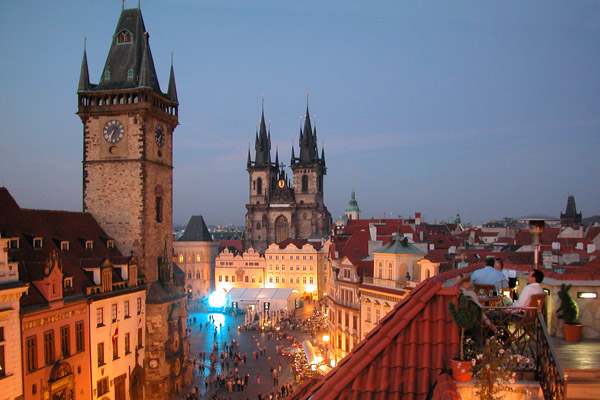
To commemorate the Smithsonian Presents Travels with Rick Steves magazine — now on sale online, and at newsstands nationwide — Rick is blogging about the 20 top destinations featured in that issue. One of those destinations is Prague, Czech Republic.

I’m currently on a Central European swing, updating my guidebooks: Budapest, Prague, Vienna, Munich. Being back in Prague reminds me of how that city first broke down the Iron Curtain in my guidebooks many years ago.

On a research trip back in the 1990s, I was on a train heading to Rothenburg to update the ultimate medieval town in Germany, as I did nearly every year. For a decade, I’d been diligently visiting to check the woodcarvings, walk the old wall, visit the toy museum and the medieval crime-and-punishment museum, and check in with old friends who run the hotels and restaurants that serve the town’s hordes of tourists. The work was almost mechanical. Socially, it was a happy homecoming. The ramparts and cute lanes were filled with my readers, who cheered me on. I loved going to Rothenburg.

This was just a couple of years after the end of the Cold War. The obvious new frontier of European tourism was the mysterious East. The former Warsaw Pact countries were now wide open and eager to welcome Western travelers. I knew that sooner or later, I’d tackle the region and expand my guidebook coverage there. But it was overwhelming, and, psychologically, it was easy to just keep redoing the Rothenburgs of Western Europe. I was daunted by the job — a bit lazy…dreading the unavoidable truth that if I was to cover Europe, I would now need to stretch east.

I was rattling down the tracks in the direction of Rothenburg, when I realized the very train I was on would end its run in Prague. I started comparing the value of spending the next three days in Rothenburg versus doing a groundbreaking research stint in Prague. I stayed on that train and didn’t get off until the Golden City of a Hundred Spires. I jumbled my itinerary a bit to accommodate the new job, and what followed was one of the most exciting and rewarding weeks of research I can remember. I left with Prague now in the realm of what we covered.

That first Prague chapter needed a home, and the only home we had for it was splicing it into our existing Germany, Austria & Switzerland guidebook. What was called “GAS” in my office would now be “GASP.” (Over the years, GASP became GAS, then GA…until finally there were separate guidebooks for each of the four destinations, including Prague.)

With the beautiful co-author partnership of Honza Vihan (our good friend and super guide from Prague), Prague joined the elite league of cities that merited their own Rick Steves guidebook (along with London, Paris, Venice, Florence, and Rome). Cameron Hewitt took this Czech nucleus and expanded into another five countries (which I termed the “Louisiana Purchase” of Europe) — Poland, Slovakia, Hungary, Croatia, and Slovenia — co-authoring my Eastern Europe guidebook, and then two others (on Croatia & Slovenia and Budapest). Today Eastern Europe is fully integrated into our Europe-wide program, with four different guidebooks and six different bus tour itineraries.

And it all started in that year when Rothenburg went unresearched and a seed was planted in Prague.

Euro Experiences from NW to SE — Part II

Enlarge photo

Enlarge photo

Enlarge photo

Let me stoke your travel dreams by sharing some of my favorite European experiences, roughly from northwest to southeast. Maximizing the experience is a dimension of smart budget travel that’s just as important in challenging times as saving money. Imagine these…

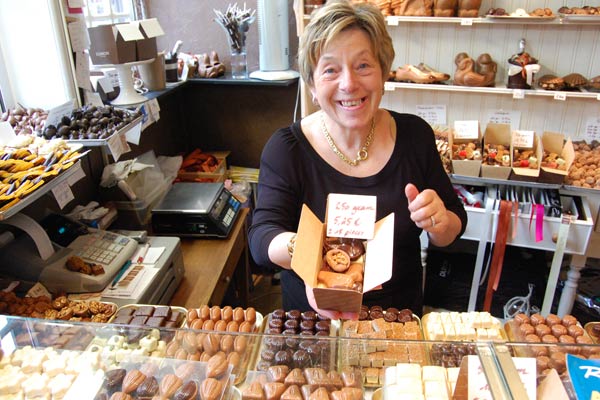
Nobody does chocolate like the Belgians. There’s something elegant about dropping in on the most expensive chocolate-maker in town—there’s one in every Belgian burg. Find a place that’s family-run, where locals buy their chocolate fresh, and people expect the shop to close on hot days because quality chocolate can’t survive the heat. Skip trendy “gourmet chocolatiers” who serve their chocolates with gimmicky flavors from gorgonzola to ginger—go for the purists.

A big percentage of American tourists visit Belgium as pilgrims…beer pilgrims, traveling all the way to that country to savor its plush and creamy beer. Hang out with devotees for a few nights and became a believer. My favorite Belgian evening is spent in an upscale pub, savoring a monk-made Trappist Blauwe Chimay (for example) with a rustic plate of bar food with locals who are both patriotic and evangelical about their Belgian brew.

In Holland, the “pilgrims” are more likely focused on the marijuana scene. Even if you’re not interested in smoking, drop by a “coffeeshop” for a whiff of its ambience. Baristas are patient in explaining to awkward Yankees how things work. Then, make an education out of the experience—talk to a local policeman, getting his take on why the Dutch stopped arresting pot smokers in 1976 and why this approach works. (I know, I just can’t pass up an opportunity to talk drug policy. To see the interesting “America’s Top Ten” list I just made in Coed Magazine, click here).

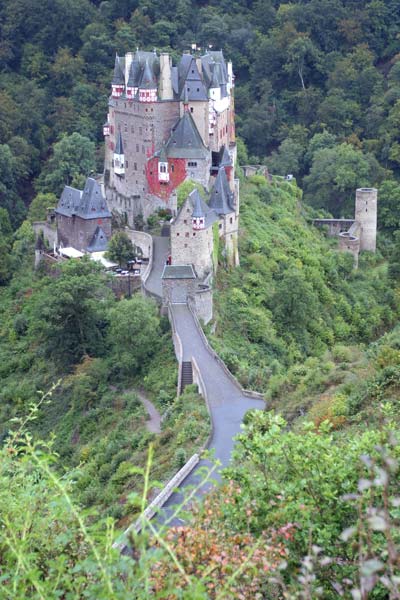
In Germany, my favorite castle experience is at Burg Eltz. Nestled in an enchanted forest just above the Mosel River, the Eltz castle is lovingly cared for by the aristocratic family that has called it home for centuries. The noble lady still puts out fresh flowers for her many visitors. Hike in from the train station and the experience gains a kind of magic. After an hour climbing under gentle trees through an ancient forest where you’d expect Friar Tuck and Martin Luther to be hiding out, the castle of your fantasies suddenly appears.

Every traditional German beer hall or Bierstube has a table for regulars—just look for the Stammtisch sign. To sample German conviviality at its best, make friends with the Stammtisch gang and get invited to join them at their table. Alternate between sniffing snuff (snorted from the “anatomical snuffbox” created by lifting your thumb high above your first finger) and drinking local schnapps. Before you know it, you’re leading the gang in a rousing rendition of “Country Roads.”

While perhaps the most touristy thing to do in Germany’s most-touristy town, following Rothenburg’s Night Watchman around on his evening rounds is a medieval hoot. Walk the town’s dark and evocative back streets with Georg Baumgartner, the wildly entertaining character whose delivery makes you forget what century you live in. While mobbed with tourists in mid-day, Rothenburg empties at night, when its flood-lit ramparts are all yours.

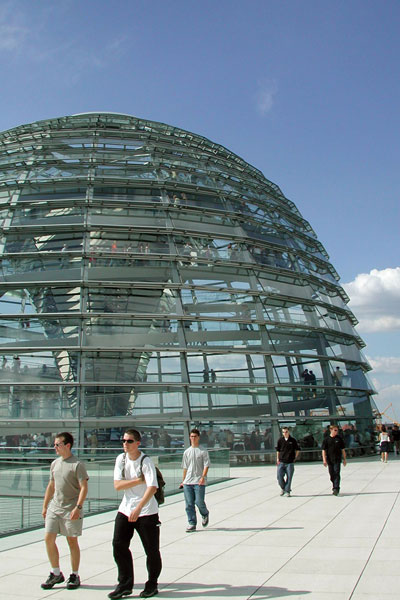
Climb the shiny glass dome that now caps the Reichstag (parliament building) in Berlin—for me, the most energizing thing to do in Germany’s most-energized city. From the top, look down on Germany’s legislators at work. You’re surrounded not by tourists but by Germans, who are determined to get politics right from now on.

The Characters of Rothenburg

Why do I still love Rothenburg? Everyone in the town makes their living off tourism. The place is stampeded midday with visiting tour groups. The town even created its own traditional pastry — the Schneeball(“snowball”) to compliment all the faux-traditional Christmas ornaments it sells. Yet when I pass through its medieval gates, I feel like a kid who just got a three-day pass for all the rides at Disneyland.

I used to think I liked Rothenburg for the medieval lifestyles on display in Germany’s best-preserved medieval town. The ramparts are intact — complete with arrow slits. The fish tanks next to the water fountains still evoke the days when marauding armies would siege the city, and it would survive on the grain in its lofts and the fish in its tanks. The night watchman stokes his lamp and walks wide-eyed tourists through the back lanes, telling stories of hot oil and great plagues. The monastery garden still has its medicinal herbs. And the crime and punishment museum shows graphically how people were disciplined back when life was nasty, brutish, and short.

But on my last visit, I realized why I like Rothenburg so much (in spite of its Schneeballs, obnoxious tour groups, and Christmas trinkets). It is a community of real characters…and a small enough community that all the characters know each other. And as a return visitor, I’ve learned the social scene.

Enlarge photo

Norry — the man whose guesthouse was so creepy and whose moustache was so droopy that I had to sing the “Addams Family” theme song with each visit — invented a cross between a trombone and a saxophone. He calls it the Norryphone, and now with each visit I boogie on his honky-tonk piano while Norry improvises.

“Herman the German” has spent a thousand Wednesdays at Mario’s “Old Franconian Wine Stube” hosting the English Conversation club (where Germans hang out with tourists, sharing slang, “tongue-breakers,” and beer). Mario — a bohemian chef Gene Wilder look-alike — fastidiously checks each plate as it leaves his kitchen.

Marie-Therese sells kitschy German knick-knacks so enthusiastically that when she takes me home for dinner, her house feels like the innards of a cuckoo clock — and it doesn’t surprise me.

Reno the Italian married into the town and runs a great little hotel-restaurant. For a generation his daughter, Henni, has caused travelers to dream in German. Spry Klaus, who runs a B&B above his grocery store, takes travelers jogging with him each evening at 7:30. Every time I walk under her house, I still remember the old woman who lived in the wall who loved showing off her WWII bullet wound. She’s gone now.

George, the night watchman, is the envy of his neighbors for his lucrative gig — taking a hundred English-speaking tourists around each night for $8 a head on a one-hour tour. Then he does it again in German. (He collects for the English tour at the end. But for the German-speaking crowd, he needs to collect at the beginning…since, otherwise, they’d melt away just before collection time.)

On my last evening in town, everyone seemed to be at Mario’s. Herman the German was holding court with his table of American travelers, there for the English Conversation Club. He gave me a tiny business card that said, “If I had some of your business, I could afford a bigger card.” Norry was playing chess with Martin the potter at the next table. I was enjoying a beer with Henni and Klaus. Mario jokes that it’s impolite for me to not have my hands in sight above the table. He sits down, and the four of us make a square with our stretched left hands — thumbs touching little fingers — and he sprinkles a little snuff tobacco in the “anatomical snuff boxes” we make where our thumbs hit our wrists. “For good health,” we sniff together.

After my nose stops wiggling, Henni tries to impress upon me how sick she thinks it is that American tourists are so nervous about their children having to share a double bed. She keeps repeating, “This is sick in head, krank im Kopf.Never would a European family ask for twin beds for brother and sister. Never. Why Americans? Why they insist?”

George, looking like one of the Bee Gees in his flowing hair and billowing white shirt, is done with his tour and joined by his hippie girlfriend. They dream of their next trip to Thailand. He’s chained to the town to do his tours every night for six months…then he’s free to travel.

In a small town, everyone knows everything. People get along impressively well. The only gang universally not liked seems to be the cartel of farm boys who take tourists on horse-and-buggy rides — apparently they are about as charming as their horses.

I told Henni of a wonderful new hotel I found run by Herr Baumann. I tell her he reminds me of the Wizard of Oz enjoying a relaxed retirement. She concurs, and marvels at how I am able to uncover the characters of the town.

I marvel at — in Rothenburg — how easy that is. For travelers, the challenge is to find places where you can be a part of a quirky yet lovable community…and find a way in. As a returning guidebook reseracher I have an advantiage. But I see lots of travelers having the same fun.