Rothenburg’s Anneliese Friese, 1927 — 2017

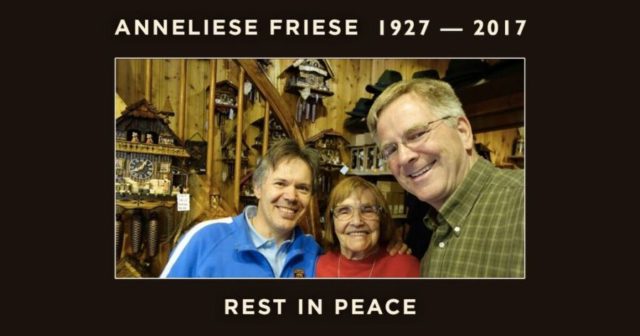
Anneliese Friese, rest in peace

The medieval town of Rothenburg holds a special place in the hearts of Americans. A highlight for many travelers has been meeting Anneliese Friese, the charming woman who for decades ran her family’s souvenir shop — teeming with very German knick-knacks — just off the market square. Anneliese died last Tuesday and Rothenburg has lost one of the endearing characters that gave a charming human dimension to its venerable cobbles and facades.

While I generally make a point to not recommend tourist shops, for 30 years I’ve included The Friese Shop in my guidebooks, due to the sheer power of Anneliese’s personality and love of helping out visiting travelers.

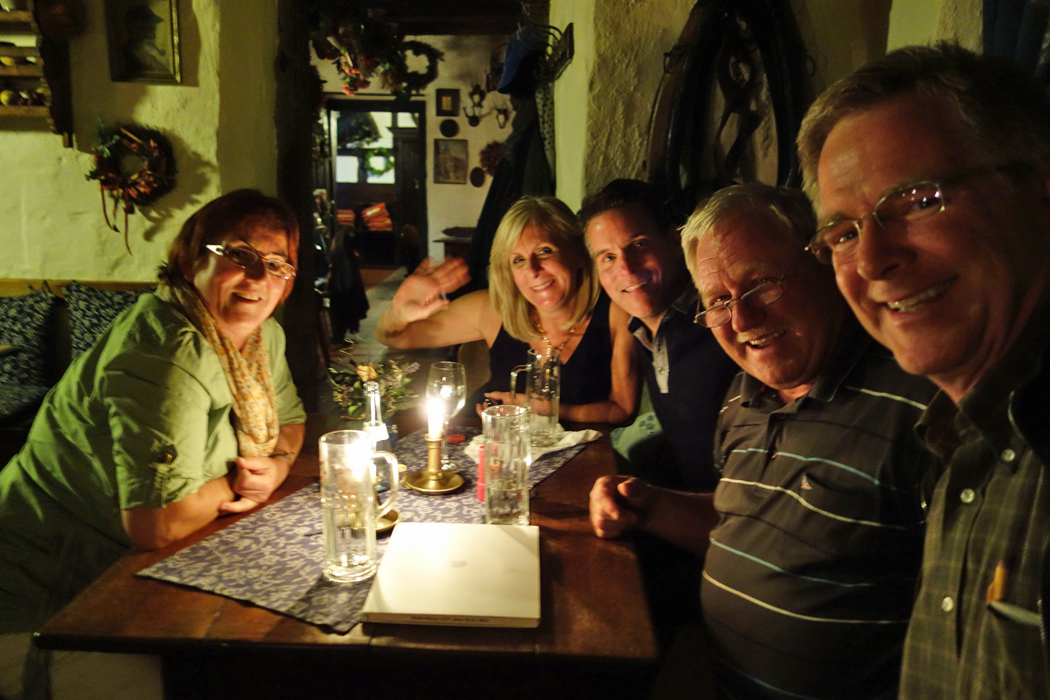
Anneliese was also a founding member of Rothenburg’s English Conversation Club, which has been meeting every Wednesday for decades. This was her passion, where she would join both locals and tourists in a weekly excuse to get together, drink, and practice their fanciest English on each other. Every time I visited Rothenburg, if I was there on a Wednesday, I’d meander into the candlelit pub and squeeze a three-legged stool up to a table already crowded with Anneliese and the gang. She’d pour me a glass of wine, and we’d share our favorite slang and tongue twisters.

This photo shows Anneliese with her son Bernie and me. Bernie and his family will keep the shop going, but we’ll all miss his mother. Bless you, Anneliese, and thanks for the decades that you put delightful bits of Franconia into a box and shipped it home so we could enjoy those wonderful Rothenburg memories.

Rothenburg as a Stage Set

We spent 12 days scrambling to film our Reformation special. And the last stop was the historic German town of Rothenburg. If the town’s good enough to use as a location for “Pinocchio,” “Harry Potter,” and “Chitty Chitty Bang Bang,” it’s good enough to film “Rick Steves’ Luther and the Reformation.”

Rothenburg entrance

Rothenburg scenes like this (the Burgtor) are perfect for on-camera bits.

Lord Mayor of Rothenburg with Rick Steves

For over 30 years I’ve been bringing groups to Rothenburg, promoting it in my guidebooks and featuring it in my TV shows. And Rothenburg, which recognizes the value of our partnership, was extremely supportive of our filming needs. Oberbürgermeister (Mayor) Walter Hartl, understanding how tight our schedule was, presented me with a lovely proclamation of appreciation without a big and fancy banquet. The medieval-style wax seal was still warm.

Bringing in a table

Upon arrival in Rothenburg, we scouted every museum, church, and possible film location. This was essential if we were to use our time smartly. The wonderful Imperial City Museum had the perfect place to recreate the moment Luther discovered the verse in Romans that said Christians are saved by grace and don’t need to earn it or buy it. But we needed a big old Bible and a proper table. Nearby, one of my favorite restaurants (Altfränkische Weinstube) had the perfect table. The boss was gone, so we had to do some fancy talking for the cleaning lady to let us walk out of the place with a table.

Large bible

With the perfect corner in the museum, artful lighting, our table in place, and a Bible that was actually 500 years old, we were ready to film. Here, Second Cameraman Tim Frakes sits in for me as we tweak the lighting. Can you imagine how beautiful that shot will be as I say:

He found his answer in Paul’s letter to the Romans. It read: “The just person shall live by faith.” With that key phrase, Luther discovered what he considered the “good news”: that salvation is not earned by doing good works or giving the Church money, it’s a free gift to anyone who believes. Luther decided the subject should be debated openly.

Rick Steves TV crew in the forest

After hiking into a forest to shoot the bit when Luther ran from the law before hiding out in Wartburg Castle, we paused for a crew shot: from the left, Cameraman Peter Rummel (who shoots nearly half our TV episodes), Cameraman Tim Frakes (who produced the Luther show I did for the Lutheran Church 15 years ago), Producer Simon Griffith, and me. Working hard is very rewarding with creative partners like this talented crew.

TV crew gear

It’s just great how, as we get older, our gear gets lighter. For a TV crew, we pack extremely light. I took a moment on the curb of the Frankfurt airport to show exactly how much our crew of three packs when we are making our TV shows (including a carry-on bag each for personal gear). The crew flew home, and I got off in London to start a three-week research stint in southern England.

Inside Look at Amazing Crime Museum

While filming in Rothenburg at the amazing Medieval Crime and Punishment Museum, we got a behind-the-scenes look at how great museums don’t just happen. (Tacky and commercial “torture museums” — which you’ll find all over Europe — do just happen… but I’m talking about real museums that have real historic artifacts.) Put on some white gloves, watch this video clip, and have a peek.

Modern Germans Reenact Medieval Battles

While filming our Protestant Reformation documentary in Germany, we decided to use Rothenburg’s 16th-century settings to do my “on cameras.” It was perfect: Its Medieval Crime and Punishment Museum is the best of its kind. Its churches are quiet and stately in a 1500s Protestant kind of way. The ramparts just scream Thirty Years’ War. And Jörg Christöphler, the very effective director of the Rothenburg tourism office, made sure we had access to whatever we needed to do our work well. Jörg actually called up his Thirty Years’ War (1618-1648) army for us. I had the joy of commanding about 50 stunningly clad reenactors. In this clip, we’ve divided them in two groups so each cameraman can be creative. We wanted to get some artistic clips that Simon, my producer, can use for his treatment of the Wars of Religion that devastated Germany in that period. (We kept thinking Protestant and Catholic Christians 500 years ago are an eerie parallel to Shiite and Sunni Muslims of our era. By 1648, about 20 percent of Germany lay dead.) When we were finished with our work, Commander Jörg declared “100 liters of beer for all!” And our army marched to the nearest beer garden. Life is much better these days.

In Awe at Rothenburg’s Great Altarpiece

Rothenburg may feel touristy, but in its day, it was a major artistic and economic force. You see that by the amazing carved altarpiece in its main church.


Reimenschneider-altar-Rothenburg.jpgIn St. Jacob’s Church is the artistic highlight of Rothenburg, and perhaps the most wonderful woodcarving in all of Germany: the glorious 500-year-old, 35-foot-high Altar of the Holy Blood. Tilman Riemenschneider, the Michelangelo of German woodcarvers, carved this from 1499 to 1504 to hold a precious rock-crystal capsule that contains a scrap of tablecloth miraculously stained in the shape of a cross by a drop of communion wine.


Journalist-in-Rothenburg-Doyle-McMannus.jpgI was capturing my thoughts in front of Rothenburg’s altarpiece and taking notes in my little book. The passage I was working on: “Before continuing on, take a moment to simply linger over the lovingly executed details: the curly locks of the apostles’ hair and beards, and the folds of their garments; the delicate vines intertwining above their heads; Jesus’ expression, at once tender and accusing.” A man next to me caught my eye. It felt like we were old friends, but I couldn’t place him. He said something like, “Good old-fashioned journalism — in the field with a pencil and notepad…I like that.” He told me that he and his wife were fans of my books and TV shows, and I still couldn’t place him. Finally he said, “I’m Doyle McManus.” Turns out he’s one of my favorite political commentators — a regular on PBS’s Washington Week and columnist for the Los Angeles Times — and he was having a great trip.


English-land-club-in-Rothenburg.jpgI wish every town offered an opportunity to connect with real locals, as Rothenburg does. For over 20 years, whenever I’m in town on a Wednesday evening, I drop by Rothenburg’s English Conversation Club. It’s a rare chance to mix it up with locals who aren’t selling anything. Just bring your favorite slang and tongue twisters to Mario’s Altfränkische Weinstube am Klosterhof (Wednesdays after 6 p.m.). This group of intrepid linguists has met more than 1,000 times. Hermann the German and his sidekick Wolfgang are regulars. When the beer starts to sink in, the crowd grows, and everyone seems to speak that second language a bit more easily. Do you know any other club like this in Europe where an American would be so welcome?