On My Last Nerve at The Last Supper

I’m done traveling for the year, but other members of my staff are still in the field. While I regroup from 100 days in Europe, I invited my frequent collaborator Cameron Hewitt to share some posts from his blog. Cameron has traveled about as much as me this year, updating our guidebooks in Italy and France, and turning our already strong material in Scotland into a stand-alone Rick Steves Scotland guidebook (due next spring). While Cameron and I are in perfect sync in terms of travel styles and priorities, he gives voice to the next generation of Rick Steves travelers. If you like Cameron’s insights, you can read much more on his travel blog, and you can also follow Cameron on Facebook. — Rick

On My Last Nerve at The Last Supper

by Cameron Hewitt
Last Supper

Sometimes, guidebook research doesn’t feel like work at all. A sunny day spent tooling around Lake Como, touring sumptuous villas and sprawling gardens? That’s not work.

But on one particular day in Milan, I really had to work. I packed about three days of sightseeing into one very busy day. It was interesting, and fun at times, but exhausting. Especially this exchange.

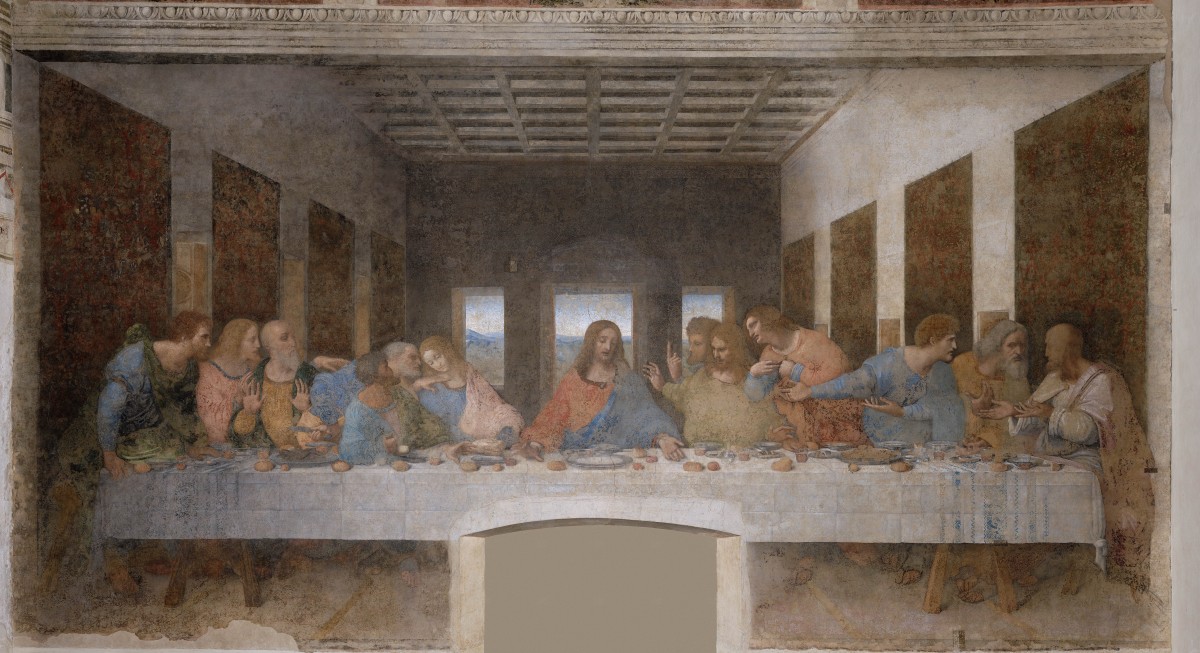
I walked into the ticket office for Leonardo da Vinci’s Last Supper. Spaces are severely limited, and reservations are mandatory — and book up weeks in advance. We devote nearly an entire page in our guidebook to explaining this system, and I needed to confirm everything with the woman at the information desk. She greeted me with a permanent snarl, close-cropped, died-blonde hair, and steely, cruel eyes. Before I opened my mouth, she didn’t like me. (I don’t take it personally. She doesn’t like anyone.) After I explained I was updating a book, she allowed me to continue talking, which is probably her version of tacit approval. Here are some highlights of our actual conversation. (I am not making this up.)

“So, we explain here in our guidebook that you need a reservation.”

“Yes, that’s correct. You can call or go on our website.”

“And we say that you can make a reservation three months ahead.”

“On our website, you can reserve three months ahead. At our call center, you can reserve, maybe, ten days ahead.”

“So tickets are available online three months before, but by phone only ten days before?”

“Well, you can get tickets anytime you want.”

“Yes, but if someone wants to book very early, they can try three months before?”

“On our website.”

“Not by calling?”

“No! Of course they can get a ticket by calling. Ten days before.”

“So by phone, tickets are only available ten days before?”

“It depends.”

“Well, we say here you can start trying to get a ticket three months before. More or less. Is that about right?”

“Yes.”

“Online and by telephone?”

“Yes.”

Phew. “OK, so we also explain that if you don’t have a reservation and really want to see The Last Supper, you can try to come on the same day to see if there are any cancellations.”

“No! Not possible.”

“Oh, so you…”

“Reservations are mandatory!” [Holds up sign that says “Reservations are mandatory”]

“Yes, I understand that. What I’m saying is, let’s say someone did not make a reservation. And now they are in Milan and they really want to see The Last Supper. We say that sometimes there may be a few cancellations…”

“No! You must reserve.” [Eyeing me suspiciously] “Huh. Do you write in your book that you don’t need a reservation?”

“Oh, no, we do explain that very carefully!” [Showing her several paragraphs in the book explaining that reservations are mandatory]

“But you write in your book that you do not need a reservation!”

“No, we don’t say that. We say that in case you do not have one, sometimes it’s possible…”

“It’s never possible!” [She’s really starting to blow up now] “People come here, all day, and complain to me because they do not have a reservation! And you are telling them to do this in your book!”

“But I…no, wait, look. It’s the opposite. You see, I’m trying to help people understand how this works. I want to make it very clear so people are not disappointed.”

“Huh.”

“So if you can help me now for five minutes, I can try to make sure it’s very clear in our book, so those people won’t bother you anymore — so they will understand how it works.”

“I don’t care!”

“You don’t care? You mean you don’t care if people are disappointed?”

“No! I don’t care. People come here all day and are disappointed anyway, so what does it matter what you say in your book?”

“Yes, but I’m trying to reduce the number of…” [I decide to give up on that point] “OK, sorry, I’m almost done. I just want to confirm that it is not possible to buy tickets on the same day.”

“No, it’s impossible!”

“So you never have any cancellations and tickets that are available last minute?”

“No! Well, maybe one or two tickets each day. But almost none! It’s very difficult. You must take this out of your book!”

“OK, I’ll take that out, if you say it’s not possible.”

“Yes, not possible.” [grumbling to herself] “I don’t know why you tell people in your book they don’t need a reservation…”

“OK, well, thanks for your help. By the way, I know this is very unlikely, but do you maybe have any tickets available for today?”

“You want one ticket?”

“Yes.”

[Checks computer] “OK, we have a reservation available for 5:15.”

By the way, The Last Supper was magnificent…well worth the painful conversation.

In Milano, The 1% Salutes the 99% with a Massive Middle Finger

Milano may be Italy’s no-nonsense business and banking capital, but locals still have a sense of humor. Here’s a new listing (from my upcoming Rick Steves’ Italy guidebook for 2014) about a new monument that has quickly become a fixture:

p40-the-finger

Piazza degli Affari and a towering middle finger mark the center of Milano’s financial district. The bold Fascist buildings in the neighborhood were built in the 1930s under Mussolini. Italy’s major stock exchange, the Borsa, faces the square. Stand in the center, appreciate the modern take on ancient aesthetics (you’re standing atop the city’s ancient Roman theater), and find the stern statues representing various labors and occupations, and celebrating the nobility of workers—typical whistle-while-you-work Fascist themes. Then, notice the equally bold modern statue in the center. After a 2009 contest to find the most appropriate sculpture to grace the financial district, this was the winner. Of course, Italy has its financial problems, and a similar sentiment that powers the Occupy Movement in the USA rumbles in this society as well. Here we see how “the 99 percent” feel when they stand before the symbol of corporate power in Italy. (Notice how the finger is oriented–it’s the 1 percent, and not the 99 percent, that’s flipping the bird.) The 36-foot-tall, Carrara marble digit was made by Maurizio Cattelan, the most famous—or, at least, most controversial—Italian sculptor of our age. L.O.V.E., as the statue is entitled, was temporary at first. But locals liked it, and, by popular demand, it’s now permanent.

middle-finger

Nuovo in Milano: A Big Bank Shares Its Fine Art

Even though I’ve been coming to Milano for a long time, I enjoyed some great new sights on my latest visit. Here’s another first-time-ever listing that will be part of the new and improved Rick Steves’ Italy guidebook for 2014.

Art from Milan’s Gallerie d’Italia takes you back into the 19th century—even into the confession booth.
The Galleria Vittorio Emanuele II was famously the first place to be illuminated with electric lights in Italy. Imagine the wonder of it all.
An entire section of the Gallerie d’Italia is devoted to art of the Risorgimento (the fight for Italian unification). Here we see a touching scene of a mother and her soldier son with a portrait of the inspirational revolutionary leader, Garibaldi, on the dresser, calling all good men to war.

Gallerie d’Italia
This museum fills two adjacent palaces that were once banks with the amazing art collections of those banks. One palace dates from the 19th century and boasts  the nicest  Neoclassical interior I’ve seen in town; the other is 20th century—Tiffany-like Historicism, with a hint of the coming Liberty Style. Impressive buildings in their own right, they are filled with the exquisite work of 19th- and 20th-century Italian painters. One has romantic landscapes; hyper-realistic, time-travel scenes of folk life; and Impressionism. And in the adjacent palace, marble reliefs by Antonio Canova are displayed in appropriately Neoclassical rooms, while upstairs you’ll find dramatic scenes from the Risorgimento—showing the thrilling story of the unification of Italy. You can even go downstairs and peer into the original bank vault, which now stores racks and racks of paintings not on display.
Cost and Hours: Free entrance, free audioguides (for as long as the bank is feeling generous), Tue-Sun 9:30-19:30, Thu until 21:30, closed Mon,  across from La Scala Opera House at Piazza della Scala 6, tel. 800-167-619, www.gallerieditalia.com.

Nuovo in Milano: A Thriving Eating and Drinking Scene at the Old Canal

I capped my Italy travels this year in the great city of Milano. And even though I’ve been coming here for a long time, I enjoyed some great new sights. Here’s a first-time-ever listing that will be part of the new and improved Rick Steves’ Italy guidebook for 2014.

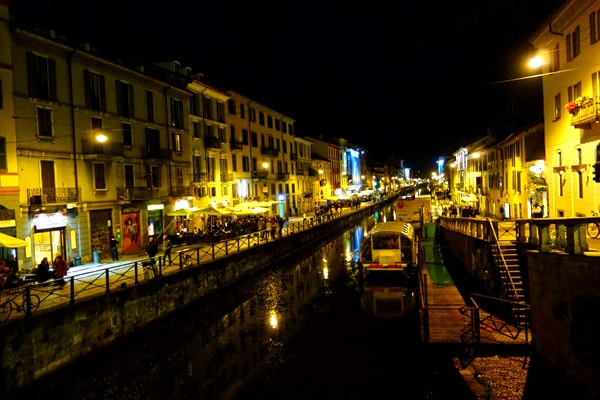
Milan's rejuvenated old industrial canal is becoming one of the city's top nightspots.
Milan’s rejuvenated old industrial canal is becoming one of the city’s top nightspots.

Naviglio Grande
Milan, while far from any major lake or river, has a sizable port. It’s called “The Big Canal.” Since 1170, a canal has connected Milan with the Mediterranean via the Ticino River (which flows into the Po River on its way to the Adriatic Sea). Five hundred years ago, Leonardo helped further develop the city’s canals and designed a modern lock system. Then, during the booming Industrial Age in the 19th century—and especially with the flurry of construction after Italian unification—the canals were busy shipping in the marble and stone needed to make Milan the great city it is today. In fact, a canal (filled in in the 1930s) once circled the walls of the city and allowed barges to dock with their stone right at the building site of the great cathedral. And in the 1950s, landlocked Milan was actually the seventh-biggest port in Italy, as its canals were instrumental in the rebuilding of the bombed-out city. Today, disused train tracks parallel the canal, old warehouse buildings recall the area’s working-class heritage, and former workers’ tenements—once squalid and undesirable—are much in demand and being renovated smartly. While recently rough and characteristic, today the area is trendy, traffic-free, and pricey—thriving with inviting bars and eateries.

The canal district, with its lively restaurants and bars lining the old industrial canal that once so busily served the city, is an understandably popular destination for dinner or evening fun. To get here, ride the Metro to Porta Genova, exit following signs to Via Casale, walk the length of Via Casale one block directly to the canal, climb halfway across the metal bridge, and survey the scene. To the left, on both sides of the canal, are plenty of great places to eat and drink. The best bars line the canal within a half-block of the bridge.

Eating at the Canal
Consider ending your day at the port of Milan. The Naviglio Grande has a bustling collection of bars and restaurants where you have your choice of memorable and affordable options that will come with a great people scene.

La Vineria is a fun place, serving wine from giant vats and cheap and fun plates of cheese and meats to a cool crowd with streetside seating (open daily, June-Sept dinner only from 15:30, Oct-May lunch and dinner except no lunch on Mon, Via Casale 4, tel. 02-8324-2440).

Pizzeria Tradizionale is a local favorite for pizza (open daily, at the far end of canal walk, Ripa di Porta Ticinese 7).

Ristorante Brellin is the top romantic splurge, with a dressy crowd and fine food. The menu is international while clinging to a bit of tradition (€14 pastas, €24 secondi, daily 12:30-15:30 & 19:00-24:00, behind the old laundry tubs at Vicolo dei Lavandai, tel. 02-5810-1351, www.brellin.it).

Osteria Cucina Fusetti is a charming little place serving good Sardinian cuisine. What’s that? Giuseppe speaks English, and enjoys explaining (€8 pastas, €15 secondi, closed Sun; near the curved bridge with the zigzag design at the Japanese restaurant, go away from canal to Via Fusetti 1; mobile. 340-861-2676).

Pizzeria Spaghetteria La Magolfa is a local fixture offering good, cheap €5 salads, pastas, and pizzas. You can sit inside, on a veranda, or at a table on the street. For €15, two people could split a hearty pizza and a good bottle of wine and get full…and a bit drunk (no cover, a long block off canal at end of Via M. Fusetti at Via Magolfa 15, tel. 02/832-1696).