They say that for every church in Rome, there’s a bank in Milan. Indeed, the economic success of postwar Italy can be attributed, at least in part, to this second city of bankers, publicists, and pasta power-lunchers. While overshadowed by Venice, Florence, and Rome in the minds of travelers, Milan still has plenty to offer anyone who visits. And, as tourism gradually returns to Italy after the pandemic, this dynamic city will certainly be in the lead in restoring this country’s economic vitality.
Even though we’re not visiting Europe right now, I believe a daily dose of travel dreaming can be good medicine. I just published a collection of my favorite stories from a lifetime of European travels. My new book is called “For the Love of Europe” — and this story is just one of its 100 travel tales.
The importance of Milan is nothing new. Ancient Romans called this place Mediolanum, or “the central place.” By the fourth century AD, it was the capital of the western half of the Roman Empire. After struggling through the early Middle Ages, Milan rose to prominence under the powerful Visconti and Sforza families. By the time the Renaissance hit, Leonardo had moved here and the city was called “the New Athens.”
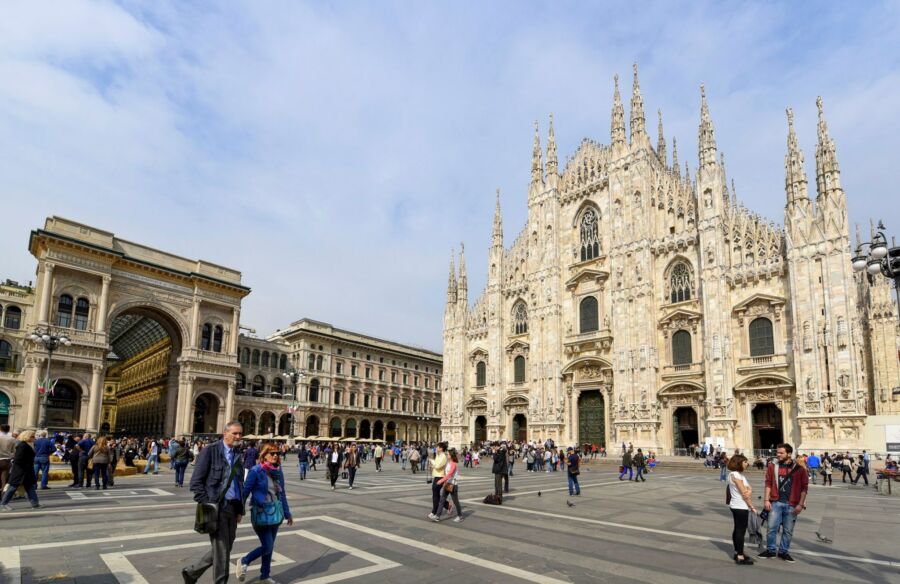
Milan’s cathedral, the city’s centerpiece, is the third-largest church in Europe. It’s massive: 480 feet long and 280 feet wide, forested with 52 sequoia-sized pillars and populated by 2,000 statues. The place can seat 10,000 worshippers.
Climbing the tight spiral stairs designed for the laborers who built the church, I emerge onto the rooftop in a forest of stony spires. Crowds pack the rooftop for great views of the city, the square, and, on clear days, the Italian Alps. But it’s the architectural details of the church that grab my attention. Marveling at countless ornaments carved more than five centuries ago in marble — each flower, each gargoyle, each saint’s face is different — I realize the public was never intended to see this art. An expensive labor of love, it was meant for God’s eyes only.
The cathedral sits on Piazza del Duomo, Milan’s main square. It’s a classic European scene. Professionals scurry, fashionista kids loiter, and young thieves peruse.
The grand glass-domed arcade on the square marks the late-19th-century mall, Galleria Vittorio Emanuele. Built around 1870, during the heady days of Italian unification, it was the first building in town with electric lighting. Its art is joyful propaganda, celebrating the establishment of Italy as an independent country. Its stylish boutiques, restaurants, and cafés reflect Milan’s status as Italy’s fashion capital.
I make the scene under those glassy domes, slowly sipping a glass of the traditional Italian liqueur, Campari, first served in the late 1800s at a bar in this very gallery. Some of Europe’s hottest people-watching turns my pricey drink into a good value. While enjoying the parade, I notice some fun-loving commotion around the bull in the floor’s zodiac mosaic. For good luck, locals step on the testicles of Taurus. Two girls tell me that it’s even better if you twirl.
It’s evening, and I see people in formal wear twirling on that poor bull. They’re on their way to the nearby home of what is quite possibly the world’s most prestigious opera house: La Scala. Like other great opera houses in Europe, La Scala makes sure that impoverished music lovers can get standing-room tickets or nose-bleed seats that go on sale the day of the performance. And the La Scala Museum has an extensive collection of items that are practically objects of worship for opera devotees: original scores, busts, portraits, and death masks of great composers and musicians.
Imagine: Verdi’s top hat, Rossini’s eyeglasses, Toscanini’s baton…even Fettucini’s pesto.
The next morning is the highlight of my visit: Leonardo’s ill-fated The Last Supper, painted right onto the refectory wall of the Church of Santa Maria delle Grazie. Leonardo was hired to decorate the monks’ dining room and this was an appropriate scene. Suffering from Leonardo’s experimental use of oil, the masterpiece began deteriorating within six years of its completion. The church was bombed in World War II, but — miraculously, it seems — the wall holding The Last Supper remained standing.
Today, to preserve it as much as possible, the humidity in the room is carefully regulated — only 30 people are allowed in every 15 minutes, and visitors must dehumidify in a waiting chamber before entering. I jockey with the other visitors, like horses at the starting gate. We all booked our timed entry weeks ago. Knowing that when the door opens we get exactly 15 minutes to enjoy the Ultima Cena, we’re determined to maximize the experience. I’ve studied up, but waiting to enter I review my notes, like cramming for a test. I want to get the most out of every second in the presence of Leonardo’s masterpiece.
The door opens and we enter. There it is…filling the far wall in a big, vacant, whitewashed room: faded pastels, not a crisp edge, much of it looking look like an old film negative.
To give my 15 minutes an extra punch, I decide to enter the room as if I was one of the monks for whom The Last Supper was painted some 500 years ago… I imagine eating here, in my robe and sandals, pleased that the wall in my dining room, which for so long has been under some type of construction, is finally done.
It’s a big day — the unveiling. The painting is big and realistic. Jesus and the 12 apostles are sitting at a table just like the three big tables we monks share here in our dining room. It’s as if we were just blessed with more brothers. The table in the painting is even set like ours — right down to the stiffly starched and ironed white tablecloth.
The scene now gracing our refectory is a fitting one. The Last Supper was the first Eucharist — a ritual we celebrate daily as monks. The disciples sit with Jesus in the center. Jesus seems to know he’ll die — his face is sad, all-knowing, accepting. His feet are crossed one atop the other, as if ready for the nail.
While we eat in silence, I meditate on the painting. It shows the moment when the Lord says, “One of you will betray me.” The apostles huddle in small groups, wondering, “Lord, is it I?” Some are concerned. Others are confused. Only Judas — that’s him clutching his bag of silver — is not shocked.
Again and again, my eyes return to Christ. He’s calm despite the turmoil he must feel over the ultimate sacrifice he must make.
But then, my modern-day sensibility intrudes. I can’t help it. I want to tell the monk that Leonardo cleverly used lines of perspective that converge on Christ, reinforcing the idea that everything does indeed center on him. But I suspect the monk wouldn’t care, since he already understands the artist’s intent.
Suddenly, two doors burst open — abruptly ending my musings. My group and I are sternly ushered out one door and a new group of 30 enters the room through the other. On a bench in front of the church, I sit down for a moment to settle back into the 21st century.
This story appears in my newest book, For the Love of Europe — collecting 100 of my favorite memories from a lifetime of European travel. Please support local businesses in your community by picking up a copy from your favorite bookstore, or you can purchase it at my online Travel Store. You can also find a clip related to this story at Rick Steves Classroom Europe; just search for Milan.