The beauty of my recent Alaska trip with American Safari Cruises was that there was no contact with civilization on land. The closest thing we got to civilization was hiking down a desolate logging trail through a peaceful forest. I parked my rubber boots at the shore and slipped on my normal hiking shoes, not realizing we’d encounter giant puddles. Thankfully my guide went above and beyond the call of duty by carrying me piggyback across four such puddles during our memorable-for-many-reasons hike…while my travel partner, Trish Feaster, filmed it (over the giggles of my fellow hikers).
If you can’t see the video below, watch it on YouTube.
Still thrilled after our bear encounter (see my post from last week), our American Safari Cruise motored to the next stop. Up in the bridge, I studied the traditional yellow charts and learned to navigate the software program with those same charts digitized. A channel led to the distant horizon, evoking the mystique of the Pacific Ocean. Between us and the open sea was a dramatic landmass. The captain said, “That’s Admiralty Island — 1,700 square miles and 1,700 bears, one bear per square mile. Tlingit Indians called it the ‘Fortress of the Bears.’”
Anchoring in Thomas Bay, we geared up for a hike along Cascade Creek. In Southeast Alaska, the metabolism of nature seems to churn at a high level. While the region has a thousand estuaries, the entire area could be considered a single, vast estuary. Geologists figure more freshwater flows into the sea in Southeast Alaska than in the Amazon basin.
Everyone on board was issued rain pants, rain jackets, and rubber boots. While I wanted to use the hiking boots I packed from Seattle, it was the ship’s rubber boots that served me best. In this area, there are almost no trails and certainly no docks. Skiffs skid to a stop on wild beaches. Boatswains expect to ding up propellers on their outboard motors. Our 90 HP Yamaha outboard has a guard for the propeller — but they still get bent up, and the ship comes with four replacements for each skiff. Hopping out, then walking through marshy tidal flats, we often encountered the notorious “boot-sucking mud” — mud that could literally pull the boot right off your foot. The other risk was “topping off” — stepping into a river or tide pool that was deeper than your boots were high.
Our hike followed the aptly named Cascade Creek up and up. As is the case when experiencing Southeast Alaska, the trail didn’t actually take us to a particular destination. Time after time, we’d venture in some direction, and the venture itself was the reason. We’d hike, motor, paddle, or gaze until we’d seen enough…then turn back. Things don’t seem to end around here. Stand on the prow of the ship and pan slowly in one direction, and the view doesn’t stop. Things just keep going.
It was amazing to think that the very rough Cascade Creek trail, apart from faint and unseen animal trails, was the only path through a vast wooded mountainside that towered mightily out of the sea. It led deep and high into a vast yet rare-on-this-planet coastal temperate rain forest. This climb took concentration, as each step needed to be carefully placed on a notched stone, exposed root, boggy ground, or stretch of boot-sucking mud. Walking sticks were so helpful it almost felt like I was cheating.
For the photographers, this was a chance for extremely close-up work: spider webs beaded with dew drops; armies of tiny mushrooms festooned in red, marching up a nursery log; and vibrant bouquets of little flowers growing in vertical gardens on the dirt-caked root system of a once mighty but now upended tree.
Sun and shade were nature’s sweet and sour, as a towering canopy filtered the light, and silver rims of backlighting seemed to direct my attention. Standing silently, I listened, smelled, and looked. Turning very slowly 360 degrees, it was as if I was in a fertile world where the cycle of life was a slow-moving carousel and the only color was moss.
On my recent trip through southeast Alaska with American Safari Cruises, while kayaking in a remote bay, we came upon a bear happily fishing for salmon…and catching plenty. We gently maneuvered our kayaks in place, paddling quietly against the flow of the river as it hit the bay, spending about half an hour observing this wonderful scene. (Thanks to Trish Feaster, for shooting this video.)
If you can’t see the video below, watch it on YouTube.
On many Alaskan cruises, the first stop out of Juneau is Glacier Bay National Park — for most passengers, an itinerary highlight. Because of the pristine and precious nature of this place, only a relatively few ships are allowed to visit, and they are carefully regulated. On our cruise with American Safari Cruises, we were joined by an enthusiastic ranger from the park lodge at the mouth of the bay. Then we sailed up a strait speckled with tiny icebergs until we came face-to-face with a tongue of the Grand Pacific Glacier.
Captain George Vancouver sailed by Glacier Bay back in 1794, when it was almost entirely covered by ice. Since then, the busy glacier retreated, leaving a bay that’s currently 60 miles long. Whether they’re retreating because of global warming or just going through their normal life cycle, glaciers are slow-moving rivers of ice, which break off in small bits and crash into the sea when they reach the end of their slow journey. A calving glacier loses six to eight feet of ice each day. Considering that the sloughing face of the glacier is about 250 feet tall and a mile or so wide, that’s a lot of baby icebergs.
Scientists figure that the ice that finally tumbles into the sea is over two hundred years old. That means rain that fell on the day Captain Vancouver dropped his anchor here could actually be the calving ice visitors see from their ships today.
The good ship’s happy transom.
Our small cruise ship has a stern designed for fun. A landing ramp lowers to the transom, providing a convenient and comfortable launch pad for kayaks and paddleboards. With the help of a hardworking crew, you simply put on your life vest, sit in the kayak, and clip on your “skirt.” They push you into the water — like a new ship sliding down its dry dock after the champagne crashes on its maiden voyage.
Whether on a small-boat tour, or even closer to the water in a kayak, when exploring desolate little bays and inlets, sea lions are a constant presence. From a distance, they look at first like floating bowling balls. As you get closer, hearing their snorting as they come up for air and seeing their little doggy-boy faces curiously checking you out, you realize they’re sea lions.
Kayaking to be close to Alaska.
While kayaks get you away from the ship and very close to the sea life, stand-up paddleboards take things one step further. My first time on a paddleboard was over Alaskan waters — and a polar bear I’m not. I was nervous. A paddleboard is an oversized surfboard that you kneel on, paddle a bit to get some momentum, and then gingerly stand up on. While I was filled with anxiety until I actually did it, as long as you don’t overthink it, paddleboarding is not hard. And once up and gliding across the bay, you gain confidence. For me, the reward came when I got into shallow waters. With a higher view of underwater sights (like Dungeness crab, pincers up and ready for action), this beats a kayak.
Sightseeing by paddleboard.
In Freshwater Bay, we spent a morning exploring. Several guides took small groups out in kayaks or on small skiffs. They were in radio contact, because when nature provides some action, they all want to be there. Word came that a bear was fishing at the waterfall at the head of Pavlof Harbor.
Paddling determinedly yet silently, we approached the waterfall. The scene was like an old-school museum tableau. It felt utopian: waterfall below mighty snow-spotted mountain; salmon leaping up falls, getting enough air for three tail wags; sun glancing off ripe brown seaweed; a family of duck-like mergansers in the foreground; berry bushes and crushed grass on the banks. And there, to the side of the churning waterfall, was a brown bear trolling for salmon. Looking wary, then still, then suddenly jerking into action, he made his catch. While young and not terribly graceful, he was good. He’d stomp on the salmon, pin it to the rock with his paw, bend down, and bite its head. Then, with his meal thrashing in the grip of his mouth, the bear lumbered to a sunny perch where, like a kid savoring the only Fudgsicle, he’d enjoy a fresh salmon picnic.
Our Alaskan cruise itinerary with American Safari Cruises was seven days of pure nature, stopping at no towns. In fact, after leaving Juneau, we barely saw a building. Southeast Alaska — a 500-mile-by-130-mile territory — has only 70,000 people. Other than Juneau, which contains about half of that population, there are only a handful of communities.
Southeast Alaska has three kinds of land: ice and rock, thick forest (a mix of old growth and once-forested younger growth), and ancient peat land (wetlands called muskeg). Its Fairweather Range is the highest coastal mountain range in the world, with mountains climbing 12,000-plus feet directly up from the Pacific Ocean shore. (Take that, Norway.)
The cruise industry is very big here. Giant ships inject — like syringes — a huge amount of business into the local economy, and hardball cruise companies extract their profits in an aggressive way. A grocer from Wrangell, a small town of 2,400, told me how tourists would buy bottles of water from his shop, then pour out the water and fill them with booze to sneak onto the ships — which didn’t allow alcohol purchased anywhere but on board. He told me how a big cruise line offered a stop in Wrangell, but only if every business in town paid 30 percent of its annual profit to the company. His neighbors got together and told the cruise line, “We’re third-oldest town in Alaska. We can manage without the cruise industry.” And Wrangell is no longer on most big ship itineraries.
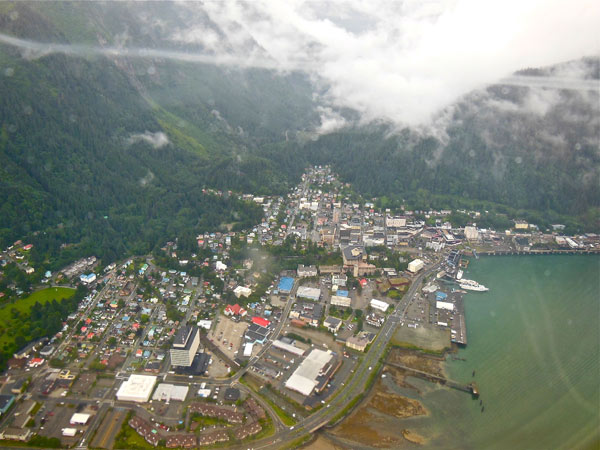
The view of Juneau from our airplane.
The only Alaskan town I saw was Juneau, where our cruise started and ended. In spite of what must be the ugliest state capitol building in the USA, Juneau has a certain Alaskan charm. The industrial-strength harborside feels way too big… until a giant cruise ship drops in. The hundred-year-old facades of Main Street give a Gold Rush spirit to the main drag, which is lined by shops with tiny signs bragging “Alaskan-owned.” While most of the town’s 32,000 people were gathered for the first high school football game of the season, I had dinner at Tracy’s King Crab Shack (and almost bought the T-shirt: “Tracy gave me crabs”).
The tiny wooden Russian church, a century old, was a reminder of the colonial forces that converged on native communities here from both East and West. While all white settlers were eager to get the natives to embrace their religion, only the Russians allowed Christianity to be preached in the indigenous Tlingit language. That’s why their missionary work was much more effective — and to this day, there’s a big Russian Orthodox community of native Alaskans.
A small ship like ours (the Safari Endeavour, with just 43 staterooms) offers a different experience from the gigantic ships I can see lumbering up Puget Sound from my house. It’s quite a bit more expensive. But they’ve made their money up front, so everything (from on-board expenses to excursions and activities) is included. I stowed my wallet upon boarding, and I’ll have no bill of extra expenses when I leave.
The good ship Safari Endeavour.
My stateroom was in the bow, near the waterline — and that means next to the anchor. After rising with our anchor for several mornings, I know exactly how many links are on that 150-foot chain. On the plus side, a small ship doesn’t need to stick to a schedule. If a whale is jumping, we stop. Big ships march on through regardless, aiming for that next port of call.
The Safari Endeavour is just big enough to have a hot tub. On our first night, we were in the tub marveling at the snowcapped peaks and glassy waters arcing 180 degrees around our stern. I thought, “How could this be any nicer?” Then a crew member appeared and asked, “Can I bring you a drink?”