Cruising Alaska Video: Breaching Whale on Icy Strait

This video (taken by Trish Feaster) captures the fun of our recent cruise with American Safari Cruises through Southeast Alaska. On the first morning of our cruise, we were excitedly awakened by our crew for the best display of breaching whales any cruiser could hope for. This is tough to capture on video, because you just can’t know exactly when and where the whale will pop out of the sea, but these clips offer a taste of the experience.

If you can’t see the video below, watch it on YouTube.

Small Ship Cruising in Southeast Alaska

I capped my 2012 travels by finally enjoying a cruise in Alaska. It was a beautiful experience. This eight-part series is my report to you. (All Photos by Trish Feaster)

When I carved out a week for an Alaskan cruise, I just assumed that I’d be on one of those lumbering ships. But as I struggled with the various one-week itineraries, it occurred to me that, sailing north from the Lower 48, I’d spend too much time getting there and back. And, once in Alaska, the big cruise ships — with 3,000-plus passengers — spend more time in cities (letting shoppers shop) and less time with the glaciers and whales. I wanted to experience nature, both intense and intimate. My search quickly shifted to smaller ships, and eventually I booked a week with American Safari Cruises, sailing from Juneau on their good ship Safari Endeavor — 43 staterooms, 60 passengers, and a crew of 30.

Cruising Alaska.

Within a few hours of flying from Seattle to Juneau, my travel partner Trish Feaster and I found ourselves on the bridge of the ship with Captain Jill and several of the crew, scanning the sea for wildlife through our binoculars. The Safari Endeavour has a proud “open bridge” tradition — just knock first, and you’re generally welcome to hang out with the captain. As I marveled at the view, the expedition leader told me, “Here, take the captain’s seat.” I said, “It’s not every day you get to sit in the captain’s seat.” One of the crew replied, “Actually, yes it is.”

On the bridge with Captain Jill.

While it’s on every cruiser’s wish list, an Alaska cruise can’t promise whales breaching. But when those majestic marine mammals do burst out of the sea and happily skyward, you can bet the call goes out…and everyone’s on deck. I went to sleep with visions of breaching whales dancing in my head.

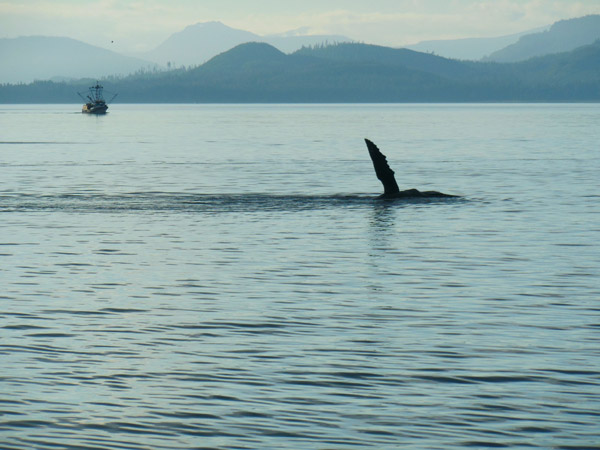
Just after our first sunrise at sea, a voice on our stateroom intercom wakes us up with a cheery, “Good morning. Humpback whales are breaching on the port and starboard.” I pull open the curtain and there they blow, right out my window!

Within minutes, we’re on the bow deck, coffee mugs and cameras in hand, ready for the action. We’re at Point Adolphus in Icy Strait, over a deep trench where two bodies of water converge — bringing together lots of plankton, which attracts tiny bait fish, which attract whales. (While we’re here on vacation, the whales are here to fatten up for their long migration to Hawaii.)

It’s a classic Alaska scene: Rays of sun break through the clouds and glint on a single trawler in the distance. Between us and that stately old fishing boat, the glassy sea is alive with leaping whales. It’s breakfast time. The gulls, the fishermen on the trawler, and the whales are all out. With whales showing off, the peek-a-boo porpoise and jumping salmon are ignored.

Before doing their leaps, the whales set the water rumbling with repeated slaps of their pectoral fins. Are they stunning fish, sending out sounds to other whales, or just entertaining us sightseers? They slap and slap repeatedly, like a little kid throwing a fit. Then the whale dives, its T-shaped tail (fluke) slipping up high and gracefully — and then, like a champion diver, out of view.

Waking up to a breaching whale.

Three whales spout geysers of water, enlivening the vast Icy Strait like squirting clams enliven a mudflat at low tide. They exhale, like clearing a snorkel in surroundsound. Our guide explains that over countless generations, the nostrils migrated to the top of his head, as that’s where the breathing is easiest — a great example of evolution.

Then, suddenly, as if looking for a partner to chest-bump with, the whale breaches, exploding joyfully out of the water. The motor drives of the fancy cameras all around me seem to clap each time the whale performs.

Marveling at this display of nature provides the same thrill as admiring a room full of Bernini statues — but here, it all happens in a fleeting glimpse. Culture is what man creates. Nature is God’s work. Enjoying and appreciating each is good living.

Guest Blogger: The Travelphile and Alaskan Nature

As I noted in yesterday’s post, I’m featuring a few entries from my frequent travel partner, Trish Feaster, who blogs under the name The Travelphile. If you enjoy her stories and photos, I hope you’ll follow her. This entry dates from a recent non-European trip we enjoyed: a cruise to Alaska.

There’s More to Nature than Meets the Eye

Alaska is big. I mean it’s huge. It’s twice the size of Texas. On this seven-day cruise through Alaska’s Inside Passage, we would explore a mere fraction of this massive state, but what we would see was enough to fill my camera with almost 1,400 photos and my mind with countless unforgettable memories.
While I expected we’d see mountains, trees, glaciers, and hopefully some animals, I had no concept of the scale, quantity, and diversity that Alaska — often called “The Last Frontier” — had to offer.

When we awoke the first morning to breaching whales on all sides of our ship, I was stunned by the beauty, grace and agility of these colossal aquatic mammals. But really, you’d have to be a fool not to be. They are, in the most accurate use of the word, awesome.

Moving beyond the obvious was a bit more challenging for me. As we cruised through Icy Strait and admired the passing scenery, the running internal soundtrack of mind kept repeating, “Oh, it’s so beautiful.” Well, yeah.

But Ranger Andrew changed all that. After our whale morning, we picked up Ranger Andrew at Bartlett Cove near the entrance to Glacier Bay. He joined us for two days and shared his expertise about the wildlife, plant life, and geology that comprised Glacier Bay.

While I can’t remember all the names of or facts about the things we saw, I can remember one thing: his enthusiasm. It was contagious. I have never met anyone as excited about his job and so eager to share his wealth of knowledge as Ranger Andrew. From birds to sea lions, from lichens to flowers, and from shale rocks to glaciers, he made everything fascinating. He didn’t just impart information, he made the complicated simple and the simple magnificent.

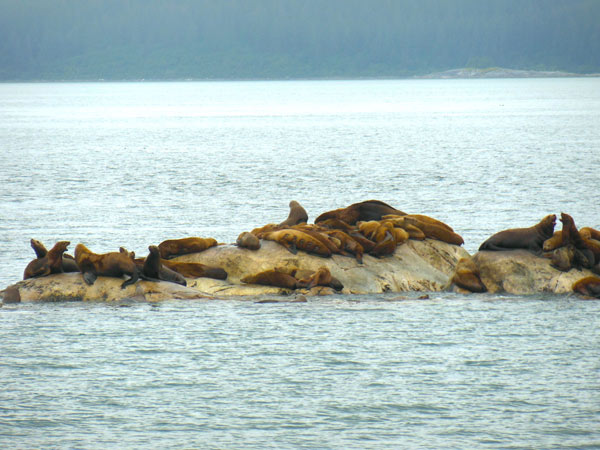
At South Marble Island, we ogled several harems of sea lions lounging on rocks like celebrities on the French Riviera, surrounding their respective dominant males. While the decibel level of these yelping beauties reached peak levels, what was even more powerful was their stench. Even from 100 yards away, that smell was brutal. Every now and again a sea lion would silently slink away and slip into the water and then suddenly reappear scaling another part of the rock. We noticed several who were branded with a mark so that researchers could track them.

Some of their neighbors on South Marble Island included puffins, common murres, and various gulls. The variety and bounty of animal life on this relatively small island was astonishing, but, as we came to expect, Ranger Andrew had the explanation. The island (composed of limestone and featuring a dense spruce forest, sloped cliffs, and grassy round hilltops) is an ideal sanctuary for all these creatures because the diverse terrain of the island offered perfect spaces for shelter, resting, hiding, and nesting.

Ranger Andrew also ran us through exercises in patience and what could possibly be used as a replacement for an eye chart test when he had us scour the mountainous face of another island to search for elusive mountain goats. For over half an hour, every passenger with binoculars or a camera with a decent lens panned up and down and left and right, across the lines of trees, below the grey stripes in the rocks, and into every single possible nook and cranny we could find. Ranger Andrew was, of course, the one to spot our first mountain goat, and his face just beamed when he explained to everyone where to look. Victory was his…and ours.

When we dropped anchor near the glacier, we had the option of exploring the coastline in a small skiff, doing a relaxing beach walk, or hiking the along a craggy-faced mountainside and crossing onto a glacier. Guess which one we picked.

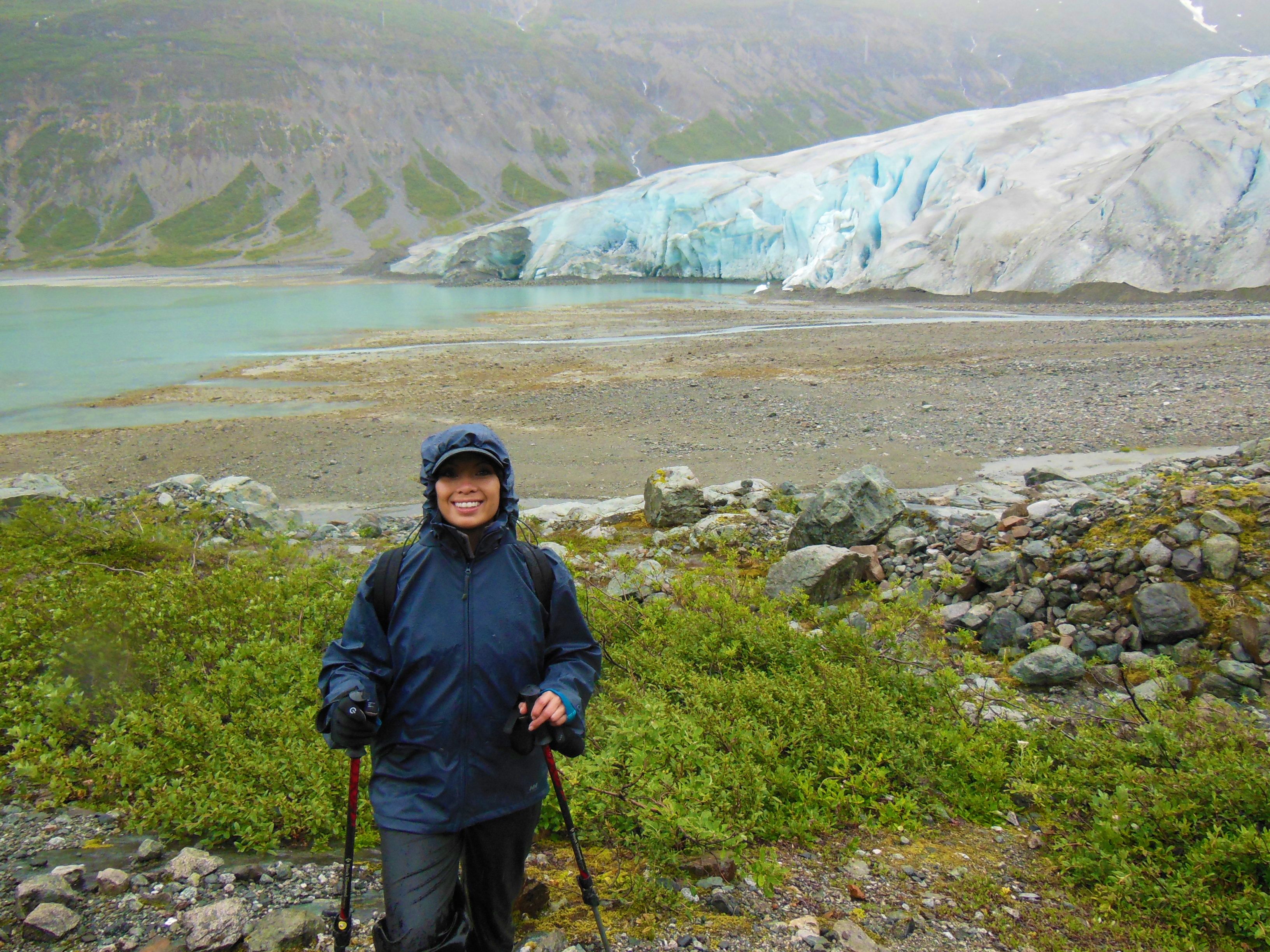
With Laurie (expert expedition guide) and Ranger Andrew leading us, we scrambled up and across the face of the mountain. Despite wearing six layers on top, four layers on the bottom, a scarf and a wooly hat, I still felt the rain, the whipping wind, and the chilly 40-degree air temperature bite into my core. Being next to an ice mass that was, at its mouth, as wide as three football fields, as tall as a thirty-story building, and was miles long intensified the chill. I was grateful to be on the move and work my body into a warmer state. I was equally thankful that I had two walking sticks to steady my balance. Between the slithering streams that glided down the slope, the slippery shale fragments that slid out from under us, and the jungle-gym boulders we had to clamber over, staying upright was a real challenge.

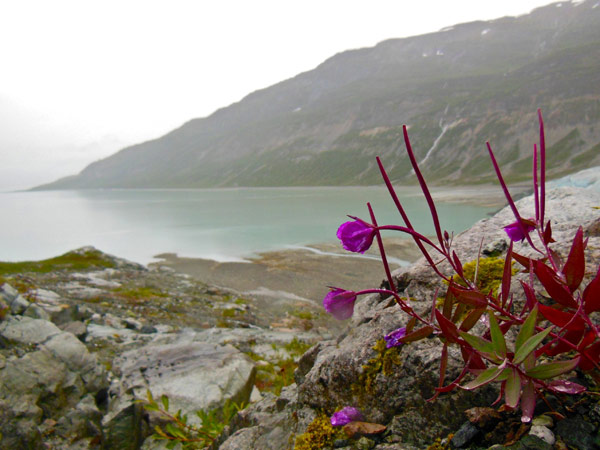
I found myself being the frequent straggler, partly because I cautiously tried to stay sure-footed, but mostly because I liked looking at all the stuff around me. Since Ranger Andrew was acting as the caboose for our hilly scramble, it gave me a chance to ask questions and eavesdrop on the info he was sharing with my fellow inquisitive hikers. While I was initially struck by the grandness and color of the glacier on our left, the vivid bursts of the plant life along the hillside, and the countless waterflows that cascaded through every path we took, both Ranger Andrew and Laurie helped me to see the deeper beauty of the nature that surrounded us.

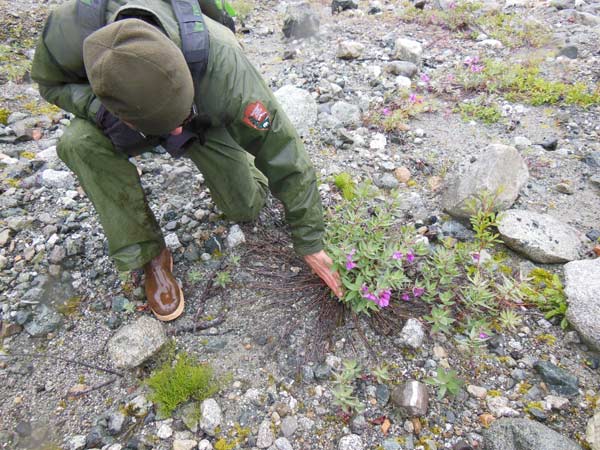
One hundred years ago, the slope on which we stood was completely covered by that glacier. Since it receded, life found a way to emerge where there once was no life. Lichens, fungi, and flowers now fight their way for survival and provide the basis for new life. Despite the difficult conditions and terrain, they strive to thrive. They cling to edges of rocks and reach their way across streams to proliferate, reshape and redecorate the landscape. It’s nature triumphing over itself.

And the rocks reveal their own histories through their composition and color. These sedimentary and metamorphic mineral and organic life composites were formed over millions of years, subjected to a geological tango of intense pressure, extreme weather conditions, erosion, and glacial movement. While I lack any expertise to interpret their geological record, Ranger Andrew taught me that these rocks — with their streaks of orange or blue that separate layers of white or green or black or grey — invite me to recognize and appreciate the history that formed them.

The experience all came together the moment I stepped onto the glacier. I felt the world fall silent and still, and all at once, I felt small and grand. I understood that the force of nature that created and maintains this glacier is the same that shaped the adjacent mountains, fosters the life that blooms on the rocks, nourishes and shelters the wildlife of this region and sustains and produces life everywhere. In geological time, everything was churning…living and dying, then living again. I realized that I am a part of that. I am connected to this, even if time and distance separate me from it. We are all a part of it.

Perhaps I already knew all of this on an intellectual level before. But thanks to the Ranger Andrew (and Laurie), I’m gaining a deeper understanding of that. Experiencing nature, not on a screen or in a book, but in the shadow of a thundering glacier with the bite of the Alaskan wind in my face, I have connected with my world like I didn’t know was possible. And I can’t wait to see what’s next.

A majestic whale puts on a spectacular show for us.

Be thankful this isn’t in smell-o-vision.

Ranger Andrew explains where to spot certain birds and their nests on South Marble Island.

Mountain goat sighting. (Image courtesy of Rob Arora)

My first glacial experience

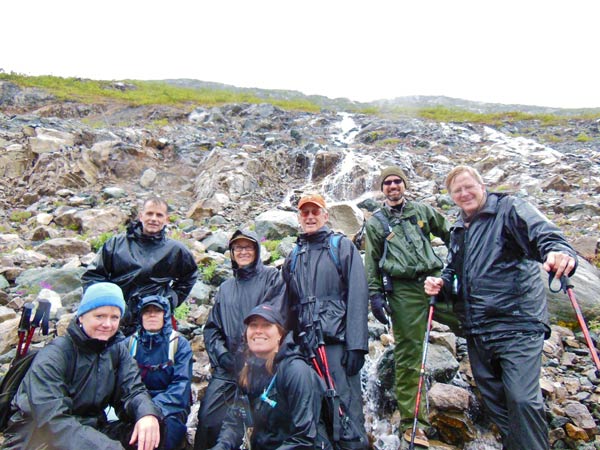
My fellow hike-mates from left to right: Wendy, Rob, Debby, Colleen, Laurie, John, Ranger Andrew, and Rick.

Geared up and ready to scramble up the mountainside to see the glacier up-close.

Beauty, color, and life abound beyond the perimeters of a glacier.

There’s a fungus among us.

Ranger Andrew explains how even in this rough terrain, plant life grows, decays, and becomes the basis for new soil and new life.

These colorful boulders and rock rubble are million-year-old artifacts that guard the geological history of this glacial space.

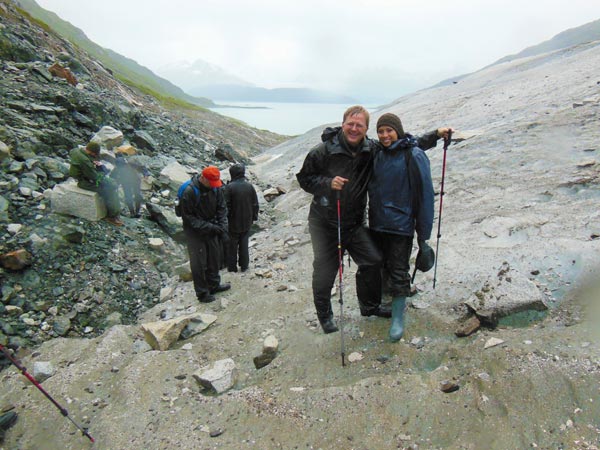
Rick and I relishing our moment on the glacier.

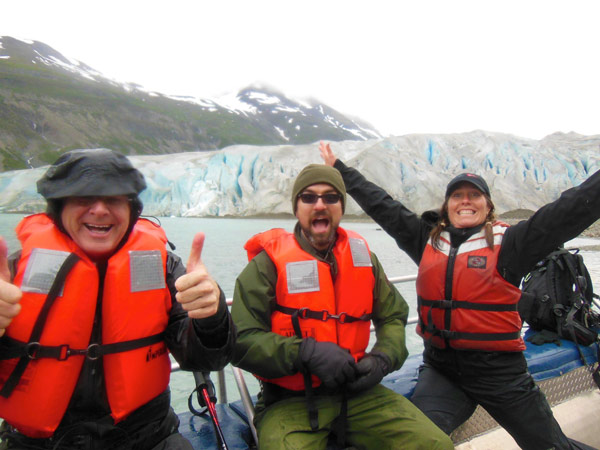
Rick, Ranger Andrew, and Laurie can’t contain their excitement about nature.

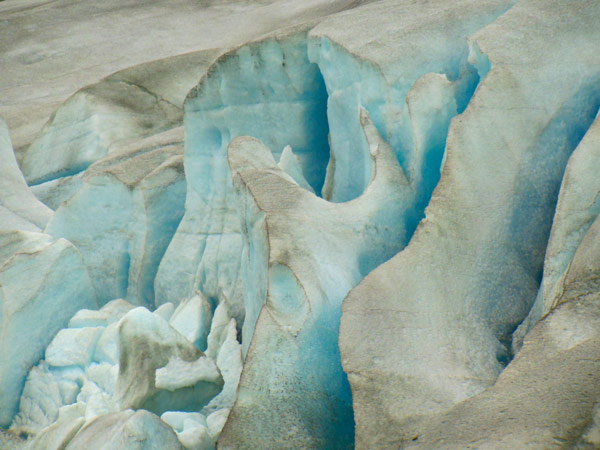
Details shot of the glacier.

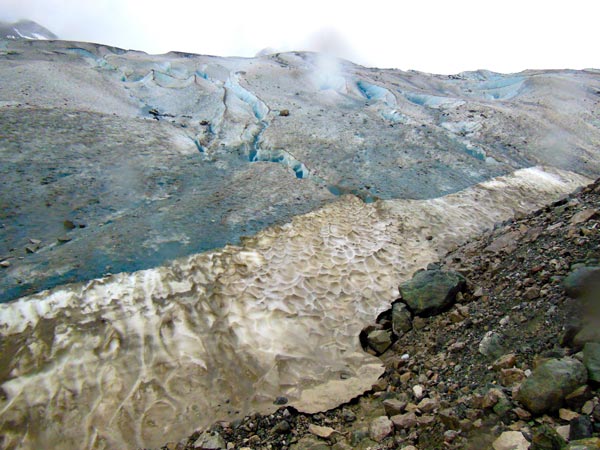
Detail shot of the glacier.

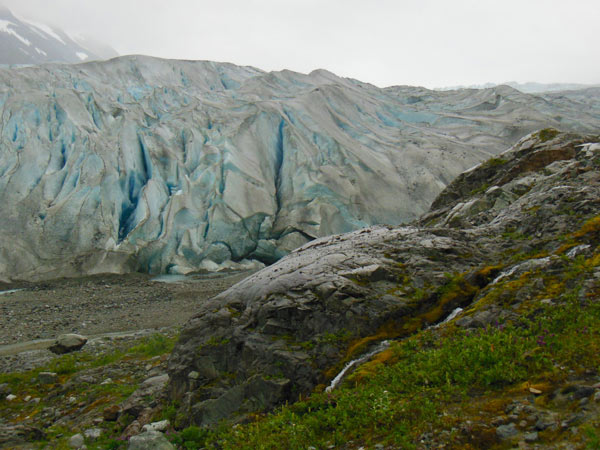
Detail shot of the glacier.

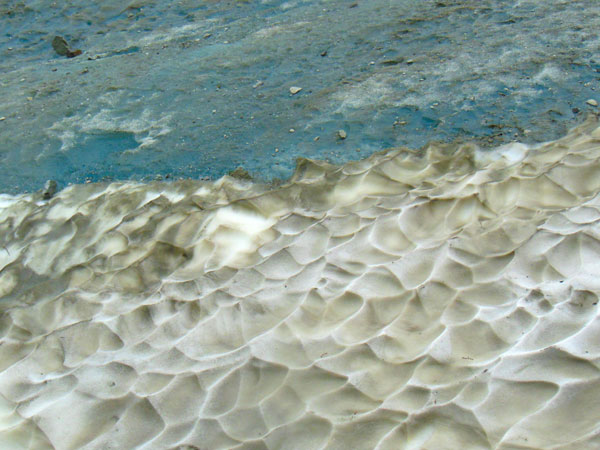
Detail shot of the glacier.

Inside the Very Buoyant Mind of a Cruise Line Marketer

Cruise ShipOur Rick Steves’ Mediterranean Cruise Ports guidebook has been the surprise sales hit of our season. It’s currently our 5th-bestselling title, and in January, it was the USA’s 12th-bestselling guidebook by anyone, to anywhere. Popular as that guidebook may be, it sits lonely on my windowsill and needs a sister. So this fall we’re researching and producing a guide to Northern European Cruise Ports, for publication next summer.

I recently enjoyed a fascinating conversation over lunch with the CEO of a cruise line. A brilliant marketer who once sold children’s snacks, he explained how the impulse of a child to explore — as long as she has a safe home to return to — stays with us as adults. While travelers love to get out of their comfort zones, most have that strong, childlike need for a safe refuge or nest. His goal in marketing cruises is to provide a routine enabling people to get out and explore, but also to create a consistent welcome-home ritual when they are back on board. On my recent cruise, I noticed how ships do this expertly, with a welcome table with cold drinks at the gangplank and a friendly greeting as we boarded. And I even remember thinking, “Whew…we are safely back home now.”

I mentioned that cruise lines seemed less aggressive than I had anticipated in selling shore excursions, and that I was surprised how readily they let two-bit competitors organize and promote budget independent alternatives to their formal excursions. He explained that, for some cruise lines, shore excursions are not the main profit driver. People taking Caribbean cruises tend to lounge on the ship more. But people taking a Mediterranean cruise want to see and experience famous things on shore. The more they are able to do that on their own terms, the better. He acknowledged that, while excursions play a role in his profits, “for larger cruise lines, the real money is made between the steel” — that is, from purchases made by cruisers on board: eating, drinking, shopping, gambling, and so on. (I remembered how, even with my frugal approach to little extras on board, my tab was pretty substantial when that moment came to settle up at disembarkation.)

To make money, getting as many people as possible “between the steel” is top priority. He agreed with my hunch that the base cost of a cruise on large ship doesn’t have a lot of profit built in. Cruise lines manage prices so that all departures go full (offering deep discounts and creative incentives as necessary to fill the last staterooms). While discounting is big, marketers know that if you give cash back, customers pocket the cash. But if you give them a discount disguised as an “on-board credit,” they still bring and spend the same cash they would have without the credit: “No one takes a discount to the bank.”

Some cruise line sales departments are now morphing into “vacation-planning departments,” which sell not simply a cruise, but vacations that include a cruise. People generally extend a little before and after the cruise itself — especially in Europe.

I noted how, in my cruise experience, it was clear that marketing shaped the clientele, and the clientele shaped the experience on board. While some cruises specialize in an upper-crust ambience, others cast a wide net to attract a variety of socioeconomic backgrounds. He said that this approach can be tricky, as wealthier passengers can be uncomfortable mingling with people from a different socioeconomic class.

When I told him we were proud that more than half of our tour customers were return clients, he said, “Any niche company needs a 50 percent return clientele. It’s just too expensive to win first-time customers over and over, from a marketing point of view.” This explains the vigor with which cruise ships work to sell another cruise to people already on board — even before they finish the one they’re on.

So, Is Cruising Really Travel?

A cruise ship may be a floating 14-story-tall food court/shopping mall/entertainment complex — but cruising is just one of many ways of traveling and, keeping an open mind, I enjoyed the experience.

I’m home now after cruising the Mediterranean. And it’s time to wrap up this Blog Gone Europe series. Thanks for all the great comments this last month. I’ve enjoyed reading them each day. And I’ve learned a lot. I thought a summation of my experience would be a good capper. So here goes:

There are travelers and there are tourists. There is travel and there is hedonism. I’ve long thought that cruising was hedonism for tourists, catering to people for whom travel is “see if you can eat five meals a day and still snorkel when you get into port.” In fact, I’ve built a career championing the beauties of experiencing Europe independently…through the back door. And that’s about as far from cruising as you can get.

But my newest guidebook — Rick Steves’ Mediterranean Cruise Ports — is selling like hotcakes. It’s the first and only cruising guidebook written by someone with a healthy skepticism about cruises. I’ve left the cruise-ship rundowns to the industry aficionados, and focused my book on what I consider the main attraction: some of the grandest cities in Europe. Even if you have just eight hours in port, you can still ramble the colorful Ramblas of Barcelona, kick the pebbles that stuck in Julius Caesar’s sandals at the Roman Forum, hike to the top of Athens’ Acropolis, and hear the Muslim call to prayer warble from an Istanbul minaret across the rooftops. Yes, you could spend a lifetime in Florence. But you’ve only got a few hours…and I have a plan for you. 

But with the new cruise book selling so well, many of my traveling friends are wondering what’s going on. What happened to “going through the back door?” Have I sold out? Have I turned my back on “real travel?” Am I suddenly “pro-cruising?”

I visited 12 ports in two weeks. Dancing my nights away under starry, starry skies at sea, I shared a ship with 3,000 people whose priorities seemed to be shopping, gambling, eating, drinking, and sightseeing —often in that order. Yes, for many of these cruisers, the experience was hedonism plain and simple. But for many others, cruising has become an efficient, affordable, and enjoyable way to enjoy the best of both surf and turf.

For me, it was two weeks toggling between life on shore and life on board — a time filled with culture, camaraderie, and calories. As soon as I returned to the ship after a day exploring, I’d plop my wallet into the top drawer of my dresser and rejoin a fantasy, cashless world that, in many ways, is a floating 14-story-tall food court/shopping mall/entertainment complex.

Cruising is just one of many ways of traveling and, keeping an open mind, I enjoyed the experience. And I learned a lot. The officer who monitors supplies told me the two most important items to keep in stock: TP for guests and rice for the predominantly Asian crew. They once ran out of rice and nearly had a mutiny. I also learned a lesson when booking a sea view seat in the ship’s fanciest restaurant: A window seat after dark on a cruise ship has you sitting next to a big, glassy, black wall with nothing to see but your reflection.

While plenty of cruisers I met were clueless about the various ports and seemed to want to stay that way, I was impressed by the number of passengers who bounded down the gangplank as soon as it was open, determined to get the most out of each hour in port. These are the people who are enjoying my new guidebook. Its goal — and my challenge as its author — is to empower those who enjoy the fun, efficiency, and economy of cruising with the information necessary to get the very most out of their time in port.

So, is cruising really travel? It depends on the cruiser. I enjoyed a relaxing vacation at sea, but each day in port I managed to venture away from the cruise crowds. Whether it was in a farmer’s market in Livorno, a tapas bar in Barcelona, or a dusty corner of Athens’ Agora, I tried get out of my comfort zone and experience a slice of real Europe. While there’s plenty of fun on board for cruisers, my most vivid and prized memories came from back-door adventures I enjoyed on land.