Northern Europe (Scandinavia and the Baltic Sea) lends itself to cruising–that’s why it was a natural destination for my new cruising guidebook. While in most cases the ship ties up right in the city center, the “port of Berlin” is an exception. Cruisers visit Berlin by the tens of thousands via the northern German port town of Warnemünde, which is a whopping 150 miles away. From Warnemünde, cruise lines charter buses or trains (in the case of my cruise, two entire trains), and over a thousand travelers from each ship get an early start and make the three-hour trip to the German capital for a busy five hours before hopping back on the same train or bus for the three-hour return trip. It’s a long day, but if you’ve never seen Berlin, it’s a real hit. While I didn’t make the excursion south, everyone I talked to enjoyed their day. I stayed in the north, visiting Warnemünde, a beach town with a popular boardwalk; and Rostock, less than a 30-minute train ride away.
The cruise port of Warnemünde feels made-to-order for the arrival of cruise ships. Here you see the port, the terminal building (with exchange desk, tourist info, clichéd bars and eateries, and souvenir shops), buses gathering for various excursions, the train station (where private trains chartered by the cruise line await to whisk their cruise travelers south)…and the town itself, awaiting your business.Northern German beach resorts feel a bit like English ones: prepared for bad weather. Here, the beach is decorated with traditional rentable windshield lounge chairs.
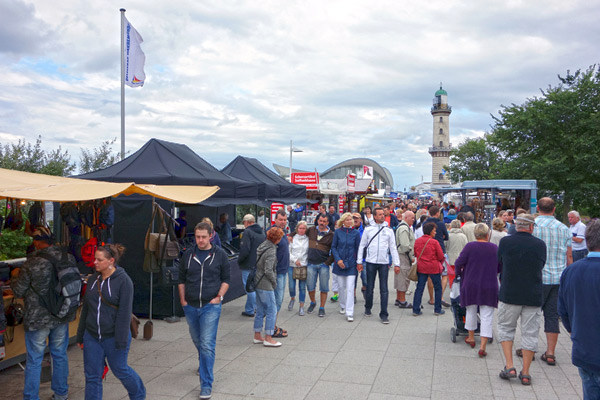
Even on a blustery day, the promenade of Warnemünde was packed with people bundled up and out looking for a nice sausage.Rather than spend six hours on the train side-tripping to Berlin, I toured Rostock, which has a rustic Hanseatic League flavor evoking a day when it was an economic powerhouse.
I’m on a Baltic Sea cruise, taking my brand-new Rick Steves’ Northern European Cruise Ports guidebook on its maiden voyage. The fun thing about cruising is that every morning when you look out your window or step out onto the deck, it’s a different great city. While land travelers often see only the fairy-tale half-timbered centers, cruisers are not shielded from the economic realities of keeping a city fed and powered. Ports are busy industrial machines…and you become part of them. Here’s my first look at Warnemünde, the port on the northern coast of Germany, from where most cruise travelers catch the train into Berlin.
If you can’t see the video below, watch it on YouTube.
I’m cruising Scandinavia and Northern Europe to update our new, hot-off-the-press Northern European Cruise Ports guidebook. And it’s fun to be sure not to miss any new sights that need assessing and writing up. For instance, for years, Sweden has been trying to find a place for its long-awaited ABBA Museum. Now it’s finally open, in Stockholm. Here’s how I wrote it up after my visit, plus a quick virtual visit by video:
ABBA the Museum — This Swedish pop group was, for a time, a bigger business than Volvo. They’ve sold more than 380 million records, and the musical Mamma Mia! (based on their many hits) has been enjoyed by 50 million people. Now the long-awaited ABBA Museum has finally opened, conveniently located just across the street from Skansen open-air folk museum and next to Gröna Lund amusement park on Djurgården. Like everything ABBA, this is aggressively for-profit, with pricey tickets and slick promotion. The museum is high-tech, with plenty of actual ABBA artifacts, recreated rooms where the group did its composing and recording, lots of high-energy video screens, everything explained in English, and plenty of interactive stations. Included in the ticket is a “digital key” that lets you record a music video karaoke-style as a fifth member of the group, then pick up the production from their website. To control the crowds, only 75 people are let in every 15 minutes, and tickets come with an entry time. You can buy your ticket online or at the TI to choose your “slot time,” or just drop in. If they’re busy, you may need to come back in an hour or two, but you can generally go right in. The ticket is expensive, and you’ll need to pay 40 kroner (about $6) extra for the audioguide, in which Agnetha, Benny, Björn, and Frida share their own memories. A small wing features the Swedish Music Hall of Fame, but apart from that, it’s all ABBA. If you like ABBA, it’s lots of fun (195 kr — that’s about $30, daily 10:00-20:00, on Djurgården at Gröna Lund, bus #44, tram #7, www.abbathemuseum.com).
I’m kicking off the next phase of my summer research rounds, taking our brand-new Northern European Cruise Ports guidebook out for a test drive. My cruise starts from Copenhagen. But, because I enjoy the city so much, I arrived a couple of days early to squeeze in some sightseeing.
Some cities lend themselves to bike touring better than others — and Copenhagen is the best of any. The first thing I did upon checking into my hotel was to rent one of their bikes. That was my mode of transportation for our entire stay, and we also booked a city tour by bike (with Mike, recommended in my guidebooks) that was thoroughly enjoyable. The tour finished at the ever-popular Little Mermaid.
Researching my guidebooks, I am determined to do as many of the activities we recommend as I possibly can. On this trip, I spent a delightful hour on a Bike Mike tour of Copenhagen. A fun part of taking a small, local, independent tour (walking or biking) is that you feel like you get to know a local who is generally a fun and opinionated character. (Mike Sommerville, at http://www.bikecopenhagenwithmike.dk/, offers a good three-hour guided bike tour of the city daily at 10:30.)
Copenhagen’s beloved Little Mermaid is 100 years old…but she’s only been beloved for 60 years. She sat on her rock basically ignored for four decades until Danny Kaye sang “Wonderful, Wonderful Copenhagen” in the Hans Christian Andersen movie, and the Danish tourist board decided to make her the symbol of the city. Today, while kind of underwhelming on her rock, she draws a steady stream of tourists to the pier at the edge of town to snap photos.
Later on my visit, I crossed paths with one of our tour groups. I can recognize our groups out on the streets by the fun-loving nature of the tour members and the ease and joy they seem to exude as they follow their guide across town. It just happened that their guide had arranged an ambush on the way to their dinner by none other than good old Hans Christian Andersen.
I was walking my bike with the group, chatting with Åsa (our Scandinavia tour guide), when this wonderful gentleman interrupted us and invited us to sit on the steps of the old city hall so he could tell us his story. And he is a wonderful storyteller.
Watching the faces of our group enjoy the surprise visit from Hans Christian Andersen on their first evening walk across Copenhagen reminded me how much I enjoy my work. To be part of a team that brings so many travel memories to so many good American travelers makes working fun. (Photo by Trish Feaster. Read her blog at The Travelphile.com.)
Copenhagen’s Hans Christian Andersen is Richard Karpen, whose friendship I’ve enjoyed for over a decade. He’s one of those guides who simply love to share their passion for history and culture…and that’s a perfect fit for our groups. After his half-hour street theater monologue for our enthralled group, he bid the group farewell and walked off into the city. Then I got to join HCA for dinner. Richard’s tours are a great value — for details, see Copenhagen Walks.com (Photo by Trish Feaster.)
As we enjoyed breakfast aboard our American Safari Cruise, our guide reminded us that with the beautiful full moon we enjoyed last night came a very low tide this morning. And in 15 minutes, the first skiff would head out for some tide pooling in Port Houghton. The little boy in me jumped into action, as I once loved nothing more than to lose myself in the wonders of a bay drained of water and entirely exposed at low tide. Every tide pool was both crisp and slimy, a salty wonderland. Every rock was some crunchy creature’s castle.
Landing with a dozen cruisers, our guide oriented us. I figured I’d wander off on my own. But he gave meaning to each discovery in a way I had never appreciated. He wielded a guidebook to the sea life (Audubon Society Nature Guide: Pacific Coast) like I would employ a guidebook to the Renaissance. Empty clamshells had a neat hole hammered by the beak of an oystercatcher. Chitons, considered one of the oldest life forms, clung to rocks as if part of the rocks themselves. An array of barnacles adapted to their environment so obviously that they inspired Charles Darwin to pursue his notion of evolution.
Standing alone in my mighty rubber boots, I just listened to the crunching, squirting, wilting, and tilting of the fertile compost pile of life all around me. With each step, I killed things… while convincing myself that they were heartless things that would kill me if they could.
Eagles soared overhead. Our guide said something about “obligate siblicide” among gulls, who had to kill their brothers and sisters to survive. I wondered, “Why? With this buffet of free and fresh seafood exposed with the falling tide twice a day, isn’t life pretty easy?”
After the ebbing tide reached its lowest point, it began its steady march back in. Watching a limpet go from high and dry to underwater a matter of minutes, I pondered the flexible toughness of these creatures — under the sun for half their lives, and then under the cold sea for the other…first the prey of grazing birds, then the prey of scary-looking crustaceans.
And surveying all this life — from that which the low tide never quite reached, to tide pools abundant with fanciful creatures; from the yellow lichen blanketing high rocks nourished only by sea spray, to birds overhead — I saw strata. It was a parfait of sea life.
A salty parfait of sea life.
Our ship’s dining room — 10 tables for the 60 of us, with the crinkled surface of the sea at about table level just outside the big windows on either side — was a place of conviviality, for feasting on seafood while still marveling at the majesty of Alaska. Sitting down for dinner, we left Port Houghton and were heading up Frederick Sound to Stephens Passage. Just before dessert, our captain suddenly slowed way down and turned 90 degrees starboard. On one side, the sun was dipping behind glacier-blanketed mountains in the distance. On the other side, a big full moon was rising over glacier-blanketed mountains in the distance.
After five days, I thought I had experienced all that a cruise through Southeast Alaska could offer: breaching whales, calving glaciers, bears dragging salmon out of waterfalls, kayaking among harbor seals in desolate inlets, and hikes through temperate rainforests. Now, with this meal, bookended by the sun and the moon, I thought, probably not. Southeast Alaska goes on and on.