Coronavirus Reports from Our Guides in Europe — Week 7

On many days, the first thing I read — while I’m still in bed — are emails from our tour guides all across Europe, many in countries more locked down than mine. It’s touching and fascinating to learn what their lives have been like for the last two months. Earlier this week, I sent them all a video message reassuring them that our company is financially strong and determined to weather this storm. Like them, we are eager for this crisis to be over, so we can all get back to guiding our Rick Steves tour groups around Europe. But in the meantime, it’s great to be in touch.

Here’s a recap if this week’s communiques from guides.

Jana Horovska sent these eerie images of empty Prague, including some of the most crowded places in town:

Karlova Street, which we usually make a point to avoid with our tour members because it’s so jammed.

Charles Bridge, normally clogged with visitors.

And the Old Town Square.

In the Netherlands, Ellen Janzing writes:

“This time after Easter is a festive period for us, with our National Holiday, or King’s Day, on 27 April (our King Willem-Alexander’s birthday), plus Memorial Day on May 4 and Liberation Day on May 5 coming up. The commemoration of these have all changed drastically now because of the coronavirus crisis.

“Usually on King’s Day there are car boot sales everywhere, people go out in droves (dressed in orange!), and there are festivals, bands playing, parties, and so on. This year, everyone celebrated at home — together with our king, who was at home, too, and checked in with people online.

“The day began at 10 a.m. with the national anthem being played by the members of the Concertgebouw Orchestra from their homes, with people around the country invited to join in. And they did! (With the notable exception of Amsterdam, the city that traditionally has a love-hate relationship with the monarchy.) Here’s a clip:

“At 4 p.m., the day was concluded with a toast from the king, and my husband and I joined in from our garden with the traditional, orange drink: Oranjebitter and an orange tompouce cake.
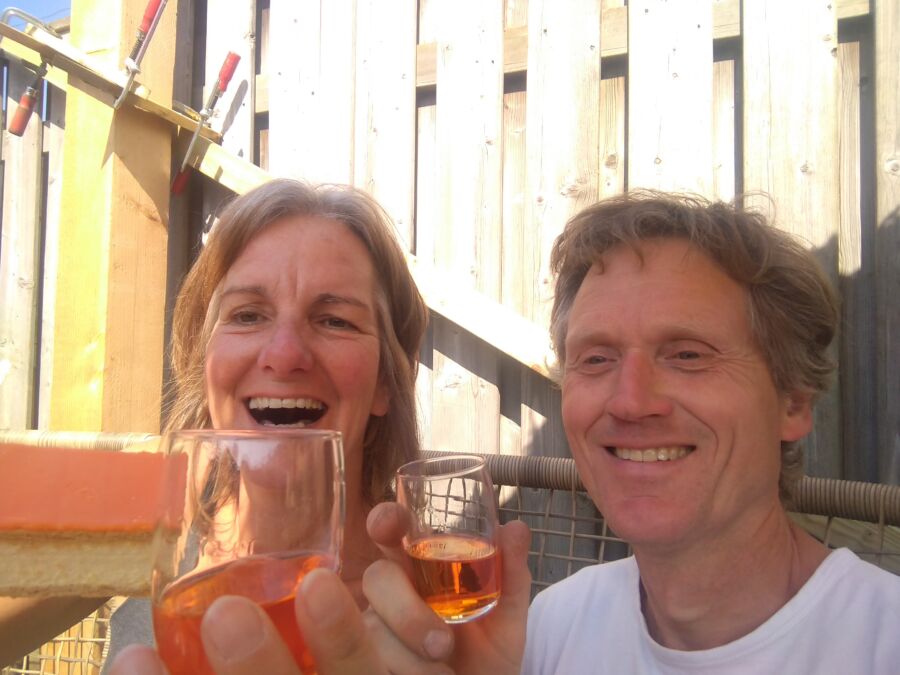
“Here’s the king’s toast:

“In the last week, I also had the chance to go to Amsterdam. I know, we’ve all seen the quiet streets of otherwise buzzing cities, but to me personally it was shocking, memorable, and emotional to see this vibrant city so quiet now. What remains of a city when people have left it? I filmed it for my tour guide colleagues:

“You’ll see Central Station, the Red Light District, Dam Square, a coffeeshop, the Homomonument, and the Anne Frank House. And yes, I talk too much and show too little — I’m no professional vlogger, sorry!”

Stephen McPhilemy — not in Ireland, but in Switzerland — writes:

“I’ve been isolating in the silent, blissful, and safe Swiss Alps for about three months now. My two American friends, Patrick and Cyrus, and I have always daydreamed of buying a little hotel in Switzerland as we love hiking in the Alps each summer. In mid-February, this dream came true. We took over the keys from Mark and Ursula, celebrated, and sat back for a blissful life as Swiss hoteliers in one of the most beautiful spots on earth, the Lauterbrunnen Valley.

“The lads headed back to life in California, and my Brazilian wife, Rubia, joined me, leaving her best friend Vera to watch our three huge Irish wolfhounds at Milltown House in Dingle. The plan was to stay in Lauterbrunnen for a month, get things ready here for the busy summer season, and then return home to Dingle to our wolfhounds…and for me to begin my 20th summer on the road guiding Rick Steves Heart of Ireland tours.

“Oh how our world has changed.

“We are now approaching our third month in the Alps. Summer has arrived, and Switzerland is still in an obedient and disciplined lockdown. Financial support from the Swiss government has been swift and relatively generous. So although, in retrospect, the timing of our hotel purchase was abysmal, we are secure and ready to reopen when it is safe to do so and the Swiss Federal Council gives us the go-ahead.

“My wife and I have become vegetarian, after an initial month of Rösti and bratwurst! Vegetables and herbs grow wonderfully in the strong alpine sun. We are cycling every day along beautiful trails with not a tourist crowd in sight. And I’m learning German! Then the even wilder Swiss German…here’s a clip of my best efforts.

“Our Irish wolfhound pack is being well taken care of in Dingle with poor Veramuza from Brazil — little did she know what she was letting herself in for when she volunteered to dogsit!

“We are safe and happy here in our isolation. I’m dreaming of the day when we tour guides can be ‘on the road again.'”

In Sarajevo, Amir Telibećirović shares the Bosnian perspective on life in self-isolation, with his characteristically dry sense of humor:
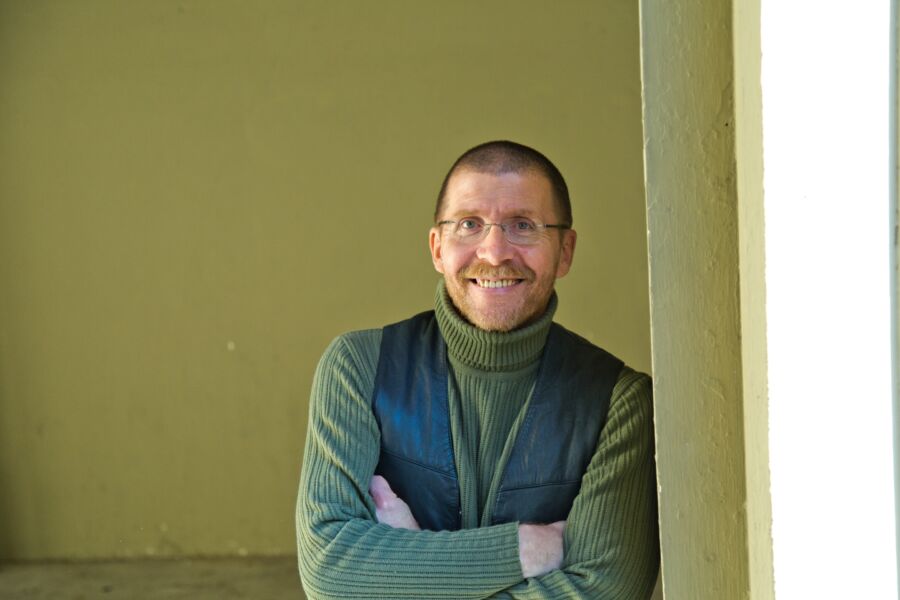
“As a very small country, often almost forgotten but socially and culturally vibrant, Bosnia is struggling through the ongoing international crisis. While we are dealing with similar issues as in other European countries, I am finding that people who lived through the siege, war, and/or expulsion in the 1990s are a bit more resilient than younger people. They are handling this collective isolation with more patience.

“In order to avoid the stereotype of ‘do you want the good news or the bad news first?’, let’s make a sandwich of the ‘good’ list divided in two, with ‘bad’ in between.

“Good News, Part 1: According to a 2015 Gallup poll, 96% of all Bosnian citizens wash their hands with soap and water after going to the toilet. That puts Bosnia on the top of European countries. Before this global state of emergency, this number didn’t seem like a big deal. But now many people in Bosnia are reminding ourselves that we have already been following WHO advice to wash hands carefully, for generations, with or without the pandemic.

“Another suggestion on hygiene from the authorities is to take shoes off before entering a home or other indoor space, as a precaution against the virus. That’s another tradition deeply rooted in Bosnia.

“While people around the world have been buying enormous amounts of toilet paper, that’s been done at a lesser scale in Bosnia. At first, Bosnians did some stocking up out of fear of shortages, but soon we remembered our own hygienic tradition. It’s simple: Water is more important, more significant, and more effective than toilet paper. Water and soap first, and then paper, but not paper alone.

“Bad News: The economy, which was already in bad shape even before this crisis, is about to collapse. A lot of people are losing their jobs. The ongoing political crisis is more visible, especially with corruption on a local level.

“Also, the governments of neighboring countries — Croatia, Serbia, and Montenegro — are taking advantage of the crisis to Bosnia’s detriment. They are sending illegal immigrants across the border into Bosnia, and Croatia has announced plans to dump nuclear waste on the Bosnian border, with many Bosnians living just downriver.

“Good News, Part 2: Ordinary people are closer to each other, helping their neighbors. Young volunteers are self-organizing to help older and disabled people who can’t go out for their supplies. People are spending more time with their relatives. And people are turning more to agriculture, in order to rely on their own production, like their ancestors.

“We’re greeting each other in a similar way to what Native Americans used to do: with an elbow and a small bow for respect. There is more humbleness now in greetings — more modesty, less formalism. It looks odd at first, but traditions are there to be changed, to evolve into new traditions, to be adjusted. The rest is history, as long as people respect each other.”

And in London, Jeanie Carmichael takes a “stiff upper lip” approach to finding things to be positive about through this crisis:

“Even though the news seems increasingly grim from all around the globe, I have been playing on repeat Ian Drury and the Blockheads’ fantastic 1970s song ‘Reasons to Be Cheerful’:

“And there are, in fact, many of them to be found — first and best the incredible Captain Tom Moore, who decided to celebrate his 100th birthday by walking 100 laps of his garden, to raise funds for our wonderful National Health Service. He had hoped to raise £1,000 at best — his inspiring story went viral, and so far he has raised over £30 million! He has also recorded a song with Michael Ball and the NHS Choir which has gone to number 1 in the charts (our oldest chart-topper ever) and on his actual birthday, April 30, the Royal Air Force did a fly-past over his home, as a thank-you to this gallant and inspirational gentleman.

“Every Thursday at 8 p.m., we have ‘Thankful Thursday’ and we hang out of our windows, clap, cheer, and bang saucepans to thank the NHS — this week it was for him, too.

“Other inspiring elderly folk from Britain, the Rolling Stones, have released the brand-new single ‘Living in a Ghost Town,’ which is great stuff and good for dancing around the kitchen:

“Our museums and art galleries have wonderful online tours to enjoy — and how marvellous to be able to enjoy all these treasures with no one else around to get in the way!

“The National Theatre, Shakespeare’s Globe, and many other theatres are streaming terrific productions for free, and I am settling down with a glass of something lovely and a plate of cheese, in my own private theatre every night. It just doesn’t get any better…

“This situation has really brought out the Blitz Spirit in Londoners: Armies of volunteers are every day helping neighbours and housebound folk, with the result that we are meeting people we never knew before. I deliver medicines for my local pharmacy and have endured endless teasing from my chums, calling me ‘The Local Drug Mule.’ But I have the last laugh as I get more outdoor exercise than is normally allowed, and get to chat to neighbours, and best of all, feel useful.

“This strange situation in which we all find ourselves has given us all plenty of time to think and re-evaluate many things — and it’s been interesting to discuss with family and friends, what is the first thing we will do when we are finally let out of lockdown. I want to head straight for Westminster Abbey, just to sit and soak up the beauty, and to think of all the troubles and struggles which that loveliest of buildings has helped people endure for a thousand years…I am not a very religious person but I do think that courage, faith, art, and the lessons of history will get us through.

“Chin up, everyone, and remember what Churchill said: ‘When you’re going through Hell, KEEP GOING.’”

Daily Dose of Europe: Mysterious Britain 

On my next trip to Britain, I’ll linger a bit longer at its many mysterious sights.

Even if we’ve had to postpone trips to Europe, I believe a daily dose of travel dreaming can actually be good medicine. Here’s another one of my favorite travel memories — a reminder of what’s waiting for you in Europe at the other end of this crisis.

On my first trip to Dartmoor National Park, back when I was a student, word of the wonders lurking just a bit deeper into the moors tempted me away from my hostel in Gidleigh. I was told of an especially rewarding hike that would lead me to the mysterious Scorhill Stone Circle. Climbing over a hill, surrounded by ominous towers of craggy granite, I was swallowed up by powerful, mystical moorland. Hills followed hills followed hills…green growing gray in the murk.

Where was that 4,000-year-old circle of stone? I wandered in a scrub-brush world of greenery, white rocks, eerie winds, and birds singing unseen. Then the stones appeared. It seemed they had waited for centuries, still and silent, for me to visit.

I sat on a fallen stone and my imagination ran wild, pondering the people who roamed England so long before written history documented their stories. I took out my journal, wanting to capture the moment… the moor, the distant town, the chill, this circle of stones. I dipped my pen into the cry of the birds and wrote.

That experience, 40 years ago, kicked off decades of my fascination with mysterious Britain. Dartmoor, Stonehenge, the Holy Grail, Avalon…there’s an endlessly intriguing side of Britain steeped in lies, legends, and at least a little truth. Haunted ghost walks and Loch Ness Monster stories are profitable tourist gimmicks, but the cultural soil that gave us Beowulf, King Arthur, and Macbeth is fertilized with a murky story that goes back over 5,000 years — older, even, than Egypt’s pyramids. With a little background, even skeptics can appreciate Britain’s historic aura.

There are countless stone circles, forgotten tombs, man-made hills, and figures carved into hillsides whose stories will never be fully understood. Britain is crisscrossed by lines, called ley lines, connecting these ancient sites. Prehistoric tribes may have transported these stones along a network of ley lines, which some think may have functioned together as a cosmic relay or circuit.

Two hours west of London, Glastonbury is located on England’s most powerful ley line. It gurgles with a thought-provoking mix of history and mystery. For the views, hike up the 500-foot-tall Glastonbury Tor (a grassy, conical clay hill capped with an old church tower), and you’ll notice the remains of the labyrinth that made climbing the hill a challenge some 5,000 years ago.

In AD 37, Joseph of Arimathea, Jesus’ wealthy tin-merchant uncle, supposedly brought a vessel containing the blood of Christ to Glastonbury, and with it, Christianity to England. (Joseph’s visit is plausible because back then, merchants from the Levant came here to trade with the local miners.)

While that story is supported by fourth-century writings and accepted by the Church, the King Arthur and Holy Grail legends it inspired are not. Those medieval tales were cooked up when England needed a morale-boosting folk hero to inspire its people during a war with France. They pointed to the ancient Celtic sanctuary at Glastonbury as proof of the greatness of the fifth-century warlord, Arthur. In 1911, his supposed remains, along with those of Queen Guinevere, were dug up here, and Glastonbury was woven into the Arthurian legends. The Camelot couple was reburied in the abbey choir and their gravesite is a kind of shrine today. Many believe the Grail trail ends at the bottom of the Chalice Well, a natural spring at the base of the tor.

In the 16th century, Henry VIII, on a rampage against the power of the monasteries, destroyed Glastonbury Abbey. For emphasis, he hung and quartered the abbot, sending his body on four national tours… at the same time. Two centuries later Glastonbury rebounded. In an 18th-century tourism campaign, thousands signed affidavits stating that water from the Chalice Well healed them, putting Glastonbury on the tourist map.

Today, Glastonbury is a center for searchers. It’s too out there for the mainstream church, but just right for those looking for a place to recharge their crystals. Since the society that built that labyrinth worshipped a mother goddess, the hill, or tor, is seen by many today as a symbol of the Sacred Feminine.

Along with its history, the geology contributes to the mystery of this land. Southern England’s shoreline is lined by famed white chalk cliffs. And that same white chalk is just below a thin layer of topsoil all across the region. Eons ago, all it took was a shovel and a little hard work to peel away the soil and transform rolling hillsides into works of art — or messages.

Travelers to this day are entertained by giant white figures popping out of these grassy green slopes. Many are creations of 18th- and 19th-century Romantics acting out against the coldness of the Industrial Age, but a few of these figures have, as far as history is concerned, always been there. One figure is particularly eye-catching: The Cerne Abbas Giant, armed with a big club and an erection, is hard to ignore. For centuries, people fighting infertility would sleep on Cerne Abbas. As my English friend explained, “Maidens can still be seen leaping over his willy.”

And fixed like posts into that same chalk subsoil are stone circles, more souvenirs of England’s misty, distant past. The most famous stone circle, Stonehenge, is an hour’s drive from Glastonbury. Built in phases between 3000 and 1000 BC with huge stones brought all the way from Wales, it still functions as a remarkably accurate celestial calendar.

A study of more than 300 similar circles in Britain found that each was designed to calculate the movement of the sun, moon, and stars, and even predict eclipses. These prehistoric timekeepers helped early societies know when to plant, when to harvest, and when to party. Even in modern times, when the summer solstice sun sets in just the right slot at Stonehenge, pagans boogie.

Curiously, some of the particular “blue stones” used in Stonehenge were found only in distant Wales. Why didn’t the prehistoric builders use what seem like perfectly adequate stones nearby? Consider those ley lines. Perhaps a particular kind of stone was essential for maximum energy transmission. How might these massive stones have been transported in a pre-industrial age? Various practical explanations have been suggested, but there’s no consensus among experts. Imagine instead congregations gathering here 5,000 years ago, raising thought levels and creating a powerful life force transmitted along the ley lines. Maybe the stones were levitated in Wales and rocketed a hundred miles to this spot. Maybe psychics really do create powerful vibes. Maybe not. It sounds unbelievable, but at one time, so did electricity.

Not far away, the stone circle at Avebury is 16 times the size of Stonehenge and about one-sixteenth as touristy. Visitors are free to wander among 100 stones, ditches, and mounds, and ponder these curious patterns from the past. Near Avebury is the 130-foot-high pyramid-shaped Silbury Hill. More than 4,000 years old, this man-made mound of chalk is a reminder that you’ve only scratched the surface of Britain’s fascinating prehistoric and religious landscape.

More Neolithic wonders lurk in England’s moors. While they inspire exploration, beware: you can get lost in these stark, time-passed commons. Directions are difficult to keep. It’s cold and gloomy, as nature rises like a slow tide against anything human-built. A crumpled castle loses itself in lush overgrowth. A church grows shorter as tall weeds eat at the stone crosses and tilted tombstones. Over the centuries, the moors have changed as little as the longhaired sheep that still seem to gnaw on moss in their sleep.

One of England’s wildest and most remote regions is in the southwest corner of the country. It’s Dartmoor — that wonderland of powerfully quiet rolling hills that inspired me long ago. Near the Cornwall Peninsula in the county of Devon, it’s crossed by only three main roads. Most of this area is either unused or shared by its 34,000 villagers as a common grazing land — a tradition that goes back to feudal days. Ordnance Survey maps show that Dartmoor is peppered with bits of England’s mysterious past, including more Bronze Age stone circles and enigmatic megaliths than any other chunk of England. It’s perfect for those who dream of enjoying their own private Stonehenge without barbed wire, police officers, parking lots, tourists, or port-a-loos.

Returning to Dartmoor on my last trip, I sat peaceful and alone on the same mossy stone I warmed the day I first experienced Scorhill Stone Circle in 1978. I recalled that day, at the age of 23, when I realized how many wonders in Europe were still undiscovered…hidden and unheralded. I remembered how, hiking home that evening, I decided that my calling was to find these places and to share them. That was the day I became a travel writer.

(This story is excerpted from my upcoming book, For the Love of Europe — collecting 100 of my favorite memories from a lifetime of European travel. It’s coming out in July, and available for pre-order. And you can also watch a video clip related to this story: Just visit  Rick Steves Classroom Europe  and search for “mysterious Britain”.)

Daily Dose of Europe: In Search of Edelweiss 

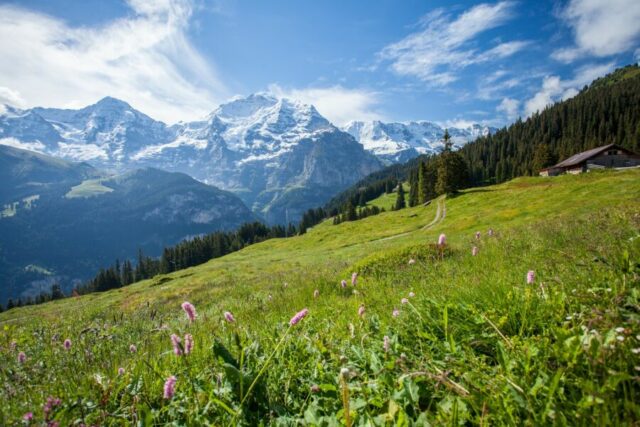
When this pandemic is all over, I can’t wait to get back to Europe. And the first hike I’d like to take is high above the Lauterbrunnen Valley, in Switzerland, with my friend Olle. I’ve been thinking back on one of my favorite such hikes.

Even if we’ve had to postpone trips to Europe, I believe a daily dose of travel dreaming can actually be good medicine. Here’s another one of my favorite travel memories — a reminder of what’s waiting for you in Europe at the other end of this crisis.

It’s a glorious Swiss Alps morning. I’m spending my day walking with my schoolteacher friend, Olle, exploring the alpine landscape surrounding his home in Gimmelwald. Before we’re too far along, I realize I’m getting a blister.

Opening his rucksack on a rock, Olle asks me to take off my shoe and sock. Muttering that he can’t believe how tourists tackle these mountains without good hiking boots, he fits some moleskin around my tender toe. As Olle works, I lie back on the rugged tufts of grass growing through the pebbly shale.

We continue on, following a faint path along the ridge. I stop every few steps to enjoy vast views of the Schilthorn on our left and the Jungfrau on our right. Olle takes on his teacher’s voice: “We respect nature more than the tourists do. When there’s an avalanche warning, we take the gondola down. Tourists continue sledding. There are many accidents. In Lauterbrunnen, maps show red flags for places of mountain injuries and black ones for deaths.” Pointing to the towering rock cliff of the mountain over the valley directly ahead of us, he says, “The Eiger is solid black.”

As I squint up at a wasp-like helicopter, Olle answers my question before I ask it. “Those are mostly sightseeing trips. But even sightseeing trips are related to mountain rescue. As they show a tourist around, they are practicing for emergency rescues.”

“Are there really dead climbers hanging from ropes on the Eiger?” I ask.

“Yes,” says Olle. “It’s sad when bodies are finally recovered. They look like they did when we saw them last, except with a very light beard. You can tell from the beard how long they lived. The family has to identify them.”

The weather can turn at any time. Just last month, a storm hit fast. Within a few minutes, five people died: three mountaineers on the Eiger, one on the Mönch, and one in the air — a paraglider.

I tell Olle of a harrowing experience I had back in my youth-hostel days. We’d hike up the Schilthorn from the hostel with a plastic bag, sit on the bag, and slide down the glacier — breathtaking fun. As a reckless young tour guide, I’d lead my groups down the mountain in the same way.

One day, late in the season, sliding on an icy but smaller-than-usual sliding field, I started going out of control. Hurtling directly toward the rocky edge, I didn’t know what to do, but I did know I had to do something. After almost too much time to consider my options, I dug my hands like brakes into the rocky ice. Going through several degrees of burn in a matter of seconds, I ground to a halt with blackened, blistered, and bleeding hands — and a bloody butt.

My group heralded me as a hero. But in the doctor’s office in Mürren, I was scolded as a fool, the whipping boy for all the stupid tourists who disrespect the power of the mountain. The doctor didn’t even bother to clean my hands. He lectured me, sprayed something on my wounds, and bandaged me. I left knowing that the little bits of Schilthorn embedded in my palms would come out only in the pus of a later infection.

Olle nods, as if in support of the doctor, and says, “This happens many times.”

He tells me that even cows become victims of the mountains, occasionally wandering off cliffs. Alpine farmers expect to lose some of their cows in “hiking accidents.” These days, cows are double the weight of cows a hundred years ago and no less stupid. If one wanders off a cliff in search of greener grass, the others follow. Farmers tell their sons about the time at the high Alp above Gimmelwald when a dozen cows performed this stunt…and died like lemmings. Helicopters recover the dead cows, flying them out, but because the meat must be drained of blood immediately for human consumption, it’s wasted. It’s meat fit only for dogs.

As we continue our walk, a pastel carpet of flowers trims the scene: golden clover, milk kraut, bellflowers, daisies. “For me, it’s like meeting old friends when the flowers come out again in the spring,” Olle says. All but abandoning me for the flowers, he rummages through his rucksack and pulls out a weathered handbook describing the local flora. “My bible,” he says. “When the cows eat this grass with all these flowers…it is a good mix for the milk.”

“Okay, Rick, you will now risk your life for a flower.” He leaves the trail and creeps over an edge and out of sight to find an edelweiss. Loose rocks, huge drop, no helicopter in sight…I don’t really care about finding edelweiss.

Then I hear Olle holler, “Yes, I found some! Come around.”

Feeling fat and clumsy, I leave the trail. Pulling gingerly at weed handholds, I work my way around a huge rock and across a field of loose shale. Olle comes into view, looking younger than he did a moment ago. “There are three edelweiss here. But this is a secret for only you and me. This spot must not go in your guidebook.” At this point I am not concerned about my guidebook, only my survival. Olle grabs my hand with hands that have grown strong and tough after 14 years of high-altitude village life.

As if to pump up the drama, he whispers, “For me, it would not be a hike without a little danger.”

“That’s why your school is so small,” I whisper under my breath.

“Edelweiss. It means ‘noble white.’ In the valley, it’s noble gray. Only at high elevations do they get this white. UV rays give all flowers brighter colors at this altitude.” Creeping with me to the ledge, Olle gently bends three precious edelweiss toward the sun. Pinching off a petal, he assures me, “This will not affect reproduction.”

Petting a petal gently, I note that it feels like felt.

“Yes, like felt,” Olle agrees. “This protects the plants from dehydration. I collect and press flowers but have never pressed an edelweiss. Edelweiss has been picked nearly to extinction.”

As we struggle back to the trail, Olle talks on. “Here in Switzerland we are getting serious about our environment. Twenty years ago, our rivers and lakes were very polluted. Today you can nearly drink out of Lake Thun. Now we understand. You don’t pee in your living room, do you?”

I assure him that I do not.

Finally reaching the safety of the trail, we walk more quickly, with ease. “Do farmers mind if we walk through their property?” I ask.

“This is a human right — to walk through the land,” Olle says. His environmental passion crescendos with his voice. “When I was in Boston, I asked, ‘How can I get to the lake?’ They told me, ‘You can’t, it is private.’ That is for me perverse. This is unthinkable here in Switzerland. We are guests of this Earth.” Like welcome guests, we make ourselves at home, stopping at a peak that stands dramatically high above Gimmelwald. Olle shares a snack as we sit quietly to savor our perch.

Switchbacking steeply back down, we pass through a thick forest and step out at the top end of Gimmelwald. We’re cheered on by a fragrant finale…a field vibrant with flowers, grasshoppers, bees, crickets, moths, and butterflies.

Olle says, “This year farmers obeyed tradition and not their eyes. They waited too long and had to take cows directly to the high Alps. They skipped this lower field. For these flowers, it is a fine year — no hungry cows.”

Switzerland embraces its traditions with such gusto that locals like Olle fear visitors think it’s an underdeveloped nation. It’s certainly not. And the good news: The traditional alpine culture survives most heartily — like edelweiss — in its most remote corners.

(This story is excerpted from my upcoming book, For the Love of Europe — collecting 100 of my favorite memories from a lifetime of European travel. It’s coming out in July, and available for pre-order.)

Coronavirus Reports from Our Guides in Europe — Week 6

Through the ongoing coronavirus crisis, we’re looking for bright spots. And one of the brightest comes in the form of updates from our tour guides around Europe. Hearing from our European friends is a great reminder that we are all in this together — and we will be together again, when the crisis is over.

Continuing our weekly series, here’s what we’ve been hearing from our guides this week:

In Athens, Filippos Kanakaris describes the Orthodox Easter celebration that took place in Greece earlier this week:

“In Greece, we have been on a very strict lockdown for the last four weeks, which includes a certain procedure in order to be allowed to go out. That includes specifying the reason (which you send in a text to a relevant authority) and always carrying a valid form of identification with you in case the police stops you in one of the very frequent random checks that are being performed on a daily basis. The whole country has gone into an eerie silent mode, and empty streets have turned the urban centers into ghost towns. I take some very empty photographs when I take my bike on authorized trips.

“Churches have also been closed to the public for weeks now, and for the first time in centuries, Easter celebrations were confined within the premises of our apartments without any guests allowed. This has been unthinkable for the Greeks, considering the intensity of Easter celebrations in the country — which include the consumption of a lot of traditional food such as lamb on a spit.

“Despite all these unusual times we all live in, the mayors of Athens and other large communities went ahead with the fireworks associated with the occasion. (Fireworks and loud noises represent the loud victory of life over death that happened through the resurrection of Jesus.) I’m not religious at all, but the experience of the fireworks was a rather spiritual one. It worked as a symbolic reinstatement of the belief that there is light somewhere at this end of this very long tunnel.”


In Switzerland, Mirjam Grob writes:

“In January, I moved to a very small village in the countryside of French-speaking Switzerland. Especially in these days, I am very happy to live here. The solidarity between people here is great: We take care of each other, check in regularly (especially with the elderly), and keep on singing and playing music together at safe distances and around campfires in the evening, so nobody becomes too isolated.

“I have also been busy taking care of my garden. Together with three other women of the little village, we garden almost every day. It is very likely that prices for vegetables will increase a lot this summer, as Swiss farmers were not able to get the farm workers from other countries as usual (who were paid far less than Swiss workers and made it possible to sell the vegetables for the lower prices we were used to during the past decades). As I also lost almost all my income — with museums being closed and translation work also becoming scarce — I am very happy that I will have at least a lot of vegetables from my garden!

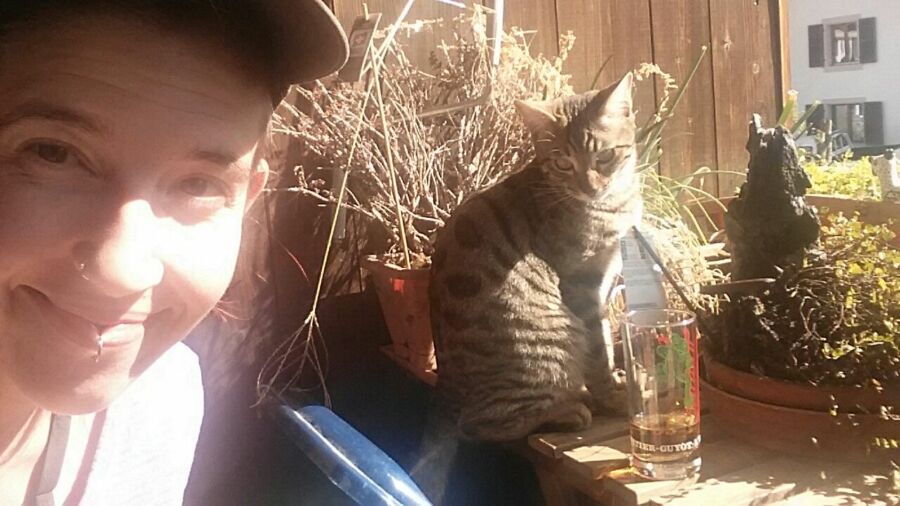
“I also enclose a little pictures of my lovely cat, who is very happy to have me spending more time with him, sitting on one of the jigsaw puzzles that I have been doing a lot of recently.”

In France, Arnaud Servignat posted this musical video playing along with Vivaldi’s “Nisi Dominus — Cum Dederit”:

In Turkey, Lale Sürmen Aran wrote to tell us about the very important national celebration that took place earlier this week and how it was modified because of coronavirus concerns:

“April 23 is both Turkey’s national holiday and Children’s Day. In fact, this year was the 100th anniversary of the Turkish National Assembly. Under normal circumstances, every year, Turkey invites hundreds of children from around the world to celebrate with Turkish children. Children fill up stadiums and celebrate. There are parades and fireworks. This year, instead, we all went out to our balconies, or stood in front of open windows, and sang the national anthem exactly at 21:00. And to make up for the cancelled celebrations, they streamed a concert in which Beethoven’s Ode to Joy, and important Turkish music, were performed in striking locations.”

Lale also wrote that her family had a scary week: Her 12-year-old son began running a fever of over 105 degrees. He was taken to the hospital, where hazmat-suited medical staff gave him tests for various diseases — including COVID-19 (all covered by the national healthcare system). Fortunately, he tested negative and is feeling better now. Lale notes that one big challenge was isolating him at home while they waited for results: “In Istanbul, isolation is not easy in the condominiums that most of us live in.” They were also contacted by members of the Ministry of Health’s “tracking crew” — contact tracers assigned with investigating possible COVID-19 cases.

In Italy, Susanna Perrucchini writes about another big celebration happening this week, which is causing her to re-evaluate an old holiday through new eyes:

“This Saturday, April 25th, is Italy’s Liberation Day — in fact, it’s the 75th anniversary of the liberation from Nazi occupation and the fascist regime. This year, that holiday is taking on a new importance. Today we are fighting a virus that is already decimating many of our older people — including those who were born before or during World War II. With them, we are losing parents, grandparents, dear loved ones, and our legacy…our link to a recent past.

“Only one year ago, many Italians would have celebrated this holiday by taking a few extra days off work to fare il ponte — ‘make a bridge’ between the April 25 and May 1 holidays. Many of us would have had a picnic or a day trip to the countryside or the sea. But instead we are all at home, feeling a sense of impotence and great tragedy. We are just starting to realize how our lives have been turned upside-down…just like that, almost in the blink of an eye.

“Because of the ‘Eternal Lockdown,’ our celebrations will be virtual, starting at 11:00 with the National Anthem (for details, see www.25aprile2020.it). Reading about the celebrations, these words struck me: ‘On April 25, liberty is reborn. This year, on the 75th anniversary of the Liberation, we need, more than ever, to celebrate our freedom, to look at the future with hope and courage.’

“I don’t see these words as easy rhetoric. I see them, maybe for the first time in my life, with a strong need to go back to our deep roots and values. As Italians, we have never been very patriotic. Italy started World War II allied with Hitler and finished on the other side, with the winners — quite an achievement! We always felt a bit silly declaring our love and pride for our country. We believed that criticizing and blaming others (politicians, local authorities, public servants, you name it) was the only way to face our deep frustrations and anger for being born in a country that’s so beautiful and yet so inefficient and corrupt.

“But I decided that today I want to be optimistic, because we need that now more than ever. This epidemic may give us all a chance for personal growth, and maybe for a new global awareness of our true needs as human beings. I never longed so much for a walk in a park, with trees and flowers and fresh air. Being confined in my flat, I feel I am losing my inner balance — and being close to the sea, countryside, or nature is the best medicine.

“I looked at those black-and-white pictures of April 25th, 1945, and I saw cheering crowds in the streets of Italy: men and women hugging, kissing, and dancing with wide smiles on their faces. War was over, and so was death, hunger, and misery. They needed to believe they were facing the dawn of a new, bright era with no starvation and violence.

“Those images will help me remember that losing hope is the worst we can all do. Seventy-five years ago, from the ruins, rubble, and debris of the past, they started to build — stone by stone, brick by brick — a new country. Endurance and resilience are needed. And we can look at our recent past to find them in our people.”

And finally, from Naples, Alfredo Cafasso Vitale offers this essay, which he calls “Pane e Camorra” (loosely translated as “Bread and the local Mafia family”):

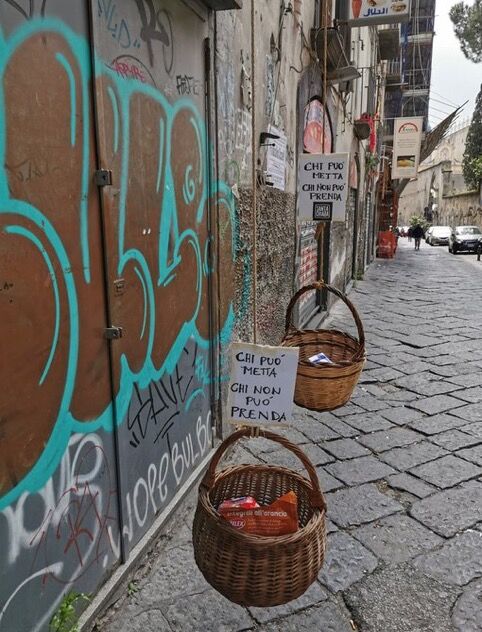
The baskets shown in the picture below — called panaro solidale, ‘supportive basket’ — have been posted, tweeted, shared, and printed all over the world. Stars like Madonna have chosen to share these images, to highlight to their followers how good-hearted and creative the Italians can be in moments of need. This spontaneous initiative by two locals, living along the Spaccanapoli, is however, only one of many in Naples, and its people have initiated to fight the increasing poverty and distress occurring to families during the COVID-19 lockdown.

“The sign reading Chi può metta, chi non può prenda (‘If you can, put in something; if you need, take something out’) is a wonderful motto created by a doctor, Giuseppe Moscati (sainted by Pope John Paul II in 1987), who used to cure poor Neapolitans for free in the early 1900s. In these days of COVID-19, when doctors and health-care personnel are on the front line of the fight against this deadly virus, the motto resonates perfectly.

“Apart from the obvious humanitarian response to assist those in desperate need, there is another underlying need for these initiatives: to counter the efforts of the Camorra, the Neapolitan mafia, which is trying to take advantage of people’s distress.

“In the words of judge Catello Maresca, who coordinated the capture of the Camorra boss Michele Zagaria in 2011 and today is heading one of the food distribution initiatives: ‘They pretend to be your friend, lending money to people in need, or buying them food or other primary needs. But tomorrow, once the emergency over, they will hand them a heavy bill. When they will ask a housewife or a retired person to hide drugs in their homes, who will be able to refuse?’

“Some might have heard of the caffè sospeso (‘spended coffee’), which is a unique Neapolitan feature.  A customer in a bar will take a coffee, but will sometimes pay for two. This coffee ‘credit’ can then be passed on to someone who cannot afford to pay for one. The COVID-19 version of this feature is now spesa sospesa — ‘suspended shopping.’ When shopping in a neighborhood grocery, butcher or bakery, one can pay for something to leave for people in need, on the same principle as the coffee.

“The familiar hum and whine of scooters is an integral part of the noise of life in the central historic neighborhoods as anything else. Silenced at the beginning of the lockdown, these scooters have now found another function: distributing food boxes, prepared both from the municipalities and from associations (like the evangelical Tabita Onlus). The Red Cross has also distributed more than three thousand food boxes during these lockdown weeks.

“Other initiatives involving citizens, municipalities, the Catholic Church, and NGOs include food vouchers, tables outside buildings collecting food, distribution of free books, and all kinds of other services offered to the those in need, in a network of solidarity unseen  in the last decades of globalized economy.

“Napoli has a unique mixture of social, economic, and cultural classes, all sharing the same spaces, which are mainly, but not exclusively in the historic center of the city — neighborhoods like Quartieri Spagnoli, Vergini, Sanità, and Pallonetto a Santa Lucia.

“The ground floors of the (ancient) buildings, called palazzi, are made up of bassi, the one-room, ground floor apartments where the poorest inhabitants live. The higher floors house the more spacious apartments of the signori, the much wealthier citizens live. These two diverse groups of people continue to share the same building in an everyday dynamic unknown in any other city in the world.

“The streets of the Quartieri used to be the domain of the scugnizzi, the poor and aggressive yet sweet-hearted street kids, who are part of the iconography of Neapolitan art and cinema.

“Today, a more varied population — made up of Neapolitans and immigrants from African, Asian, and Eastern European countries — shares life in the bassi, and today’s signori are mostly Neapolitan intellectuals and young professionals that find here beautiful, historic apartments, often with breathtaking views, at reasonable prices.

“The people of the bassi and the signori share more than just housing. They share, in fact, everyday life, with the same open-air markets, and the difficulties of living in a city where often legal and illegal practices live side by side.

“Naples is indubitably a complex and contradictory city, and, as a result, it has generated a series of misconceptions: It is not easy to distinguish the traits of the Neapolitan identity from the stereotypes, and it is difficult for non-Neapolitans to fully grasp the delicate balance between legality and what here is called arte di arrangiarsi — ‘the art of making do’ — that often collides with the Camorra and for sure with a parallel, untaxed economical system.”

It’s clear that each country and region — and each individual — is dealing with their own challenges during this time. And yet, it’s also clear that we are all in this together.

Daily Dose of Europe: Naples — Bella Chaos 

European travel is a sensory experience…especially Italy, and especially Naples. And in these sensory-deprived times, I find myself thinking back on happy memories in one of Italy’s most vivid, most intense, and most sensory cities.

Even if we’ve had to postpone trips to Europe, I believe a daily dose of travel dreaming can actually be good medicine. Here’s another one of my favorite travel memories — a reminder of what’s waiting for you in Europe at the other end of this crisis.

Strolling through Naples, I remember my first visit to the city as a wide-eyed 18-year-old. My travel buddy and I had stepped off the train into vast Piazza Garibaldi. A man in a white surgeon’s gown approached me and said, “Please, it is very important. We need blood for a dying baby.” Naples was offering a dose of reality we weren’t expecting on our Italian vacation. We immediately made a U-turn, stepped back into the station, and made a beeline for Greece.

While that delayed my first visit by several years, I’ve been back to Naples many times since. And today, even with its new affluence and stress on law and order, the city remains appalling and captivating at the same time. It’s Italy’s third-largest city, as well as its most polluted and crime-ridden. But this tangled urban mess still somehow manages to breathe, laugh, and sing with a joyful Italian accent. Naples offers the closest thing to “reality travel” in Western Europe: churning, fertile, and exuberant.

With more than two million people, Naples has almost no open spaces or parks, which makes its ranking as Europe’s most densely populated city plenty evident. Watching the police try to enforce traffic sanity is almost comical. But Naples still surprises me with its impressive knack for living, eating, and raising children with good humor and decency. There’s even a name for this love of life on the street: basso living.

In Naples, I spend more time in the local neighborhoods than the palaces and museums. Since ancient Greek times, the old city center has been split down the middle by a long, straight street called Spaccanapoli (“split Naples”). Just beyond it, the Spanish Quarter climbs into the hills. And behind the Archaeological Museum is perhaps the most colorful district of all, Sanità.

Walking through the Spaccanapoli neighborhood, I venture down narrow streets lined with tall apartment buildings, walk in the shade of wet laundry hung out to dry, and slip into time-warp courtyards. Couples artfully make love on Vespas while surrounded by more fights and smiles per cobblestone than anywhere else in Italy. Black-and-white death announcements add to the clutter on the walls of buildings. Widows sell cigarettes from plastic buckets.

I spy a woman overseeing the action from her balcony on the fifth floor. I buy two carrots as a gift and she lowers her bucket to pick them up. One wave populates six stories of balconies, each filling up with its own waving family. A contagious energy fills the air. I snap a photo and suddenly people in each window and balcony are vying for another. Mothers hold up babies, sisters pose arm in arm, a wild-haired pregnant woman stands on a fruit crate holding her bulging belly, and an old, wrinkled woman fills her paint-starved window frame with a toothy grin.

On a nearby street I run across a small niche in the wall dedicated to Diego Maradona, the fabled soccer star who played for Naples in the 1980s. Locals consider soccer almost a religion, and this guy was practically a deity. This little Chapel of Maradona includes a “hair of Diego” and a teardrop from the city when he went to another team for more money. It’s these little eccentric passions that make exploring Naples such fun.

Around the corner there’s an entire street lined with shops selling tiny components of fantastic manger scenes, including figurines caricaturing politicians and local celebrities — should I want to add a Putin or a Berlusconi to my Nativity set.

The abundance of gold and silver shops here makes me think this is where stolen jewelry ends up. But I’ve learned that’s not quite true. According to locals, thieves quickly sell their goods and the items are melted down immediately. New pieces go on sale as soon as they cool.

Paint a picture with these thoughts: Naples has the most intact ancient Roman street plan anywhere. Imagine life here in the days of Caesar, with street-side shop fronts that close up to become private homes after dark. Today is just one more page in a 2,000-year-old story of city activity: meetings, beatings, and cheatings; kisses, near misses, and little-boy pisses.

The only predictable elements of this Neapolitan mix are the boldness of mopeds — concerned residents will tug on their lower eyelid, warning you to be wary — and the friendliness of shopkeepers.

To cap my walk, I pop into a grocery and ask the man to make me his best ham-and-mozzarella sandwich. I watch, enthralled, as he turns sandwich-making into a show. After demonstrating the freshness of his rolls with a playful squeeze, he assembles the components, laying on a careful pavement of salami, bringing over a fluffy mozzarella ball as if performing a kidney transplant, slicing a tomato with rapid-fire machine precision, and lovingly pitting the olives by hand. He then finishes it off with a celebratory drizzle of the best oil. Six euros and a smile later, I find the perfect bench upon which to enjoy my lunch while watching the Neapolitan parade of life.

An older man with a sloppy slice of pizza joins me. Moments later, a stylish couple on a bike rolls by — she sits on the handlebars, giggling as she faces her man, hands around his neck as he cranes to see where they’re going.

I say, “Bella Italia.”

My bench mate says, “No, bella Napoli.”

I say, “Napoli…is both beautiful and a city of chaos.”

He agrees, but insists, “Bella chaos.”

“Tell me, what is Napoli in one word?” I ask.

Turning his head, he watches a woman stride by. Then, with a long string of mozzarella stretching between his mouth and what remains of his pizza, he chews for a moment, pauses, and says, “Abbondante.”

I agree. “Abundant.”

(This story is excerpted from my upcoming book, For the Love of Europe — collecting 100 of my favorite memories from a lifetime of European travel. It’s coming out in July, and available for pre-order. And you can also watch a video clip related to this story: Just visit  Rick Steves Classroom Europe  and search for “urban Naples.”)