Daily Dose of Europe: The Cotswolds — Thatched Kingdom of Quaint

There are places in Europe where I go to do what I call “convalesce” — places that, when I’m burned out or feeling spent, I can go to be calm and recharge. England’s Cotswolds is one of those places. As a travel writer, I try not to use the word “quaint.” But in the Cotswolds, I just can’t help myself.

With so many of us stuck at home for the foreseeable future, I believe a daily dose of travel dreaming can actually be good medicine. Here’s another one of my favorite travel memories — a reminder of what’s waiting for you in Europe at the other end of this crisis.

The Cotswolds are crisscrossed with hedgerows, strewn with storybook villages, and sprinkled with sheep. Everything about them — the meadows, thatched roofs, churches, pubs, B&Bs, and even the tourist offices — is quaint.

The Cotswolds are also walkers’ country. The English love to walk the peaceful footpaths shepherds walked back when “polyester” only meant two girls. Hikers vigorously defend their age-old right to free passage. Once a year, the Ramblers, Britain’s largest walking club, organizes a “Mass Trespass,” when each of England’s 50,000 miles of public footpaths is walked. By assuring each path is used at least once a year, they stop landlords from putting up fences. Most of the land is privately owned, but you’re legally entitled to pass through, using the various sheep-stopping steps, gates, and turnstiles provided at each stone wall.

As with many fairy-tale regions of Europe, the present-day beauty of the Cotswolds was the result of an economic disaster. Wool was a huge industry in medieval England and the Cotswold sheep grew it best. Wool money built lovely towns and palatial houses. Local “wool” churches are called “cathedrals” for their scale and wealth. Stained-glass slogans say things like “I thank my God and ever shall, it is the sheep hath paid for all.”

Then came the rise of cotton and the Industrial Revolution. The wool industry collapsed, mothballing the Cotswold towns into a depressed time warp. Today, this most pristine English countryside is decorated with time-passed villages, gracefully dilapidated homes of an impoverished nobility, tell-me-a-story stone fences, and “kissing gates” no one should experience alone. Throngs of 21st-century romantics enjoy a harmonious blend of humanity and nature…and the Cotswolds are enjoying new prosperity.

In these small towns, everyone seems to know everyone. They’re all ever so polite. Chatty residents commonly rescue themselves from a gossipy tangent by saying, “It’s all very…ummm…yaaah.”

I use Chipping Campden as my home base. Just a few miles from the train station at Moreton-in-Marsh, it was once the home of the richest Cotswold wool merchants.

The great British historian G. M. Trevelyan calls Chipping Campden’s High Street the finest in England. Walking its full length, I agree. As in most market towns, the street is wide enough to have hosted plenty of sheep business on market days. On one end are the top-end homes with, it seems, competing thatched roofs. I pass the 17th-century Market Hall, the wavy slate roofline of the first great wool mansion, a fine and free memorial garden, and, finally, the town’s famous 15th-century Perpendicular Gothic “wool” church.

Nearby, Snowshill, Stanway, and Stanton are my nominations for the cutest Cotswold villages. Like marshmallows in hot chocolate, they nestle side by side.

Snowshill, a nearly edible little bundle of cuteness, has a photo­genic triangular town center and a good pub. I enjoy observing the ­hikers, young and old, wandering through, much like the wayfarers from centuries past. And, as if standing by for the older hikers, the traditional red phone booth no longer offers a telephone…but a defibrillator.

Stanway is notable for its manor house. The Earl of Wemyss, whose family tree charts relatives back to 1202, opens his melancholy home — once so elegant and now wistful for times gone by — to visitors two days a week in the summer. His 14th-century Tithe Barn was where the peasants of the manor would give one-tenth of whatever they produced to their landlord. While motley peasants no longer gather here to pay their feudal “rents,” the lord still gets rent from his vast landholdings and hosts community fêtes in his barn.

Stepping into the obviously very lived-in palace feels like stepping into a previous century. I see a demonstration of the spinning rent-collection table and marvel at the one-piece oak shuffleboard table in the great hall. I ask about the 1780 Chippendale exercise chair, and get an answer from the earl himself. He explains, “Half an hour of bouncing on this was considered good for the liver.” He also shows me that the manor dogs have their own cutely painted “family tree,” but then admits that his last dog, C. J., was “all character and no breeding.”

This place has stories to tell. And so do the docents stationed in each room — who, even without fancy titles, can trace their histories back just as far as the lord of the manor. Talking to them, I’m reminded that seeking out one-on-one conversations like this is how I’ve really gotten to know and understand England.

Stanway and neighboring Stanton are separated by a row of oak trees and grazing land, with parallel waves echoing the furrows plowed by generations of medieval farmers. Driving under a canopy of oaks and past stone walls and grazing sheep to get to Stanton is a joy.

In Stanton, flowers trumpet, door knockers shine, and slate shingles clap — cheering me up the town’s main street. The church, which probably dates back to the ninth century, betrays a pagan past. Stanton is at the intersection of two ley lines (considered by many to come with mystical powers) connecting prehistoric sites. Churches such as this one, built on pagan holy ground, are dedicated to St. Michael —
the defender of the Church against pre-Christian spiritual threats. Michael’s well-worn figure is above the door. Inside, I take a seat in the back pew and study the scene. Above the capitals decorating the columns leading to the altar, I see the pagan symbols for the moon and the sun. But it’s Son worship that’s long established here; the list of rectors behind me goes back to 1269. I finger the grooves cutting into the finely carved end piece of the pew, worn away by sheepdog leashes over the generations. Even today, a man’s sheepdog accompanies him everywhere. Some things never change, especially in the Cotswolds.

(This story is excerpted from my upcoming book, For the Love of Europe — collecting 100 of my favorite memories from a lifetime of European travel. It’s coming out in July, and available for pre-order. And you can also watch a video clip related to this story: Just visit  Rick Steves Classroom Europe  and search for Cotswold.)

Coronavirus Reports from Our Guides in Europe — Week 5

On both sides of the Atlantic, the Rick Steves’ Europe team is doing their part by staying home. And our European guides continue to be in touch with the home office, offering insightful slices of life from quarantine. As great guides, they can hardly miss a teachable moment and grab every opportunity to share insights from their respective cultures.

Here’s our weekly roundup of what we’ve been hearing from our guides during the coronavirus pandemic:

Our man-on-the-street in Oslo, Pål Bjarne Johansen, uploaded this video of a soothing walk through the eerily empty Norwegian capital. He reports some promising news: Norwegian social distancing efforts have been highly successful, drastically reducing the contagion rate. In fact, just a few days from now, Norway plans to slowly open up some daycare centers and other services:

Jeanie Carmichael, one of our UK-based guides, sent us notice that she and other London Blue Badge Guides are offering free virtual “tours” three times each week (Mondays, Wednesdays, and Fridays at 4 p.m. London time — that’s 11 a.m. on the East Coast, and 8 a.m. on the West Coast). You can watch live, or peruse previous lectures.

Jeanie explains: “We are trying to keep our brand alive and provide some light relief for our friends in the United States.” Topics include Jack the Ripper, street art, royal jewelry, and British etiquette. For details, check out their Facebook page or their YouTube channel.

Stefanie Bielekova, who works at our Rick Steves home office, posted this interview (on her blog, Postcards from Stef) with Granada-based guide Margaret Monnier about what life is like these days in South Spain.

We also received a pair of more in-depth reports. From Budapest, Anna Lénárd contemplates how the empty sights of today are reminiscent of the communist days of her youth:

“I have been watching this new, very inspiring promotional video about my beloved home city of Budapest — beautiful shots of the empty city in the time of coronavirus:

“I remember the last few Aprils and Mays, when these iconic sights — now hauntingly empty — were full of locals and visitors. It is a strange feeling to stay at home without a job, without rushing, and without appointments. I am alone (my family got stuck in another country). So now — for the first time in my life — I have so much time to read, write, and learn about the rich history of my favorite city. I have been looking through the photo archives at www.fortepan.hu, three of which are reproduced below.

“The empty streets and squares on the video remind me of my childhood. We did not have tourism in the eighties behind the Iron Curtain except for a few students and comrades from other Eastern European countries. Nobody asked for tickets when I walked up on the Fishermen’s Bastion (the famous view terrace of Budapest). There were no tourists — just those ugly socialist cars and policemen on guard. The most beautiful tourist sight of Budapest was empty…just like today.

“Of course, there were happy times, too, in my country, when we had visitors from all over the world. Just have a look at this international conference of physicians from 1929 — those ladies are so chic:

“And then World War II arrived, and Soviet soldiers looked out over a view of a freshly occupied city:

“To tell the truth, I do not mind having a year off. I was traveling so much, I was overwhelmed with adventures. Now it’s time to have some rest, to cook new recipes, and to talk to old friends. I just hope that the time comes soon when the Fishermen’s Bastion is crowded again with visitors from five continents — especially with Rick Steves tour members, who always want to learn a little bit more than the typical tourist.”

And from her garden on the Sorrento peninsula, in Italy, Ann Long shares this touching point of view:

“Perspective….if this global tragedy has taught me anything, it has taught me to look for some perspective as to what has happened to others, now and in the past.

“This year would have been my eighth season guiding for Rick Steves’ Europe, leading tours all over Italy. Just two months ago, there was such promise for it being a great season for us. Now I am in my home, cleaning everything that can’t get away from me, and trying to get some exercise by walking and climbing around in my garden. The lockdown laws here in Italy are pretty severe: I cannot go outside my house unless it is for necessities like food, medicine, or work.

“Since my area relies totally on tourism as its main industry, not many workers are moving around. All of our hotels (about 150) are still closed, and you can actually feel the tension in the air when the locals speak — fear for their livelihoods for this year. We just passed our Easter season, which was without the noise, activity, food-shopping, cake displays in bakeries, and religious processions that are so typical in my area. It’s clear that the locals are deflated and depressed by not being able to do what they have always done to mark this important holiday.

“During my walks in my garden, I get to thinking about how I ended up where I am and what my ancestor-in-laws must have experienced in their lives on this same land. I am originally from Illinois and came to Italy 40 years ago to spend six months learning the language. I met a tall, dark Italian man…and the rest is history. Now I am a widow with a 29-year-old son and live in the house where my husband and his father were born, on land that has been in his family for 120 years.

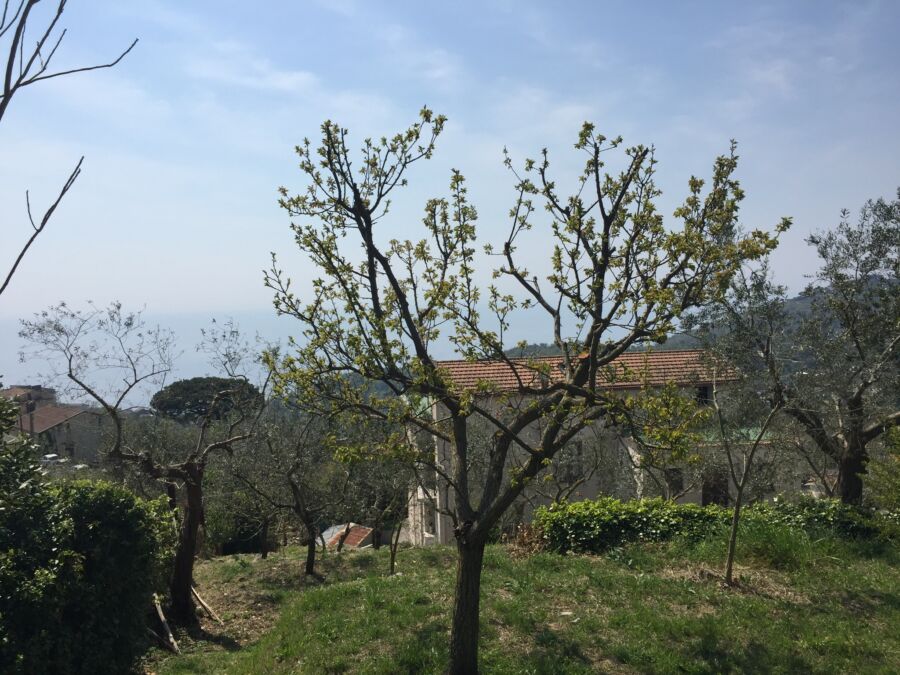
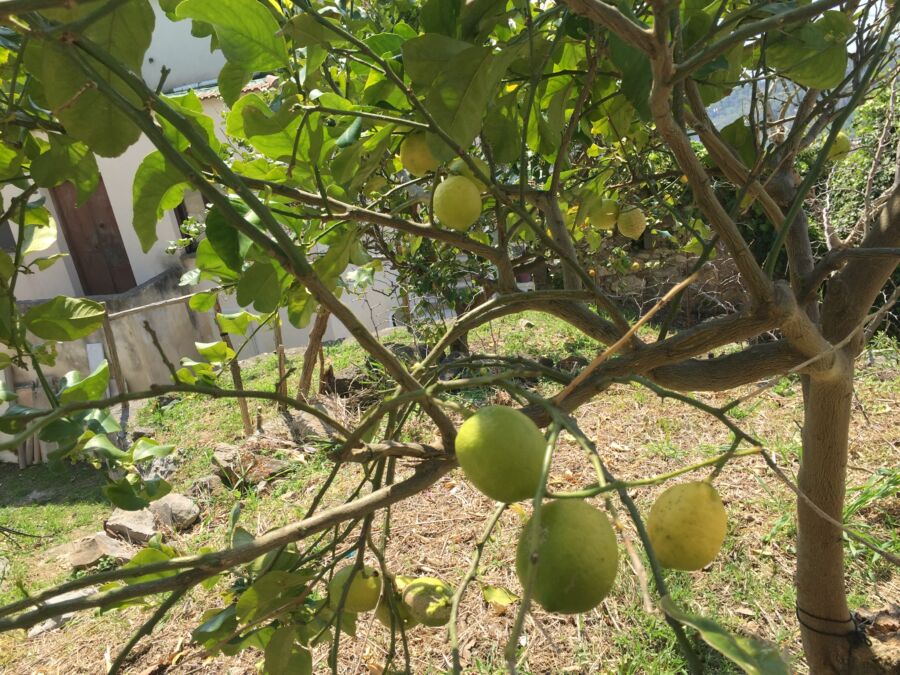
“The trees in these pictures were all planted by my husband’s paternal grandfather. Some of them even came from South America, where he spent six months each year traveling around and selling goods from Italy to make a living and raise his eight children. I moan and groan about having to prune and look after the olive and fruit trees, but then I remember that they kept my husband’s family alive and fed throughout World War II. Perspective…

“My husband’s maternal grandparents emigrated to the States in the early 1900s and settled in New Jersey, where the grandfather sold fruit and vegetables. He started out with a cart in the middle of the street and eventually was able to rent a small shop. More than likely, he worked very long hours to support his six children. His wife caught the Spanish flu. In our time of coronavirus, I try to imagine 100 years ago, when my grandmother-in-law was sick in a country where she probably didn’t speak the language, with no close family around except young children, an illness that was spreading like wildfire, no money for medicine, and no help or information from the government. She survived the illness, but it must have scared her enough that she decided to pick up her children and return to Italy so that she could be closer to her family. If not for that move, her daughter would not have met her husband, and they would not have had my husband! Perspective…

“I am one of the lucky people here in Italy because I do have some land around my house where I can walk and get a breath of air, whereas so many Italians live in apartment buildings with only a small balcony as their ‘yard.’ My land is terraced, and I have a view looking toward the Mediterranean. I have a couple of lemon trees (limoncello…yum!) and several kinds of fruit trees and numerous olive trees.

“Looking out to sea, to the left is the Amalfi Coast and to the right, just a short distance away, is the island of Capri. The emperor Tiberius lived there from A.D. 26 until he died in A.D. 37. I imagine that he, too, lived through some scary, uncertain times like we are now. Otherwise, he wouldn’t have barricaded himself on the island, making it into a fortress where no one came on the island without his permission, very much like what we are going through here in the peninsula by not being allowed to move around freely. Perspective…

“When it is safe again, come and experience our history and get your own perspective!”

Coronavirus Reports from Our Guides in Europe — Week 4

With home-quarantine and self-isolation efforts ramping up on both sides of the Atlantic, we continue to hear from many of our European guides. Here are a few highlights from this week:

Everyone’s trying to stay positive and cheer each other up. David Tordi, who we heard from a few weeks ago, did a live concert with his neighbor for his entire neighborhood in Orvieto, and live-streamed it on Facebook:

https://www.facebook.com/davidtordi/videos/10157264020656569


And we’re all getting creative. One guide described how he discovered two baguettes he’d intended to freeze, which had already gone stale. So he sliced them up, stuck them in the oven, and made toasts. Another guide shared a video of her daughter making homemade bath bombs. And another has been using one of those freebie eye masks they give out on overnight flights as a makeshift mask to cover her nose and mouth for trips to the store.

We also received some beautiful “slice-of-life” reports:

In Northern Italy — so hard-hit by the virus — Patti Fanon writes:

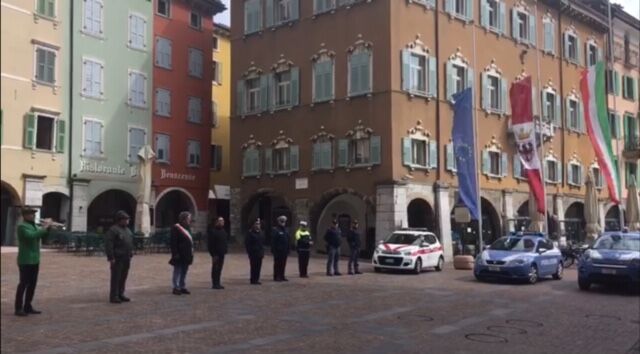
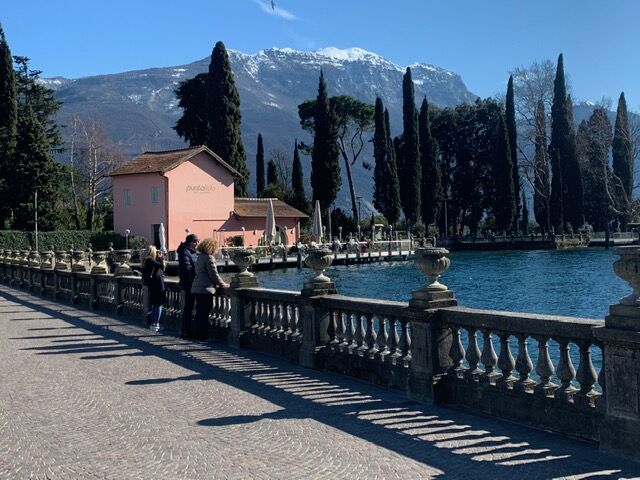
“Greetings from my home town of Riva del Garda, where lockdown keeps the streets practically empty.

“The exception was a moving ceremony this week to honor Italy’s virus victims. It was on my way to the communal garbage bins — a trip I am allowed to make — so I stopped and listened to the haunting bugle lament which could be heard all over my deserted town.

“I am busy organizing my 12-year-old son’s home schooling. He’s a willing online learner of the saxophone and often plays to amuse me, bless him!

“I also volunteer for anything needed by my elderly neighbors who have to stay completely indoors because of their medical vulnerability. That includes the 200-meter household rubbish run to the communal bins at the top of the lake where the big boats normally ply their trade.

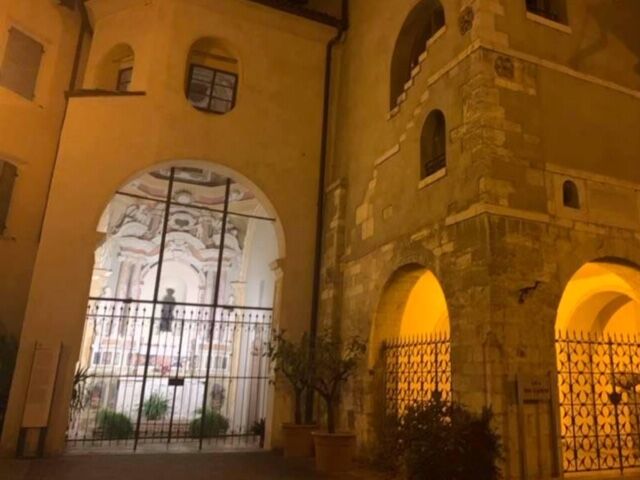
“To be honest, it’s the highlight of my day, not just because it’s a rare chance to get out and about, or because of the stunning views of which I never tire, but also because it takes me past the beautiful Chapel of San Rocco. Believe it or not, this holy man is the patron saint of Contagious Diseases, so I stop every time to have a little word with him.

“I think we all need him to hear my prayer!!!🙏🙏🙏”

In Prague, Jana Kratka wrote to explain how the pandemic is affecting her family’s Easter celebrations:

“This is our 5th week that we’re locked down in Prague. We’re in a rather small apartment, so it’s not easy. But we spend a lot of time home schooling. We also cook, bake, exercise, play table games, and watch movies. My kids love to watch your Classroom Europe videos! I already recommended it to several of my friends, so their kids can practice English and history at the same time. So I‘m sending a huge THANK YOU from all of us!

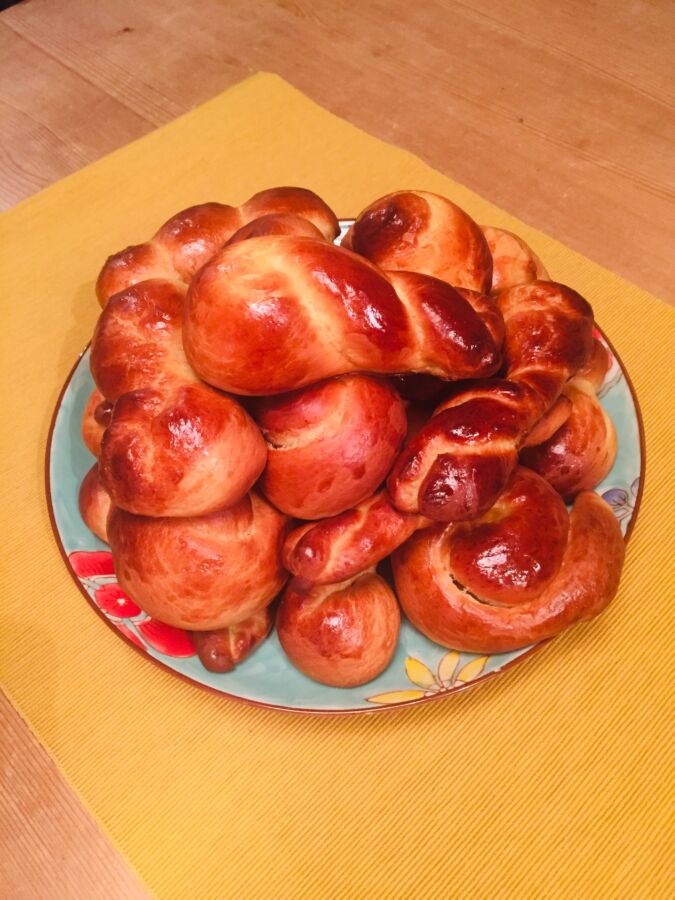
“We’re getting ready for Easter even though it’s going to be very different this year. We’ll miss being with our larger family, being outdoors, and breathing the fresh air. We’ll miss all the traditions. We baked a special Easter sweet with my kids yesterday – it’s called jidáše in Czech, or “Judas buns” in English. This is a special sweet baked on Holy Thursday named after Judas Iscariot. It’s made from a special dough that is shaped and baked as a knot. It’s supposed to symbolize Judas’s betrayal. And it’s yummy.

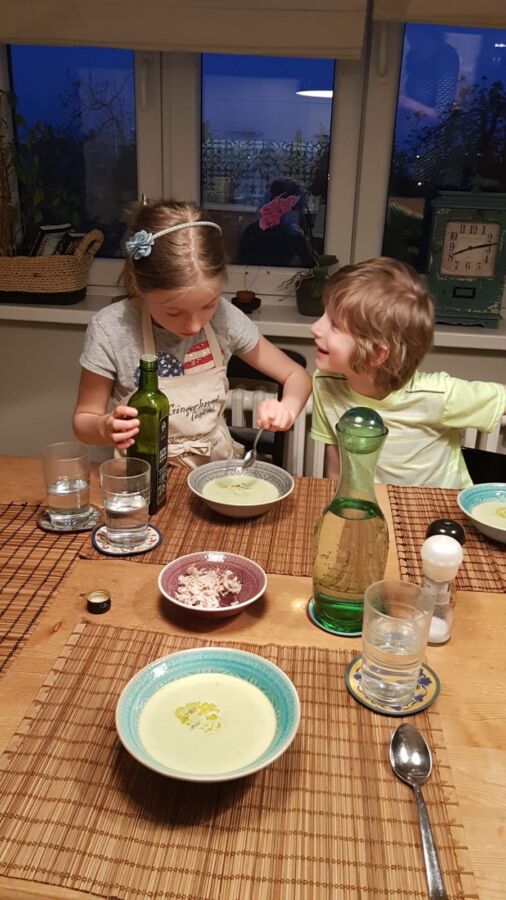
“There’s another Czech tradition related to Holy Thursday, or Green Thursday as we call it in the Czech Republic. Everyone is supposed to eat something green that day. My daughter Nela made a pea cream soup with smoked mackerel last night for us. It was delicious and it made her day, as well as ours!

“I miss my job so much, I miss the tours and our tour members. I can’t wait for the day my next RS tour will start!! I believe that after this – people will keep on travelin´!!”

Finally, Lale Sürmen Aran, tour guide and co-author of our Rick Steves Istanbul guidebook, explains how the pandemic has caused a surprising shortage in Turkey:

“There has been a shopping craze in each country after COVID-19 started spreading. It has been interesting to see what people buy in different countries: toilet paper, hand sanitizer, canned goods, flour and baking supplies, and so on.

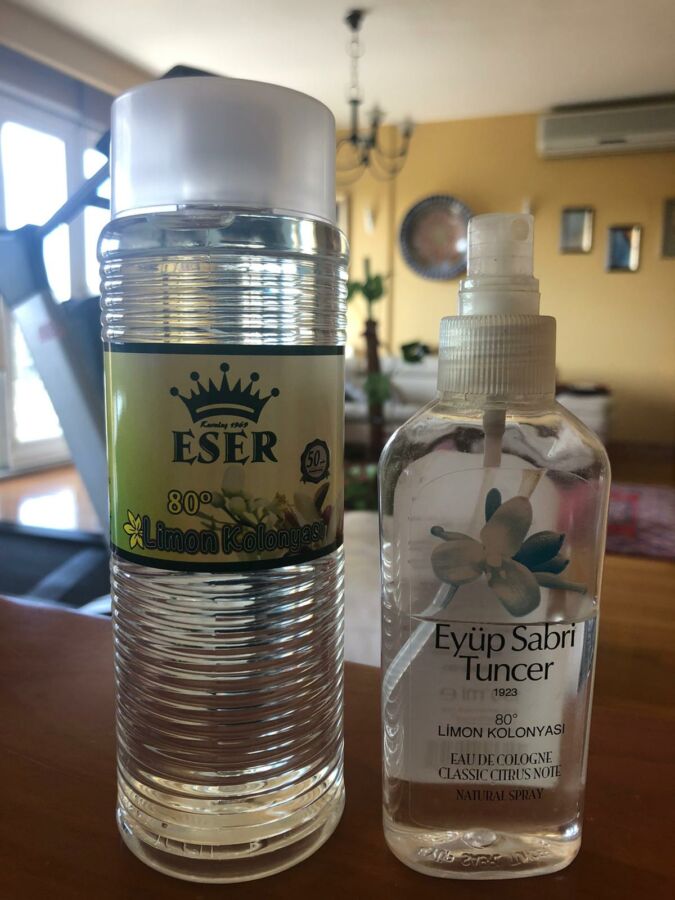
“Here in Turkey, we all rushed to pharmacies, markets, and medical suppliers to buy…cologne! This is not because we want to smell good, but because cologne is a staple in our lives that we use as a disinfectant.

“Variations are sold as perfume worldwide and called ‘Eau de Cologne.’ But in Turkey, it is simply called kolonya (kohl-ahn-yuuh). The simplified name points out the everyday use and affordable price. It costs about $6-10 per liter if bought in plastic containers, as most of us buy it.

“Turkish kolonya includes at least 80% germ-killing ethanol, distilled water, and fruit fragrance, mostly lemon.  As little as 3 grams would suffice to disinfect both hands. So a liter goes a long way.

“Culturally, kolonya is mostly perceived as a refresher that replaced rose water after it arrived in the Ottoman Empire in the 19th century. With COVID-19, all of a sudden we realized it is also a very strong disinfectant.

“You can’t think of a Turkish home without kolonya. It is always the first thing a guest is offered upon arrival; it refreshes and helps get rid of germs.

“Every barbershop carries it. The barbers would bathe clients’ faces with it after a shave. It is also offered on intercity bus trips, in restaurants, and in public bathrooms. It is some sort of a cleansing ritual for us.

“On the other hand, like a one-size-fits-all product, kolonya is also used to treat dizziness, fainting, and headaches.

“As a result, at the end of the week schools closed due to the coronavirus, there was a dire shortage of kolonya. Outside the branded retail shops, lines were longer than 100 yards to buy directly from the producer.

“Due to huge demand and public grumbling about the shortage, the government decided to temporarily stop requiring ethanol in gasoline to help boost disinfectant production. The nation praised the move, and it seems we are settling in for a long period of heavy kolonya use.”

Thanks to all of our guides for keeping us up-to-date on the situation in their home countries. Hopefully we can all be reunited, in person, soon.

Daily Dose of Europe:  Living History  

In my travels, I love to connect with people — including ones who actually lived through the local history and make it real for me. I can’t wait to get back to Europe and have more of these unforgettable experiences.

Travel dreams are immune to any virus. And, with  so many of us stuck at home,  I believe a daily dose of travel dreaming can  actually be  good medicine. Here’s another one of my favorite travel memories — a reminder of what’s waiting for you in Europe  at  the other end of this crisis.

On one of my earliest trips to Europe when I was just 14 years old, a family friend in a dusty village on the border of Austria and Hungary introduced me to a sage old man. I remember thinking he was a caricature of a classic old Austrian, with a handlebar moustache, a wardrobe that looked like it was stolen from a museum, and an intricately carved pipe. Spreading lard on rustic bread, he shared his eyewitness account of the assassination of Archduke Franz Ferdinand in 1914, which sparked the beginning of World War I. I leaned forward with awe as he described the motorcade, the archduke and his wife in an open car, the explosion of gunfire, and the hysteria that followed. That encounter, beside an onion-domed village church and in the shadow of the Iron Curtain, helped spark in me a lifelong interest in history.

Decades later in Prague, I walked with my Czech friend Honza down the path that he walked in 1989 with 100,000 of his countrymen, demanding liberation from their Soviet overlords. Stopping in front of a grand building, Honza said, “Night after night we assembled here, pulled out our keychains, and all jingled them at the President’s window, saying, ‘It’s time to go home now.’ Then one night we gathered…and he was gone. We had won our freedom.” Hearing Honza tell this story as we walked that same route he did all those years ago made me understand — and really feel — the jubilation of a small country winning its hard-fought independence.

As an advocate of freedom, I made a pilgrimage to the Gdańsk Shipyard where the Polish shipbuilders’ union, Solidarity, was born, marking the beginning of the end of the USSR — and communist rule of half of Europe. Standing at the gate under a “Solidarity” banner hanging where the big letters “LENIN” once were, I met a retired worker who walked with us to the adjacent monument. As my guide translated, the man told us of the part he played in this pivotal fight for workers’ rights.

He explained that when Solidarity negotiated its way to victory in 1980, one of their conditions was that the Soviets let Poland erect a monument to workers killed a decade earlier while demonstrating for those same workers’ rights. The government agreed, marking the first time a communist regime ever allowed a monument to be built to honor its own victims. Lech Wałęsa called it “a harpoon in the heart of the communists.” The towering monument, with three crucified anchors on top, was completed just four months after the historic agreement was signed. It was designed, engineered, and built by shipyard workers — and our new friend was one of them. The trio of 140-foot-tall crosses still honors his martyred comrades today on Gdańsk’s Solidarity Square. When you visit, there’s a good chance that someone who helped build it — someone who stood up to tyranny and helped change history — will be there to tell the story.

In Northern Ireland, my guide Stephen made his country’s struggles come alive for me when he took me to Belfast’s Felons’ Club. Stepping through a black metal security cage to reach the door, he whispered, “Membership here is limited to those who have spent at least a year and a day in a British prison for political crimes…but I think I can get you in.” Once inside, I was spellbound, listening to heroic stories of Irish resistance while sharing a Guinness with a celebrity felon. His gift of gab gave me a deeper under-standing of their struggles. The next day I walked along the green-trimmed gravesites of his prison-mates. Because of my time at the Felons’ Club, I better understood what these people sacrificed — why they starved themselves to death for the cause of a united Ireland.

My uncle Thor lived through the Nazi occupation of Norway. He took me into Oslo’s grand City Hall to show me the huge “Mural of the Occupation” and share his story of those dark days with the visual support of powerful art. Walking slowly, with a soft voice, he narrated the story scene by scene in the present tense — as if the mural told his personal experience as it was happening: “The German blitzkrieg overwhelms our country. Men head for the mountains to organize a resistance movement. Women huddle around the neighborhood well, traditionally where news is passed, while traitors listen in. While Germans bomb and occupy Norway, a family gathers in their living room. As a boy clenches his fist and a child holds our Norwegian flag — we love it so much — the Gestapo storms in. Columns lie on the ground, symbolizing how, by closing newspapers and the university, Germans did what they could to shut down our culture. Finally, years later, the war is over, prisoners are freed, and Norway celebrates its happiest day: May 17, 1945.” Thor’s voice cracked as he added, “Our first Constitution Day after five years under Nazi control.” He finished by waving his arm wide and saying, “And today, each December, the Nobel Peace Prize is awarded in this grand hall.”

We can go to places like Austria, the Czech Republic, Poland, Northern Ireland, or Norway to do some sightseeing yet learn nothing of their people’s lives or their struggles. Or we can seek out opportunities to connect with people who can share eyewitness stories. Travel can — and should — change our perspectives and broaden our worldviews.

(These daily stories are excerpted from my upcoming book, For the Love of Europe — collecting  100  of my favorite memories from a lifetime of European travel, coming out in July. It’s available for pre-order. And you can also watch a video clip related to this story: Just visit Rick  Steves  Classroom  Europe and search for “prague communism”).

Daily Dose of Europe:  Estonia — The Song of Freedom

I was a piano teacher before I was a travel teacher. And I find a special spirit in Estonia, where the people celebrate their cultural identity by singing.

Travel dreams are immune to any virus. And, with  so many of us stuck at home,  I believe a daily dose of travel dreaming can  actually be  good medicine. Here’s another one of my favorite travel memories — a reminder of what’s waiting for you in Europe  at  the other end of this crisis.

In Tallinn, my guide Mati suggests that we visit the cemetery just outside of town. As we arrive and step out of his beat-up Soviet-made car, I realize this is no ordinary cemetery. The lovingly tended tombs are scattered throughout a dense pine forest.

“Estonia is a thickly forested country,” Mati explains. “Many Estonians see trees as spiritual. Since ancient pagan times, we have buried our loved ones with the trees. We are people of the trees. This is one way we are still connected with our pagan past…still uniquely Estonian.” Walking under these towering trees makes me think about the Estonians’ connection to their land and heritage.

It’s amazing what a stretch of water can do. The Baltic Sea separates Estonia from Sweden and Finland. The struggles of the last couple of generations couldn’t be more different on these opposite shores. When I visited the Baltic states back in the 1980s, labor was cheaper than light bulbs. While I was touring museums, an old babushka would actually walk through the museum with me, turning the lights on and off as we went from room to room.

Those days are long gone. Estonia’s busy capital, Tallinn, is like a petri dish of capitalism. Since winning its freedom in 1991, the country has blossomed. Mati brags that Estonia has the strongest economy, most freedom, and highest standard of living of any republic that was part of the USSR. He says that by some measures, Estonians are now one of the freest people on Earth.

Mati points out the great irony of Russia’s communist experiment. Russia, once the supposed champion of radical equality — as far as Leninism and Marxism were concerned — is now infamous for having the worst inequality. In the dirty derby of unequal wealth distribution, Russia is one of only a few countries to actually beat the US. Estonians are better off today than Russians not because they have more money per capita (they don’t), but because the wealth in this country is distributed much more evenly. Mati, who’s spent half his life under communism and half under capitalism, says, “Politics. It’s all about the distribution of wealth.”

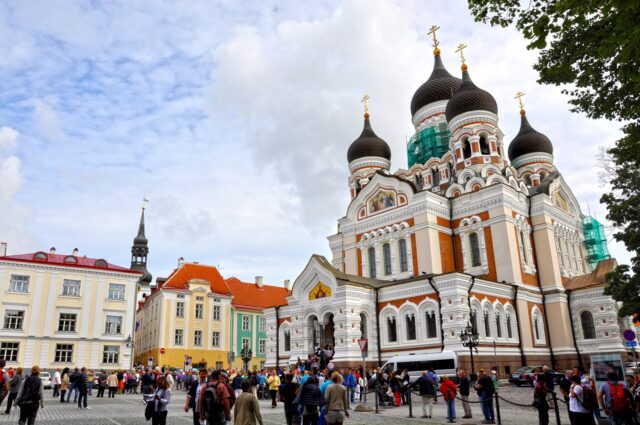
Mati drives us back into Tallinn to explore the Old Town. Strolling the street in need of a coffee break, we step into a courtyard. At the entry the landlord has hung a photo of the place back in 2000. It looked like a war had hit it. Today, while it looks much the same, it’s inhabited by thriving businesses.

The courtyard’s trendy little café has wicker chairs rocking on the rough cobbles. The first seat I eye seems empty, but it has a vest hanging on it. So I look for another empty spot…it has a vest, too. I really, really need coffee. Then I realize that on the back of every chair hangs a different vest. They’re not saving anyone’s seat, they’re just decor. Noticing my confusion, Mati explains, “Estonian chic.”

Over coffee, I ask Mati more about the USSR. Mati spent time in the USSR military, driving Soviet officers around the Crimea. Estonian boys got this plum assignment because they were considered smarter (and therefore safer drivers) than village boys from the interior of Russia.

With Finland within distance of rabbit-ear antennas, Estonians were the only people in the USSR who got Western TV during the Cold War. Mati remembers when the soft-porn flick Emmanuelle aired. No one here had seen anything remotely like it. With that single broadcast, there was a historic migration of Estonians from the south of the country to Tallinn, where they could receive Finnish TV. He said, “Nine months later, we Estonians experienced a spike in births.”

In Mati’s youth, the entire USSR — one-sixth of the world — was theoretically open to him, but he had no way to get a plane ticket or a hotel room, so in practice travel was not possible. The other five-sixths of the world was simply off-limits. In 1950s and 1960s, the USSR ordered all Estonian recreational boats destroyed because they were considered potential “escape vehicles.” It was an era in which Estonia was virtually a prison.

When Mati was young and asked his grandmother where his grandfather had gone, she said, “He’s a tourist in Siberia.” Because loved ones were routinely imprisoned in the far east of the Soviet Union, that was the standard answer to shield kids from knowing about the hell their family members were living in. After Estonia’s independence, Mati learned that his grandma had a bag packed under her bed for the surprise visit from the local police that she both dreaded and expected.

In the early 1990s, after the fall of the USSR, a kind of Wild West capitalism swept the country. The country’s first millionaire was a clever entrepreneur who dismantled the physical trappings of Soviet control and sold it as scrap metal. Mati and five friends made good money by importing classic American cars and selling them to rich Russians. But one day, four of Mati’s friends went to Russia to collect payment on a car and were killed — riddled with machine-gun bullets. Mati decided to drop his car business and become a tour guide.

Mati says, “The Russian mob makes Sicily’s mob look like a church choir. Putin directed the KGB back then. If you think Putin doesn’t understand how to hold on to power, forgive me, but you are a fool or you are blind.”

Mati and I visit Tallinn’s huge Song Festival Grounds, which looks like an oversized Hollywood Bowl. Overlooking the grassy expanse, with the huge stage tiny in the distance, Mati explains that in 1988, when Estonia was breaking away from the USSR, over 300,000 people — a third of the country — gathered here to sing patriotic songs.

Mati says, “Stuck between Russia and Germany, we were almost invisible. Our national songfest was a political statement. We are so few in number that we must emphasize that we exist. We had no weapons. All we could do was be together and sing. This was our power.”

Their Singing Revolution, peaceful and nonviolent, persisted for several years, and in the end, Estonians gained their freedom in 1991. The Song Festival Grounds, still used for concerts today, is a national monument for the compelling role it played in this small country’s fight for independence. Traveling with Mati through Estonia, I’m reminded that I simply inherited freedom. For many, freedom has to be earned.

(These daily stories are excerpted from my upcoming book,  For the Love of Europe — collecting  100  of my favorite memories from a lifetime of European travel, coming out in July.  It’s  available for pre-order. And you can also watch a video clip related to this story: Just visit Rick Steves Classroom Europe and search for Estonia.)