I was a piano teacher before I was a travel teacher. And I find a special spirit in Estonia, where the people celebrate their cultural identity by singing.
Travel dreams are immune to any virus. And, with so many of us stuck at home, I believe a daily dose of travel dreaming can actually be good medicine. Here’s another one of my favorite travel memories — a reminder of what’s waiting for you in Europe at the other end of this crisis.
In Tallinn, my guide Mati suggests that we visit the cemetery just outside of town. As we arrive and step out of his beat-up Soviet-made car, I realize this is no ordinary cemetery. The lovingly tended tombs are scattered throughout a dense pine forest.
“Estonia is a thickly forested country,” Mati explains. “Many Estonians see trees as spiritual. Since ancient pagan times, we have buried our loved ones with the trees. We are people of the trees. This is one way we are still connected with our pagan past…still uniquely Estonian.” Walking under these towering trees makes me think about the Estonians’ connection to their land and heritage.
It’s amazing what a stretch of water can do. The Baltic Sea separates Estonia from Sweden and Finland. The struggles of the last couple of generations couldn’t be more different on these opposite shores. When I visited the Baltic states back in the 1980s, labor was cheaper than light bulbs. While I was touring museums, an old babushka would actually walk through the museum with me, turning the lights on and off as we went from room to room.
Those days are long gone. Estonia’s busy capital, Tallinn, is like a petri dish of capitalism. Since winning its freedom in 1991, the country has blossomed. Mati brags that Estonia has the strongest economy, most freedom, and highest standard of living of any republic that was part of the USSR. He says that by some measures, Estonians are now one of the freest people on Earth.
Mati points out the great irony of Russia’s communist experiment. Russia, once the supposed champion of radical equality — as far as Leninism and Marxism were concerned — is now infamous for having the worst inequality. In the dirty derby of unequal wealth distribution, Russia is one of only a few countries to actually beat the US. Estonians are better off today than Russians not because they have more money per capita (they don’t), but because the wealth in this country is distributed much more evenly. Mati, who’s spent half his life under communism and half under capitalism, says, “Politics. It’s all about the distribution of wealth.”
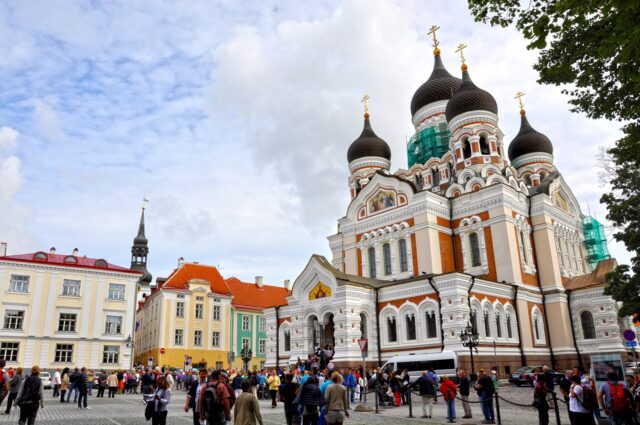
Mati drives us back into Tallinn to explore the Old Town. Strolling the street in need of a coffee break, we step into a courtyard. At the entry the landlord has hung a photo of the place back in 2000. It looked like a war had hit it. Today, while it looks much the same, it’s inhabited by thriving businesses.
The courtyard’s trendy little café has wicker chairs rocking on the rough cobbles. The first seat I eye seems empty, but it has a vest hanging on it. So I look for another empty spot…it has a vest, too. I really, really need coffee. Then I realize that on the back of every chair hangs a different vest. They’re not saving anyone’s seat, they’re just decor. Noticing my confusion, Mati explains, “Estonian chic.”
Over coffee, I ask Mati more about the USSR. Mati spent time in the USSR military, driving Soviet officers around the Crimea. Estonian boys got this plum assignment because they were considered smarter (and therefore safer drivers) than village boys from the interior of Russia.
With Finland within distance of rabbit-ear antennas, Estonians were the only people in the USSR who got Western TV during the Cold War. Mati remembers when the soft-porn flick Emmanuelle aired. No one here had seen anything remotely like it. With that single broadcast, there was a historic migration of Estonians from the south of the country to Tallinn, where they could receive Finnish TV. He said, “Nine months later, we Estonians experienced a spike in births.”
In Mati’s youth, the entire USSR — one-sixth of the world — was theoretically open to him, but he had no way to get a plane ticket or a hotel room, so in practice travel was not possible. The other five-sixths of the world was simply off-limits. In 1950s and 1960s, the USSR ordered all Estonian recreational boats destroyed because they were considered potential “escape vehicles.” It was an era in which Estonia was virtually a prison.
When Mati was young and asked his grandmother where his grandfather had gone, she said, “He’s a tourist in Siberia.” Because loved ones were routinely imprisoned in the far east of the Soviet Union, that was the standard answer to shield kids from knowing about the hell their family members were living in. After Estonia’s independence, Mati learned that his grandma had a bag packed under her bed for the surprise visit from the local police that she both dreaded and expected.
In the early 1990s, after the fall of the USSR, a kind of Wild West capitalism swept the country. The country’s first millionaire was a clever entrepreneur who dismantled the physical trappings of Soviet control and sold it as scrap metal. Mati and five friends made good money by importing classic American cars and selling them to rich Russians. But one day, four of Mati’s friends went to Russia to collect payment on a car and were killed — riddled with machine-gun bullets. Mati decided to drop his car business and become a tour guide.
Mati says, “The Russian mob makes Sicily’s mob look like a church choir. Putin directed the KGB back then. If you think Putin doesn’t understand how to hold on to power, forgive me, but you are a fool or you are blind.”
Mati and I visit Tallinn’s huge Song Festival Grounds, which looks like an oversized Hollywood Bowl. Overlooking the grassy expanse, with the huge stage tiny in the distance, Mati explains that in 1988, when Estonia was breaking away from the USSR, over 300,000 people — a third of the country — gathered here to sing patriotic songs.
Mati says, “Stuck between Russia and Germany, we were almost invisible. Our national songfest was a political statement. We are so few in number that we must emphasize that we exist. We had no weapons. All we could do was be together and sing. This was our power.”
Their Singing Revolution, peaceful and nonviolent, persisted for several years, and in the end, Estonians gained their freedom in 1991. The Song Festival Grounds, still used for concerts today, is a national monument for the compelling role it played in this small country’s fight for independence. Traveling with Mati through Estonia, I’m reminded that I simply inherited freedom. For many, freedom has to be earned.
(These daily stories are excerpted from my upcoming book, For the Love of Europe — collecting 100 of my favorite memories from a lifetime of European travel, coming out in July. It’s available for pre-order. And you can also watch a video clip related to this story: Just visit Rick Steves Classroom Europe and search for Estonia.)