Machismo with Good Taste in Rome

Rome epitomizes the male-dominated Mediterranean world. Going to dinner with Chiara, a Roman guide and friend of mine who’s petite, blonde, and with a thin (almost cartoony) voice, I learned a lot. Chiara explained, “Italian men just can’t take a blonde seriously — especially one with a thin voice.” In fact, she refuses to guide Italian groups now that she knows American groups take her seriously.

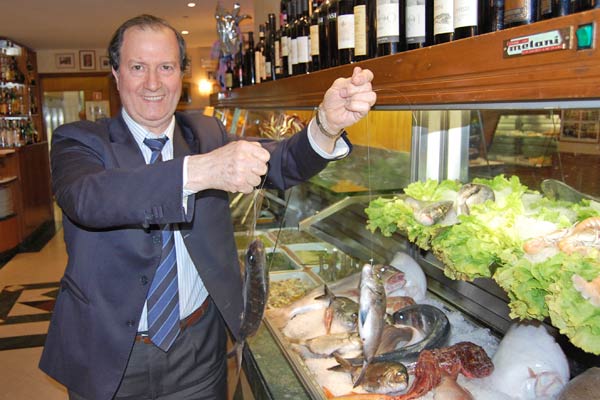
Our target for dinner: Restaurant Fortunato, the kind of place with photos on the walls of the owner posing with fat and happy customers like Condi Rice, Tarik Aziz, Bill Clinton, and Ronald Reagan. Sitting down, we were immediately cased out by the businessmen and politicians who seemed to fill the place. I didn’t notice until Chiara explained. “About 20 percent of Roman women are blonde like me, but we’re still considered exotic.” When Chiara’s father takes her to dinner here, she enjoys the strange looks as other men fantasize about their relationship.

I wanted Signor Fortunato to understand that Chiara was much more than a good-looking blonde. I pointed to her head and said, “Fifty percent of my Rome guidebook came from this beautiful head.” He looked past her at me and said, “Bene, 15%.” It’s a man’s world in Rome.

Despite the lack of respect for women, the food was great. Chiara insisted on vignarola: artichoke, peas, and fava beans with bacon. It’s only available during a perfect storm of seasonality, with everything bursting with flavor. Vignarola is on the menu early this year. In fact, this year’s early spring is bringing confusion in Rome…old timers can’t remember ever seeing vignarola on the menu before Easter.

Chiara shared her thoughts on dining in the USA: “American food has to travel, look good, and be available all year. Italian food does none of that…just taste good. We Italians have never seen apples with wax. I even saw waxed lemons — shiny only in the USA. For Italians, your lemons are too uniform.”

Another Chiara observation: “An American can’t wait in a restaurant. They eat bread dipped in oil before the meal comes…as if to escape the actual meal. Talk, sip your wine, relax…the real food is coming…and worth the wait.” At Fortunato, that’s especially true.

Home now, final blog.

I’m home…thankful for a safe and smooth trip full of learning. I always marvel at how smooth things go in Europe if you’re on the ball. In six weeks, I can’t think of a mishap.

This blog was more fun (and more time-consuming) than I expected. I’m glad I did it. In fact, I hope to make this a regular part of my travels from now on. It reminded me of the fun I had a few years ago when I went to Europe to write my Postcards from Europe anecdotal book. I went not to make a TV show, lead a tour, or update a guidebook…but with just free time and a notebook.

Every few days on this trip, when it was blog time, I’d rummage through my collection of stray notes and cobble together an entry. Entries generally grew to be larger than I planned…but it’s hard to tell a story correctly without a few paragraphs.

While all notes started out as stray notes, most ended up building something. But some never found a home. Now that my blog is done, I empty the bucket and find these last scraps (which for some reason, I can’t bear to just chuck):

* Soviets learned it’s easier to make something go away (like religion) if it’s not completely forbidden. (I may have been trying to make a marijuana parallel.)

* Parenting on a European vacation changes radically as the kids get older. On this trip (in Dublin) our kids (aged 19 and 16) routinely stayed out later than Anne and I did. In the morning, we’d slip a paper under their hotel room door (we promised not to wake them up) inviting them to join us for breakfast if they were awake. We’d breakfast alone waiting to debrief the kids on their wee hours adventures.

* I told Jackie “I tried to River Dance and almost drowned.” It’s the first time she’s laughed at one of my jokes in a long time.

* The pet peeves entry got me thinking about more pet peeves: Like hotels that put a decorative foot board on their beds that robs good sleep from guests like me over six feet tall. Like when I try to conserve by reusing the little soap bar and the hotel maid throws it out so I need to open a new one each day. Like European sinks that have separate cold and hot faucets (why on earth?). Like elevators that tell you what floor you’re on. And like having to walk back and forth through a long empty slalom of needless stanchions to get to a security check.

* In Helsinki, after a full night of restaurant visits, no one is still serving food. I ended up munching a McDonald’s meal in my hotel room. I actually felt ashamed to walk through the lobby with my McDonald’s bag.

* After visiting several European airports with a strangely relaxing ambiance, I realized why. They don’t have TVs playing CNN in each waiting area. It’s quiet and free of advertising.

Over the last six weeks, I’ve enjoyed the conversation. Thanks to all who participated with their comments. It was hard not to get involved in the discussion, but I made a personal rule to just upload the entries. I have to fess up that (in response to a few harsh comments) I did revisit a few of my entries to clarify points that were unclear or misunderstood. I think I enjoyed the experience so much because it gave me the daily excuse to be more than a guidebook researcher–to be a travel writer (which I really love). And doing this blog let me enjoy the best of both travel worlds: I was traveling both alone…and with a gang of travel partners. Thanks for joining me on my trip. And thanks also to the special reader who made sure I will never again misspell Chiwawa.

Happy travels, Rick

Sticky, Clammy Hands

People seem to be fascinated by how I handle “my celebrity” in Europe. It’s kind of strange to talk about it, but here’s my take on this:

When you’ve had a TV show on the air for over 100 episodes and 15 years, lots of people recognize you. I often hear about how some people in my shoes are rude to “their public” when viewers say “Hi” and want to chat. Even if I didn’t enjoy it, I think it would take more energy to be rude than to be polite to people who enjoy your show. The fact is, I flat out enjoy the fans of my books and TV shows who recognize me in Europe.

On rare occasions when I seem rude to these people, it’s impressive to me how I’ll hear about it via e-mail later on. There is a strong expectation from fans that you take time with them. I am thought to be “rude” occasionally and it’s almost always when people want to stop and talk and get an autograph when I’m under a time pressure with my TV crew (memorizing lines, trying to do an “on camera” performance, or in a TV production-related crises).

Another example of me upsetting a fan was in Rothenburg. I know when I go on the now famous “Nightwatchman’s Tour” that half the people on the tour will be there because of the high recommendation the tour gets in my guidebook. I find Georg, the Nightwatchman, so entertaining that I take his tour year after year. And, each year when I drop by, I cause a commotion that takes attention away from Georg’s performance. As a kind of performer myself, I know how this can be a problem. So, I kind of slink into the crowd hoping not to be recognized. On my last visit, I was recognized by a family while Georg was doing his shtick. I told them to direct their attention to Georg–it was his show after all–and not me. Judging from the emails that flew around after that episode, it was clear they were really upset with me.

When I meet someone, I routinely shake hands, ask where they’re from, and enjoy a little chat. While this can get out of hand and slow me down, it’s fun (and of practical value, as they have invariably been doing things I’m working on in my research–often things I don’t have time to actually do myself–and I can pick their brains about the experience).

I know a character named Jimmy in Tangiers, Morocco who when some one says their home town, he’ll respond with their telephone area code. (For instance, he asks, “Where are you from?” I say, “Seattle.” He responds, “206.”) He’s amazing about this…but the recent addition of so many new area codes must be giving Jimmy fits. I do something similar with PBS call letters. I’m generally bad at remembering such details, but for some reason, I have a knack for remembering station call letters. I always ask where someone’s from. I respond with the call letters. When someone says “I’m from Tampa” I just have to respond “WEDU.” Sacramento…”KVIE–that’s a great station”… Calgary–“KSPS” (Spokane covers Alberta)…and so on.

The only bad thing about meeting all these great people in my travels, is that many of them have sticky and clammy hands. When out in public and shaking hands all day long, you become like a Hindu in India (divvying up the job your hands do according to needs for cleanliness). While to a Hindu, the left hand is the dirty one, I shake hands with my right hand and eat finger food with my left. So many times I wash my hands for a meal and then, on the way back to the table, I hear, “Hey Rick…love your show.” And naturally, I shake hands. My TV producer, Simon, who I’ve spent probably well over 400 days in Europe with, cringes every time I take my glass of water under the table to rinse off my once clean, but now sticky again hands. Rinsing my hands (discretely) under the table has become a crude ritual for me.

Something that goes hand in hand with shaking lots of hands is posing for lots of photos. When someone tries to get a stranger to take our picture, I often just grab the camera and take the photo. While it’s quite simple, people are impressed when I hold a camera up and away and click a portrait of the two of us with my other arm around the person I’ve just met.

Interactions are often strange. For some reason many people walk right up to me out of the blue and say, “You’re not Rick Steves?!” Occasionally, I agree and walk on. Another common comment I get from strangers who recognize me: “You look just like Rick Steves.” Depending on my mood, I occasionally say, “Yeah, lots of people say that.” And I walk on. While my European friends are almost appalled at the casual “Hey Rick” I get from strangers, I really enjoy it.

I particularly enjoy meeting Canadians on the road. I thank them for being Canadians and not bending to American pressure every time they want to organize their society in a way that doesn’t please our government. I encourage them, remind them that God put Canada next to America for good reason, and I thank them again for staying strong. As we chat, the topic of my accent often comes up and I explain that many people think I sound Canadian because my Norwegian grandparents homesteaded in Edmonton, Alberta and my Mom, who is Canadian, taught me to talk.

In my guidebooks, I’m not that much into consistency. You can actually read into my material what happened to me where. If there’s lots of romantic evening coverage, it was likely a place where my wife Anne joined me. If I got sick in a town, you’ll find details about a clinic or hospital there. If I was really exhausted, you’ll find a masseuse listed. I just travel and do my best to bushwhack a smooth path. I live Europe as wide-eyed, naively, and eagerly as the image I have of my readers, hoping to collect experiences that will help those with my guidebook next year.

I don’t know if it’s because I’m getting forgetful or because there’s just more to remember (as I cover more territory deeper and deeper), but I’ve noticed a reoccurring pattern lately. As I research, I “discover” something really exciting. I take notes, write it up, then, when I turn the page…I see it’s already researched and written up. What’s interesting for me as I analyze this phenomenon is that there’s a remarkable consistency. Years after my first encounter with what I think is a new nook or cranny, it will impact me the same. I’ll observe the same quirky details to try to make it vivid and I’ll write it up–completely oblivious to my previous coverage of it. And then, when I find the previous write-up–it’s almost exactly the same. I guess that’s good.
I wash you twice…relax

In my work, I struggle almost daily with this issue: is an experience actually a unique and living slice of this culture or is it a cliché kept alive by the tourist industry. For instance, in Finland: the sauna.

There are only a few public saunas still around in Helsinki. Why? Because, with the affluence here, most people have them in their homes or cabins. Gritty working-class neighborhoods are most likely to have a public sauna. So, I got on the subway and that’s where I headed. Finding the address, my first sight made it clear: this place was not for tourists. Outside, a vertical neon sign in simple red letters read: SAUNA. Under it, a gang of Finnish guys wrapped only in small towels and enjoying bottles of beer filled a clutter of white plastic chairs–expertly relaxing.

As there wasn’t a word of English anywhere, I relied on the young attendant at the window for instructions. He explained the process: pay €7, grab a towel, strip, stow everything in an old wooden locker, wear the key like a bracelet, shower, enter the sauna…and reeeeelax. “Was it mixed?” “No, there’s a parallel world upstairs for women.” “What about getting a scrub?” He pointed to a woman in an apron and said, “Talk directly with her…€6 extra.”

The sauna was far from the sleek, cedar pre-fab den of steam I expected. Six crude concrete steps with dark wooden railings and rustic walls created a barn-like amphitheater of steam and heat. A huge iron door closed off the wood stove (as it was busy burning its cubic meter of wood a day). The third step was all the heat I could take. Everyone else was on the top level–for maximum steam and heat. Taking in my towel, I wondered if it was used for hygiene or modesty. Once inside, the answer was clear…neither.

People look more timeless and ethnic when naked with hair wet and stringy. The entire scene was three colors: grey concrete, dark wood, and ruddy flesh. There was virtually no indication of what century we were in. I fantasized I was in the 1700s. From the faces, somehow it was perfectly clear: this was Finland…and these were tough working class guys. Each had a tin bucket between their legs–for cool splashing of the face. I didn’t talk to anyone actually in the sauna as I sensed they weren’t thrilled to have tourists as voyeurs in their domain. (I knew this was a lost opportunity…not good travel.)

I asked the young attendant about birch twigs. He explained that by slapping your skin with these, you enhance the circulation and the roughed up leaves emit a refreshing birch aroma. He insisted it must be birch for chlorophyll–that opens the sinuses. But the bin of birch twigs sat on the bottom concrete step, unused.

Part two of a good sauna is the scrub down. The woman in the apron–looking like a Stalin-era Soviet tractor driver–was dousing one guy who sat on the plastic chair looking like a lifeless Viking gumby. I asked “Me next?” She welcomed me to her table. Wearing a white and green vertical striped house dress under her tough apron, she scrubs men one at a time all day long. Sitting on the table, I ask “up or down?” She pushes me down…belly up…and says “This is perfect. I wash you twice.” Lying naked as a fish on the plastic sheet…I felt like a salmon on a cleaning table ready for gutting. With sudsy mitts she works me over. She hoses me off…which makes me feel even more like a salmon.

It’s extremely relaxing. (It would be entirely relaxing but for my anxiety that I might show how much I’m enjoying the experience.) From deep in my scalp to between my toes, she washes me twice. Stepping back out into that gritty Helsinki neighborhood, I have affirmed my hope: that the sauna is no cliché kept alive for tourists.

800 singers and no more pennies

I’m out for the evening in Helsinki. My guide, Hanne, explains, “We call Wednesday our little Friday.” There’s an energy in the streets. Our mission: to visit the restaurants I recommend in my guidebook and find new, better ones. I find Helsinki the least expensive of the Scandinavia capitals–the restaurant scene is affordable and fun. And there are plenty of distractions.

A huge demonstration fills the main boulevard. (The street is actually named “boulevardi”–given that grandiose title two hundred years ago. Back then–in Europe’s then newest, now youngest, capital–the concept of a grand boulevard in Helsinki was somewhere between absurd and wishful thinking.)

Then I realize they’re not demonstrators…but choral groups. From all corners they converge on the massive steps of the Lutheran Cathedral which normally overlooks Europe’s finest neo-classical square. Today the steps overlook thousands of locals, dropping by to hear this massing of the choirs. Eight hundred singers fill the steps–each group represented by a placard–to sing a rousing set of anthems. While I can’t understand a word, the songs are sung with a stirring air that must tell of a hard-fought history and a thankfulness to be who they are–the people of Finland. Then, the balloons are freed, and the groups disperse kicking off a festive week called “art goes to the pubs.” Each choir sets off to an appointed bar…and the city’s drinking holes are filled with song.

Leaving the crowd for our evening’s work, we pass a poster of a demonic-looking rock band. Hanne explained “hell froze over this year.” Europe’s biggest TV event is the annual Euro-vision Song Festival. (Most famous to boomer travelers like me as the event Abba won back in the 1970s with their breakout song, Waterloo.) Finns are perennial losers in the event and locals have long said, “When Finland wins the Euro-vision Song Festival hell will freeze over. This year, people from all over Europe telephoned in their votes and Finland’s Kiss-inspired heavy metal band “Lordi” (led by a soft-spoken charismatic Laplander) won with a cute little number called “Hard Rock Halleluiah.”

At the curb, there are no cars. I get halfway across Boulevardi boulevard and look back at Hanne still waiting. As if in needless defeat, I return to the curb. She says, “In Finland, we wait. It can be two in the morning and not a car in sight, but we wait. That’s why we have such low crime.” I said, “Germans respect authority too.” She said, this is different. “We buck authority…but follow the laws…even little ones.”

Finns seem to have a fun-loving confidence. I asked, “All of Scandinavia is so prosperous but only Norway has oil. How is this?” Hanne said, “Norway has oil…Finland has Nokia. It’s like Microsoft for you in Seattle.” Then I asked, “What then, is Sweden’s trick?” Hanne shows the standard Scandinavian envy of the regional powerhouse saying, “They never get in a war. They’re always rich…just collecting money all the time. The Swedes are like our big brother. They always win. Like in ice hockey. We won only once…back in the 1990s. The Swedes–assuming they’d win–already wrote their victory song. But we won. We Finns still sing this song. It’s the only song Finns know in Swedish and every Finn can sing it…even today.”

The Finns are so prosperous that they’re the first Europeans to do away with the Euro pennies. Prices are rounded to the nickel and the one cent and two cent coins are now officially out of circulation. (I am particularly happy today. Each Euro country has its own versions of the Euro coins and I’m filling my coin book with a set from each country. I have an ethic that I only take coins out of circulation. My big trick is befriending a waitress and getting her to let me paw through her change purse to find missing coins. The only gaps I have now (not counting the collector sets from Monaco, San Marino, and the Vatican City–which go immediately out of circulation when minted) are Finland and Luxemburg. They mint so few compared to the behemoth countries that you don’t see them outside their home countries. I dropped by a coin shop and purchased the Finnish penny and two cent coin (at €3, that was 100 times their face value). In the shop, I commented “it would be difficult to find these in circulation and the keeper said, “you are wrong…it would be impossible.” (So I didn’t break my ethic.)

Of the many restaurants we surveyed, the most elegant had a dining hall perfectly 1930s–Alvar Aalto-designed Functionalism. The kind of straight design and practical elegance Finns love. A private office party was raging–a crayfish party. It’s crayfish season–at $10 each, it’s far from a budget meal. But all over town Finns are doing the crayfish tango: suck and savor a big red mini-lobster, throw down a glass of schnapps, sing a song and do it again. With a “hundred bottles of beer on the wall” repetitiveness, it just gets more fun with each round.

Hanne shows me the table of Mannerheim, the heroic George Washington of modern Finland who led their feisty resistance to the USSR and is likely personally responsible for artfully keeping Finland free during and after WWII. No Finnish military leader will ever again hold Mannerheim’s rank of “Field Marshal.” But any one can sit at his favorite table…and suck a crayfish.

We step onto the rooftop terrace with a glorious 8th floor view of Helsinki. The late-setting sun is gleaming on both the Lutheran cathedral and the golden onion domes of the Russian orthodox church. They seem to face off, symbolizing how east and west have long confronted each other here in Finland. (Europe’s second mightiest sea fortress–after Gibraltar–fills an island in the harbor…the reason for Helsinki’s birth.)

Below us on the neighboring rooftop, six bankers wrapped in white towels are enjoying a sauna. In all great office buildings–whether banks, insurance companies, or research institutes–a rooftop sauna is an “elemental and essential part of the design.” (Free snacks and drinks at the sauna after work from 5:00 to 9:00 is an almost expected perk.) One big fat guy was so pink from the heat that–with his white towel wrapped around his waist–he reminded me of a striped pool ball.

The Finns seem happy. Their woman president, Tarja Hallonen–just re-elected for a second 6-year term–has an 80% approval rating. And they are proud of the way they tackle challenges confronting their society. With the coming of bird flu, they tented their famous market and everyone here seems to crow about how those Swedes had a case of bird flu…and the clever Finns did not.