Iran: Death to Election Fraud

Readers have been asking me for my take on the situation now unfolding in Iran. How have my experiences filming a public television show there last year shaped my impressions of current events?

I plan to explain my thinking about this issue in an op-ed piece for the Seattle Times,which is scheduled to run in next Sunday’s edition (June 28). Since we don’t know how this situation will end, of course it’s far too early to talk about cause and effect. But, as someone who has traveled to Iran recently, this is my hunch:

When I visited Iran a year ago, I sensed that they would eventually win their freedom — but it had to be on their own terms. Crucially, what’s going on today in Iran is an organic process, not something brought about by foreign meddling. In my mind, this gives it a legitimate chance of success, and our stance so far of simply staying out of their way is the best thing we can do.

However, even if we have no direct involvement with the Iranian protests, I like to think that we have contributed to the cause of Iranian freedom in some way. When I was in Iran and our own presidential election was heating up, it occurred to me that the Bush (and, seemingly, McCain) policy of tough-talking rhetoric might actually empower Iran’s leaders to more effectively preach their message of fear and hate. But under an Obama Administration, our government’s attitude (if not our policy) about how to engage the Muslim world has changed. President Obama’s stated philosophy of respect and listening makes it harder to demonize the US, and the “Death to America” chants don’t quite have the gravity they once did. I have to wonder if our president’s more respectful stance toward the Muslim world might have had some effect on events there today (and particularly on Ahmadinejad’s ability to harness his people’s anger against us).

I do find it fascinating that rather than our government radicalizing the Iranian masses, it’s the Iranian government itself that is radicalizing its masses. And by drawing a line in the sand, as their supreme leader did last week, they may have underestimated their young population’s passion for freedom.

(PS: I’d like to assure those of you who wondered why I removed my longer entry on this subject from the blog — and suspected I couldn’t handle the hot topic — that I don’t consider this very hot. I just wanted to use much of that material in my op-ed piece in a big-city newspaper rather than here. Sorry. I’ll bring it back when I can.)

Media Musings

I was just in LA working to promote my new Travel as a Political Act book. I got to be on the Tavis Smiley Show(which will air nationally on PBS starting this Friday). He is a beautiful man, and it was a joy to sit down with him (cameras rolling) and explain how my passion for getting value out of travel fits his passion for America getting it right.

It’s occurring to me that being a PBS celebrity and living in Seattle isn’t the best recipe for getting media exposure. Media is commercial — advertising is its lifeblood. I went to Rachael Ray headquarters last week in NYC for an “informational interview” with one of her editors. While she may be the emerging Martha Stewart (and I find her smile strangely mesmerizing), it was clear from our meeting that my passion for people-to-people travel didn’t fit their corporate-friendly approach to tourism. We politely chit-chatted for a few minutes, each of us wondering, “Who set up this interview?”…and then said “best wishes,” knowing we were as different as a front door and a back door, and that nothing would come of that meeting.

On the other hand, I’ve been able to talk with Bob Edwards (PBS and Sirius — big mind, inspirationally insightful, a thrill to talk with for 40 minutes), Alan Colmes (Fox Radio — a fun and very engaging man), lots of NPR hosts, and the extremely progressive Pacifica radio in LA. In each case, we had enthusiastic conversations, and know that we’ll be talking more in the future.

Getting all this media to promote a book is exhausting, time-consuming, and an almost demoralizing struggle. But yesterday I sat in a chair still warm from the interviewee before me — Francis Ford Coppola. If the exposure was worth it for him to talk up his new movie…I guess it’s worth it for me to talk up my new book.

One thing has occurred to me over the 20-some interviews I’ve done in the last week: Encouraging people to make travel a political act may get me on progressive radio stations, but that kind of travel is something the industry in general will never embrace. Tourism is huge money, with lots of investments, and it’s a challenge to keep travelers blindered and focused on the commercial aspect of tourism.

By most accounts, tourism and armaments are the two biggest industries on earth. Using tourism to build understanding between cultures and peoples helps the short-term bottom line of neither.

Nomads and Cuff Links

I was on the terrace of a fancy Dubrovnik hotel in jeans and a T-shirt. A big shot was at the next table with his hair just right, a coat and tie, and fancy cuff links. I thought, wouldn’t it make more sense if the poor and powerless were the ones who had to dress up like that?

In Dubrovnik, the cruise ship crowds were so intense that we literally could not do our filming in the middle of the day. The city was inundated…a human traffic jam. I got a bit down. Then, as is so often the case, things cleared out and the town regained its charm. Those who stay after the tenders have stopped ferrying people back and forth enjoy a town the thousands who blitzed it from their ship have no appreciation of. It’s sad to think that the vast majority of Dubrovnik’s visitors see a hellishly crowded city and probably leave with the wrong impression. Even if they think they liked Dubrovnik, they didn’t really get to meet it.

There’s a buzz about how humble little Montenegro is emerging as “the new Mediterranean hotspot.” The tourist board there put my film crew in an “emerging hotspot” designer hotel on the Bay of Kotor. It was so elite and reclusive that I expected to see Idi Amin poolside. (Actually, I think he’s dead…but I thought it would be cool if they had a blow-up version of him just parked next to the pool on a lounge chair with a cocktail.)

The hotel, open just a month, was a comedy of horrible design. We felt like we were the first guests. My bathroom was far bigger than many entire hotel rooms — but the toilet was jammed in the corner. I had to tuck up my knees to fit between it and the sink cabinet. The room was dominated by a big Jacuzzi tub for two. I am certain there wasn’t enough hot water available to fill it. I doubt it will ever be used, except for something to look at as you’re crunched up on the toilet. My bed was vast, but without a side table light or even access to a light switch. A huge rain storm hit with fury enough to keep the automatic glass doors opening and closing on their own. Nothing drained — a torrent ran down the stairs outside the front door, and everything was dripping. With the rain, a horrible smell drove us out of our rooms. Just as we sat down to our breakfast, the storm knocked out the electricity. Looking past the candelabra on our table, the overwhelmed receptionist explained with a shrug, “When it rains, there is no electricity.” The man who runs the place just looked at us and said, “Cows.” (I think he meant “chaos.”)

Looking in the mirror the other day, I noticed how white my teeth looked. It reminded me that when I asked my dentist the best way to get my teeth whitened, he said, “Get a tan.” It’s so great to be getting sunshine and exercise on the road.

We drove by a Gypsy camp switchbacking from the Mediterranean coast up into the interior of Montenegro. Our guide explained the local Gypsies don’t want to go to school and don’t want to work. I commented that they don’t want their children to be taught lifestyles that threaten their nomadic ways. The camp was absolutely filthy. Our guide said, “That’s their aesthetic.” I couldn’t really imagine a society with an aesthetic to be sloppy…as if moms bark at her kids, “You can’t go out to play until you mess up your room.”

All over our world, nomadic cultures like the Roma (or Gypsy) culture are struggling — I think because they’re at odds with societies that require fences, conventional ownership, and non-nomadic ways. I wonder how many nomadic cultures (American Indians, Eskimos, Kurds, Gypsies) will be here in the next generation.

Cresting the mountain into the Montenegrin heartland, we came to a village that looked like it had no economy. Then a man took us into a big, blocky, white building that looked like a giant monopoly house. He opened the door and we stepped inside, under tons of golden ham peacefully aging. It was a smokehouse — jammed with five layers of hanging hamhocks. Our Montenegrin friend stoked up his fire, filled the place with smoke, and we filmed. More industry than you realize hides out in sleepy villages.

Photos Help Tell the Story

Wrapping up a great trip, a few photos add to the story. Note also a number of photos added to entries over the last two months.

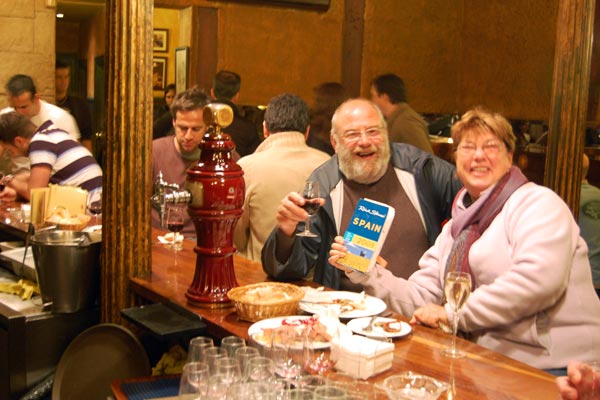
Travelers enjoying tapas and their guidebook. When blitzing tapas bars in Madrid’s best neighborhoods, it’s fun to find happy travelers putting their guidebook to good use.
Enlarge photo

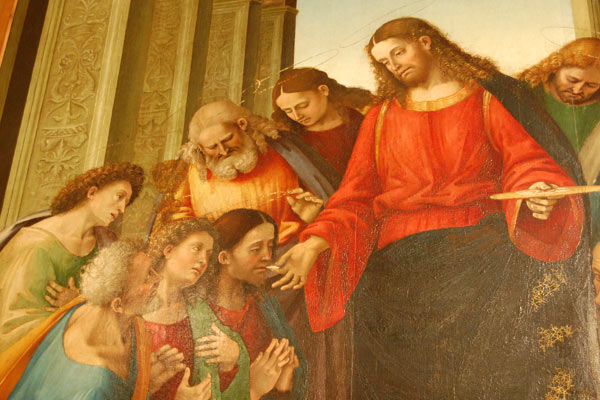
An amazing painting in Cortona.
Enlarge photo

Bright-eyed and bushy-tailed, I open the shutters and greet a new day in Volterra. In a week I meet the TV crew…
Enlarge photo

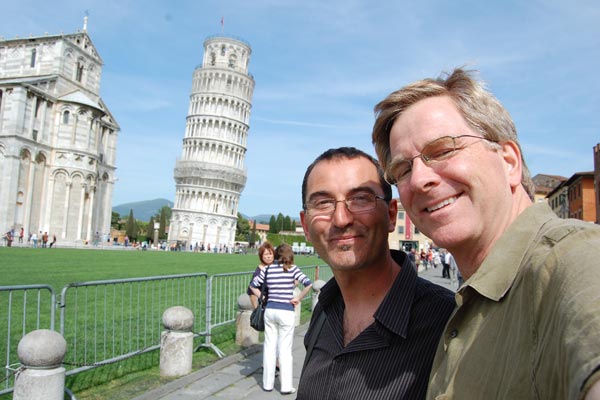
Dottore Vincenzo Riolo in Pisa taught me volumes about his town and is one of many excellent new local guides I met and will recommend in my guidebooks.
Enlarge photo

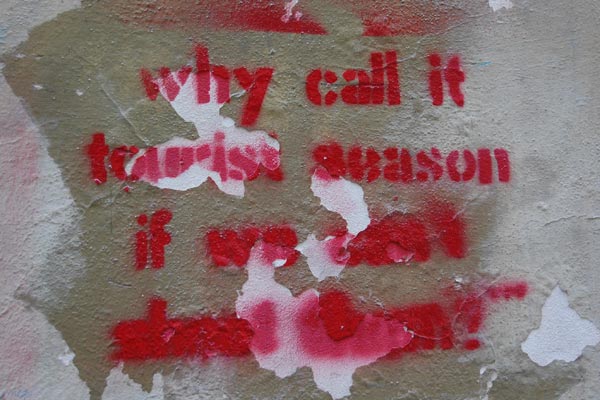
Why call it tourist season if we can’t shoot them? A scary welcome in Florence’s Oltrarno district.
Enlarge photo

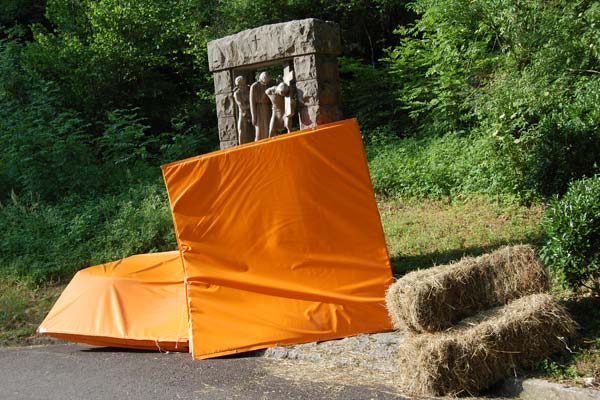
Station of the Cross, padded for protection, along the route of a bike race in Slovenia.
Enlarge photo

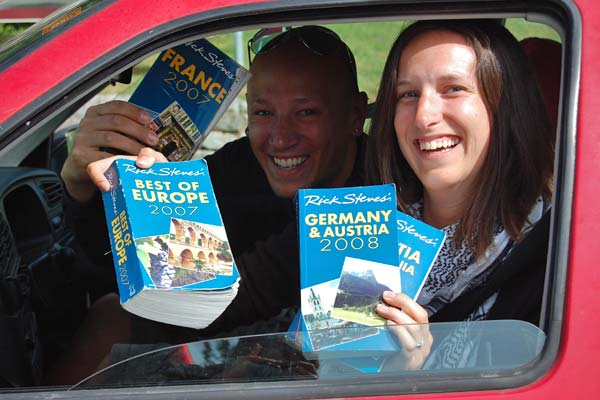
Happy road trippers with favorite guidebooks in Slovenia.
Enlarge photo

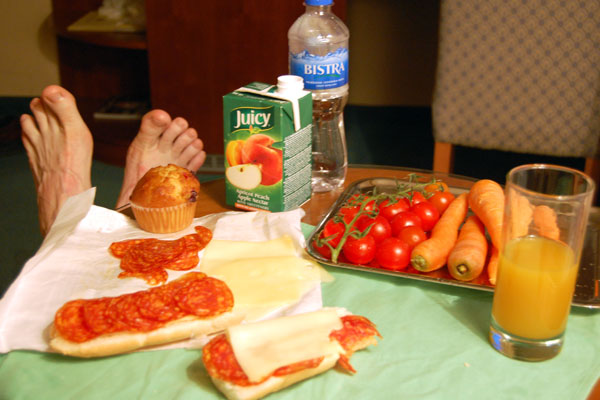
Cheap and delicious picnic, relaxing in my Zagreb hotel room.
Enlarge photo

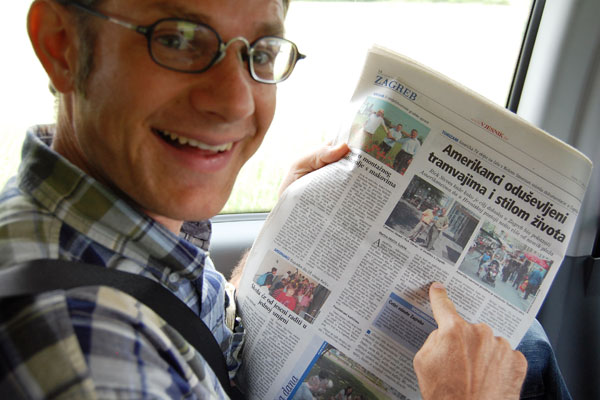
Cameron Hewitt (co-author of our Croatia & Slovenia guidebook) reads about himself, me, and our American film crew in a Zagreb newspaper. I guess an American film crew in Zagreb is newsworthy.
Enlarge photo

Croatian B&B hosts—clicking with new friends in Korcula.
Enlarge photo

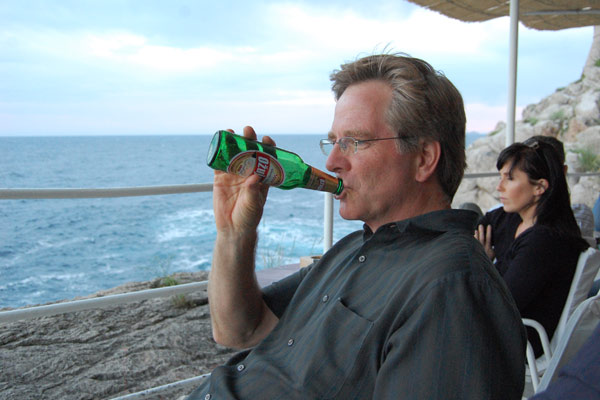
Day #70…Trip over, one last beer to enjoy a Dubrovnik vista and celebrate a smooth and productive trip before flying home.
Enlarge photo

Are Brains and Brawn a Zero-Sum Game?

I love traveling in former Yugoslavia. Many enjoy it for its Dalmatian Coast resorts, its seafood, or its great prices. For me, it’s like turning a history and politics text book inside out, shaking its contents all over the earth, and then playing in it.

While the region is still smarting from the bloody wars of the 1990s, things are changing fast. Much of the war damage scenes I saw two years ago in Mostar (Bosnia) and wrote into our script have been fixed up. Updating my script, I replaced the sad images (and words) with hopeful ones — men in hard hats on scaffolds rebuilding blackened shells of buildings.

Like the Habsburgs and Ottomans, Yugoslavia was the fault line of cultures between east and west. Bosnia was the same fault line within Yugoslavia, and the unfortunate city of Mostar was the fault line within Bosnia. It was an epicenter of ethnic tension. That’s why city parks (which were out of the line of sight of snipers) are now jammed with shiny marble tombstones, mostly dated 1993. Primarily Muslim graves, they have images of the person buried there…a reminder that while the Muslims here came to blows with Christians, they are European Muslims and don’t have the strict limits (regarding alcohol, modest dress, showing images in art, and so on) imposed on many Muslims farther east.

While each evening the tourists clamor to eat down by the river with delightful views of the city’s beloved, pointed, single-arch bridge, I took my business to the Boulevard — the former front line that only now is getting some tentative businesses opening up.


As Mostar in Bosnia-Herzegovina rebuilds, this big new church comes with a minaret-shaped spire that seems designed to reach higher than the neighboring minarets.
Enlarge photo

Enjoying a plate of stuffed peppers and a Sarajevsko beer — I thought of Sarajevo, considering the Bosnian capital in the news in 1914, 1993, and today. I talked with a young man who served me. He just opened his bar here on the Muslim side. Immediately across the street stands the new Catholic church, with a minaret-shaped spire that rockets up at least double the height of any minaret in town. (He and I compared stress-related cold sores…mine from finishing up three TV shows covering most of ex-Yugoslavia in 20 days…his from opening up a bar on the former front line.) He said that while bullets are no longer flying, he worries about vandalism from young, hate-filled men across the road. There’s understandably a lot of “Your father killed my father” and vice versa sentiment. He’s been open two months, and so far…no problem.

Eating my meal, I was surrounded by poignant sights and sounds. First a warbly call to prayer echoed across town. Then the church bells tolled determinedly across the street. It was like Turkey and Germany were taking turns knocking on my ears. All the while, a little boy with training wheels on his pint-sized bike pedaled vigorously around and around the newly laid sidewalk by a still-bomb-damaged line of buildings and grass too young to walk on. He went faster and faster with each circle.

The day before, we crossed from the Serbian part of Bosnia into the Croat and Muslim part, filming visual indicators showing that we were crossing a centuries-old cultural divide that was gerrymandered into a border in the 1990s to finagle a fragile peace. Flags flapped proudly from wires strung over the road. Old Serbian kings were stenciled onto abandoned buildings. Ruined castles guarded ghosts of centuries-old threats on strategic mountain passes. On road signs, Cyrillic letters gave way to Latin ones.

Stopping to film one sign at the cusp where cities were indicated in both scripts, Cameron (co-author of our guidebook on this region and a critical part of our filming effort for his passion, knowledge, and contacts here) and I were sitting like Clark Kent’s puppies in our van while big, strong Simon and Karel were out with their fancy camera and tripod, framing up the shot. Suddenly a beat-up truck screeched around the corner and skidded to a halt next to Simon and Karel, raising enough dust to obscure the camera.

An enraged man powered out, slammed his door, and screamed at my crew, thumping his chest so hard he almost got air. As he was threatening our friends, Cameron and I were traumatized, watching from the car. Simon and Karel talked calmly with him while taking the camera and tripod down, then walked back to the car — not knowing if the mad Serb would actually get physical. Thankfully it didn’t come to blows.

We learned afterward that the media has been angering Bosnia’s Serbian community lately with its 60-Minutes-type coverage of sensitive issues, and apparently this brute just had it out for anyone with a big camera.

While we’ve met generally gentle and thoughtful people in all communities here, I can also see the potential for more of the sectarian tumult that made the 1990s so horrific. There’s a certain strata of society here in each ethnic community, and when you see them, you just have to think “for war…just add bullets and agitate.”

I’ll see a café filled with skinhead bodybuilders who make me think brains and brawn are a zero-sum game. Some are built like big tubes, with muscles that seem to squeeze their heads really small. They live in poverty, amidst broken concrete and angry graffiti with little but unemployment in their futures.

And then, you get out of the backcountry, and the energy and focus are much different. On Montenegro’s coast, people are still talking about the recent concerts featuring Madonna and the Rolling Stones. Both visited Montenegro (with local government sponsorship to help put that homely little country of 700,000 on the map) and sold out (30,000 tickets at $50 each — lots of gross for a small, poor country).

The Stones learned native words, referring to the country by its local name (Crna Gora), wishing all a dober dan (good day), and so on. They thrilled the euphoric crowd with a robust encore set. Madonna, on the other hand, didn’t relate to anything local, never talked to the people, and ignored their pleas for an encore. Friends who went to the concert recalled that she was in her helicopter, lifting up over the stadium on her way out of the country three minutes after singing the last verse of her last song.