There’s something poetic about summer evenings on a fjord. There’s a mellow, steady, no-shadow light that hardly changes from 8:00 until 11:00 p.m. The steady call of gulls and the lazy gulping of small boats taking on little waves provide a relaxing soundtrack.
When settled into a Victorian-era fjordside hotel, I find myself spending lots of time sitting on porches, mesmerized by Norwegian mountains. Rather than jagged, they’re bald and splotchy, with snow fields on top and characteristic cliffs plunging into inky fjords. Tonight I took my strawberries à la mode onto one such porch and sat there long after my coffee cooled and the ice cream melted.
After dinner, I strolled through the village enjoying the blond cherubs running barefoot through the stalled twilight. Cobbled lanes led past shiplap houses to rock cliffs — gullies and cracks green with trees. Half the sky was taken up by the black rock face of the mountain.
Sitting on a lonely pier, I enjoyed the souvenir stains: black splatters on my khakis — carbon smudges from my glacier hike. Apparently ancient plant matter peppers the glaciers and is eventually exposed as the slow-moving river of ice makes its way down the mountain.
In my research work, I did the two most-promoted “glacier trips,” taking me to the two most-visited tongues of the Jostedal Glacier — northern Europe’s largest glacier. One trip sails down Fjærlandsfjord to Mundal, Walter Mondale’s ancestral home town (and just as exciting), from where an awaiting bus shuttles visitors up to Bøyabreen. The other trip, up another fjord, goes to a tongue of the glacier called Nigardsbreen.
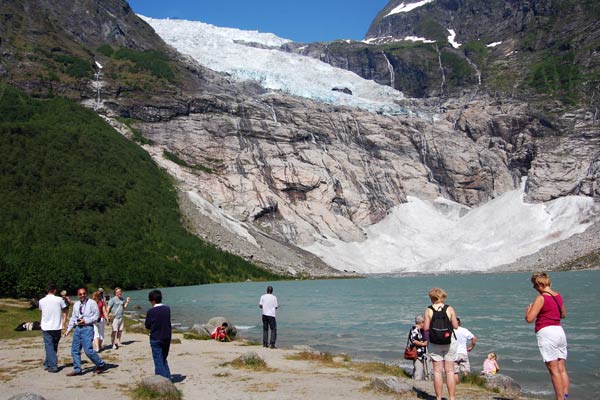
Being here tunes you into the glory and tragedy of nature. Bøyabreen has retreated to the point where it’s actually dishonest to sell a trip there as a “glacier visit.” You look at it in the distance past a lake made by its run-off, listening to your guide, who sounds more like an environmentalist who lost a loved one.
The other, Nigardsbreen, still thunders to the lake at its feet. To reach it, you pay to enter a national park, hop a small boat to cross the lake, then hike over glacier-smoothed rocks to a small group of tents where local guides are lashing spikes onto visitors’ shoes to take them hiking up into the mountain of blue ice with its black speckles.
Roped up with a dozen visitors, we did the hour-long hike. At first I moved gingerly — not trusting my simple, four-spiked crampons. But as long as I walked “with angry steps,” stamping each step deliberately, I could climb steeply up and down with no problem on the ice.
It took me the better part of two days. But now I can say with more certainty than any information I found in print: Bøyabreen is a waste of time. If you like your ice on the rocks, head for Nigardsbreen.
 |
 |
 |
| Sleepy Solvorn, under towering rocks with peeling paint, provides a restful, fjordside escape. Enlarge photo |
The Bøyabreen glacier experience? It sounds good in the ads…but you’ll need binoculars. As glaciers recede, some tour experiences are left on the rocks but without the ice. Enlarge photo |
Nigardsbreen, a tongue of the Jostedal glacier — Europe’s biggest — offers Norway’s best easy-access glacier experience. Enlarge photo |
 |
 |
|
| All roped-up on the one-hour family hike, you’ll be glad you made a potty stop before setting out. Enlarge photo |
Climbing on the ice with flimsy strap-on, four-toothed crampons, you proceed gingerly. But by making “angry steps” you realize they grip, and soon you are confidently glacier hiking. Enlarge photo |