I spent a long day touring the Estonian countryside with my guide, Mati. It seems that the life and money are being sucked into the big city, Tallinn. Country people are moving there for work. The Estonian countryside seemed pretty dead — enjoyed by holiday-makers and offering work to those who can telecommute.
 |
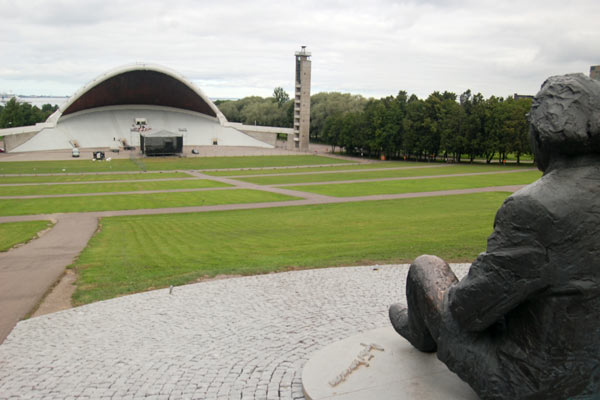
| Estonia’s Baltic coast was once the wall of its Soviet-maintained prison. Now the ruins of that cage are a place that free Estonians come for peace, rest, and to celebrate their nature. Enlarge photo |
The forests are thick, but the country is flat. Its highest “mountain” is under 1,000 feet, nicknamed “Big Egg Hill.” The endless pine forests are carpeted by wild berries and mushrooms. It is a part of the lifestyle to pick the berries. Mati said, “We have many berries. If you are very sick, some can make you well. Others can kill you. We pick them now for the joy, but during communist times, we picked them because we needed the food.”
The coastline is littered with souvenirs of Soviet occupation. Each little lip of land had a track for a gun and a searchlight. The metal used to keep the Estonians down is everywhere. Estonia’s first post-independence millionaires made their fortune selling scrap metal to the West. Today, Estonians enjoy their mellow, peaceful Baltic coastline, playing amid the ruins of their former prison.
History was tough even before the Soviet Union. If it wasn’t Russians, it was Germans…making life miserable around here. Until the mid-19th century, a good hunting dog was worth more than an Estonian peasant worker. And it was even tougher east of Estonia. In fact, Mati said that the vast majority of Soviet movies set in past centuries were shot in Tallinn, Odessa, or Riga. He said that was because these three towns were among the few from the former Soviet Union with an old quarter that survived the tumult of the 20th century.
And there was nothing charming about the architectural heritage of the Soviet Union. Ugly buildings, which dominate most cityscapes, are just assumed to be “from communist times.” Hotel Viru, long the only skyscraper in Tallinn, was an infamous Soviet hotel. Mati said it was built of a new Soviet material: “mico-concrete” (60% concrete, 40% microphones).
Doing my research, I asked Mati about a good Italian restaurant. He said these days, Italian restaurants are common in Estonia…but no good. They’re generally based on couples: Italian guy marries Estonian girl. His mom was a good cook, so they think, “Easy. Let’s open an Italian restaurant.” Mati said, “It’s always Italian boys and Estonian girls — not the other way. Italian boys think Mediterranean women (Portuguese, Spanish, Italian) don’t age well. Let’s face it: For this, God created the Catholic religion…so they can’t divorce.”
Mati explained his theory that Italian boys see Estonian women as the best bride material: They are the ideal Russian/Scandinavia/Estonian mix: deep, poetic, and romantic like Russians; free-spirited like Scandinavians, but without the problematic feminism of a Scandinavian; and the hands-on, can-do practicality of Estonians…the perfect woman.