 |
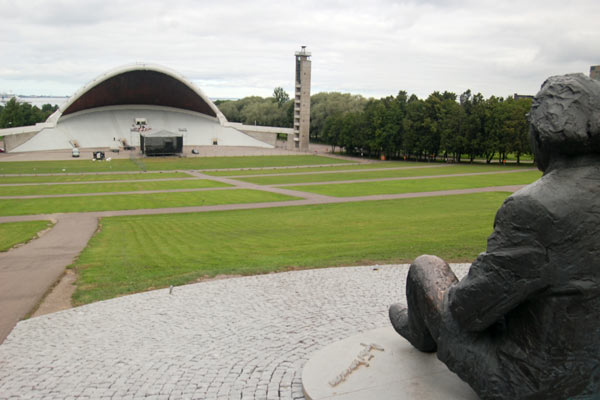
| The Festival Song Grounds in Tallinn mean freedom to a million Estonians. This is where choral music helped bring down the USSR. Enlarge photo |
It’s amazing what a stretch of water can do. The Baltic Sea separates Sweden and Finland from Estonia. And the struggles of the last couple of generations couldn’t be more different on opposite sides of the Baltic. Traveling to Estonia spices up any Scandinavian visit — especially if you connect with the people and let them tell their story.
My guide, Mati, spent his time in the USSR military driving Soviet officers around the Crimea. Estonian boys got this plum assignment because they were considered smarter (and therefore safer) than village boys from the interior of Russia.
With Finland within rabbit-ear distance, Estonians were the only people in the USSR who got Western TV during the Cold War. Mati remembers when the soft porn flick Emmanuelleaired on Finnish TV. No one here had seen anything remotely like it. There was a historic migration of Estonians from the south of the country to Tallinn, where they received Finnish TV. Nine months later, the country experienced a spike in births.
Estonia gets jerked around a lot. It hopes to get the euro in 2011. While I can’t imagine a change in currency, for Estonians it’s no big deal. Mati’s grandmother lived through seven different currencies.
When Mati asked his grandmother where his grandpa had gone, she said, “He’s a tourist in Siberia.” That was the standard answer to shield little kids from the hell they were living in. After freedom, Mati learned that his grandma had a bag packed under her bed for the surprise visit from the local police that she dreaded but half expected. We all live with stress and anxiety…but imagine living fifty years with that fear, as she did.
In Mati’s youth, one-sixth of the world was technically open to travel (the entire USSR), but there was no way to get a plane ticket or a hotel room. In an age when all Estonian recreational boats were destroyed (1950s and 1960s) because they were considered potential “escape vehicles,” one-sixth of the world was a prison.
After independence, in the early 1990s, Mati and five friends built a business importing classic American cars and selling them to rich Russian guys. One day, four of Mati’s friends went to Russia to collect payment on a car and were killed — riddled with machine-gun bullets.
Mati said, “The Russian mob makes Sicily’s mob look like a kindergarten. Putin directed the KGB. If someone thinks Putin doesn’t understand, forgive me, but you are a fool or you are blind.” Mati decided to drop his car business and become a tour guide.
Tallinn’s huge Song Festival Grounds looks like an oversize Hollywood Bowl. Standing overlooking the grassy expanse, with the huge stage tiny in the distance, my guide explained that when Estonia was breaking away from the USSR, a third of the entire country — over 300,000 people — gathered here to sing.
Imagine little Estonia, with less than a million people, free for 20 years from 1920 until 1939, but lodged between Hitler and Stalin. Mati said, “We are so few in number we must emphasize that we exist. We had no weapons. All we could do was be together and sing. This was our power.”
And that spirit of song led to Estonia’s stirring Singing Revolution. I’m embarrassed that my guidebook coverage completely missed this aspect of a visit here. I’ve visited Tallinn several times, and the thrill of this phenomenon (and the historic importance of the Song Festival Grounds) never hit me. With this visit, I was so inspired, I purchased the documentary movie The Singing Revolution online. This marked the start of a new age in tourism for me: be inspired, go back to the hotel, buy the movie on iTunes, and enhance my experience by watching it right there. In the future, this will be commonplace among engaged travelers. (Curious? Visit www.singingrevolution.comto watch the movie’s trailer.)
The Soviet Union was good at wiping out cultures. The USSR intentionally moved people all around to destroy ethnicities and make their citizens simply Soviets. The Livonian culture died out in the 20th century. They tried to wipe out the little Estonian culture, too. They moved in Russians. They drafted Estonian boys, sent them to far corners, and gave them incentives to marry into other regions. Mati recalled how Russian girls swooned at boys in uniform — especially Estonians — and there was plenty of opportunity to marry.
But there’s something resilient about Estonian culture. Mati said, “I’ve been in most of Europe and what I miss when I return is this black bread. I cannot live one week without it. I spent one week in Thailand, and we forgot our black bread. We were very unhappy.”
Having traveled with Mati, Estonia will forever be a more vivid place on my globe.
The Estonian Singing Revolution is a keeper, and reminds me of two unforgettable moments on two of your tours. In Munich, the Munich City Museum clearly documents Hitler’s takeover of a progressive city through propaganda of ‘us versus them’. In Prague, the Museum of Communism documents another progressive city being taken over by the same tactics. Having barely survived Cheney, Rove and their tactics, let us sing.
Thank you, Rick, for sharing this experience.
Yes, thank you Rick and Mati for sharing your experiences. I forwarded the blog to my husband who has always had an interest in the Baltic countries and he thoroughly enjoyed it.
Estonia is an awesome country. That is where I went in 95 and 96 on my first 2 visits to Europe. The people there were great. More than any other country in Europe, Estonia will hold a special place in my heart. Thanks for taking the time to learn, care about about, and visit Estonia. Also, try and visit Tartu Rick. It’s a great college town. Maybe not a lot going on now since it is summer but it really is a back door experience!
I find it interesting that of the 1.4 million Estonians, less than 70% are ethnic Estonian and 1/4 are Russian today.
That’s because the Soviets (especially under Stalin) went in for big population movements. Possibly rebellious Estonians got shipped out to Siberia, and ethnic Russians were moved in. Happened in other parts of the Soviet Union too. Just like the Han Chinese have been moving in large numbers into Tibet and Xinjiang.
Will anyone be ‘singing’ after Obama & his so called ‘czars’ hijack America?
I was in Tallinn for the Song Festival just a month ago- I went after being so inspired watching the “Singing Revolution” in an art theatre back home. I’ve since purchased the movie and shown it to a ton of friends, all who want to join me on my next trip to Tallinn… I fell in love with the city- it’s fantastic. But made ever so much better by the atmosphere of the Song Festival. It was so amazing to experience the joy and pride amongst the so many thousands of Estonians in the festival grounds with me. I will keep going back to Tallinn- as often as I can. And I highly recommend a tour with a local guide if you go. View with a Brew tour with EstAdventures was amazing.
Thanks so much Rick for posting this. I’m looking forward to seeing the film, and visiting Estonia. Would never know about this, were it not for your blog post.
Oh Mike, your intellect overwhelms me!
Speaking of Stalin…. this link (http://www.whitehouse.gov/blog/Facts-Are-Stubborn-Things/)from the White House website says: There is a lot of disinformation about health insurance reform out there, spanning from control of personal finances to end of life care. These rumors often travel just below the surface via chain emails or through casual conversation. Since we can’t keep track of all of them here at the White House, we’re asking for your help. If you get an email or see something on the web about health insurance reform that seems fishy, send it to flag@whitehouse.gov. Better to be a free non-intellectual than a fool!
We took the Scandinavia tour and the Estonia,Helsinki, St. Petersburg tour this summer. It was great to do the tours together. We felt we learned a lot about the Baltic area and the intertwined history of these countries.