Watching the Blonde Girl Get Drunk


Ashley Sytsma, Rick’s publicist, is a guest writer this week. She’s reporting on her travels to Georgia (the one over by Russia).

Georgian drinking culture is infamous to those who’ve visited the country. For particularly celebratory occasions, the men regularly consume 3-5 liters (4-7 bottles) of wine per person. Knowing this, I expected to find drunks all over the streets of Tbilisi, but I was wrong. I didn’t see a single one.

Now, I’m not condoning binge drinking, but once I learned more by experiencing it firsthand, I had to give Georgians props for having a unique and, dare I say, heartfelt booze culture. And for better or worse, I found I could hold my own – to the delight of the locals.

High up in the Caucasus Mountain near the Russian border, my husband and I ran into a humble country restaurant to seek shelter from the bitter cold. We ate lunch with our driver, Greg (who looked like a cast member from a mafia movie), and our guide, Levan (a Harvard-educated, professional-snowboarding, Georgian-folk-dancing, Renaissance Man). Being inside didn’t help the cold much. I could still see my breath while the lonely waiter wore a knitted cap and puffy jacket.

As we sat down next to the only wall heater, Levan asked us what we wanted to drink. Lemonade, beer, vodka? When traveling, a lunchtime beer is a fun addition, but being so close to the Russian border, we figured what the heck? Let’s have a shot of vodka with our meal! To our surprise, Levan didn’t order one round of shots, he ordered an entire bottle.
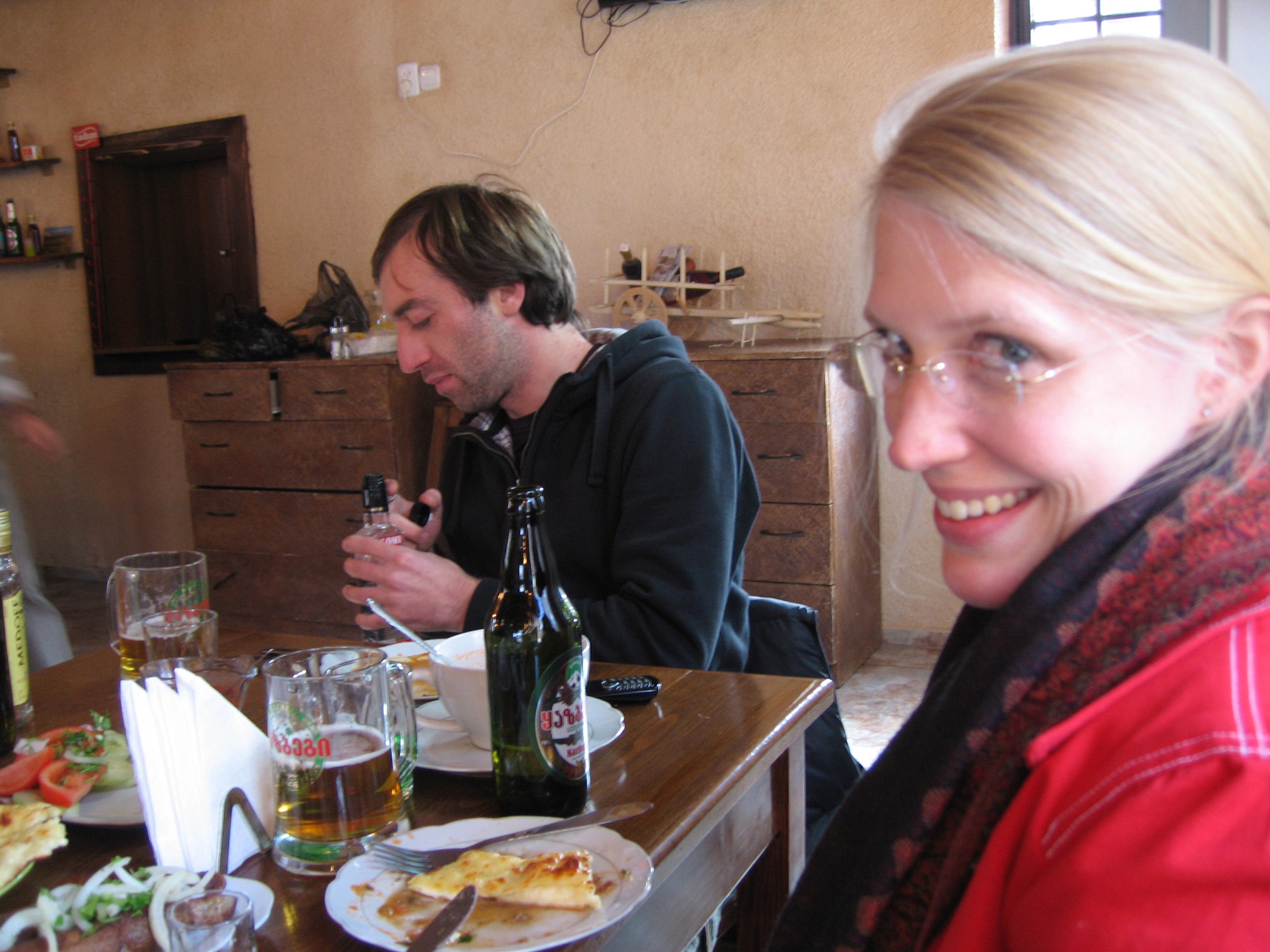
Levan opening our bottle of vodka.

While steaming hot plates of stewed lamb, red beans and dumplings came flowing out of the kitchen, Levan exclaimed in his charmingly flawed English, “I’m going to teach you the tradition of the toast-ies!”

Often considered a defining part of Georgian culture, every single feast and celebration (or humble lunch in our case, I guess) is assigned a “tamada” or toastmaster. This person leads the attendees in a series of toasts as dictated by a very old tradition. Levan was to be ours.

He poured and passed ice cold shots, and with deep sincerity and reverence he began. “I first wish to honor that which is everything…is all…is forever the guiding light of our life. I wish to give a toast-ie to our loving and beautiful God.”

Coming from a culture where shots tend to be a part of bachelorette parties and other such debaucheries, I was surprised God was making an appearance. But I tentatively raised my glass, tried my best to thank my Higher Power, and knocked back my first warming (and surprisingly smooth) shot of Georgian vodka.

Perhaps sensing my bewilderment, Levan explained that the tamada never toasts frivolous things like possessions or shallow feelings but rather that which makes life worth living – those intangibles that bring a spirit, spark and light into our lives.

Within a minutes, he poured another shot. “Next I wish to honor those who have made the ultimate sacrifice, those who without which we would not be here, those who honor us with their spirit and make us the people we are at our very core. I wish to give a toast-ie to our family members who have passed on – to our ancestors.” And back goes another shot.

Over the course of an hour, Levan led us through a heartfelt, soulful collection of toasts that honored the love of our parents, the safety and security of our homes, the support of our life partners, the protective touch of our unseen guardian angels and many more.

With each shot, I loosened up. With each shot, I followed Levan’s emotions more closely. With each shot, let’s be honest, I became more and more a sentimental fool. From the outside (meaning poor Greg, our very sober driver) we looked like sorry, sloppy, slurring drunks. But from the inside of our inebriated circle we were sharing…communion. We collectively felt the love for our families. We shared the last time we spoke to our guardian angels. We draped arms around each other’s shoulders and whispered secrets (funny because…who was going to hear?). We connected. We all “got it”! We were brothers and sisters! We celebrated life’s spark! It was actually quite a touching experience. Seriously.
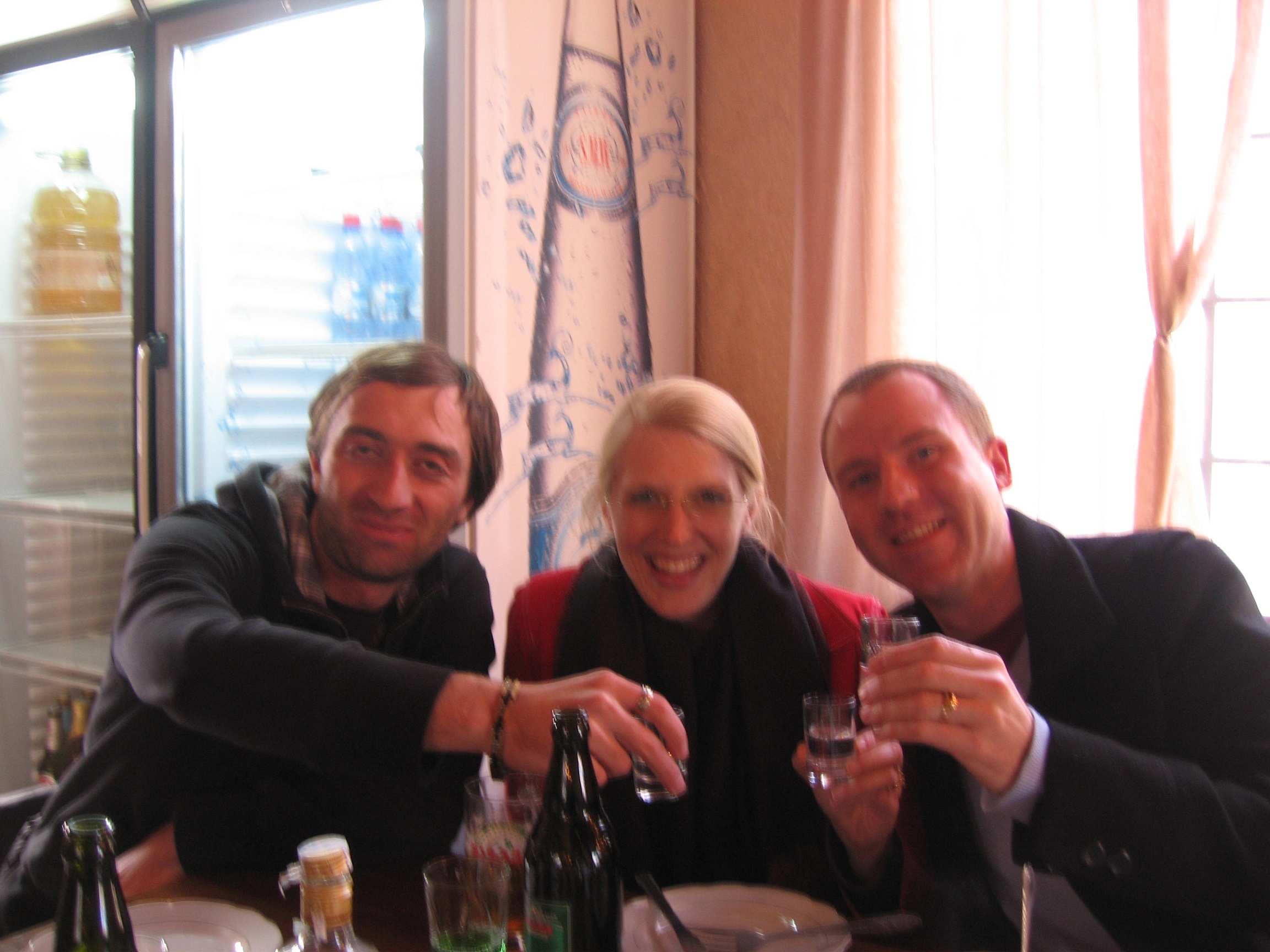
Sharing communion.
Sharing communion.

By the end we three had consumed two bottles of vodka, a bottle of wine, and one large beer. Our only saving grace was the seemingly pounds of rich meats, cheese and bread we ate. It was by far the most I’ve drank without getting sick. And I had to buck up too. There was still a half-day of sightseeing left.

When Levan and Greg dropped us off at our hotel that evening, I was more than sleepy. As I stepped out of the car, Greg winked at me and chuckled in Georgian (Levan translated), “Good work today. I’ve never seen a blonde woman drink so much!” Levan assured me that this was a compliment.
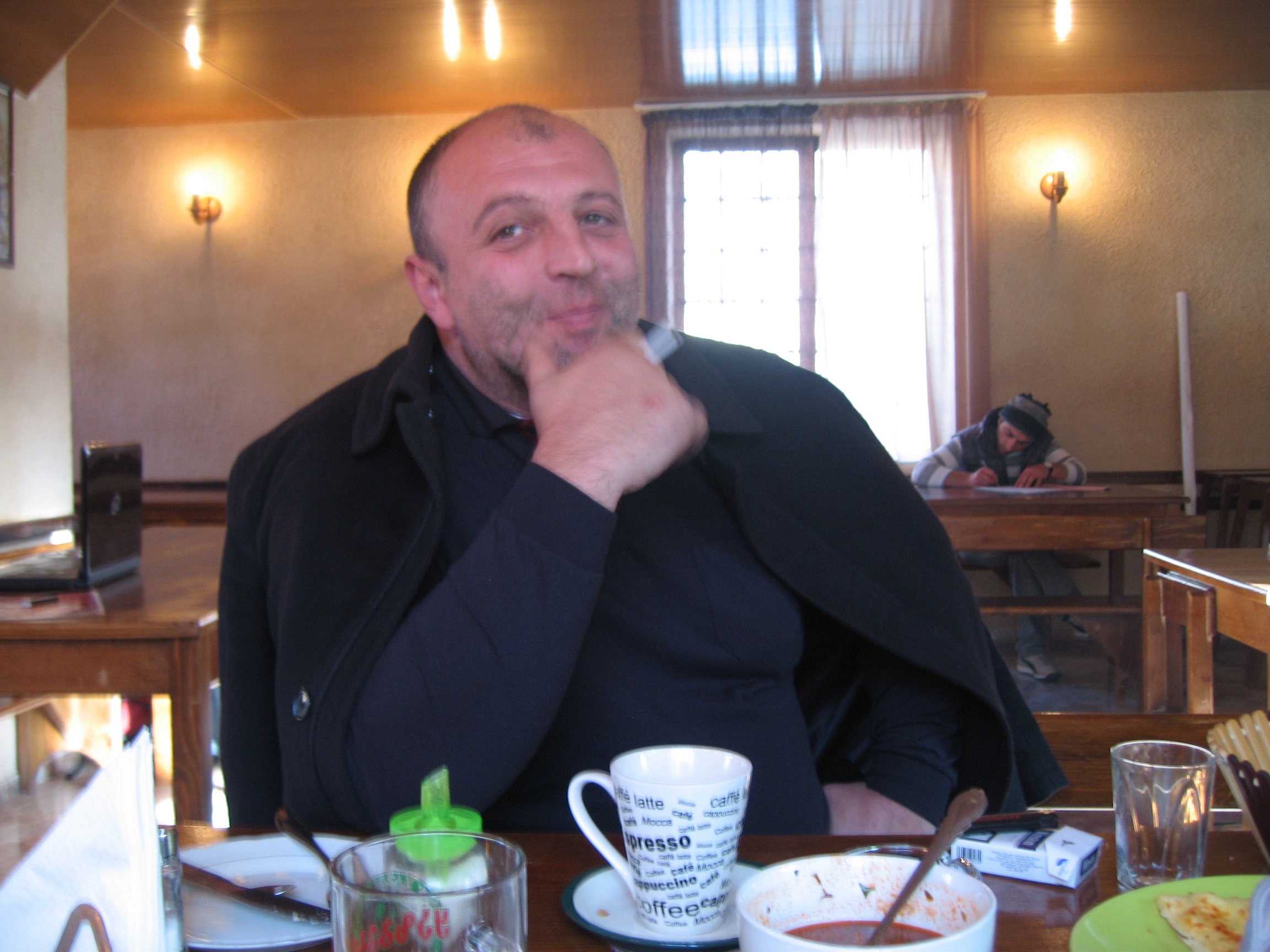
Greg our very sober driver.

National Security or a Police State?


Ashley Sytsma, Rick’s publicist, is a guest writer this week. She’s reporting on her travels to Georgia (the one over by Russia).

Across the river from Tbilisi’s Old Town sits Georgia’s new Presidential Palace. Blending classical columns with a modern glass dome, it’s a graceful addition to the city’s many other charms. Intrigued, my husband and I decided to get a closer look. Maybe there’d be a tour!

We started our short trek to the palace in below-freezing, windy conditions. Walking arm-in-arm, scarves cinched tight and faces pointed down, we were so focused on staying warm that we didn’t notice it at first. But we were being watched…closely.

It’s become a habit of mine to make eye contact and give a courteous smile and nod to police officers. No matter the country, I tend to get a smile back. There was no reason to suspect that this time would be different.

We passed a particularly surly-looking officer. I smiled and nodded. He frowned and gave me a thorough look up and down. I thought, “Strange. What’s his problem?”

Within seconds, another officer appeared. Same response.

Moments later, I was startled by an officer standing in a concealed doorway. Same response.

A man in a black leather jacket brushed past us before zipping over to an officer. They whispered and pointed in our direction. We were the only pedestrians. There were no cars. We were alone.

My husband grumbled, “Keep your head down. Don’t take your hands out of your pockets, and keep moving.” He, too, was uncomfortable with our friends.

As we approached the palace, more police seemed to spring out of nowhere — one startling us every few yards or so. They smoked cigarettes, rested their hands on their guns, and silently watched us walk down the street. The security cameras turned in our direction.

As we approached the front gate, the officers seemed to take two steps toward us. I made eye contact with the closest one. I pointed at myself, and I pointed at the gate. With one slow affirmative nod, he allowed us to approach.

Trying to keep it light, we said things like, “How pretty it is! What a nice view!”— all the while thinking, “I wonder if our embassy would know if we disappeared?”

Obviously, they did not give tours.

Later that day, I was troubled. Our experience just didn’t jibe with the extremely warm reception we’d received everywhere else in Georgia — police included. To gain a bit of perspective, I recounted the experience to our Harvard-educated Georgian friend, Levan.

“Gosh, Levan. Are you living in a totalitarian state or something?”

He shrugged, “It’s the president.” He then proceeded to give me some context:

In 1992, shortly after the fall of the Soviet Union, Georgia declared its independence despite being more than a little unprepared. Under communist rule, the state had owned everything. When the Soviets left, a power vacuum mixed with tons of unclaimed resources to create one huge mess. “Owners” become whoever had the meanest gang and carried the biggest shotgun. And the biggest, best-armed gang of them all was…the police. A decade of civil war, banditry and a collapse of civil society followed. As Levan solemnly told us, “It was bad. Really, really bad.”

Happily, those dark days are behind Georgia. For example, every police station — even tiny, rural outposts — has glass walls. My husband and I made a game out of waving at the workers and betting on how many would wave back. Levan explained that after all the years of corruption, the glass represented a new, open and honest force.

A glass-walled police station
A glass police station

Many attribute this and other positive changes to Georgia’s democratically elected president, Mikheil Saakashvili. In 2003, he led thousands of citizens to the Parliament — all of them carrying roses — to demand the resignation of a particularly corrupt president. It worked, and this peaceful movement is now lovingly called The Rose Revolution.

Saakashvili is, as one friend called it, “radically Western-focused.” Despite sitting at the easternmost fringe of Europe, Saakashvili’s Georgia is, by decree, purely and completely European. Billboards throughout the city proclaim (in English), “Our foreign policy priority is the integration into NATO.” Although the country is not a card-carrying EU member, the European Union flag flies as high as the Georgian flag at the Parliament Building.

Parliament Building: Site of the Rose Revolution and where the EU flag hangs proudly.
Parliament Building: Site of the Rose Revolution and where the EU flag now hangs proudly.

Smaller test
These policies have won the president many friends…and many enemies. Now add in the complication of a recent violent crackdown on protesters and rumors of high-end corruption. Assassination is a real threat, Levan explained. Perhaps the police around the Presidential Palace are necessary?

I heard myself utter what has become my favorite travel phrase: “Huh. I never thought of it that way.”

I still don’t know what to think about our less-than-friendly reception at the Presidential Palace. Was it a bullying show of intimidation to a couple of innocent tourists? Or was it a necessary evil for a government trying to build a country out of a very dark past? Was it national security or a police state? I don’t know. I’m just glad that Levan was there to give me some perspective. These are complex issues, and it doesn’t help anyone for me to pass judgment based on fear.

My Naked Hot Tub Experience


Ashley Sytsma, Rick’s publicist, is a guest writer this week. She’s reporting on her travels to Georgia (the one over by Russia).

When I heard Tbilisi was known for its ancient bath houses, I put it high on my sightseeing list. Who wouldn’t love a relaxing spa day? But I had no idea what I was in for.

Georgia’s capital was founded thanks to one thing: natural sulfuric hot springs. According to legend, 1,500 years ago King Vakhtang was hunting with his trusty falcon. Injured while catching a pheasant, the falcon fell into a small pool. The bird’s body was retrieved…fully cooked. The poor creature was boiled to death. The king decided this would be the perfect place to pass the cold winters. He called it “Tbilisi,” or “warm place.”

The domed roofs of Tbilisi's ancient baths.
The domed roofs of Tbilisi’s ancient baths.

Ever since then, people of all classes and creeds have soaked, bathed and warmed themselves in large, brick bath houses here. The one we chose for our adventure was hundreds of years old, and its facade was covered in bright-blue tiles. It looked more like a mosque than a giant hot tub. With bathing suits in hand, my husband and I trotted in.

Smaller test

This spa was different from those back home. There was no calming music or iced cucumber water, no perky hostess waiting to give us a tour of the facilities. Instead we walked up to a small office set behind glass. The lobby, while sparkling clean, smelled of stale cigarettes. A bustling beauty parlor was tucked into the corner.

In broken English, the office worker barked, “No man-woman together in group rooms. Together only in private rooms. You go see!”

While I waited, my husband ran upstairs to check out the men’s area. He came down and giggled, “Let’s get a private room. That is, unless you want to relax with 50-year-old naked men smoking cigarettes and drinking beer.”

As we paid, the worker asked, “You want massage?”

“Yes, please!”

“OK. I call him.”

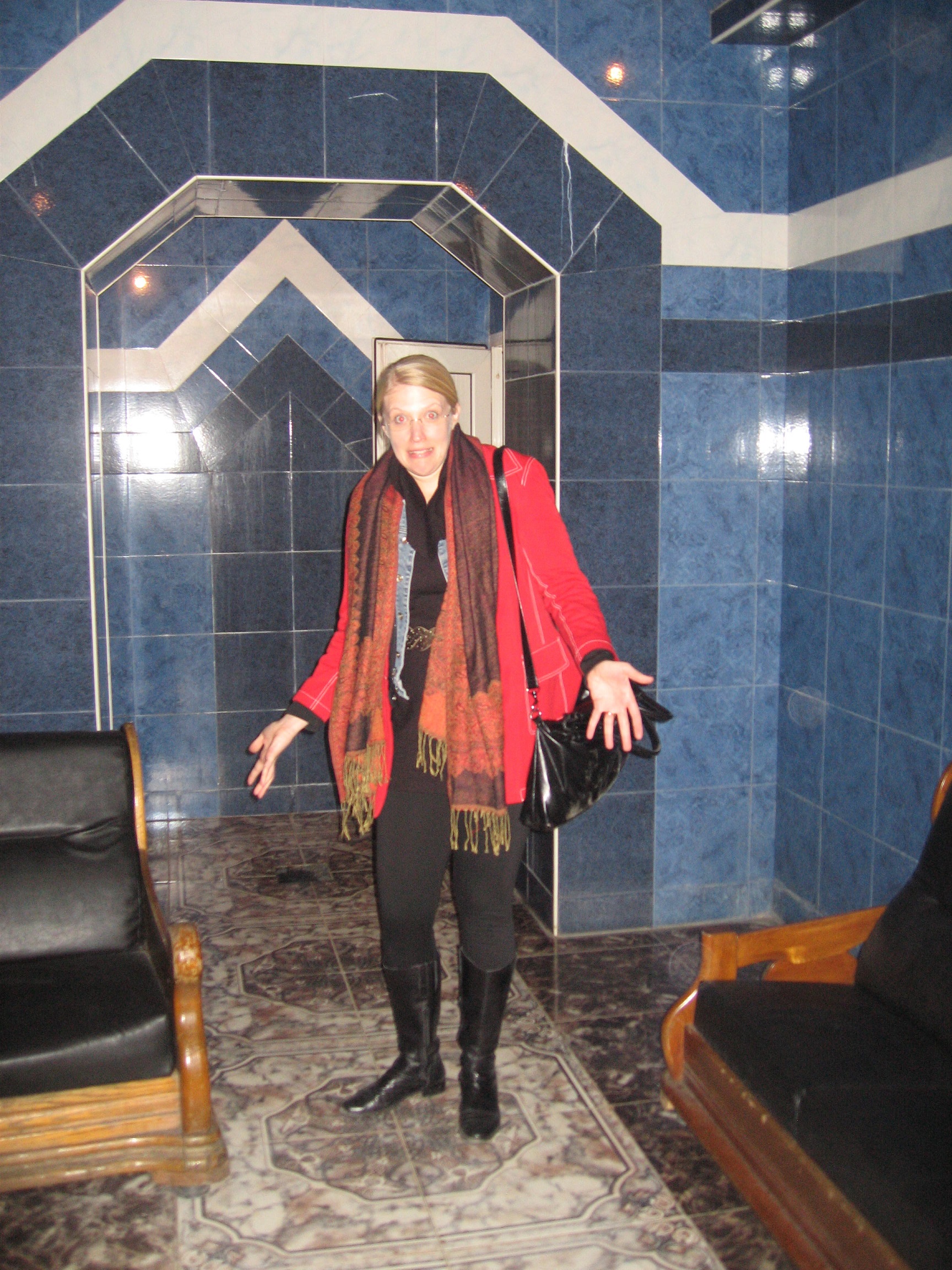
Our private room was actually two large rooms with a dressing area and a toilet. It was very clean but dingy, with modern and Soviet-era tiles. However, the spaciousness and the elegantly domed ceilings and arched entryways hinted at past luxury.

Our dingy (though clean) private bath room.

After changing into our suits, we nestled into the hot (albeit sulfur-stinky), five-foot-deep tub. Lounging there, it was easy to imagine a time when harems of naked women soaked, ate grapes and drank wine in that same room. We floated and sipped beers.  I even felt saucy enough to remove my bikini top.

Our peace was interrupted by a small white-haired man wearing boxers — the masseur. I quickly reached for my top, but with a shooing motion he made it clear that it wasn’t necessary.

His kind eyes and warm, toothless smile put us at ease. Through an elaborate set of hand gestures (he spoke no English and we spoke no Georgian), I was instructed to get completely naked and lie face-down on a large marble table.

With a firm slap on my back, he got to work. Using soap suds and what felt like a Brillo Pad, he began scrubbing every nook and cranny of my body. At first it felt nice, but with increased pressure and vigor, my skin quickly turned cherry-red and my few raised moles began to bleed. The force was so strong, he needed to show me how to properly grasp the table to keep from sliding off. He flipped me over. I felt like a large fish being descaled. He enjoyed pointing out the amount of dead skin flaking off of my body.

Next came the “massage.” With the full force and weight of his body, my white-haired friend tugged on my arms and legs, popped all of my joints, and worked my muscles like he was tenderizing a huge human steak. By the end, he was obviously proud of his work and sweating from exertion. I thanked him and sheepishly sunk back into the hot water.

I never truly understood the term “squeaky clean” until then. There wasn’t a lick of dead skin or oil left. I felt like a piece of Tupperware pulled from a hot dishwasher. I couldn’t help but laugh at how much it…hurt!

After all was said and done, we emerged into the daylight dehydrated, physically exhausted and still dripping dry. We leaned against a wall to catch our breath. As we rested, we watched hardy, working-class men walking out with a spring in their step, invigorated by the same scrub that had almost killed me. Humble old ladies proudly protected their new hairdos with bright silk scarfs. What a sorry sight we must have been to these well-groomed regulars!

That day I realized Tbilisi’s famous “spas” aren’t spas at all. They are bath houses…places for people without hot running water at home to bathe. The experience gave me a treasured insight into real working-class Georgian life and culture. And that was worth every inch of red skin.

Spiritual Awakening in One of the World’s Oldest Christian Nations


Ashley Sytsma, Rick’s publicist, is a guest writer this week. She’s reporting on her travels to Georgia (the one over by Russia).

Georgia is a Christian outpost in a largely Islamic part of the world. Despite living farther east than Syria, Egypt, and parts of Iraq, Georgians have a strong Christian tradition. It was the third state to convert to the religion (after Armenia and Constantine’s Rome) in the third century A.D., and since then has resisted many attempts at forced conversion by invaders.

The most recent threat to Georgia’s religious traditions came during the decades living under Soviet Union’s state-enforced atheism. However, since Georgia’s independence in 1992, Orthodox Christianity is experiencing a flourishing revival…one that I couldn’t help but get swept up in.

Dutifully following my guidebook’s walking tour, I slipped into a small cathedral famed to be the oldest in Tbilisi. Now, I enjoy a good European cathedral as much as the next traveler. But after many years of travel, church fatigue has set in. Another church is worth a peek, but not much more. Plus, I find myself feeling sorry for the few worshipers: Would you want to be photographed by hordes of tourists while conversing with your Lord and Savior? Heck, no! So my intention was to step inside, poke around, read about its history and continue on my walking tour. Instead I stayed for hours.

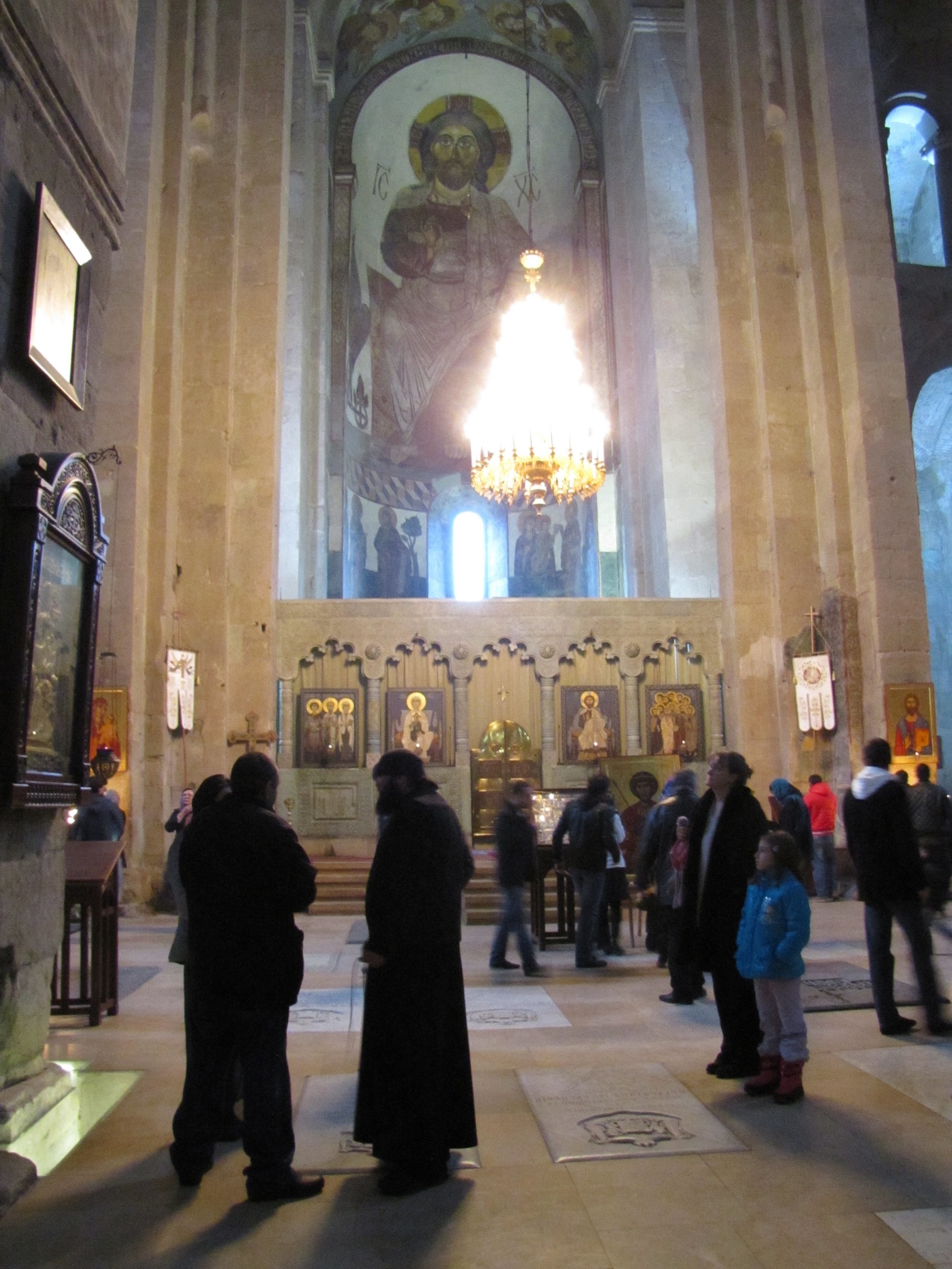
What first struck me was how busy the church was. Despite it being a Wednesday afternoon, it was packed. Mothers chased unruly toddlers. Husbands wandered arm-in-arm with their wives. Neighbors waved at each other from across the nave. Believers of all ages meandered from icon to icon — pausing to delicately touch the glass, whisper a prayer, light a candle, kiss the corner of the frame and rest their foreheads lovingly where they had kissed…all with the tenderness they would show a beloved grandmother.

Georgia's cathedrals function more like community centers than places of worship.
Georgia’s cathedrals function more like community centers than places of worship.

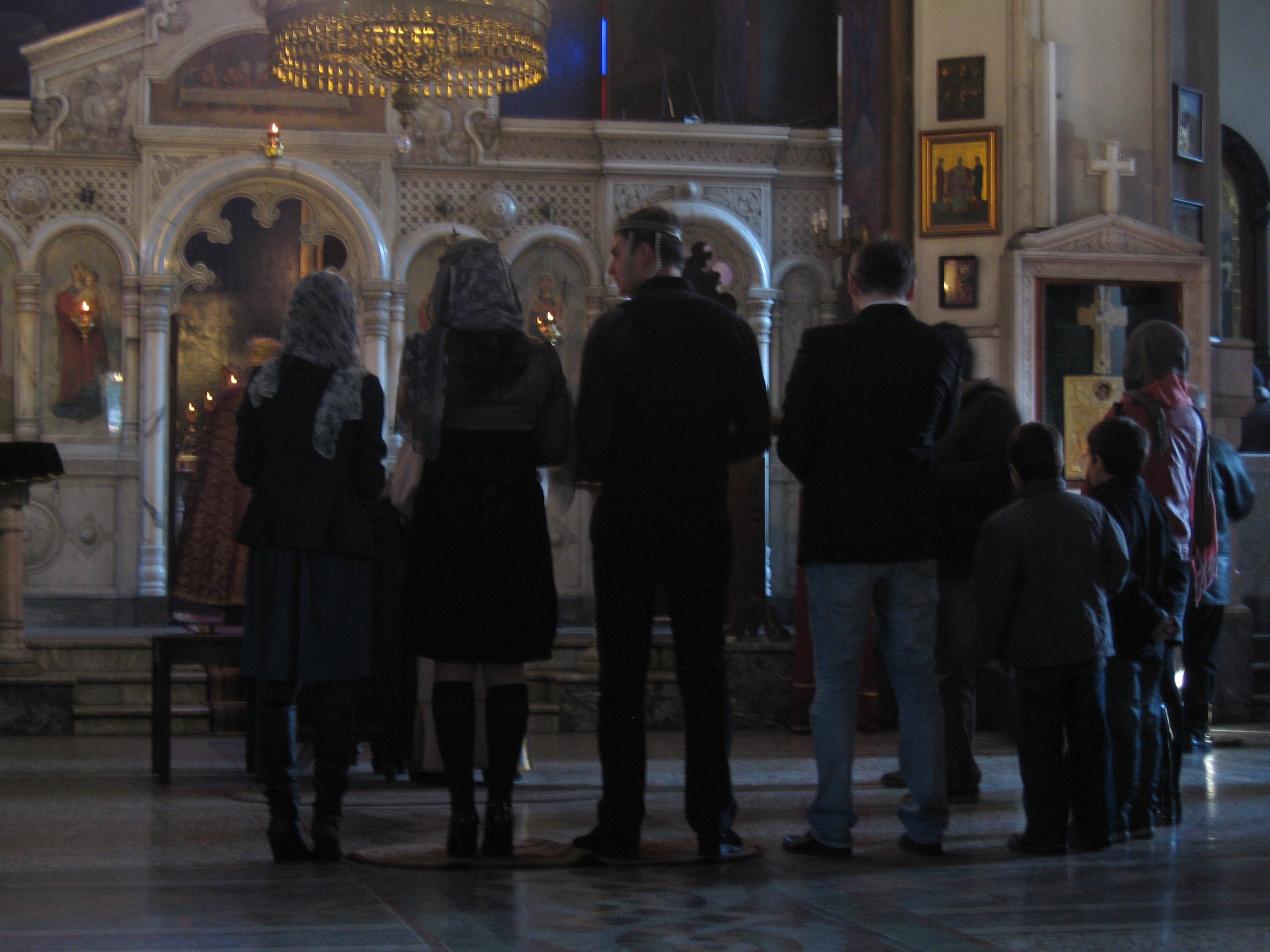
A half-dozen priests busily performed ceremonies for small clusters of followers. On the right, a baptism for three babies: Priests-in-practice shuttled in holy water with large, green-plastic buckets. In the center, a casual wedding: Wearing street clothes, a young couple took their vows. During our trip, we even saw an open-casket funeral — dead body and all.

Nothing was private. Nothing closed to the public. It was community in its truest form.

A simple wedding ceremony.

The pure, sweet love these believers had for their God was palpable. As I watched quietly from the corner, I was moved to tears by their tender devotion and strong faith.

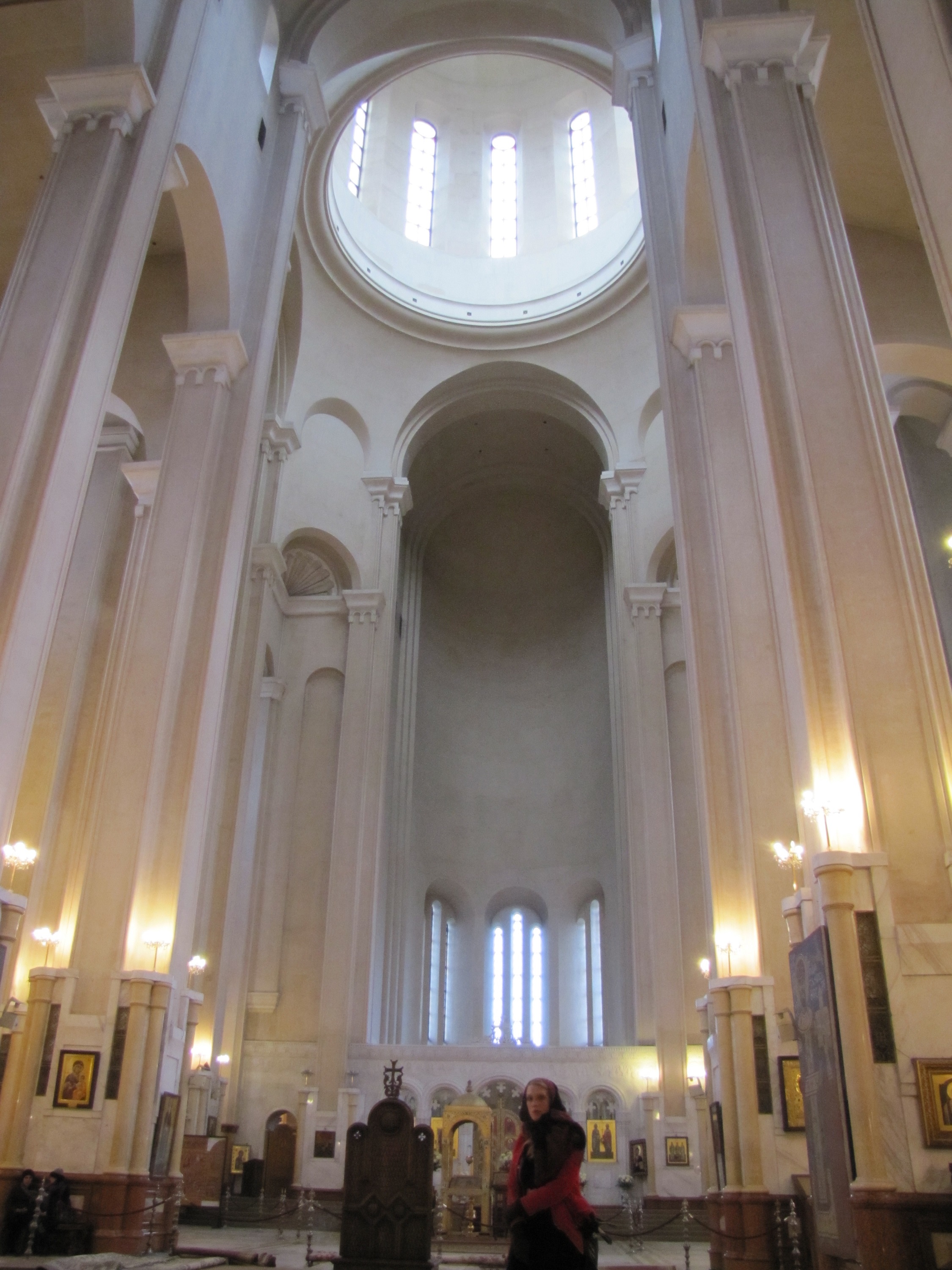
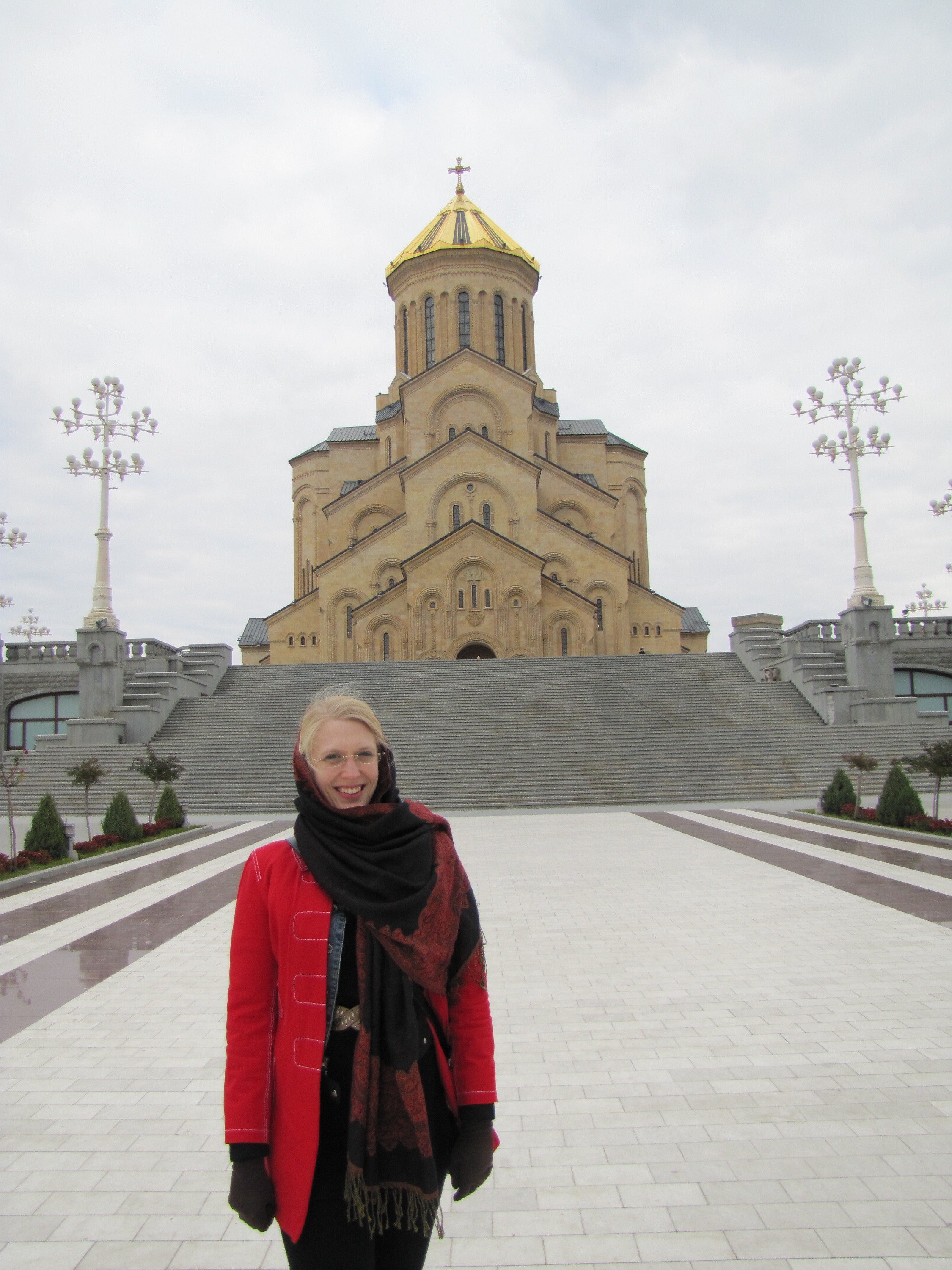
In every single church we visited, we found a similar scene. If you ever found Georgia’s streets empty, you could safely assume everyone was at church. In fact, there’s such a demand for space that in 2005, Tbilisi opened one of the largest Eastern Orthodox cathedrals in Christendom. It’s grand and beautiful, but its interior walls are still bare. They’ve started a collection to pay for a brand-new set of frescoes.

Tbilisi's newest cathedral is fundraising for frescoes.
Tbilisi’s newest cathedral is fundraising for frescoes.

Many people try to explain away this spiritual revival: Pent-up religious fervor being released after years of Soviet rule. A show of Christian religious strength in an Islamic world. An exhibition of national pride. They may be right. But above all else, what I saw was a deep and real love of God.

Georgia: Europe’s Ultimate Back Door


While most Americans refer to Central Europe (including the Czech Republic, Poland, Hungary, and Croatia) as “Eastern Europe,” the countries deeper into the former Soviet Union are the
real Eastern Europe. And lately, I’ve heard lots of rumbling that destinations like Ukraine, Armenia, and Russia are offering very rewarding travel experiences.

Ashley Sytsma, my publicist, is in Georgia on a mission to learn about its nascent wine industry for her family’s wine business. As I know nothing about this corner of Europe, I invited her to guest-host my blog for a week.

So, let’s all go to Georgia — the one over by Russia. Take it away, Ashley!

A while back, my husband asked me if I wanted to go with him to Tbilisi, Georgia to buy wine for our family business. Despite not knowing a thing about the country, I said, “Why not?” Knowing what I do now, my only regret is that I hadn’t visited Georgia sooner.

After a jolly nine-hour layover of beer-drinking in Munich, we flew east for four hours, landing bleary-eyed (and slightly hung over) at 3 a.m. in a bitterly cold and silently sleeping Tbilisi. Driving to our hotel, we quietly murmured in awe, “Where the heck are we? This is wild…”

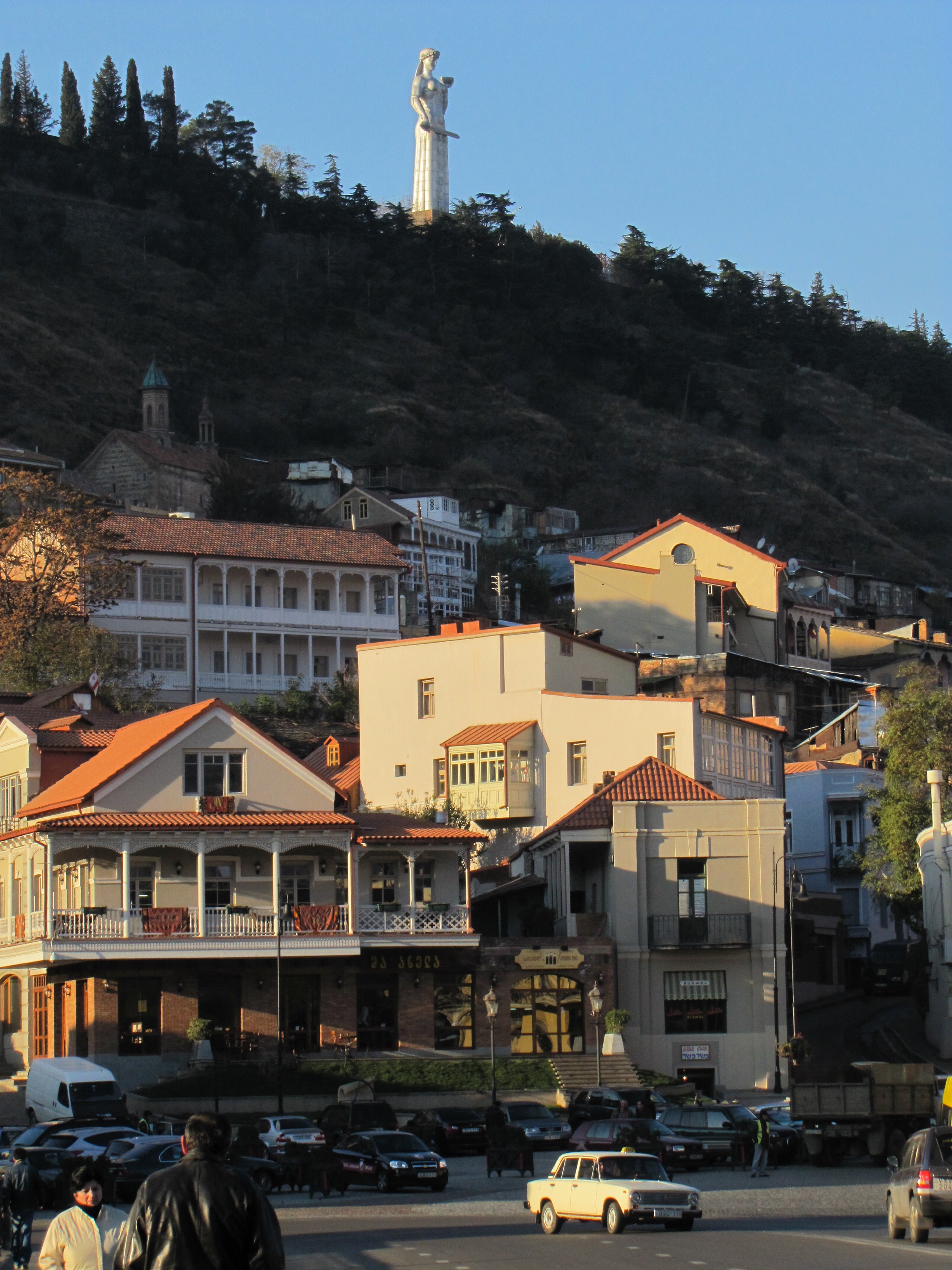
Colossal Soviet-built concrete apartment towers lined the George W. Bush highway (named after the first US president to visit independent Georgia). Orthodox cathedrals were illuminated with pink, blue, and yellow lights. Ornately carved wooden balconies (which the city is famous for) sagged on their building’s crumbling foundations. On one of Tbilisi’s many hills sat a television tower that looked like something from The Jetsons and glittered nonstop like the Eiffel Tower. On another hill stood a piercingly white 70-foot statue: Mother Georgia forlornly watching over her sleeping city, a bowl of wine in one hand for her guests and a sword in the other for her enemies.

Mother Georgia overlooking her city with a bowl of wine for her guests and a sword for her enemies.

Rick likes to discover Back Doors — special places where we travelers have our mental and spiritual furniture rearranged, and where we learn that other parts of the world consider different truths self-evident and God-given. During that ride from the airport, I knew we were about to explore the ultimate European Back Door.

By noon, we were hiking yet another hill to Tbilisi’s ancient Narikala Fortress, which is known for its spectacular city views.  Ascending the hill is like climbing up through time, as the fortress’ outer wall is a layered patchwork of different stones and building styles. In many ways, this fortress tells the history of the entire nation. Georgia sits at the center of a very profitable crossroads. Its strategic location and lush natural resources have (to the war-weary Georgians’ dismay) made it a target for countless invasions. The Romans, Persians, Ottomans, Arabs, Russians and even Mongols have all played parts in Georgia’s tumultuous history. With each invasion, the fortress was bombed. With each new victor, the walls were rebuilt on top of the destruction — the oldest layer being from the fourth century A.D., the newest being the fortress’ crown jewel: a small Orthodox church that opened only a few years ago.

As we caught our breath at the top, we gazed out over the magnificently beautiful city, marveling at the fact that our only company was a sleeping dog, the resident monk’s beehive, and an elderly Georgian man doing his daily exercises. As we listened to the cold wind whistle through the ancient rocks and trees, we giggled at our good fortune at having this place to ourselves.

For such a stunning place, where were all the tourists?

Join me as I travel in Georgia.