A Holiday Contest: Tell me your favorite global Christmas story

For the next couple weeks my public radio show (and podcast) Travel with Rick Steves will celebrate holiday traditions from around the world. Here is a short clip that explores the many different ways to say “Merry Christmas!” as a Scot.

To get all the more into the holiday spirit, I’d like to host a contest. Record a short audio file (mp3 preferably, 2 mins or less) on the theme, “A Global Holiday Season”.  Tell a funny Christmas abroad story. Sing your favorite European carol. Enlighten us on a unique holiday tradition you’ve integrated into your own family’s celebration. Be creative!

Email the mp3 file to my publicist (media@ricksteves.com) by midnight on Monday the 19th, and I’ll choose my favorite three. The winners will get their story posted on my Facebook page, an autographed Rick Steves book of their choice, and the chance of their entry being aired on my Christmas 2012 radio show.

Good luck and Happy Holidays!

If you can’t see the video below, watch it on YouTube.

Something very new: A Christmas eBook with video.

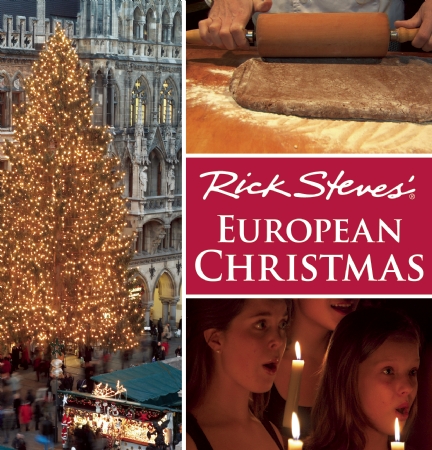
I just had an amazing experience “paging” through my European Christmas book in its new digital format that actually has photos that come to life as videos. To give your iPad, iPhone, Nook color eReader or Nook tablet a little Christmas cheer, our publisher has just turned our European Christmas book into an eBook with video.

If you’d like to give our new eBook a whirl, visit Apple iBookstore or BarnesandNoble.com. It’s available at the door-buster price of only $2.99. While this all seems so innovative and futuristic today, in a few years, it will be the new standard.

Our Travelers Raise $64,700 for Bread. Thanks!

Last week we issued a challenge and got a great response. Thanks so much to the 550 travelers who responded to our Christmas fund raiser for Bread for the World. Collectively we raised over $64,000 to help power Bread’s work in explaining to our Congress the needs of our nation’s poorest, homeless, and hungry people. We all want to get our fiscal house in order. And Bread has been very effective in its advocacy work encouraging our government not to balance our budget by cutting vital services to our nation’s most needy.

As part of my personal challenge, I promised to thank those contributing $100 to BFTW with a special Christmas gift (of our European Christmas book, DVD, and CD).  We mailed out 550 thank you packages today so you all should be getting it in a few days. I’d love to have our initiative reach $70,000 for Bread for the World.

There’s still time to join us.  If you’d like to help, donate by noon on December 16.  I’ll pop the three gifts in the mail to you within 24 hours of your donation and you’ll still get it before Christmas. Watch this video to learn more about the gift, and donate directly to BFTW to join us in this important project.

Thanks again and Merry Christmas.

Rick

Georgia: You Stole Our Hearts

While this list is by no means exhaustive, this slideshow highlights why Georgia fascinated me. I didn’t expect to fall in love with this country — it was just going to be another wine trip. But I left a part of my heart in Georgia. I look forward to the day when I’ll return and rejoin it again.

1. Wandering Tbilisi’s Old Town

IMG_6154

Decay becomes beautiful in this charming Tbilisi neighborhood. Abandoned churches and crumbling foundations blend handsomely with ornately carved balconies, grape vines and a buzz of life. We spent hours wandering its narrow streets, with only schoolchildren, busy moms and lazy cats as our company.

2. Getting Swept Up in Georgian Religious Traditions

Smaller test
I was honored to sit next to the wife of Israel’s ambassador to Georgia at our final dinner. She described the feeling of stepping inside one of Georgia’s many Eastern Orthodox Churches as “pure love, open to any human being no matter their religion.” I couldn’t describe it better.

3. Soviet Kitsch

Smaller test
Georgia’s Soviet past is hard to miss. From the ostentatious Stalin Museum in his hometown of Gori, to deteriorating USSR-built monuments, to wartime memorabilia sold at outdoor antique markets, Soviet kitsch is everywhere. Most Georgians seem to ignore it or roll their eyes (who would want to relive such a dark time?), but a very small minority still pines for the Red old days.

4. Driving Deep Into the Caucuses Mountains

Smaller test
Built by WWII German prisoners of war, the only road leading from Tbilisi to the Russian border weaves through steep, snow-covered peaks and tiny, remote villages. The awe-inspiring views had me shouting, “Praise be to God! And praise be to Georgia!” Our guide (and now friend), Levan, thought that was pretty funny. If you plan to go to Georgia, I couldn’t recommend a better guide than Levan Ergemlidze (levan.ergemlidze@yahoo.com). He’s warm, knowledgeable and one heck of a “tamada”.

5. Tsminda Sameba Church in Stepantsminda

Smaller test
To reach this remote church, you either need to hike a very steep mountain or hire a very talented driver with a four-wheel-drive car. Three devout and humble monks welcome their few daily visitors. Snow flurries from neighboring hills whip through the air. There are no sounds except for the howling wind. Tsminda Sameda Church is truly as close to heaven as you can get while still being on the ground.

6. The Food

Smaller test
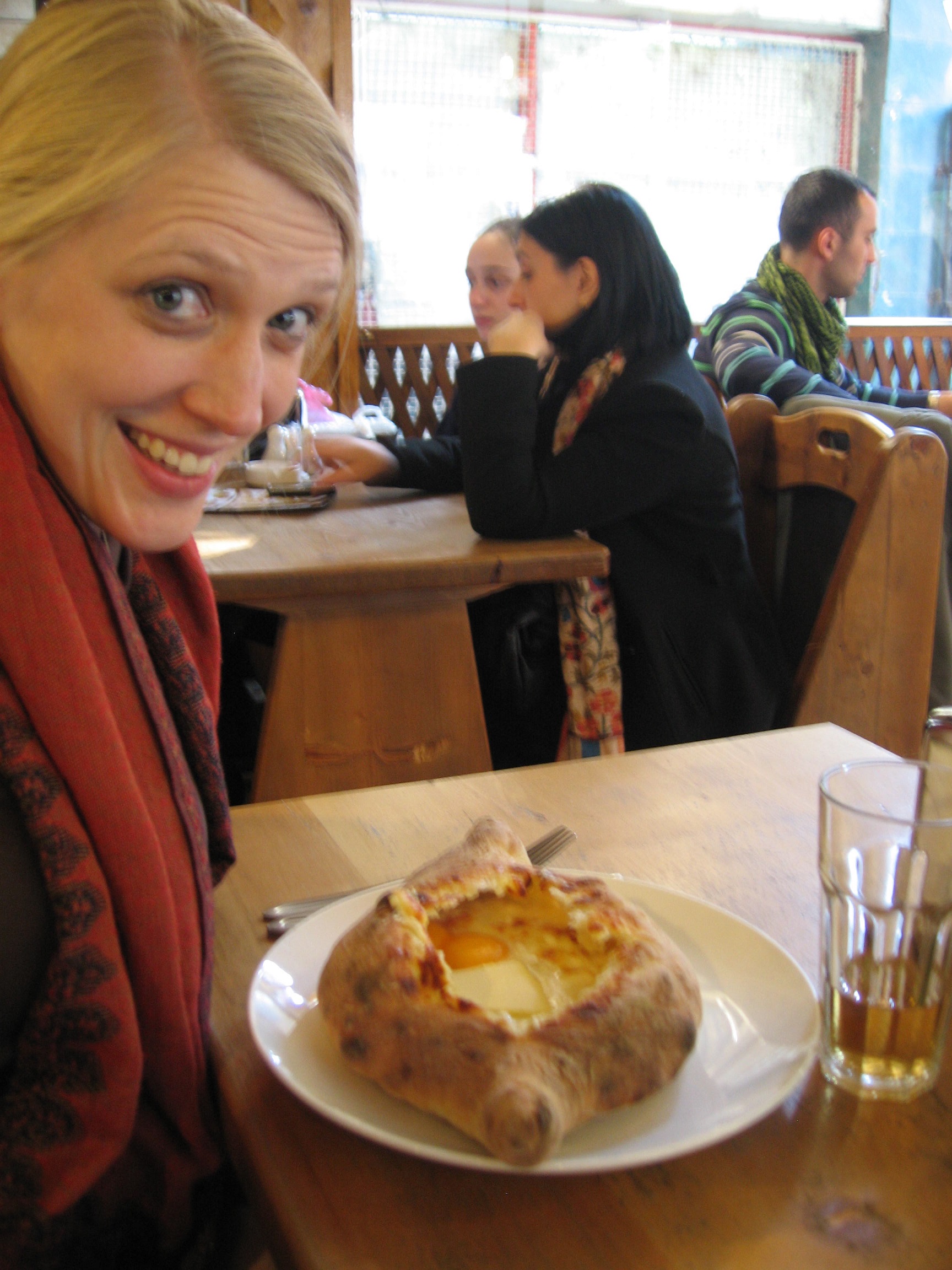
You can easily gain 10 pounds on a trip to Georgia (I speak from experience). And it’s worth every single calorie. Steamed dumplings that rival those in Hong Kong. Wood-fired breads so crispy and chewy, the Italians could learn a few tips. (Pictured above: Imagine an open-faced calzone filled with bubbling cheese and cream, topped with two raw eggs and a slab of butter. It was decadence on a plate.) Walnuts ground to a paste and wrapped in eggplant. Savory red beans, lamb kebabs, pickled caper flowers, chicken strewed in tomatoes and herbs…I could go on and on.

7. The Ancient Wine Culture

Smaller test
I grew to appreciate Georgian wine, and I grew to love their long wine tradition. While visiting a cellar with a collection of over 64,000 bottles, I found my birth year! With grape vines growing in each and every front yard, wine is an integral part of Georgian culture and life — and a delightful part of any trip here.

8. The People

Smaller test
Georgians can seem stern at first. No one smiles on the street, and shop workers tend to ignore rather than help you. However, give them two minutes (or two seconds, if drinking is involved) to get to know you, and you’ll have friends for life. They’re hilarious, sarcastic and tremendously warm people. Your trip to Georgia is not complete without getting to know the locals. Go out of your way to make a connection.

Smaller test
Chronicling my Georgian adventure on Rick’s blog has been a thrill. Thank you for reading it. And thank you, Rick, for entrusting me with your beloved blog for a week. Cheers!

Drinking Georgian Wine in an Ex-Soviet Bomb Shelter with the Chinese


Ashley Sytsma, Rick’s publicist, is a guest writer this week. She’s reporting on her travels to Georgia (the one over by Russia).

Knowing that we went to Georgia for our wine business, friends inevitably ask us, “So, how was the wine?” My response: “Unlike anything I’ve ever tasted before.”

Georgia lays claim to having the world’s oldest wine culture. At one famous site archeologists found residue over 8,000 years old. Now Georgians proudly boast that they’re on their 8,000th vintage. As a serious student of wine, I was eager to learn more.

My husband and I were invited to Georgia by the government on a wine trade delegation. These delegations — no matter the country — are often unruly, but this one was particularly so. Out of the 125 members, 80 percent were Chinese. They were a jolly lot that drank…a lot. Our two official dinners ended with very drunken businessmen singing (in Chinese) Scottish songs like “Auld Lang Syne” and “Loch Lomond.” Suffice it to say, they were fun parties.

Unlike the deadly serious ones I’ve attended in Italy and Argentina, our delegation’s organized wine-tastings were as rowdy and memorable as the dinners. The first took place in a four-mile-long tunnel the Soviets built as a bomb shelter. After being abandoned in the early 1990s, it was rediscovered by a local winemaker — who rightly thought it would make the perfect wine cellar and a unique place to hold events.

After a two-hour drive through miles of snow-covered vineyards, 125 of us professional wine-tasters eagerly dismounted our tour buses at the mouth of this large, dark tunnel. It was well below freezing outside, but with every step we took into this ex-bomb shelter, the warmer it got. By the time we hit the first rack of wine, about a half-mile into the heart of the mountain, it was a “warm” 50-55 degrees. Perfect cellar temperature!

As our group approached the tasting table, it became clear that our hosts weren’t prepared for a group of our size. Their small staff and one tasting station were quickly engulfed. We Americans and Europeans (who are less comfortable in crowds than our Chinese colleagues) hung back and observed the frenzy. After the group thinned out, we stepped up and enjoyed a thorough (and less rushed) education.

Smaller test

The exhausted winemaker poured two wines side-by-side. I picked up the first, swirled, sniffed, and took my first taste. My husband and I glanced at each other. Since we taste together so frequently, we’ve created a secret language of looks and body language to communicate our general impressions. Once I saw my husband sniff and take only one tiny sip, I knew we thought the same: The wine had gone bad. It was brown and tasted strongly of walnuts and cooked fruit — sure signs of oxidation.

The next wine we sampled was much different. From the closing of his eyes and the dipping of his nose deeper into the glass, I knew my husband and I were both very impressed. Bright, crisp, and full of white fruit and melon flavors, it was a stellar wine.

“How do you compare these first two wines?” the winemaker asked with a sly smile.

Trying not to hurt his feelings, we responded, coyly, “We prefer the second. It was the far superior wine.”

“Ha! I thought you’d say as much. They are, in fact, the exact same wines.”

What?

Traditional Georgian wines — including the one we didn’t like — do not use “modern” winemaking techniques (think stainless steel tanks and rows of oak barrels). Instead, after grapes are picked and crushed, everything (seeds and skins included) are placed in clay pots that are buried underground with only a small opening sticking out. The wine ferments in the open. Once fermentation stops, the clay pot is plugged and covered with dirt. It stays there, skins and all (even for white wines), until the winemaker deems it ready to bottle.

Smaller test

The two wines came from the same exact grapes, grown on the same plot of land, and made by the same winemaker. The only difference was Georgian vs. “modern” winemaking techniques. We learned that, while it seemed “bad” to our palates, the traditional-style wine is prized not only in Georgia, but also all throughout Russian and other formerly Soviet countries.

After many more tastings that week, I too grew to respect traditional-style Georgian wine. When made to a high standard, they’re rich, warming, light on the tongue and have a light sourness that you begin to crave once your palate grows accustomed to it. For those beer nuts out there, Georgian wine is to “modern” wine what Belgian Lambic is to lager. I wouldn’t want a glass of traditional Georgian wine every night, but it is certainly worth trying if you love the exotic and different.

A side story too funny not to tell: The next day, all 125 of us visited a traditional Georgian winery. Anxious to get the best camera angle possible, one of our Chinese colleagues wasn’t watching his step…and fell into one of the open clay pots. After seeing he wasn’t hurt, everyone laughed so hard the winery walls shook. As one British friend described, “It was absolutely brilliant!”

In all, I’m very excited to see what will come out of Georgia once they start experimenting more with blending “modern” methods with their unique style. With an 8,000-year-old tradition, this country is well-positioned to make some of the finest wine in Europe.