Day 4: Rocky Mountain Lullaby

I’m just too busy in Colorado to write a blog entry today. Napping here on a rocky crag at Colorado National Monument — surrounded by a vast canyon and red rocks, and winded from breathtaking drives over 10,000-foot passes — I’ve got piles of notes but no time to write. After my Rocky Mountain nap, we’re heading to Colorado Springs. Driving by Vail and Breckenridge on such a gorgeous day makes me wonder “What was I thinking?” not to schedule a day for skiing. Anyway, forgive my laziness. Tomorrow I’ll share the full scoop.

If you can’t see the video below, watch it on YouTube.

Day 3: Evangelical Librarians in Salt Lake City

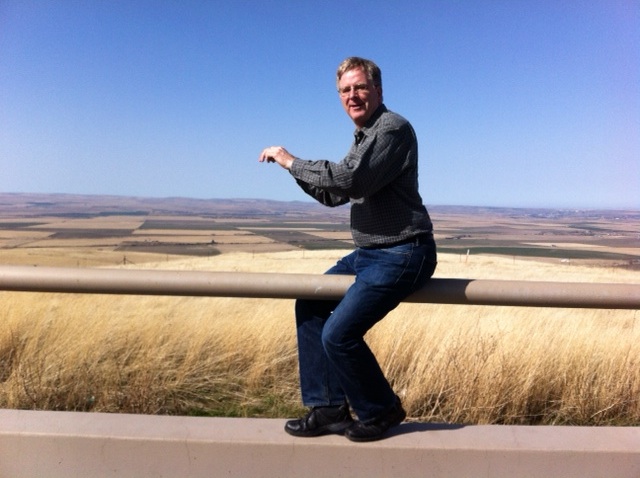
Heading out of Boise, GPS set on Salt Lake City, within a few minutes we were in a vast plain — with flattop prairie bluffs fringed by modern windmills and mighty snowcapped Rockies in the distance. The drama of this landscape must have been even more stunning to those first pioneers.

I’m liking this daily routine. Each day, I meet Keith at the car at about 8:30. We drive an hour while I rip today’s page out of our schedule. After a little writing (these blog entries take time), we stop for breakfast in a small, characteristic town. I order the special — I had “Farmer Brown’s Scramble” yesterday. Rolling along, stopping here and there at small pioneer museums and dramatic viewpoints, I can understand why so many of my friends and relatives enjoy extended USA road trips. There’s no end of fun things to see and do.

Approaching Salt Lake City, we looked down upon the majestic setting and could imagine how the Mormon pioneers felt they’d found their promised land. The city — with its original grid street plan surviving from the 1850s, after Brigham Young declared, “This is the place” — sits at the head of a sprawling plain cradled by two mountain ranges. The twin ranges, reaching out to surround the Utah State Capitol and an ensemble of stately church buildings, remind me of a vast geological answer to the Bernini colonnades that frame St. Peter’s Square at the Vatican. The snow-dusted mountains, like that colonnade in Rome, can easily be seen as representing the outstretched arms of the Church embracing its people.

Occupying a ten-acre block at the center of the grid is Temple Square, the headquarters for the Church of Jesus Christ of Latter-day Saints (a.k.a. LDS Church)…more commonly known as the Mormon Church. While non-Mormons can’t enter the towering Salt Lake Temple itself, they are severely welcome to visit the rest of the complex. Pairs of volunteers snap up anyone who enters, eager to give a delightful tour. Sister Peña from Mexico and Sister Smith from Tahiti showed us around. (One of the largest ethnic groups in Salt Lake City is Polynesians — a result of the Mormon mission focus on that part of the world.) The grounds, gardens, and architecture — like the people working there — were pristine, pure, and angelic. Even if your soul is happy where it’s at, visiting here is a fascinating peek at religious marketing.

An aluminum dome marks the Tabernacle, where the famous Mormon choir practices on Thursday evenings and performs on Sunday mornings (both free and open to the public). While the building was designed and built a century and a half ago, before the science of architectural acoustics, it would be tough to design a building with better acoustics today. Back then, this elegant hall facilitated meetings and preaching to large crowds without amplification. Today, with one of the world’s great pipe organs, it’s the setting for choral performances enjoyed by vast TV audiences all over the country.

Throughout our visit, I was struck by how the Mormon focus on the family would impress even James Dobson. Because Mormons believe the dead can be baptized and families live eternally together, there’s a big interest in genealogy. Across from Temple Square, a world-renowned center for tracing family roots welcomes the public. (Even Chinese genealogists come here to research family trees reaching beyond the demographic chaos caused by Mao’s Cultural Revolution.)

You can’t miss the “Mormon Vatican” aspect of Salt Lake City. For instance, if you know where to look, you can see “polygamy-influenced architecture” from a century ago — lanes with rows of similar houses (duplexes and four-plexes) flanking one bigger, grand mansion for the male head of the extended family.

Still, it’s important to realize that the town is not completely dominated by the Mormon Church. In fact, while the rest of the state is relatively conservative and red, Salt Lake City is relatively liberal and blue. (Provo, just an hour’s drive away, is considered the most conservative city with over 100,000 people in the entire USA.) The Salt Lake City and County Building (which resembles a Neo-Romanesque castle) and the Utah State Capitol seem to stand like two behemoths facing each other in a political boxing arena.

Even non-Mormons appreciate how LDS Church investment is clearly injecting vigor into the urban scene. “Downtown Rising” is a big urban-renewal vision with generous Mormon funding, which strives to make Salt Lake City more sustainable and a better place to call home. The mayor — who’s quite green, a biking enthusiast, and not Mormon — is spearheading projects to make the city more pedestrian- and bike-friendly. And there’s an exploratory committee planning to apply to host the 2022 Olympic Games. The infrastructure from the 2002 games (which were considered a boon for the city) is still in place… and, regardless of what happens in 2012, Mitt Romney should have some time on his hands a decade from now to help out.

Olympics or no, skiing is huge here. And while Colorado has the chic ski-resort cachet, Utahans claim their ski resorts are cheaper, better, and much closer to the big city — just 20 minutes away. (With this year being so mild, they had to make millions of gallons of snow.)

While Temple Square has the most visitors in town, Salt Lake City’s amazing library is a close second, with about 4 million visitors a year. It’s a striking modern building (by Moshe Safdie, the same architect as the Vancouver Library) designed with the Information Age in mind. As our society evolves beyond traditional print, modern librarians remind us that librarianship is more than just shelving books. It’s fundamentally facilitating the exchange of ideas and information: courses, books, Internet access, and hosting itinerant travel writers with stories to tell. Libraries help a society of haves and have-nots bridge the digital divide, providing free Internet and computer access to people who couldn’t otherwise afford it. The Salt Lake City Public Library is thriving with users and is generously supported by the community, with 97% of its revenue raised through local taxes.

After a reception with important supporters of the library, I gave my travel skills talk. The small (440-seat) but gorgeous auditorium was packed, and they had an overflow room with 150 people watching the talk on a screen. Picking up on the enthusiasm of this crowd of travelers (nearly all of whom had been to Europe), I talked and talked. During the Q&A session kicking off the last half, I got into a fun groove and actually forgot for a while that I still had to give “part two” of my formal lecture.  As I’m always reminded by hosts in Salt Lake City before a talk, while the state has a reputation for being quite conservative, people here in Salt Lake City are as cosmopolitan and progressive as cities elsewhere — so I don’t need to worry about being on particularly “good behavior.” One difference I did notice (which I attribute to the Mormon culture) was the number of charming families and attentive, well-behaved children in attendance.

Three hours after I started, I did my “Thanks and happy travels” and turned in early, feeling good about this lecture-a-night-for-twenty-nights gig I’ve given myself. I’m looking forward to Colorado tomorrow.

If you can’t see the video below, watch it on YouTube.

Day 2: Eastern Washington to Boise—Freakishly Friendly

Two days into this adventure, I’m already immersed in what promises to be a lifelong travel treasure. The “Inland Empire” of Eastern Washington and Idaho is corralled by mountains — the Cascades in the west, and the Rockies in the east. Monster mountains sprawl on the horizon as Highway 84 follows lonely train tracks across idyllic Western scenes. A glint of sun races along the shining brown rail, seeming to lead us — like the fake bunny at a greyhound track — through a brown wasteland across the northeast corner of Oregon and into the mountains of Idaho.

The color is thought-provoking. I sense that it has been, and will again be, green. But now, at the end of winter, plant life is the color of dirt and shows little promise of life. A dusty-beige 20th-century trailer park seems populated by ancestors of 19th-century pioneers who pulled their wagons into a circle. The only color is the flag — supersized for the setting. And, amid the browns and greys, that red, white, and blue really pops. Later, a giant pussy willow-gray cement factory provides a similar dreary visual context for the red, white, and blue of its big and furiously flying flag.  Immersed here, in what to this big-city guy from the coast feels like the heart of this great land, you become part of its grandness — engulfed in and embraced by the vastness of it all. The flag invigorates the scene. As it provides color to the setting, we provide life. Here, even more than on the coast, the flag represents you. You appreciate it.

Crossing the Snake River, we enter Idaho and stop at the tourist welcome center. A monument reminds me I’m driving the “Blue Star Memorial Highway: Dedicated to the Armed Forces who have defended America.” In the men’s room, a religious flier, propped on the sink as if waiting for me, asks the important question: “Where will you spend eternity?”

The road, cleaned by the local Mennonite Youth Group, is really clean, and we get to Boise before we know it. As I hoped to throughout this road trip, my host for the evening’s event (tonight it’s Megan from Idaho Public Television) picks me up at the hotel for a little personal tour of the town.

Boise is famously livable and, as a friend of Megan noted after settling here, “freakishly friendly.” Locals say “boy-see,” giving the town a touch of French and recalling the origin of the name, when French pioneers marveled at les bois — the woods. (You wouldn’t be particularly impressed by the trees today…but they were likely hallucinating on rotten meat.)

You can’t help but think Boise is a great place to raise a family. There are so many active things to do here, from skiing to river rafting. The city has a strong Mormon influence. In fact, locals nickname the place “Salt Lake City North.” A new law prohibits taking alcohol on the river, so anyone envisioning a floating raft party needs to sneak their booze in 7-Up bottles.

My afternoon in Boise was a delight. We didn’t know whether the people lounging on the stately steps under the capitol building dome were occupiers or just soaking up some rays. I enjoyed a peek at the Boise State stadium, with its famous blue turf. Idyllic as a Seurat painting, Boise’s parks were filled with scenes of children hula-hooping and families tossing around the football. While the edge of town — like any town these days — has fallen victim to “the saming of America,” old Boise comes with a parade of classic old weather-beaten signs advertising funky diners, hamburger joints, and motels bragging that rooms come with TVs. Low-key street corners with dueling cafés had front porches filled with Idahoans enjoying a warm afternoon — with a low-in-the-sky sun that seemed to promise spring was on its way. Here on the western edge of the time zone, there’s later light, which is much savored.

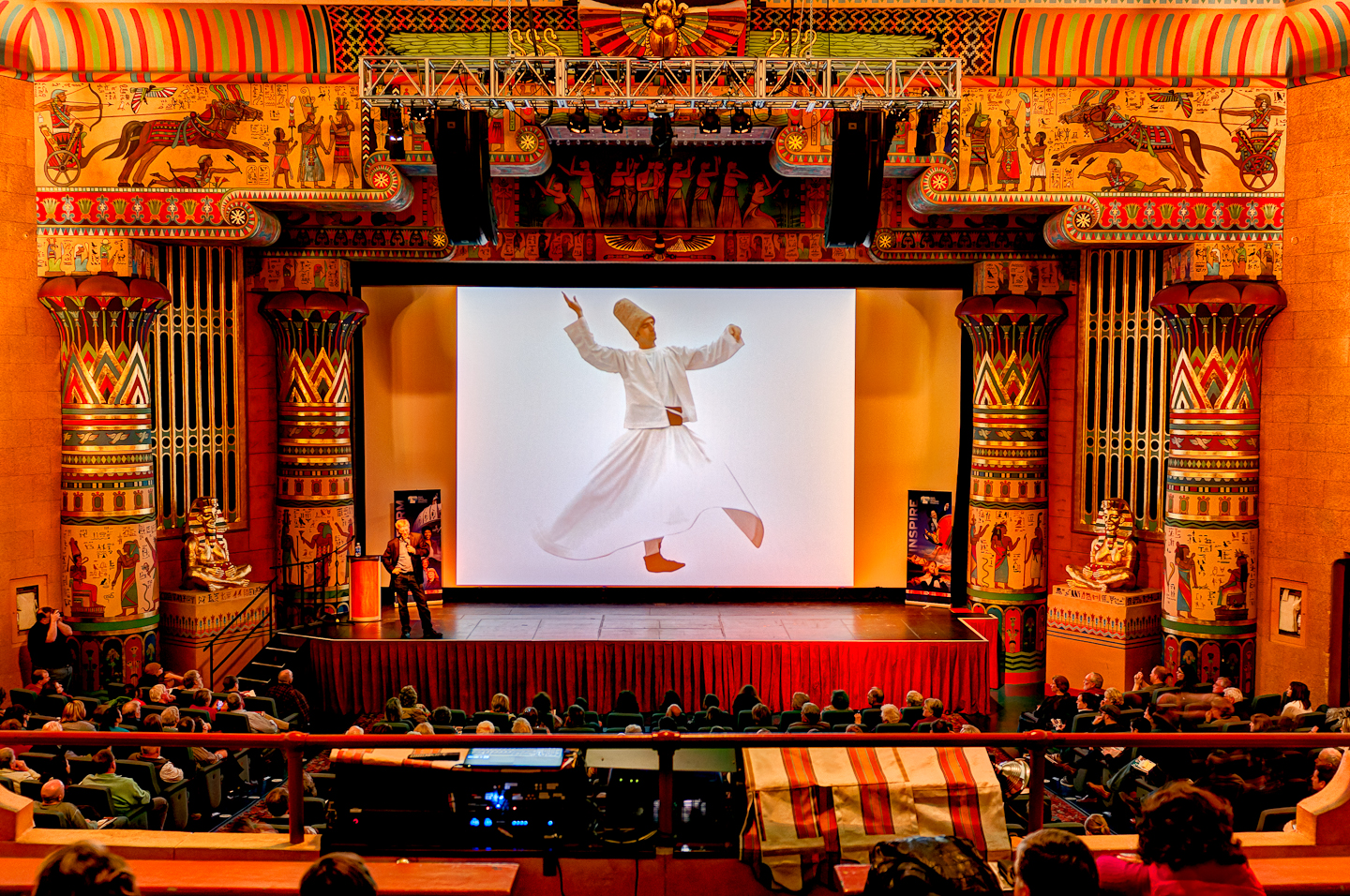
Then it was time to work. After hosting a pledge event on Idaho Public Television, I was taken to the iconic Egyptian Theater, where 700 people gathered. The station charged more than I thought was wise for admission ($30 to $50 each), but they called it right — they filled the place with supporters who understand the value of public television.

Tonight’s talk was the straight “Travel as a Political Act” talk, which I’m excited to bring into our country’s heartland. Standing on a venerable stage in a theater filled with leading citizens of a town like Boise and talking about empire (96% of humanity looks at America and sees one), terrorism (overrated), military spending (we, 4% of the planet, spend as much on our military as everyone else in the world combined), and so on, is exhilarating. From the stage I watch, measure, and feel the response. With stern, questioning faces looking at me as I weave my case, it’s a fascinating and thrilling challenge. As long as I acknowledge that Europeans are thankful for the valor and heroism of America when we freed them from the Nazi terror and stood up to and ultimately defeated the USSR, and I assert that I’d never want to run my business in Europe and that I’m thankful to be an entrepreneur in the USA, people seem happy to hear the European perspective I share. When approached reasonably and respectfully, people’s long-held perceptions are open to the crowbar of travel experience. I pulled out all the stops — talking for about two hours. Then, after a 15-minute break (to let Barnes & Noble sell a few books), I welcomed people to sit back down for an extended Q&A session and enjoyed half an hour of back-and-forth. I went home thinking, “Wow…these people are freakishly friendly.”

Photo Credit: Tim Tower

Day 1: Seattle to Richland—Maple Bars and Tumbleweeds

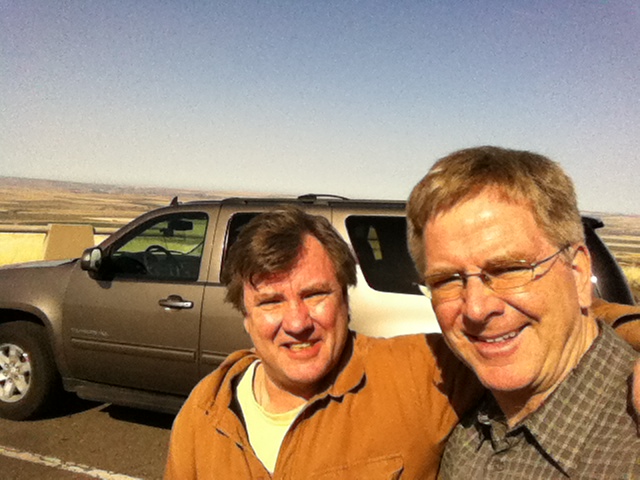
It’s odd to be packing for a 20-day “business road trip.” I’m taking way too much…but who cares? Behind the wheel of a big, safe, American car (a GMC Yukon), my driver Keith pulls into my driveway Saturday morning. Keith, an ace tour salesperson and tour guide from my office, will be my roadie and represent ETBD at each event along the way, handing out our newsletter and so on.
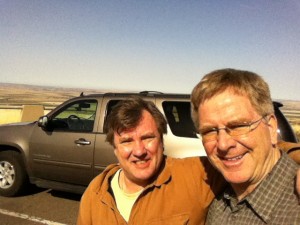
At precisely 9:11 a.m., we set the odometer to zero and pull out. Taking a left at the Space Needle, we head southeast—direction Florida. Within an hour, we are in the cloud-shrouded, snow-blanketed Cascade Mountains.

Popping out of the clouds on the other side reminds me of my childhood—long before I ever fingered Europe on a globe. Each weekend my parents would pick up my sisters and me at school on Friday afternoon, and we’d head out. In sunny weather we headed north to go boating in the San Juan Islands. In rainy weather it was “east of the mountains.” In our family “east of the mountains” was like a cry for liberty. Regardless of the weather in rainy Seattle, “east of the mountains” promised brilliant sunshine and lots of camping and boating fun.

Busting out of the mountains, I’m greeted by Washington’s “Inland Empire” and the sleepy town of Cle Elum. Our first stop: the century-old Cle Elum Bakery with minutes-old treats just out of its oven. I order a maple bar—the choice of my childhood. With that first bite it occurs to me that I haven’t tasted a maple bar for 30 years. What’s with that?! Was I trying to establish I’m not a child any more? Maple bars…I’m back. Keith gets an apple fritter, and we both promise—with great insincerity—to be sure to exercise during our road trip. Chatting with locals and enjoying historic photos, I endure a coffee that made me ache for Starbucks—but I’m trying to stick to local, independent, small businesses.

Two hours into our 20-day road trip, I look down on the Yakima River determinedly cutting its S-shaped, mini-Grand Canyon into the foothills of the Cascades, and I find myself thinking, “Why don’t I get out more?!” This is absolutely great. I want to go river rafting. Getting off the highway, we pass through small towns with log cabins housing their chambers of commerce.  
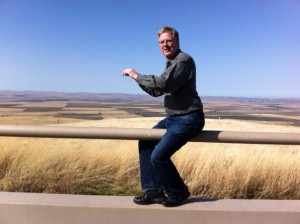
As the mountains pass, the sky gets big. How big is your sky? In Switzerland, valley people enjoy only half the sky Inland-Empire people do. The cabin of our Yukon SUV is huge too…a different world from my little Acura. If you don’t get out, you don’t know the options.

I love our car. With my office set up in the back seat, I have all the latest gear to charge batteries and be online as we drive. Since I’ve got my noise-reduction headphones and a friendly cooler at my side, time will pass wonderfully to the clicking sounds of my laptop keyboard.

I’ve got a little library filling a plastic bin: Jamie Jensen’s “Road Trip USA” published by Avalon (my publisher), “1000 Places to See Before You Die in the USA,” “Road Food” by Jane and Michael Stern (who I’ve enjoyed interviewing several times on my radio show) and their other book (which complements nicely the “before you die” book) “500 Things to Eat Before It’s Too Late.”

While Keith runs our GPS, I’m learning that Google on the road is a real blessing. For instance, coming into Yakima, I learn that Gary Puckett—a singer I hated in the 1970s—was a famous resident, and the neighboring town is what gave him a name for his horrible band: The Union Gap. With all the road-trip distractions, it’s becoming clear: I won’t be getting as much writing done as I hoped. 
The city of Ellensburg is marked by towering piles of wooden boxes—apple crates. The capital of apple-orchard country, it has enough crates to build a rampart completely around the town. Surrounding the town, orchards of apple trees, naked and taking the winter off, are trimmed like some vast topiary garden—each tree just the right height…crouching and poised as if awaiting the starting gun of spring to begin producing fruit.

Heading out of Ellensburg, a tumbleweed tumbles across the highway as my phone rings. My girlfriend, Trish, calls from Anchorage in tears. My sister Jan had just pranced happily by her, mushing 14 frisky dogs as the Iditarod race had begun. As years of training and hard work were coming to a head, Jan was setting off to reach her dream. On the very day I was setting off for sunny Florida in a big comfy SUV, my little sister was heading through the wilderness for Nome. And even to witness the race’s start had enough punch to get anyone overcome with happy emotion. Trish is reporting on the action through Jan’s blog. Don’t miss it!

While Washington is two states on the Weather Channel, it’s also two states politically…divided by “the Cascade Curtain.” Like so many states (and our country in general) the urban “coast” tends to be more progressive, and the rugged, sparsely populated, agricultural interior tends to be more conservative.

For me, the fun challenge for this trip is to better understand the rural and interior perspective while thoughtfully sharing the world view my travels have given me. I’m kicking this 20-day, 20-city tour off with a stop in probably the most conservative corner of my state: the Tri-Cities. With the huge government investment to create a nuclear bomb during World War II and then to stoke our nuclear power industry, three sleepy towns called Richland, Pasco, and Kennewick grew into one urban zone with a quarter of a million people called the Tri-Cities.

Even thought the nuclear industry has shifted into the “what-to-do-with-contaminated-garbage” phase, the Tri Cities thrives to this day with government money and world-class scientists finding ways to safely deep-store lots of nuclear waste.  With its classic 1950s-era buses that once shuttled legions of workers to the Hanford nuclear site, “Wonder Years” lanes of government-funded efficiency housing, and a high school football team still called the Richland Bombers, the Tri-Cities has a kind of nuclear nostalgia. Meanwhile, lots of great minds and federal dollars still come together here with a new agenda: to develop technology to safely “vitrify” (turn into glass) nuclear waste. The vibe these days is that these great scientists and the heritage of the local industry will put the Tri-Cities on the map as a booming center for developing smart energy for the future.

After a quick visit to the tiny Northwest Public Television station for a local affairs show interview and to tape some promos, I try unsuccessfully to piece together an appealing dinner from the VIP Meet & Greet Buffet. Then, at 7 p.m., with 420 people packing the Red Lion Hotel’s ballroom room, I give my talk. Billed as my political talk, I couldn’t bear not to give my European travel talk too. So I tell people they’re getting a double-header: first the political talk, then, after a break, travel. By 10:30 p.m. I am in my hotel room upstairs marveling at how exciting this first day was and wondering how I’ll hold up with this intensity for the next 20. Tomorrow: Boise.

Tallahassee or Bust! Kicking Off My 20-Cities-in-20-Days “Road Trip USA” Adventure

Road Trip Logo“Tallahassee: It’s Florida with a southern accent.” “Tallahassee: It’s Georgia with a Florida zip code.” These lines came out as I was giving an interview to promote my March 22 talk in Tallahassee — one of 20 talks I’ll be giving in 20 different cities as I drive from Seattle to Florida starting tomorrow. And it’s quirky little insights like these that I’ll be sopping up with the greasy road food all along the way. Starting tomorrow, I’ll be sharing 5,700 miles of thrills, spills, gut bombs, and eurekas daily via my blog.

I’ve got three or four different talks I’ll be giving, depending on the event. I’ve asked my hosts to give me quick little tours of their towns each day after checking into my hotel. Two tour guides from our office will be my drivers, roadies, and lobby travel consultants: Keith will drive from Seattle to Omaha, where Matt relieves him for the drive from Omaha to Florida.

I’ll be set up in the back seat of my big, gas-guzzling American car with an Internet connection to stay in touch with my office, where Ashley Sytsma, my talented publicist who set up the tour, is manning our command center for this complicated journey.

If I’m passing through your town, I hope we’ll meet — sign up for a talk. And even if I’m not, I’d love to have your company in spirit through this blog.

Happy American travels!