Get Ready: 16 New TV Shows Are on the Way

Thanks to everyone who overwhelmed our shipping department and cleaned out much of our supplies of Civita Day Packs. We sold over 4,500 on our Facebook blowout. I’m enjoying the havoc these monthly Facebook specials create!

It’s a busy week here at ETBD. We just picked up my car – a GMC Yukon – which will be my home for the next 20 days as we set out Saturday morning on our Rick Steves’ Road Trip USA. I’m getting really primed to do a lot of travel writing along the way, and I’ll be posting daily, so I hope you can settle in and be my travel partner for the next three weeks as it’s Florida or bust! (BTW, there are still seats for many of my lectures along the way. You can book through our hosts on line.) Also, while you’re logged on, my sister is strapping the booties onto her team and getting ready to set off on her Iditarod race in Alaska this weekend. I’ll be avidly following her reports daily, as many of you will too, on our website.

I just finished a sit-down with Simon, our TV producer, and we finalized the descriptions and titles of all the programs we are producing for public television this year. I thought you might enjoy a sneak peek. Here’s what we’re working on now and what will be released nationally this fall:

TV Show Descriptions: Rick Steves’ Europe VII (for September 2012 release)
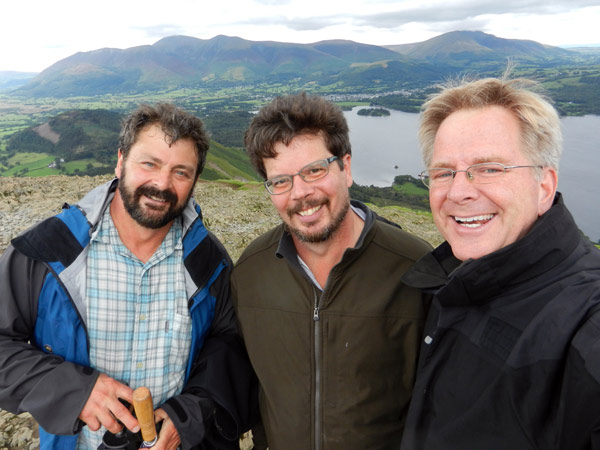
My TV crew at the Catbells in North England's Lake District

701 — Rome: Ancient Glory
Part one of three on the Eternal City, this episode resurrects the rubble and brings back to life the capital of the ancient world. Focusing on the grandeur of classical Rome, we marvel at the Colosseum, the Pantheon, and the empire’s exquisite art. Then we go offbeat by bicycle to see the Appian Way and marvels of Roman engineering.

702 — Rome: Baroque Brilliance
This second of three episodes on Rome reveals a city busy with life and bursting with Baroque. We ramble through the venerable heart of Rome, admire breathtaking Bernini statues, ponder sunbeams inside St. Peter’s Basilica at the Vatican, and mix and mingle with the Romans during an early-evening stroll. Following an exquisite Roman dinner, we join locals after dark, lacing together the Eternal City’s most romantic nightspots.

703 — Rome: Back-Street Riches
In this third of three episodes on the Eternal City, we explore this grand metropolis—so rich in art and culture—on a more intimate scale, delving into its back lanes and unheralded corners. Venturing through the crusty Trastevere district, visiting the historic Jewish Ghetto, and enjoying art treasures in a string of rarely visited churches, we uncover charms of hidden Rome that compete with its marquee sights.

704 — Florence: Heart of the Renaissance
Fifteenth-century Florence was the home of the Renaissance and the birthplace of our modern world. In this first of two episodes, we gaze into the self-assured eyes of Michelangelo’s David, enjoy Botticelli’s Birth of Venus, delve into the 3-D wonders of Ghiberti’s Gates of Paradise, appreciate Fra Angelico’s serene beauty, and climb the dome that kicked off the Renaissance. Then we cross the Arno to where Florentine artisans live, work, and eat…very well.

705 — Florentine Delights and Tuscan Side Trips
In this second of a two episodes on Florence, we enjoy more of the exquisite artistic treasures of the city that propelled Europe out of the Middle Ages. Then we side-trip to a couple of rival cities and cultural capitals in their own right, Pisa and Lucca, where we’ll marvel at a tipsy tower, circle a city on its ramparts, and enjoy some Puccini in his hometown.

706 — Paris: Regal and Intimate
In Paris, amidst all of its grandeur, the little joys of life are still embraced. In this first of two episodes on Paris, we cruise the Seine River, visit Napoleon’s tomb, and take in the Louvre. Then we feel the pulse of Paris—shopping in village-like neighborhoods, attending church in a grand pipe organ loft, and celebrating the mother of all revolutions with a big, patriotic Bastille Day bang.

707 — Paris: Embracing Life and Art
In this second of two episodes on Europe’s “City of Light,” we ride a unicorn into the Middle Ages at the Cluny Museum, take a midnight Paris joyride in a classic car, get an extremely close-up look at heavenly stained glass in Sainte-Chapelle, go on a tombstone pilgrimage at Père Lachaise Cemetery, and savor the Parisian café scene. Few cites are so confident in their expertise in good living—and as travelers, we get to share in that uniquely Parisian joie de vivre.

708 — London: Historic and Dynamic
In many-faceted London, we ponder royal tombs in Westminster Abbey, learn how to triple the calories of an English scone at teatime, discover treasures in the British Library, enjoy the vibrant evening scene in Soho, uncover Churchill’s secret WWII headquarters, join the 9-to-5 crowd in the new London, shop where the Queen shops, and straddle the Prime Meridian at Greenwich.

709 — North England’s Lake District and Durham
Hiking through the Cumbrian Lake District—England’s green and pristine mountain playground—we admire idyllic lakes, discover misty waterfalls, tour a slate mine, and conquer stony summits. And we’ll meet the locals—and their beloved dogs and sheep—everywhere. Then we play a little cricket, hike Hadrian’s Wall, and are dazzled by Durham’s Norman cathedral.

710 — Venice: City of Dreams
After sorting through the monuments of Venice’s powerful past, we trace its decline from Europe’s most powerful city to its most hedonistic one. We cruise the Grand Canal, luxuriate in a venerable café, and savor fresh fish canalside with Venetian friends. Becoming as anonymous as possible in this city of masks, we’ll be dazzled by masterpieces of the Venetian Renaissance and get intimate with the city of Casanova…on a gondola under the moonlight.

711 — Venice and its Lagoon
Venice, more than any other European city, has an endlessly seductive charm. For centuries, it was nicknamed La Serenissima, “The Most Serenely Beautiful One”—and for good reason. Along with sampling the sumptuous art treasures of Venice and exploring its back-street wonders, we cruise its lagoon, stopping in fiery Murano for glass, pastel Burano for lace, and murky Torcello for a sense of where Venice was born.

712, 713, 714 — European Travel Skills, Parts I, II & III (3 episodes)
These three episodes distill Rick Steves’ 30 years of travel experience into 90 minutes of practical advice on how to have a fun, affordable, and culturally broadening trip to Europe. Shot on location in Amsterdam, Germany’s Rhineland, Venice, Siena, the Italian Riviera, the Swiss Alps, Paris, and London, these episodes cover Rick’s favorite 3,000-mile European loop while providing viewers with essential travel skills. We cover tips on planning an itinerary, hurdling the language barrier, driving and catching the train, avoiding scams, eating well, sleeping smart, staying safe, and everything you need to enjoy the best possible experience.

One-Hour Special — Rick Steves’ Rome: Eternally Engaging (October, 2012)
Rome is, in many ways, the capital of our Western Civilization. In this hour-long special, Rick Steves resurrects the rubble while tracing the rise and fall of ancient Rome, celebrates the highlights of Bernini’s Baroque Rome, and makes a pilgrimage to the Vatican. Then, after delving into crusty neighborhoods where the character and energy of the Eternal City is most intimately felt, we join Rick for a Roman feast and an after-dark stroll lacing together the city’s romantic nightspots.

Rick Steves’ Europe: A Symphonic Journey (October, 2012)
Rick Steves teams up with the Cascade Symphony Orchestra and maestro Michael Miropolsky for an hour-long musical tour that starts in the USA, then touches down in seven different European countries. As your musical tour guide, Steves sets the context, then mixes evocative video images from each country with Romantic 19th-century anthems to celebrate how music stirs the patriotic soul of freedom lovers in every land. The musical itinerary for this symphonic journey: Grieg in Norway, Smetana in the Czech Republic, Strauss in Austria, Berlioz in France, Elgar in England, Wagner in Germany, and Verdi in Italy.

The Rome special is a 60-minute distillation of the three, new, half-hour episodes on Rome. Many of these programs will retire old shows we shot 10 years ago. And in the case of Rome, Florence, Venice, and Paris, we are replacing one show with two or two shows with three. In other words, we are covering our favorite destinations with much more depth – a luxury I am thoroughly enjoying. The shows promise to be the best we’ve ever produced. I can hardly wait for you to see them.

The Iditarod: My Sister, Jan Steves, Mushes with the Best Dog Racers in the World

Jan StevesBecause my parents imported pianos from Germany, our family traveled there when I was a kid. They took me — the eldest son — to Europe first. The next year, it was my younger sister Jan’s turn. But she opted to go to music camp instead. So I got to go to Europe for the second time in a row. I ended up going overseas every year since, and Jan, who had other passions, never did much international travel.

I never realized just how adventurous Jan is until a couple of years ago, when we discovered that she was, on the sly (thinking no one would take her seriously), setting her sights on actually competing in one of the world’s ultimate races: the Iditarod. Over the last several winters, she’s spent countless long Arctic nights mushing through the Alaskan wilds in subzero weather, running her beloved dog team down trails lit only by the moon and her headlamp. And now, the race of Jan’s life is upon her.

This Saturday, Jan Steves sets out to become the oldest woman from Washington State to ever finish the Iditarod. Starting today at ricksteves.com (look for the “Jan Steves’ Iditarod” link on the right side of the page), we’ll be running her blog, sharing an intimate, insider’s account of her personal quest. (For the fascinating back story, you can also browse through several months’ worth of Jan’s blog entries.)

The Iditarod is a thousand-mile race from Anchorage to Nome, which begins the first Saturday in March. Teams of 12 to 16 dogs take 10 to 14 days to complete the race (the fastest time is 9 days). The Iditarod was inspired by the original “serum run” in 1925. In that year, a diphtheria epidemic was sweeping Alaska, and Eskimo children, who had no immunity to this “white man’s disease,” were at great risk. A heroic relay of dog teams rushed a vial of life-saving serum to Nome, rescuing the children.Jan and her team

Each year since 1973, dog teams and mushers have set out from Anchorage to re-enact that first run — braving brutal temperatures, white-outs, wild-animal attacks, and gale-force winds. Mushers sleep with their teams under the Arctic stars, while the moose, the dogs, and the wind all howl. Competing with well-funded, beautifully equipped professional teams, Jan and her team are, you could say, the ultimate underdogs.

Trish Feaster will be there representing our family, friends, and staff to see Jan off. She’ll be reporting with articles and photographs until Jan and her dogs disappear into the Alaskan wilderness. From there on, Jan will be calling in reports nearly daily (mobile phone access permitting). These communiqués will be transcribed and posted on her blog. For Jan, just finishing this epic and grueling — not to mention dangerous — race will be a personal victory.

If you’d like to follow along and root for Jan and her team, be sure to check in, as her blog will be featured at ricksteves.com for the next two weeks.

Go, Jan, go!

Embracing Life with Abandon: Behind the Wheel, Behind the Dogs, or Paintbrush in Hand

NicolinaI’ve been thinking lately about how so many people play it safe with their lives. They follow the conventions, avoid making mistakes or taking risks…and end up with precious little to write home about. Meanwhile, free spirits (with or without much money) embrace life, play by their own rules, and chase their dreams — even when more sober loved ones say, “Get real.”

I love being inspired by people who take life by the horns and make it an adventure. There’s a perfect storm of that going on in my family right now. During this next week, I’m setting off on my 20 cities in 20 days Road Trip USA (giving lectures in smaller cities from Seattle to Tallahassee — stay tuned for my reports from the road starting March 3rd), my sister Jan is revving up her pups for the Iditarod dog race (she’ll be blogging from the icy tundra), and my niece Nicolina is in Rio de Janeiro, Brazil, inspiring poor kids with her own art-based project.

My work is all about Europe. But more fundamentally, it’s about living life with abandon through travel — whether vacationing in France, road-tripping across the USA, combing your love of snow and dogs into a 1,000-mile-long sled race in Alaska, or painting public spaces in South America. So throughout this next month, we’ll be featuring a trio of adventures: my road trip updates here on my blog, and my sister’s and niece’s blogs on my website.

Today, I’d like to introduce you to my niece, Nicolina. She’s the far-out, idealistic, nonconformist flower child of our family. A street artist who goes by just one name, she’s part of an artistic community in New York City. These days, she’s on an open-ended adventure in South America — creating travel experiences not with guidebooks or tour buses, but with a free spirit, almost no money, and paintbrushes.

Nicolina works with street kids (currently in Rio), providing them with the outlines of anatomically correct hearts and cheering them on as they fill these hearts with their hopes, aspirations, and dreams. It turns out her brainchild is inspiring and empowering for kids who need hope in otherwise very hard and often dreary lives.

Nicolina has agreed to report three times a week on her blog about her “Brazil Through the Back Door” adventure. Click over to ricksteves.com (look for the “Nicolina ART” link on the right side of the homepage) and join me in following the adventures of Nicolina.

Inside the Very Buoyant Mind of a Cruise Line Marketer

Cruise ShipOur Rick Steves’ Mediterranean Cruise Ports guidebook has been the surprise sales hit of our season. It’s currently our 5th-bestselling title, and in January, it was the USA’s 12th-bestselling guidebook by anyone, to anywhere. Popular as that guidebook may be, it sits lonely on my windowsill and needs a sister. So this fall we’re researching and producing a guide to Northern European Cruise Ports, for publication next summer.

I recently enjoyed a fascinating conversation over lunch with the CEO of a cruise line. A brilliant marketer who once sold children’s snacks, he explained how the impulse of a child to explore — as long as she has a safe home to return to — stays with us as adults. While travelers love to get out of their comfort zones, most have that strong, childlike need for a safe refuge or nest. His goal in marketing cruises is to provide a routine enabling people to get out and explore, but also to create a consistent welcome-home ritual when they are back on board. On my recent cruise, I noticed how ships do this expertly, with a welcome table with cold drinks at the gangplank and a friendly greeting as we boarded. And I even remember thinking, “Whew…we are safely back home now.”

I mentioned that cruise lines seemed less aggressive than I had anticipated in selling shore excursions, and that I was surprised how readily they let two-bit competitors organize and promote budget independent alternatives to their formal excursions. He explained that, for some cruise lines, shore excursions are not the main profit driver. People taking Caribbean cruises tend to lounge on the ship more. But people taking a Mediterranean cruise want to see and experience famous things on shore. The more they are able to do that on their own terms, the better. He acknowledged that, while excursions play a role in his profits, “for larger cruise lines, the real money is made between the steel” — that is, from purchases made by cruisers on board: eating, drinking, shopping, gambling, and so on. (I remembered how, even with my frugal approach to little extras on board, my tab was pretty substantial when that moment came to settle up at disembarkation.)

To make money, getting as many people as possible “between the steel” is top priority. He agreed with my hunch that the base cost of a cruise on large ship doesn’t have a lot of profit built in. Cruise lines manage prices so that all departures go full (offering deep discounts and creative incentives as necessary to fill the last staterooms). While discounting is big, marketers know that if you give cash back, customers pocket the cash. But if you give them a discount disguised as an “on-board credit,” they still bring and spend the same cash they would have without the credit: “No one takes a discount to the bank.”

Some cruise line sales departments are now morphing into “vacation-planning departments,” which sell not simply a cruise, but vacations that include a cruise. People generally extend a little before and after the cruise itself — especially in Europe.

I noted how, in my cruise experience, it was clear that marketing shaped the clientele, and the clientele shaped the experience on board. While some cruises specialize in an upper-crust ambience, others cast a wide net to attract a variety of socioeconomic backgrounds. He said that this approach can be tricky, as wealthier passengers can be uncomfortable mingling with people from a different socioeconomic class.

When I told him we were proud that more than half of our tour customers were return clients, he said, “Any niche company needs a 50 percent return clientele. It’s just too expensive to win first-time customers over and over, from a marketing point of view.” This explains the vigor with which cruise ships work to sell another cruise to people already on board — even before they finish the one they’re on.

Where’s the Best Place in the World to Get a Belgian Waffle?

Each year at our annual all-staff meeting, the crew in our Travel Center (our Edmonds, Washington, resource library for travelers) gives a report. Like good tour guides, they work with all kinds of people, field thousands of questions, and exercise lots of patience trying to maintain the attitude that “there’s no such thing as a stupid question.” Nevertheless, some questions are good for a polite chuckle. Here are some “interesting” emails that our heroic staff received and responded to in the last year:

  • We are in Lisbon, and found your Portugal guidebook (5th edition) on the shelf at Livraria Barateira between “How to Make Love All Night (And Drive a Woman Wild)” and “The Journals of Anais Nin (volume 6)”!! Hot stuff.
  • I recently saw one of your programs. In my estimation you are a slob. I would never take that little on a trip. I always take 5 day attires and 5 night attires. I always carry 35 lbs. You must look like a true American and not a European. I would hate to be seen with you in the USA. Do you own a tuxedo? Yes I do need formal clothing as I attend theatre, concerts and the symphony and most tickets state elegant dress. The company SAS states that you should not rewear your shoes within 48 hours so I always take 5 pairs of shoes – 3 walking and three high heels. I also take a fur coat in the winter. I only stay at 4 star hotels. I have been traveling in Europe since the late 60’s and know how they dress. I don’t wear jeans in the USA so why should I wear them elsewhere. They are for farm and garden work.
  • I use a good foam earplug and the noise cancelling ear plugs over them. But, one caution: on a ten-hour flight, somehow the plane’s system got stuck on Michael Jackson’s Greatest Hits and for the four hours I slept it was all Michael Jackson. For about two years (literally) I couldn’t get his songs out of my head!
  • What restaurant is the best place in the world to get a Belgian Waffle?
  • I used the Europe 2010 book for multiple trips to Europe. Unfortunately, my dog ate the top third of the book. Then, last week while I was in Costa Rica, my dog ate about half of the Europe Through the Back Door 2011 book too. My dog sitter thinks my dog doesn’t want me to travel anymore. I’m wondering what makes Rick’s books taste so good? These are the only two books she has eaten in nine years. Keep on writing!
  • In a recent email you said, “I was just hanging out with the officer whose responsibility is to monitor the supplies for the cruise ship. He told me the two most important items to keep in stock: TP for guests and rice for the predominantly Asian crew.” What is “TP”?
  • Rick, Were you a disk jockey in Memphis back in the 70’s and 80’s?
  • I am inquiring if Rick is interested in discussing a series that pairs him up with professional cannabis strain hunters that travel the world in search of the planet’s nearly extinct marijuana landrace strains.
  • I find your travel show painful to watch. You have to be the most boring TV personality on the planet. There is as much excitement as water evaporating. On the bright side, I have never missed a show and have watched many several times. I cannot explain my own behavior. Keep them coming. Have a great day. :)
  • What’s the empty water bottle you mention in your guidebook for?
  • I would like to know if you provide vaccinations for Hep A, Typhoid Fever, DPT and possibly rabies.
  • I was in Rome last year and bought some chap stick at the farmacia. It came it a white plastic tube that twisted at the bottom like lipstick. It had blue lettering and the brand name had 3 letters, something like “P.N.Y.” or “P.N.T.” All this information has since rubbed off on my chapstick. I have friends going to Rome next week and wanted them to bring some back. Do you know the brand I’m talking about? It was in a plastic bin on the counter of the farmacia near the Spanish Steps and cost about 5 euro for one tube. Please help!
  • My husband and I love your shows on Europe so much we named our cat after you! His name is Rickety Steves.
  • In Germany, is the Black Forest free or admission price? Can I buy an animal from another country to take back home on air-flight for a fee? Does Milan have fashion shows? Can I live in England if I wanted to and what would I have to go through?
  • Hi, I am trying to figure out if I could make a little extra money while traveling in Europe giving tarot card readings. Have you seen people doing this? Where would be the best places?