Day 10: Breadbasket Byways

In the last couple of days, our Road Trip USA has taken us from Oklahoma City to Kansas City to Omaha to Des Moines. While there’s a majesty about driving across the breadbasket of America, visually, it’s all pretty much the same.

Between Kansas City and Omaha, we took the back roads, enjoying Loess Hills National Scenic Byway. The gentle monochromatic farm country — with golden rolling hills, grandfatherly barns, and tires swinging in the breeze from backyard trees — is a land of silos and heavy farm machinery. The population is sparse. A good trick-or-treater with a fast bike might hit eight houses if he got an early start.

Sunbeams break through the clouds gliding over the golden fields, sweeping my eyes past power lines and silos to the horizon. Windmills spin a reminder that there’s a thriving modern world out there somewhere.

Towns seem fragile. Pondering the wave of destructive twisters that recently ripped through states just east of here, I imagine that a cruel tornado bearing down on these tiny farm communities must think, “Munchies!” American flags break the muted colors, almost daring twisters to blow them down.

I’m charmed by the idyllic old homes in this land where it seems more money has to be spent on heavy machinery than on houses. “Skylines” are silos. And, within a few blocks of Main Street, softly rolling hills blanketed in corn-stubble corduroy stretch in all directions.

March is sleepy time in farm country. Wondering what’s in the countless gray silos, it occurs to me how clueless I am about this culture. I later learn that none of the corn we see is the sweet and wonderfully edible corn I’ve always enjoyed on the cob. It’s “field corn,” grown for industrial purposes: feed for cows, ethanol, and corn syrup (which, truth be told, is the staple of processed American cuisine).

The economic metabolism of these small farm communities is barely enough to keep a single restaurant in business. In many towns, the only eatery is the local tavern. Page two of small-town newspapers is filled with the police report listing a log of arrests. In this very orderly-feeling world, the majority of arrests are for disorderly conduct.

In Elk Horn, Iowa, I could have enjoyed making a photo essay of the cute and classic rocking-chair porches. But I was hungry, and there was no restaurant open. When I stopped a man (who talked like a young Jimmy Stewart) to ask him for advice, he said, “Just down the street on the left there’s Vittles — oh, this is Tuesday. It’s closed. You can get a breakfast pizza at the gas station mini-market.” A few miles down the road, near Winterset (John Wayne’s birthplace), we found a great little diner.

A big-city person from the coast might wonder about living here. For some humble communities, the best brag they can muster is, “It’s a great place to raise a family.” But I suspect there’s a richness and a focus on what really matters here that those in more sprightly urban areas might not appreciate…or miss altogether. While these communities may feel low-energy, the omnipresent Veterans of Foreign Wars halls, American Legion halls, and cemeteries decorated with as many American flags as flowers remind visitors that the heartland not only feeds America — but it defends America, too.

While I didn’t have time to tour Kansas City and Omaha, my meet-and-greets, TV station appearances, dinners, and evening lectures were delightful. Talking to turn-away crowds at Unity Temple on the Plaza in Kansas City (with the University of Missouri—Kansas City, co-sponsored by the Cockefair Chair and Kansas City Public Television) and Joslyn Art Museum in Omaha (with NET, Nebraska Educational Television), I found myself energized by smart, enthusiastic, and very receptive audiences.

One man affirmed my belief that packing light is freedom by reminding me that the Latin word for “baggage” is impedimenta. Two women drove four hours from St. Louis for my Kansas City talk and wore T-shirts declaring their love for traveling “through the back door” with my guidebooks. And a German-language class, complete with fun posters, filled the first two rows in Omaha.

Drivers - Matt Yglesias and Keith Stickelmaier with Rick

My favorite moments were meeting little kids with their parents who were regular viewers of my TV show. With 10-year-old star-struck eyes, they couldn’t believe they were meeting the character they only knew from their TV sets. The love of their parents — working so hard to give these kids a broader horizon — was an inspiration.

Today, Matt flew in to relieve Keith as my driver and partner in this (so far) very smooth road trip. After driving 2,895 miles from Seattle to Omaha, and after 60.5 hours behind the wheel (an average of 6 hours per day for the last ten days), Keith gave the keys to Matt. And we continue on our trans-America, Seattle-to-Florida road trip. Thanks, Keith, for a great drive. Welcome and good luck, Matt! Next stop: Des Moines.


Day 9: Oklahoma City — Travel Certainly Broadens Your Fanny

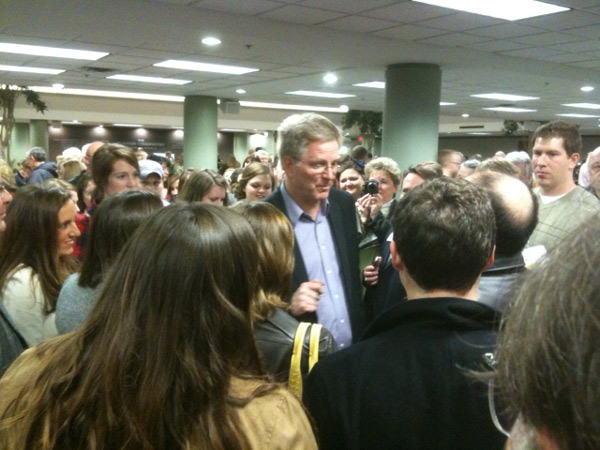
Enjoying an enthusiastic crowd at Oklahoma Christian University after my Travel as a Political Act talk.

I love the way the big cities of the Great Plains, from Edmonton and Calgary in the north to Oklahoma City here in the south, erupt with shiny skyscrapers out of the flatlands. In Oklahoma City, the Devon Energy Center sticks up like a stiletto, dwarfing other buildings on its skyline.

Oil, which makes the local economy somewhat recession-proof, is clearly a big deal in Oklahoma. It’s the only place I’ve been where oil rigs pump alongside the airport runways. They even have oil rigs on the state capitol grounds.

American Indian culture is also an important part of Oklahoma’s cultural makeup. This was the place where tribes from across the region were resettled in the “Trail of Tears” of the 1830s Oklahoma license plates, which call the state “Native America,” feature an Indian archer. Today, 9 percent of the population is Native American, casinos are big, and the city will soon open the American Indian Cultural Center and Museum, which will be the top facility of its kind in the country. High atop the state capitol dome stands a stirring statue of an Indian aptly named “The Guardian.”

But move over, Indians. In 1889, Oklahoma was the home of the great land run. With the firing of a gun, white settlers raced in from Arkansas to grab up free land: Stake it, live it, work it…and it’s yours. Some land-hungry ones cheated and left sooner than the gun went off. They were called “sooners.” This beautiful state — so full of friendly people — is the only place I can think of where the university mascot is named for cheaters: The University of Oklahoma Sooners. To this day, some of those settlers’ families — sooners and laters — still live on those original homesteads.

Oklahoma City is a heartwarmingly proud city. People just seem really good here. And they come together impressively to make their city better. In the 1990s and early 2000s, MAPS (the Metropolitan Area Projects) rejuvenated the riverbank and the old industrial Bricktown. A charming canal, complete with riverboat tours, winds through a park-like green belt, gracing the city with a dimension never before enjoyed.

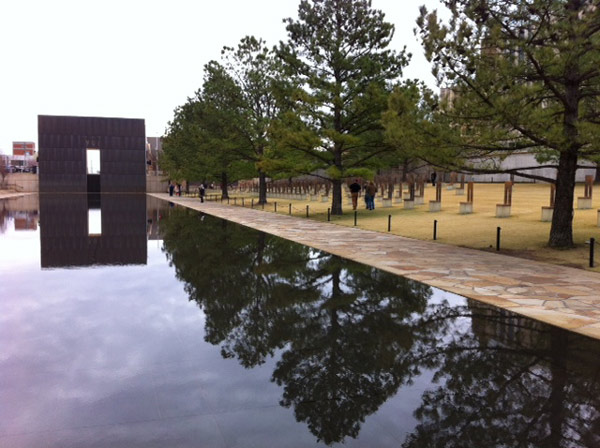
The memorial at the site of the bombed-out Murrah Federal Building is a powerful stop in Oklahoma City.

After Katrina hit, the New Orleans Hornets made Oklahoma City their temporary home for a couple of years. They were supported so enthusiastically that it was clear the city was ready for a pro basketball team. So they took my city’s Supersonics…and it’s been a huge success. Now the “Oklahoma City Thunder,” my former Sonics constantly sell out games.

An essential stop in Oklahoma City is the moving memorial at the site of the 1995 bombing of the Murrah Federal Building. With its reflecting pond, thought-provoking field of 168 empty chairs (one for each victim), and a fence still fluttering with cards, ribbons, and photos of remembrance, the Oklahoma City National Memorial — with its rangers always there to tell the story of the horrible event — is very well done.

I spent my evening at Oklahoma Christian University, a delightful little campus with 2,200 students (each given a MacBook Air upon arrival, included in their tuition). The school has a passion for foreign study — both sending their students abroad and hosting students from around the world. They have a special relationship with Rwanda, and my hunch is that an entire generation of future Rwandan leaders will be Oklahoma Christian University alums. While buildings on campus are named for benefactors with little concern for double-entendres (Fails Hall dormitory, Payne Athletic Center, and Mabee Learning Center), I was impressed by the caliber of the student body, the teachers, and the community leaders who all work to make their school excel.

The new federal building in Oklahoma City, across the street from the one destroyed by a car bomb in 1995, is designed with security in mind.

Oklahoma’s lieutenant governor, an avid traveler and a fan of my TV shows and guidebooks, made a point to come to the VIP dinner before my talk. It was a delightful gathering. Joining 30 couples who seemed to have everything right made me forget for a moment that the world is not so tidy. One sweet lady asked me, “What’s the topic of your talk tonight?” I said, “How travel broadens your perspective.” She responded, “It certainly broadens your fanny.”

After dinner, I was rushed around back of the auditorium and heard thunderous applause. I had missed my introduction by ten seconds and needed to step immediately onto the stage to face 1,200 people packing the hall.

After a bit of a rocky start, I spent the next two hours respectfully challenging this mostly Christian crowd of Oklahomans to let travel complicate, carbonate, and broaden their worldviews. I talked about how, to me, “sanctity of life” is more than a fetus. I outlined how we could deal with structural poverty abroad by exercising soft power — both doing Jesus’ will and making our country safer at the same time. And I got to confront the issue that while God may bless the USA, it’s hard to understand how the 4 percent of humanity who are Americans can be “exceptional” in God’s eyes when God loves all his children — not even the poor and unwashed, but especially the poor and unwashed. Although the organizers of the talk had prepared me to be careful with the politics here, university leaders thanked me afterwards for bringing these challenging ideas to their student body. It was a thrill.

I finished the evening (after most people’s bedtimes) with an extended Q&A session with the honors students and foreign study students in a smaller hall. That night, while cruising through the channels back at the hotel, I stumbled onto the new HBO Sarah Palin movie, Game Change, and couldn’t stop watching it. This capped a fascinating evening.

Rushing down breakfast in the hotel lobby with Keith the next morning, we were both bleary-eyed. It turns out he had also stayed up until 1:00 a.m. watching the same movie. We hit the road at 9:00 and drove the most boring stretch of the trip so far — Oklahoma City to Kansas City via Wichita. Wichita was quite desolate on a Sunday morning.  The city may have a strong faith, but, according to my Starbucks app, Wichitans don’t seem to revere St. Arbuck. So, in a driving rainstorm, we pushed on to Kansas City.

Days 7-8: Drugs in Houston

Keith dropped me off at the Denver airport for a side-trip to Houston. Fighting my way through the chaos accompanying the merger of United and Continental airlines, I finally boarded my plane. I spent the flight preparing a new talk I was about to give as a keynote address to an assembly of drug policy wonks to kick off an all-day conference on the topic.

While Houston is considered the new hub for illegal drugs entering the USA from Latin America there’s a lot of beer here too. This house, Houston’s famous “beer house”, is literally covered with beer cans.

On the airplane, Fox News was dishing out its idea of “fair and balanced” news coverage on the backs of 100 seats all around me. I don’t know how United can inflict that on a captive audience of their passengers. (Meanwhile, I enjoyed the thought that just yesterday, Fox News friend Pat Robertson came out in favor of legalizing marijuana.)

In Houston, Professor Emeritus William Martin — a wonderful man, a fixture at Rice University, and the official biographer of Billy Graham — hosted me at the James Baker Institute, where speakers from around the world are brought together to inspire Houstonians to thoughtful civic responsibility. I gave a one-hour, two-part talk: the abbreviated TED version of my Travel as a Political Act talk, followed by my NORML material that emphasizes European drug policy. While I was a bit nervous (speaking to a room full of leading Houstonians and well-connected patrons of the university from a podium that has been occupied by everyone from Nelson Mandela to Bill Clinton to Henry Kissinger), my talk was well received.

Later that night, over dinner with drug policy activists (on both sides of the issue), we had a lively conversation. I sat next to a mentor of mine, Ethan Nadelmann, the founder and executive director of the Drug Policy Alliance. Ethan has recently been shuttling between sitting presidents south of our border. Several Latin American countries (including Mexico, Costa Rica, Guatemala, El Salvador, and Colombia) have begun talking about the wisdom of taking the crime out of the drug equation to help alleviate some of the violence wracking their societies. As Ethan counsels them on the pragmatism of legalizing marijuana, Joe Biden is flying there to remind them that if they do, they’ll find themselves in a costly trade war with the USA.

The guest speaker takes pictures of himself in a mirror.

A drug policy expert from England and I explored the existentialism of drug abuse. It seems like hard drug use in the rich world correlates with futility and meaningless in life (for example, many Russians with go-nowhere lives drown themselves in vodka all alone). He made a good case that consumption in Europe is related not to the impact of existing laws, but to how a society supports its struggling citizens. For example, the Netherlands and Switzerland have similar laws — but the Swiss, with a less forgiving welfare system, have more needle junkies, while the Dutch, with a more generous way of taking care of its troubled citizens, have far fewer hard drug users. I asked him why the Czechs smoke more marijuana than any other European country. He speculated that it may be because after they won their freedom from the USSR, and the poet and playwright Václav Havel was swept into power, it was a little like the hippies taking over. Comparing the war on marijuana to Prohibition back in the 1920s and 1930s, someone said, “Alcohol with Al Capone is worse than alcohol without.”

A man at our table who had advised the US drug czar recalled how, during one negotiation session with European officials on drug policy, the Americans started the meeting by saying, “If you say the phrase ‘harm reduction,’ we’ll have to leave the room.” (For eight years during the Bush Administration, no drug policy proposal with that term was even allowed to be considered — as “harm reduction” is considered code for legalization.)

Confirming my understanding that countries are extorted into keeping pot illegal by American trade policies (enforced through United Nations agreements), I learned that while rich countries incur a trade war if they legalize any drug, poor countries get “decertified” (in other words, disqualified from receiving foreign aid) if they decide to legalize marijuana. Because of this, the presidents of Mexico and other Latin American nations are between a rock and a hard place when it comes to taking the violence and money out of their local drug wars.

Then, after a day of events for Houston PBS, I flew north to Oklahoma City to meet Keith and continue our Road Trip USA.

Day 5: Colorado’s Arid, Red-Rock Majesty

My bedroom view: Pike's Peak over looking Kissing Camels

I’ve been a mile high for the last couple of days, hyperventilating on Colorado’s mountain views and arid, red-rock majesty. With the sternness of the vast Great Plains ready to sweep us away, my attention seemed determined to appreciate the Rocky Mountain grandeur that caused those first pioneers to fall to their knees.

Driving across Colorado, we had two stops for lectures: Grand Junction and Colorado Springs.

Grand Junction — our smallest stop yet, with just 58,000 people — is the biggest city between Salt Lake City and Denver.  Apart from a world of outdoor activities nearby, Grand Junction’s charm is limited to its delightful Main Street. I strolled the entire length of Main Street — which seemed positioned to frame dramatic Rocky Mountain peaks beyond — from my hotel to the theater for my talk. It’s the first big, wide, old-time main street I’ve encountered that traded traffic capacity for people fun. Sixty years ago, they interrupted traffic flow by adding parks, gazebos, and people zones — quite progressive for that time. Losing half its functional width and forcing single lanes of traffic to zigzag slowly through town, it’s as if town fathers wanted to be sure all would enjoy the modern and entertaining public art — like the popular Chrome Buffalo, made of old car bumpers — planted every few steps. Walking through town, I got a sense of what’s happening and who’s coming…according to the signs, it’s just me and Los Lonely Boys.

Grand Junction is a springboard for good country living: vineyards, thrilling rivers, red-rock canyons, and fossilized dinosaurs. It’s the gateway to the Colorado National Monument, a mighty canyon cut into the world’s largest flattop mountain, the Grand Mesa. The town was named for the junction where the Grand River (today’s Colorado River) flowed into the Gunnison River. The Grand was later renamed the Colorado River (perhaps to avoid confusion with the similarly named Rio Grande on the border of USA and Mexico). The Grand Canyon is named not for its size, but for the original name of the river that cut it.

The scenic drive into the Colorado National Monument, through piñon trees and cottonwoods, stirs butterflies and drops jaws with little shoulder and devastating drops. I fantasized about how easy it would be to film an engrossing TV show on this area.

This is Colorado’s wine country — a fact I was repeatedly reminded of by the friendly vintner who kept filling my glass while I did an extended Q&A at the pre-lecture VIP reception. And it is good wine. As I’d hoped, visiting smaller towns like Grand Junction reminds me how our country is filled with wonderful people.

After all the intense people action that came with our biggest crowd yet, I enjoyed a lonely walk home after my talk. Strolling back down the cold and desolate Main Street, while feeling a prairie wind like I’ve never felt before cutting through town at each cross street, I played a little soccer with a tumbleweed.

Driving farther into Colorado, we were a bit frustrated that the tiny but appealing museums along the way are open only April through September. At Glenwood Springs, we started hiking up to the grave of Doc Holliday, but were stopped by snow. Still, with a big, steamy outdoor pool powered by its namesake hot springs and busy with people, this town was a delight. Inviting streets were lined by crusty old taverns, hip boutiques and bakeries, and ski resort-type gift shops.

These days, medical marijuana dispensaries, with their happy pharmacy-style green crosses, are part of every Colorado townscape. Popping into Glenwood Springs’ biggest dispensary, we enjoyed a tour — surveying an amazing collection of strains filling an inviting wall full of jars — and interviewed its owner on the latest in the drug policy debates in his state. Colorado and Washington are the two states in the USA with initiatives on the ballot in 2012 to legalize, tax, and regulate pot.

Today, all we needed to get high was a car. The scenic highway topped 10,000 feet as we drove by the ski resorts of Vail and Breckenridge. While Vail looked as fancy-condo as I expected, inviting Breckenridge was a place I’d love to come back to for some skiing.

Next up was Alma, at an altitude of 10,578 feet — the highest incorporated town in the USA. Towns like Alma, two miles above sea level (twice as high as Denver), have a thin-air, old-saloon charm. Amid the crooked tin chimneys, weathered timbers, and faded paint jobs, Colorado flags flaps like Buddhist prayer flags in the Himalayas.

Crossing the Continental Divide, we came upon the South Platte River. It occurred to me: Toss a cork in here, and I could net it in New Orleans, where I’ll be meeting my daughter Jackie for a fun father/daughter weekend to celebrate the end of this 20-cities-in-20-days road trip.

We tumbled out of the Rockies at stately Colorado Springs. The state’s second city sits beneath Pikes Peak. Locals love to remind visitors that this is “America’s Mountain,” and from its summit, the “O beautiful for spacious skies” lyrics of “America the Beautiful” were inspired and written.

If you wagon-wheeled yourself across the great American plains and didn’t want to go uphill, you’d have to stop at Colorado Springs. Founded in 1871 by a Civil War general named William Jackson Palmer, its economy was based on mining, tuberculosis sanatoriums, and, more recently, the military. NORAD, the air-defense mountain citadel, is tucked safely into the high valleys above. Locals recall how, on 9/11, the skies overhead seemed like an Armageddon tic-tac-toe board, with all the scrambling jets airborne.

Palatial-by-pioneer-standards Victorian homes line wide streets, recalling the days when the local mining aristocracy defined Colorado Springs’ high society while caring for “the deserving poor.” Chic and dressy for a Wild West town, it still feels uniquely chic and dressy today. But not too dressy. At my evening lecture — in the amazing Neo-Romanesque Shove Chapel on the Colorado College campus, packed with a thousand travelers — my host reminded me, “’Formal’ in Colorado means to wear some clean jeans.”

Working for Rocky Mountain PBS and the local public radio station (Classical 88.7 KCME-FM), I was set up in one of the nicest hotels imaginable: the Garden of the Gods Club Lodge. It’s part of a 480-acre estate given to the community in perpetuity in return for the promise that alcohol would never be served, sold, or consumed on the property. My room overlooked towering red rocks that glow in the morning sun and reminded weary pioneers of “Kissing Camels.” Walking in my bathrobe past grazing deer and spunky rabbits to the outdoor pool, I started my last day in the mountains by taking a dip and gazing through the steam at the radiant-red camels kissing at the foot of the Rockies.

Luxuriating in that pool, I wondered how my sister Jan is doing — now four days into the Iditarod. Last night, a volunteer at a station on the 1,000-mile trail to Nome called me and said she’s on track. The dogs are happy, and so is she. (For the latest on Jan’s Iditarod adventure, be sure to visit her blog).

By noon, I said goodbye to Keith and our car at the Denver airport to fly to Houston for a talk at Rice University. (I’m giving the keynote talk at a drug policy convention there.) Keith is driving to Oklahoma City, where I’ll reconnect with him in two days to continue our road trip.

Six days into our trip, we leave the Rockies. We’ve traveled 1,600 miles from Seattle in our mighty GMC Yukon (32 hours of driving at an average of 50 mph, 121 gallons of fuel burned, paying about $3 for ethanol when available, otherwise about $3.40 for unleaded — for a total of about $400 and averaging 25 mpg).

Each evening so far, I’ve been given a nice basket of local goodies as a welcome. Boarding the plane, I enjoy the last of my favorite bit of swag so far: Enstrom’s Almond Toffee Petites in Milk Chocolate from Grand Junction (like Almond Roca from Tacoma). Letting the milk chocolate make way for a happy ending of tasty toffee, I look forward to Houston.