Atlanta: Naked Dogs and Peach Trees

Atlanta is clearly the Manhattan of the South. It’s CNN slick, Coca-Cola fueled and funded…and thriving. While famous for its peach trees, I’d give it points for lack of creativity as 52 streets have “Peach Tree” in their names. Locals claim that the towering Westin Peachtree Plaza is the tallest all-hotel skyscraper in the Western Hemisphere.

I love Atlanta’s impressive skyline. It’s “topper happy” with its flashy skyscrapers sporting attention-grabbing tops (especially fun to see when enthusiastically floodlit at night). Enjoying the view, I thought of Shanghai’s skyline and how a Bedouin who suddenly strikes it rich decorates his new Mercedes like a camel.

And, speaking of Bedouins, Atlanta’s venerable Fox Theater is an acid trip of faux Moorish and Egyptian design. Its nearly 5,000 seats gather under a big, fake Bedouin canopy as part of the ceiling glitters with stars. The opulent theater, opened just two months after the stock market crash in 1929, was created by the then-powerful Shriners. They designed it with exactly as many seats as their 1929 membership in Atlanta. The theater still sports its original furniture, has its own conservation department, and is like a museum. It hosts Broadway plays all year long.

Across the street is the also venerable Georgian Terrace Hotel. This is where I learned why they call Atlanta the “Phoenix City.” While it was burned in the Civil War–and burned several times since–it keeps rebuilding. As it’s shown little interest in keeping its historic buildings, for generations now nearly everything in town has been torn down and rebuilt.

The Fox Theater, the Georgian Terrace, and an old apartment building across the street were destined for the wrecking ball when a gang of conservation-minded locals finally mobilized to save the three major buildings in Atlanta that dated from before World War II–and had any significant history. (On the other hand, Savannah, with its “pirate architecture,” had the good fortune to be spared by General Sherman, who gave the town to President Lincoln as a Civil War Christmas present. Its historic district is beautifully preserved.) At the Fox they’re still smarting from the fact that “Gone with the Wind” opened at another theater across town. And they’re still all abuzz about the world premier reception with Clark Gable and Vivien Leigh at the Georgian Terrace.

I love dropping by a classic diner or hamburger joint in a new town. Here in Atlanta, it’s got to be The Varsity. It’s a huge and thriving place with a staff that famously asks, “What’ll ya have?” and serves up their signature “Naked Dog” and “Frosted Orange.”

We all agree: There's nothing like a Frosted Orange at Atlanta's Varsity drive-in.

Driving south from Atlanta, I was struck by how humble small-town Georgia is. Stopping by a place called the Salt Lick (which was offering free samples of their beef jerky and boiled peanuts–mushy but spicy), we were told there’s not another restaurant for 15 miles, so we ate there. Bringing me my plate of fried green tomatoes, our waiter said, “Anything 10 miles off the interstate is a ghost town unless it’s military.” The interstate is to small-town commerce in the 21st century what the railroad was in the 19th century.

While perhaps dangerous, it’s still fun to make general observations and imagine what it’s like to live here. A rural Georgian road trip features very good roads dotted by gas stations, farms, liquor stores, churches, fast-food joints, BBQ shacks, billboards promoting predatory lawyers and joining the Marines, Coca-Cola everywhere, and more churches.

People line up for free Cokes in Macon, Ga.

Stopping by Macon, a major town on the road to Tallahassee, we enjoyed a hot and muggy stroll. While the metabolism of the town center felt deadly, there were lots of people converging on the main drag. We asked someone with a Styrofoam plate filled with potato salad and fried chicken what’s going on. They said, “It’s the Cherry Blossom Festival. Where you been?” Volunteers at folding tables were handing out lunches to people who didn’t know exactly why but were happy to stand in the long line. A woman in a red trailer was rhythmically passing out plastic bottles of Coke, and across the way a long line of people waited for free pink ice cream–the color of the festival.

There was free, pink ice cream in Macon, Ga., thanks to the local cherry blossom festival.

Crossing the border into Florida, we noticed an immediate change in the economy. Tallahassee and its county felt like a fragrant, garden country club in comparison–lush vegetation, crisp and prosperous neighborhoods, elegant old homes, and a thousand people jamming a theater in anticipation of the final talk of my tour.

Crossing the border into Florida with my driver Matt Yglesias.

Rhythm and Ribs in Tennessee

There are three stars on the Tennessee flag, each representing a very different region — mountains in the east, highlands in the middle, and lowlands in the west. And there are cultural differences to go with the topography.

Driving down Tennessee’s I-40, we stayed in Memphis, visited Graceland, checked out the town of Jackson, and then arrived in Nashville. The next day, veering south, we lunched in Chattanooga and crossed the border into Georgia, visiting the Chickamauga Civil War Battlefield (5,300 acres of “military park,” the scene of the last major Confederate victory of the Civil War). Then we were on our way to Atlanta.

Memphis, with its smart, little skyline, overlooks the Mississippi River. It was one of the first cities to fall in the Civil War, so it wasn’t destroyed but occupied. After the war, freed slaves came and helped power the local factories, mills, and cotton shipping. Its industrial wealth shows itself in fine, old neighborhoods filled with grand, “Four Square” houses — two-story homes of equal width and depth, many with a breezeway right through the middle that vents the four, equal quarters.

As this has long been an African American center and an industrial powerhouse, it’s where black and white culture come together musically, too. Rock ‘n’ roll has its roots in African American and blues music. And Memphis is therefore logically the city for blues and rock ‘n’ roll — and the home of the man who helped black rhythm and blues enter white culture, Elvis Presley.

Driving by the Heartbreak Hotel and RV Park, we arrived at Graceland the moment it opened and enjoyed the requisite pilgrimage to the home of Elvis. (All morning, I couldn’t stop singing Paul Simon’s “Graceland.”) The Graceland complex is a Venus flytrap for Elvis fans. There are six separate sights on the admission ticket. To both enter and exit most of them, you pass through gift shops. I couldn’t help but notice that all the customers were white — and nearly all the help was black.

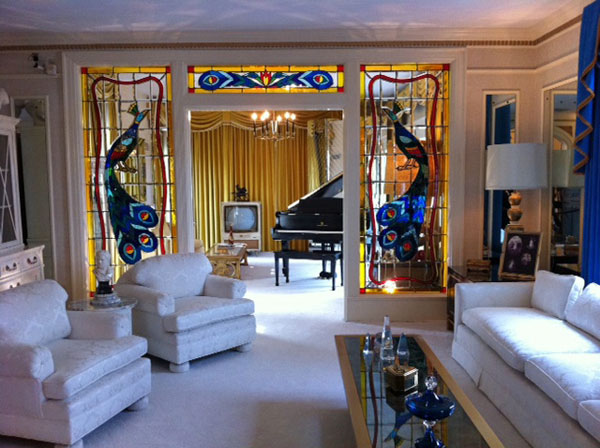
The mansion itself was nowhere near as gaudy as I expected. Elvis bought it when he was 22 for $102,000. It’s a stately mansion with big white pillars out front.  Like so many nice homes in this part of the country, it overlooks a sprawling and fun-loving estate. The interior is a trip back to the 1970s — shag carpets, mirrored ceilings, all the finest low-tech accessories of the age with Elvis’ flair for fancy. While my house in the 1970s was tiny and humble compared to Graceland, the decor, furnishings, kitchen, and so on were remarkably similar.

Welcome to My World: Elvis Presley’s living room at Graceland.

Driving across the South, you notice a huge contrast between country and city. I love the old Johnny Cash/June Carter version of “Jackson” and couldn’t bear to drive by Jackson, Tenn., without side-tripping through…just to mess around. “Jackson. Jackson.” Listening to Nancy Sinatra and Lee Hazelwood sing the tune, I studied the town, one of several “Jacksons” in  the South that could be the title town. Small poor towns seem to have little energy and nearly no momentum while big cities (like Nashville and Memphis) are dashing ahead.

In the countryside we’d see billboards encouraging kids with little future to join the Marines. Churches, which all seem to sport the same skinny, spikey, white spires, advertised, “Fishers of men: You catch ’em, God cleans ’em.” I passed a company called “Praise the Lord Mini-Storage.” Vast Walmarts stood like dominatrix giants while major intersections were fast-food-chain wastelands. I’m getting good at a game I invented:  predicting if I’ll see any Starbucks in a town before turning on my app that locates nearby outlets. Not a Starbucks anywhere in or near “Jackson town.”

Nashville was my favorite stop since the Rockies. There just seemed to be a exuberance and a love of life that showed itself in the people — both on the arboretum campus of Vanderbilt University (where I gave a couple talks) and the honky-tonk bar scene.

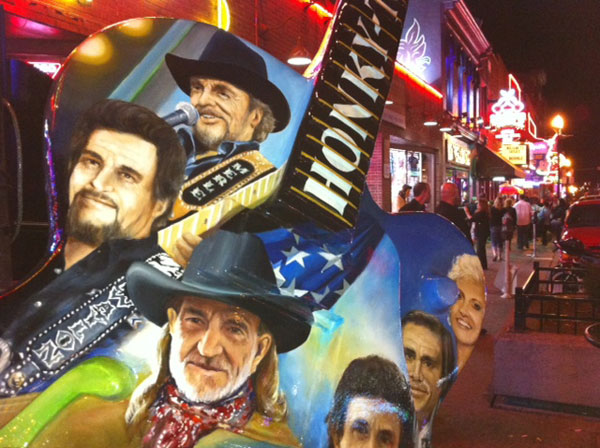
If I lived here, I think I’d make a habit of dropping by Lower Broadway for a weekly pub crawl. Eight or 10 groups were playing the night I was there. Each was distinct and both musically and visually enthralling. We’d pop into one bar and fall in love with the group. Then do the same next door…and next door…and next door. I’ve never liked country music. And here, suddenly, it’s intoxicating. I went home with three CDs wondering if bluegrass will sound as good in Seattle as it does here.

Nashville’s Lower Broadway is a can-can of country music fun.

After a quick review of our many options, we grabbed a sloppy BBQ dinner at Rippy’s. The waiters and waitresses wore T-shirts that read, “You pull my pork, I’ll rub your ribs.” As they served us our six “bones” and hot corn cakes, we were serenaded by a pop country duo that reminded me of Lucas and Mark McCain (if you remember “The Rifleman”).

Six "bones" and a beer in Nashville.

Lickin’ my fingers, I noticed how this is a distinct and thriving culture. People get real eye contact while immersed in the music. Everyone seems to know the lyrics of tunes I’ve never heard. People have Southernness in common, yet each state has its own accent, history, and favorite songs. When a song celebrating Louisiana girls was sung, Louisiana girls jumped up and shook their beers as if riding a bronco. There’s absolutely no pretense. One woman with two small children and no husband parked her kids one at a time at my table and danced with the other…cute little tennis shoes rattling on her belly. It’s real musical talent, lots of beer, and an audience hungry for fun.

Across the street, we were lured into a place where you go to get your honky tonked and your bush wacked. I’d swear it was the Marlboro Man singing classic country smooth as can be. The light hit him in a way that his body faded away.  Three elements popped like some advertising icon: his white cowboy hat with a rim making that perfect swoop, his blond guitar, and the shiny mic on a stand that cut straight up the middle. The songs were favorites. He and his band would stop playing, and everyone around me would sing a cappella anthems I had never heard. Expert dancers were two-stepping while the band created a pool of music. As the dancers swirled, they broke the dike, and it cascaded all around me…country music.

My favorite stop was Layla’s Bluegrass Hillbilly and Country Inn. The wooden floor was shaking with fun, and I knew this was the spot for my next beer. I grabbed a stool that let me teeter back and forth to the beat. Just as I settled in, my eardrums were pierced by a woman’s scream when the band asked, “Do you want some Ricky Skaggs?” The group was tight, playing and looking like hillbilly ancestors of Amy Winehouse, Jethro Tull, and James Taylor.

I couldn’t help but admire how the various stringed instruments — the banjo, violin, guitar, and string bass — must have evolved.  They complement each other with a sophisticated brilliance that I would have never attributed to bluegrass. People swapped in and out of the band like some big family. Band members traded instruments just for fun. Taking turns riffing effortlessly, it seemed to me that fingers were scat singing on frets.

The guitarist came in after an instrumental interlude singing, “I’d fill up my shotgun with rock salt and nails.” A man at the bar hollers, “Sing you bastard!” Clinking beer bottles with a guy next to me, I said that this makes me wanna be a hillbilly. He said, “The happiest day of my life was the day I sold my snowblower and moved from South Dakota to Tennessee.”

Layla’s Bluegrass Hillbilly Inn: Sing you bastard!

Jan Steves Is About to Successfully Finish the Iditarod!

Two weeks ago I set off in a comfortable GMC Yukon SUV for an epic Seattle-to-Florida road trip. Far north of the Yukon, on that same day, my little sister, Jan, set off on a journey that makes my adventure look like a trip to the mailbox. Behind 14 happy dogs, she left Anchorage for Nome, on the 1,050-mile-long Iditarod race.

Of course, even qualifying for the Iditarod is a huge accomplishment, and finishing this dangerous and grueling race is a personal victory. And Jan is about to do that. So far 50 teams have finished, 13 have dropped out or scratched, and three are still on the trail.

While Jan’s bruised, battered, and sleep-deprived, her spirits are soaring as she sets off on the last 70-mile leg of her journey. Like a nervous mother, I’ve been checking in, via the excellent Iditarod website, to see how she’s doing.

It’s fun just reading about the stations — wind-blown communities of corrugated tin igloos, with a couple hundred bundled-up residents who wait for each musher with warm bowls of soup — and about the terrain between each station. Talk about a travel adventure… I’m dreaming of interviewing Jan on my radio program once she’s back home in Seattle. I’ve got so many questions.

Today, Jan embarks from White Mountain to a station called Safety, across perhaps the most treacherous stretch of the entire race. When windy — gale-force winds routinely whip off the Bering Sea here — this can be treacherous — even deadly. When the weather turns bad, mushers are advised to grab a shelter and wait it out. This morning the weather is calm and sunny, though 16 degrees below zero. I’m so relieved, as I imagine my sister is.

If you’re interested, check out Jan’s blog, and dig around in the Iditarod website for details. (Click on “2012 Race,” where you can see the current standings or read about the terrain between her current checkpoints.)

Finishing in last place earns you the Iditarod Red Lantern — something I’ll admire on my sister’s mantle for the rest of my life. Go Jan!!!

Days 12–14: Dry and Humid in Arkansas


William J. Clinton Presidential Library

The last couple of days, while busy with travel and lecturing, have offered me scant time to get out and enjoy the towns and their people. In Des Moines, Matt dropped me at the airport and I flew to Dayton, Ohio, and then to Little Rock, Arkansas, where I met back up with Matt and the car.

My impression of Dayton was of a town with an innovative spirit that had once been a proud leader, and had then taken the kind of economic hits that walloped towns all over the Rust Belt.

The late 19th century was a heady time of inventiveness and industry here. I saw the bike shop from where the Wright Brothers “invented the airplane in 1903 and perfected it in 1905.” My proud local friends made it clear that while Kitty Hawk, in North Carolina, got all the fame, the brainwork originated here in Dayton.

Dayton is where, in 1879, a local merchant, concerned that employees were ripping him off, devised a box in which to register the cash coming into his shop. He went on to establish the National Cash Register (NCR) Company — once a huge employer here, in a thriving city where the Miami and Erie Canal helped bring goods to market. But NCR recently took its cash and skipped town, and the industrial canals have been antiquated ever since the advent of railways. Abandoned in the 1870s, the Miami and Erie Canal was eventually filled in. The Great Dayton Flood devastated the city in 1913, when the Miami River overflowed its banks (it’s now a model in flood control). Other claims to fame: In 1933 this was the birthplace of the Soapbox Derby, and among former Yugoslavs, Dayton is a household word for the peace accords carved out here, which helped quell the violence wracking their society.

Enjoying a moment to survey the packed auditorium for my Dayton talk, I overheard a young couple, who’d arrived 20 minutes early to find the place nearly full, saying, “Wow, it’s tough to compete with old people. We should’ve gotten here earlier.” Throughout this trip I’ve noticed how retired people arrive half an hour early, and younger people pop in at the last minute.

Flying down to Arkansas, I met Matt at the Little Rock Airport, and we popped into the inspirational William J. Clinton Presidential Library. Taking the tour in this beautiful building overlooking the Arkansas River, I was struck by how much history happened in the eight years of the Clinton presidency, and how important it is to have a smart person for our president. This was my first visit to a presidential library, and I noticed how it effectively gives its man a positive spin. There was no mention of sex scandals, and plenty of focus on Clinton’s charisma, eloquence, and vision. Locals seem to agree that the Clinton Library has been a real boon to little Little Rock. It made me nostalgic for the 1990s.

Driving north, toward Conway, we found ourselves in a world of flags, Coke, and God. Conway is a railroad town on the Arkansas River with a humble old center made of brick. Though they tore down their historic train station, a bank was built a block away to look like a classic small-town American train station. At the edge of the one-story-tall old town center is Toad Suck Square — something locals love to talk about, along with their Toad Suck Daze festival. While the origin of the name is murky, I was told it may have something to do with men sucking on beers and swelling up like toads. Speaking of sucking, I could see how the coming of big-box stores had sucked the life out of many of Conway’s small family-run stores.

Surveying from the former lovers’ lane high above Conway, I noticed how the town filled a basin between two ridges — and that, rather than tall buildings, the city’s skyline was towering signposts advertising Motel 6, Wendy’s, IHOP, Express Lube, and the Waffle House.

Making those phones ring at small PBS stations all around the U.S.A.

My visit to University of Central Arkansas was a busy one, with a lecture to students on travel writing, a lunch talk for supporters of the local public TV station, and a couple other events on campus. Then we gathered with supporters of the university at a grand and elegant home for a cocktail party (permitted in this dry county because it was private residence). Walking down the red-brick, carpet-like walk leading to the elegant porch, with its towering white columns, I was swallowed up by a wonderful and enthusiastic crowd of leading local citizens and travel enthusiasts. Later, taking a moment away from the happy commotion to enjoy a little quiet, I stepped onto the back porch and sat quietly, feeling the humid atmosphere of this tropical bit of America, appreciating how the porch was designed to catch the cooling breeze, how delightful a lazy rocking chair can be, and how the unfamiliar birdsong reminded me I was far from home.

I had never been in a dry county before. The human craving for alcohol creates interesting challenges here. Things are changing now, as Faulkner County is becoming “damp.” Bars and eateries can serve alcohol if they are technically clubs, letting patrons join by simply signing in. Back when the ban on alcohol was strictly enforced, locals noticed how the restaurant scene and entertainment scene were hugely disadvantaged. They’re yet to recover.

Ever since World War II, when so many beer-loving men were out of the country fighting, and women voted in the ban on booze, the people of Conway have had to drive to “last-chance” liquor stores waiting just over the county line for their beer runs. Opponents of the ban noted how young people would drive to the next county to drink…and then die in car accidents because they then had to drive home. The Faulkner County economy suffered from the loss of booze-related sales tax, and employers couldn’t lure in talented workers if there was no chance of a nice beer at the end of a long work day. Now, with the recent “dampness,” people attribute the relatively strong economy in part to the new availability of alcohol.

Party time hospitality in Arkansas

At dinner, chatting with a woman who ran a restaurant that had been one of the first in Conway to serve wine, I was impressed by her courage. She had been threatened by the local pastor, who’d said that whenever there was a fatal alcohol-related accident on the roads, she’d be partially to blame.

When dessert was served and I was called upon to give my talk, I was actually feeling a little buzz from my wine — ironic, as this was my first time lecturing in a dry county. I talked slowly and softly, hitting hard my message about Travel as a Political Act. It was a thrill to share these ideas to such a smart and engaged crowd, many who, it seemed, were new to some of these ideas.

Tomorrow we go to Memphis or Nashville. I get them mixed up, but that’s about to stop.

Day 11: Des Moines and a Palace Honoring Farming

After driving through rural Iowa — the humble, hardscrabble towns, the golden hills, and the quiet farms — coming into Des Moines is like entering the Manhattan of corn country. It feels busy, cosmopolitan, and a different world.

While its shiny golden dome marks the state capitol, Des Moines feels like the capital of the agricultural world. Appropriately, it’s the home of the World Food Prize. Dr. Kenneth Quinn, former US Ambassador to Cambodia, heads this organization inspired by hometown hero Dr. Norman Borlaug, who’s considered the father of the so-called Green Revolution that dramatically boosted agricultural production worldwide.

Borlaug, who started out as an Iowa farm boy, designed a strain of wheat that overcame the famines that wracked India and Pakistan in the mid-1960s. Because of Borlaug’s “miracle wheat,” those once-hungry lands became robust exporters of food. Borlaug is known (especially here in Des Moines) as “the man who saved a billion lives” — quite possibly more than any other person who has ever lived.

Knowing about my work with Bread for the World, the gracious hosts of my evening lecture, Iowa Public Television, organized a private tour of the newly renovated World Food Prize Hall of Laureates. I was guided by Ambassador Quinn himself, whom I had met here two years ago while attending the annual World Food Prize conference when my friend and president of Bread for the World, David Beckmann, received the award.

In the 1890s, the City Beautiful Movement was sweeping across the USA, and the people of Des Moines gave their city a stately set of Neoclassical buildings overlooking their river. With new parks and pedestrian-friendly zones playfully ornamenting a newly heightened levy, this part of town feels ready to bust into a boisterous future. The former library has recently been turned into the World Food Prize Hall of Laureates, a palace celebrating heroes in the war against hunger.

The building is really as sumptuous and filled with symbolism as the great palaces I’m accustomed to seeing in Europe. But this is from the 20th century, and all about food and Iowa. Under its awe-inspiring dome, four grand pillars each have a theme, celebrating the world’s four great crops: wheat, corn, soy, and rice. Above, as if carved on an ancient Greek temple, a frieze trumpets the Norman Borlaug quote, “Food is the moral right of all who are born into this world.”

Iowa really is enthusiastic about nourishment. The World Food Prize, awarded with great fanfare here each year, is considered the Nobel Prize for food and agriculture. The state is the birthplace of 4-H (the youth organization with more than six million members) and of Herbert Hoover. Although to many people, Hoover is most associated with the Great Depression and the unfortunate “Hooverville” shanty towns that popped up during his presidency, he’s better remembered among Iowans and throughout Europe as the man who, earlier in life, had spearheaded the feeding of hundreds of millions of desperate people in the wake of World War I. During that war, Hoover popularized the slogan, “Food will win the war.”

The World Food Prize Hall of Laureates celebrates both Iowa and feeding the hungry. A highlight was visiting a mural in the basement painted by Harry Donald Jones and overseen by Grant Wood (the man who brought us American Gothic), originally created in the 1930s during the New Deal as part of Roosevelt’s Works Progress Administration. The hard-hitting mural, with heavy socialist and worker’s-party overtones (the kind of art right-wing governors in other states try to paint over these days), is entitled A Social History of Des Moines. After seeing this beautifully restored treasure, I left ready to sing the unofficial state anthem: the Iowa Corn Song.

If you can’t see the video below, watch it on YouTube.