Europe’s Economic Crisis: A Travel Writer’s Take (and a Request for Feedback)

As I update my “Europe Through the Back Door” guidebook for next year, I’m trying to distill Europe’s economic problems into layman’s terms. I want to help travelers get their minds around the struggles there–giving their visit a little more context. It’s dangerous to simplify these things, but for a guidebook, it needs to be simplified. Here’s my attempt at Euro Econ Crisis 101. I’d love your feedback and advice on making this more true and helpful. Thanks.

After seeing news reports of violent demonstrations, angry marchers, and frustrated workers rioting, some are wondering if this is still a good time to travel in Europe. I’m certainly not an economist. But here’s my take on the situation from a travel writer’s perspective.

When assessing the seriousness of any civil unrest, remember the mantra of commercial news these days: “If it bleeds, it leads.” In the era of Walter Cronkite, network news contributed to the fabric of our society by providing solid journalism as a public service without worrying about their bottom line. But today, commercial TV news has to make a profit. In order to sell ads, it has become entertainment masquerading as news. Producers will always grab video footage that makes a demonstration appear as exciting or threatening as possible. Unrest is generally localized–it looks frightening with a zoom lens and much less so with a wide-angle shot.

And also remember that, while we in the USA and Europe may consider ourselves in an “economic crisis,” the vast majority of people on this planet would love to have our economic problems. By any fair measure, as societies, both the USA and Europe are filthy rich. Still, if you’re unemployed or if your retirement is suddenly in jeopardy, your times are, indeed, tough.

Europe’s economic problems are much like ours here in the USA. It seems on both sides of the Atlantic we’ve conned ourselves into thinking we are wealthier than we really are. Enjoying wild real estate bubbles, we’ve had houses that were worth half a million suddenly worth a million. Then, when they dropped in value by 50 percent, we felt like we’d lost half a million dollars or euros. Truth be told, we were never millionaires to start with, and what we “lost” we never honestly gained in the first place.

As societies, we’ve been consuming more goods than we’ve been producing for a long time. We import more than we export–and things are finally catching up with us. Here in the USA, our priorities are warped. Many of our best young minds are going to our finest schools to become experts in finance: Rearranging the furniture to skim off the top…aspiring to careers where you produce little while expertly working the system in hopes of becoming unimaginably rich. (Recently, surveying the extravagant châteaux outside Paris–such as Vaux-le-Vicomte–I was stuck by how many of them were the homes of financiers. Lately, the USA is reminding me of old regime France. It’s striking that over 10 percent of the USA’s economy is tied up in the financial industry.)

Europeans and Americans have some of the most generous entitlements in the world combined with aging societies. Because of that, our comfortable status quo is not sustainable. Whenever a society gets wealthy and well-educated, it has fewer children. That’s simply a force of nature. Western Europe, being one of the wealthiest and best educated parts of the world, logically has one of the lowest birth rates.

Europe’s generous entitlements were conceived in a post-war society with lots of people working, fewer living to retirement, and those living beyond retirement having a short life span. That was sustainable…no problem. Now, with its very low birth rate, the demographic makeup of Europe has flipped upside down: relatively few people working, lots of people retiring, and those who are retired living a long time. The arithmetic just isn’t there to sustain the lavish entitlements.

Politicians in Europe have the unenviable task of explaining to their citizens that they won’t get the cushy golden years their parents got. People who worked diligently with the promise of retiring at 62 are now told they’ll need to work an extra decade–and even then, they may not have a generous retirement waiting for them. Any politician trying to explain this reality to the electorate is likely to be tossed out, since people naturally seek a politician who tells them what they want to hear rather than the hard truth. And any austerity programs necessary to put a society back on track are also tough enough to get people marching in the streets.

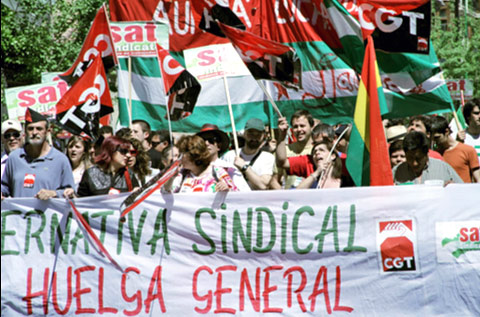
I expect you’ll see lots of marches and lots of strikes in Europe in the coming years as they try to recalibrate their economy. Europeans demonstrate: It’s in their blood and a healthy part of their democracy. When frustrated and needing to vent grievances, they hit the streets. I’ve been caught up in huge and boisterous marches all over Europe, and it’s not scary; in fact, it’s kind of exhilarating. “La Manifestation!” as they say in France. All that marching is just too much exercise for many Americans. When dealing with similar frustrations, we find a TV station (on the left or right) that affirms our beliefs and then shake our collective fists vigorously.
When Europe united, the poor countries (Ireland, Portugal, Spain, and Greece) received lots of development aid from the rich ones (mostly Germany and France). I remember when there were no freeways in any of the poor countries. Now they are laced with German-style (and mostly German-funded) superhighways. These countries traded in their lazy currencies for the euro (which is, in a way, the mighty Deutschmark in disguise, as the European economy is driven and dominated by Germany).

Today, it’s no coincidence that the European countries that have received the most development aid are the ones who are the most debt-ridden and at risk of failing. Even with that aid, their productivity has lagged far behind the stronger economies. And, while their workforce doesn’t produce as much per capita as German workers, they have a mighty currency tied to Germany. By earning wages and getting aid in euros, these nations enjoyed a false prosperity that they might not have merited–and the bursting real estate bubble made it worse. Before unity, if a nation didn’t produce much and slid into crippling debt, the economy could be adjusted simply by devaluing that nation’s currency. Today, there’s no way to devalue the currency of a particular county on the euro, so this fix is not an option. It’s much easier to get into the eurozone than to get out. (One of the biggest questions facing Europe today is: Can and should an economically weak country–namely Greece–leave the eurozone?)

Will Greece and other struggling economies within the EU be safe and stable places to visit as they work out these problems? No one can predict the future for certain. But, as a traveler, I don’t worry about it. True, I wouldn’t want to be a Greek worker counting on a retirement that may not come. But as a visitor, I expect you’ll be scarcely aware of these problems. I was just in Greece and enjoyed a warm welcome, great food, and wonderful beaches. Expect a few demonstrations and a few strikes. Expect your loved ones to be worried about you if you are in a country when there’s a demonstration. (So be in touch.) But you can also expect rich travel experiences and a society thankful that you decided to spend a slice of your vacation time and money in their country.

Washboard Wonders

I think I’ll wrap up my Road Trip USA series with this fun little video clip of a great band I bumped into on Frenchmen Street in New Orleans. How can you not love street music like this? And check out the washboard talent! I had to buy their CD, and it didn’t come in a jewel box but rather wrapped in newspaper. By the way, thanks for traveling with me across this fun, friendly, and full-of-wonder country of ours. I’m sure I’ll do it again sometime soon. But now…it’s back to Europe. I’m flying to Portugal at end of next week. Stay tuned.

If you can’t see the video below, watch it on YouTube.

New Orleans: Where the Good Times Roll All Year Long

I think I had more fun in New Orleans than any city I’ve visited in the USA. While full of tourists, it’s also bursting with culture and a contagious love of life that seems to thrive oblivious to its many visitors. At the airport, volunteers slip the famous bead necklaces over your head, like a lei in Hawaii, and greet you with “Laissez les bons temps rouler”–Cajun for “Let the good times roll.”

I was having a long-overdue father-daughter rendezvous with Jackie as a kind of pre-graduation party weekend (she finishes up at Georgetown University this May). Neither of us had been in New Orleans before, so it was all equally new.

New Orleans--a great place for a father-daughter getaway.

Canal Street, famous as “the widest street,” separates the high-rise modern city from the delightfully characteristic, grid-planned French Quarter. The French Quarter seemed filled with spirited, one-off shops, bars, and restaurants–and almost no chains. Our hotel, the International House, was perfectly located–near great restaurants, a five-minute stroll from French Quarter (where I wouldn’t want to sleep as it’s so crazy), and with a wonderful staff. Getting tips from Stephanie at the help desk, I thought New Orleans would be the best city in which to be a concierge. There’s so much to recommend, and things are so accessible, cheap, and fun-loving.

The must-sees for us: a Mississippi cruise on the steamboat Natchez, Bourbon Street, Frenchmen Street, the thriving French Market, Jackson Square with its history museums, great food, lots of blues and jazz in the bars, and an eye-opening tour of the Ninth Ward to see the Hurricane Katrina damage–and progress made in the seven years since the disaster.

Tips: Take advantage of the freedom to carry your drink out of the bar. They all have “Go Cups,” and it just seems right in this alcohol-fueled city to be strolling with some booze in hand. Seek out and enjoy better restaurants–either classy or bohemian-chic. While the good places always have a line, we found sitting at the bar got us in immediately and made for a fun experience. Bring a sweater, as people here seem to love having their air-conditioning on strong.

For evening entertainment, there is a world of action. Like Memphis and Nashville, the music scene is a mobile feast. Stroll the streets known for live music, and pop in wherever you hear a sound you like. There’s generally no cover–just buy a drink and drop some cash into the musicians’ big tip jug. While Bourbon Street is exhaustingly and depressingly bawdy, rowdy, and alcoholic, it’s worth strolling just to imagine how crazy it must be during Mardi Gras.

We made a point to walk the length of Bourbon Street at the end of each night on our way back to the hotel. The antebellum, wrought-iron balconies were lined with revelers tossing those “girls gone wild” beads; they shouted their cat calls just as they would if it were Mardi Gras. I enjoyed Frenchmen Street much more. There must have been 10 bars with live music and all but a couple without cover charges. Don’t neglect the street-music scene here either. Two of our favorite groups were just jamming in doorways. And the “Sixty-Year-Old Rapper with a Bad Knee” sang his theme song balancing atop someone’s front-yard fence.

To give the city context physically and historically, we took the standard, two-hour bus tour ($25, leaves twice a day, picks up from hotels, great live guide) which gave a fine, “once over lightly” of the city. To get a historical context (and to imagine the French Quarter when it was actually the French Quarter)–head for Jackson Square, which is named for our seventh president, Andrew Jackson, the hero of the Battle of New Orleans–the last time we fought the British. Flanking the stately St. Louis Cathedral are two historic buildings–the Cabildo and the Presbytere–now housing the city’s top museums. You’ll get the standard history–and there’s lots of it, including the Louisiana Purchase story (its final documents were signed in one of these buildings) and a powerful exhibit describing the deluge of suffering and chaos that came with Hurricane Katrina in 2005. And to finish your orientation, relax on the steamboat Natchez–a characteristic paddleboat that cruises down the Mississippi and back. Its great narration explains the importance of the river historically as well as pointing out interesting sights along the way (2 two-hour cruises daily, $25).

At the city museum, the piano of Fats Domino is displayed in the way it was found after Hurricane Katrina ruined his home.

It’s hard to imagine the chaos, horror, and destruction of Katrina seven years ago. But a tour of the poor black neighborhood which was essentially destroyed by the flooding is both fascinating and emotional. The Ninth Ward was cut off from city services by an industrial canal built in the 1920s to connect Lake Pontchartrain and the river. All over New Orleans, the fanciful wooden domestic architecture is charming–and the Ninth Ward is no exception. Even the poorest homes were built with panache.

But today, vast swaths of the neighborhood remain overgrown, boarded up, or simply gone. After the hurricane, homes built on a concrete slab left only the slab. Homes built on stilts in anticipation of flooding left absolutely nothing.

By contacting the Lower Nine Organization (www.lowernine.org), we enjoyed a private tour by car with a person dedicated to rebuilding this sad neighborhood. While there’s been plenty of construction and lots of good-spirited relief work and volunteer labor, there are plenty of bureaucratic frustrations and still plenty of abandoned homes filled only with black mold. “Katrina Crosses”–markings spray-painted onto doors by rescue workers that indicated in a kind of tic-tac-toe code what was checked at that address (and if there were any casualties)–still remain. Walking past houses awaiting stripping and rebuilding, it’s hard to imagine those days when street signs were swept away, refrigerators were hot boxes of food turned to mold, and most of the population was holed up in Houston evacuation camps.

In New Orleans' flood-devastated Ninth Ward, new homes are built on stilts...just in case

I can’t remember enjoying eating anywhere in the USA as much as in New Orleans, which could have been thanks to trusting Jackie’s restaurant selection. The guidebooks seemed to agree with the locals about the best places, and we went four for four. August, the flagship restaurant of famous local chef John Besh, was delightful for high cuisine, a rich setting, wonderful service, and a chance to enjoy traditional dishes with the very best local ingredients. Ordering three courses and sharing, we were surprised to see the servers bring the split portions on separate plates. They brought each dish out at the right tempo and with a loving explanation. Boucherie, in an uptown bohemian-chic neighborhood a short taxi ride from the center, filled a big, old home with great local dishes, elegantly served but without pretense and at a painless price. The Ruby Slipper and Elizabeth’s were both great for breakfast. They were crowded, but the dishes–mixing in seafood like I’ve never seen at breakfast–were worth the wait. At the Ruby Slipper we just slipped right into the bar, and at Elizabeth’s we enjoyed a 45-minute wait by taking a neighborhood walk.

That stroll–like New Orleans itself–came with just a twinge of danger (the city has more than its share of muggings), a dash of history (a memorial to the parish’s WWI dead), a good measure of dogged pride in the century-old wooden homes with stay-awhile front porches and lovingly crafted eves, the promise of a meal I’d never forget, and a reinforced levee, the symbol of a determination to survive.

Florida!

Crossing the Florida state border, we made it to our last gig (for public television in Tallahassee) with about 15 minutes to spare. From our experience, American roads are really good–and so are its cars. I’m sure I’ll be doing another road trip next year. This was just too much fun. Thanks for following along.

If you can’t see the video below, watch it on YouTube.

How I spent my 72 driving hours

During our road trip, I generally did the limo thing, sitting in the back with my writing gear during the 72 hours our panel said we actually drove. The time passed so fast. My hours were spent editing the new 31st edition of “Europe Through the Back Door,” writing this blog, doing interviews on the phone, and enjoying the view. We brought a Frisbee and only managed to toss it around once. That was in Iowa.

If you can’t see the video below, watch it on YouTube.