As I update my “Europe Through the Back Door” guidebook for next year, I’m trying to distill Europe’s economic problems into layman’s terms. I want to help travelers get their minds around the struggles there–giving their visit a little more context. It’s dangerous to simplify these things, but for a guidebook, it needs to be simplified. Here’s my attempt at Euro Econ Crisis 101. I’d love your feedback and advice on making this more true and helpful. Thanks.
After seeing news reports of violent demonstrations, angry marchers, and frustrated workers rioting, some are wondering if this is still a good time to travel in Europe. I’m certainly not an economist. But here’s my take on the situation from a travel writer’s perspective.
When assessing the seriousness of any civil unrest, remember the mantra of commercial news these days: “If it bleeds, it leads.” In the era of Walter Cronkite, network news contributed to the fabric of our society by providing solid journalism as a public service without worrying about their bottom line. But today, commercial TV news has to make a profit. In order to sell ads, it has become entertainment masquerading as news. Producers will always grab video footage that makes a demonstration appear as exciting or threatening as possible. Unrest is generally localized–it looks frightening with a zoom lens and much less so with a wide-angle shot.
And also remember that, while we in the USA and Europe may consider ourselves in an “economic crisis,” the vast majority of people on this planet would love to have our economic problems. By any fair measure, as societies, both the USA and Europe are filthy rich. Still, if you’re unemployed or if your retirement is suddenly in jeopardy, your times are, indeed, tough.
Europe’s economic problems are much like ours here in the USA. It seems on both sides of the Atlantic we’ve conned ourselves into thinking we are wealthier than we really are. Enjoying wild real estate bubbles, we’ve had houses that were worth half a million suddenly worth a million. Then, when they dropped in value by 50 percent, we felt like we’d lost half a million dollars or euros. Truth be told, we were never millionaires to start with, and what we “lost” we never honestly gained in the first place.
As societies, we’ve been consuming more goods than we’ve been producing for a long time. We import more than we export–and things are finally catching up with us. Here in the USA, our priorities are warped. Many of our best young minds are going to our finest schools to become experts in finance: Rearranging the furniture to skim off the top…aspiring to careers where you produce little while expertly working the system in hopes of becoming unimaginably rich. (Recently, surveying the extravagant châteaux outside Paris–such as Vaux-le-Vicomte–I was stuck by how many of them were the homes of financiers. Lately, the USA is reminding me of old regime France. It’s striking that over 10 percent of the USA’s economy is tied up in the financial industry.)
Europeans and Americans have some of the most generous entitlements in the world combined with aging societies. Because of that, our comfortable status quo is not sustainable. Whenever a society gets wealthy and well-educated, it has fewer children. That’s simply a force of nature. Western Europe, being one of the wealthiest and best educated parts of the world, logically has one of the lowest birth rates.
Europe’s generous entitlements were conceived in a post-war society with lots of people working, fewer living to retirement, and those living beyond retirement having a short life span. That was sustainable…no problem. Now, with its very low birth rate, the demographic makeup of Europe has flipped upside down: relatively few people working, lots of people retiring, and those who are retired living a long time. The arithmetic just isn’t there to sustain the lavish entitlements.
Politicians in Europe have the unenviable task of explaining to their citizens that they won’t get the cushy golden years their parents got. People who worked diligently with the promise of retiring at 62 are now told they’ll need to work an extra decade–and even then, they may not have a generous retirement waiting for them. Any politician trying to explain this reality to the electorate is likely to be tossed out, since people naturally seek a politician who tells them what they want to hear rather than the hard truth. And any austerity programs necessary to put a society back on track are also tough enough to get people marching in the streets.
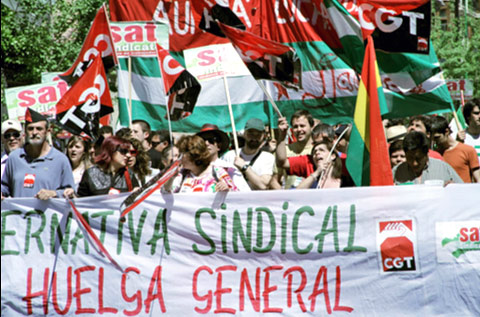
I expect you’ll see lots of marches and lots of strikes in Europe in the coming years as they try to recalibrate their economy. Europeans demonstrate: It’s in their blood and a healthy part of their democracy. When frustrated and needing to vent grievances, they hit the streets. I’ve been caught up in huge and boisterous marches all over Europe, and it’s not scary; in fact, it’s kind of exhilarating. “La Manifestation!” as they say in France. All that marching is just too much exercise for many Americans. When dealing with similar frustrations, we find a TV station (on the left or right) that affirms our beliefs and then shake our collective fists vigorously.
When Europe united, the poor countries (Ireland, Portugal, Spain, and Greece) received lots of development aid from the rich ones (mostly Germany and France). I remember when there were no freeways in any of the poor countries. Now they are laced with German-style (and mostly German-funded) superhighways. These countries traded in their lazy currencies for the euro (which is, in a way, the mighty Deutschmark in disguise, as the European economy is driven and dominated by Germany).
Today, it’s no coincidence that the European countries that have received the most development aid are the ones who are the most debt-ridden and at risk of failing. Even with that aid, their productivity has lagged far behind the stronger economies. And, while their workforce doesn’t produce as much per capita as German workers, they have a mighty currency tied to Germany. By earning wages and getting aid in euros, these nations enjoyed a false prosperity that they might not have merited–and the bursting real estate bubble made it worse. Before unity, if a nation didn’t produce much and slid into crippling debt, the economy could be adjusted simply by devaluing that nation’s currency. Today, there’s no way to devalue the currency of a particular county on the euro, so this fix is not an option. It’s much easier to get into the eurozone than to get out. (One of the biggest questions facing Europe today is: Can and should an economically weak country–namely Greece–leave the eurozone?)
Will Greece and other struggling economies within the EU be safe and stable places to visit as they work out these problems? No one can predict the future for certain. But, as a traveler, I don’t worry about it. True, I wouldn’t want to be a Greek worker counting on a retirement that may not come. But as a visitor, I expect you’ll be scarcely aware of these problems. I was just in Greece and enjoyed a warm welcome, great food, and wonderful beaches. Expect a few demonstrations and a few strikes. Expect your loved ones to be worried about you if you are in a country when there’s a demonstration. (So be in touch.) But you can also expect rich travel experiences and a society thankful that you decided to spend a slice of your vacation time and money in their country.
I have always felt the Euro was an ill-conceived idea that would never work. You cannot blend the Greeces and Germanys of Europe with their divergent economic and cultural attitudes. It has always been a trainwreck in the making. The economic malaise in Europe is a direct result of an entitlement society. Too few working but everybody wants a cushy retirement at 50. An even bigger problem is the overregulation of those societies. For example, my family in Belgium owns a business. They have so many laws regarding how an employer is to treat the employee that it is impossible to fire anybody, else you face stiff penalties. My female cousin with two children demanded every Wednesday off to be with her children, was “suffering” from a chronic sinusitis condition so her employer “had” to give her a paid vacation to Spain to alleviate her condition; my mother-in-law is one of 7 children in her family..All of her siblings are in their 60s and 70s with families of their own, yet every single one of them had to each contribute to the financial support of their one sibling who couldn’t hold down a job. These are just some examples of a government enforcing laws that not only make it hard for business to prosper but put unrealistic and unfair demands on everybody. That’s why I left. Unfortunately, I feel this country is on the same path to destruction.
Come visit Sweden. No Euro, no demonstrations and no hassles. Just friendly people, great scenery and fine food. On another note, why doesn’t the news tell of the success stories in European economics? Oh that’s right, if it bleeds it leads. No bleeding in Sweden, no austerity programs either. Anyway, Sweden’s doors are open so come visit.
But as a traveler, I DO worry about it because I am spending hard earned money and I don’t want to be stressed or inconvenienced by riots even if all they are doing is throwing soft,rotten food. And I certainly don’t want my family threatened, even in a joking manner. The malcontents love to do their thing where it gets the most attention and that correlates with tourism: London, Madrid, Cairo, Paris etc. But wait there’s more. Only a masochist, or somebody stuck in a cubicle all day, wants to subject themselves to crowded airports, cramped airplanes, surly service, and merchants whose chief lot in life is gouging Americans foolish enough to travel at peak times. A volcanic eruption, a flood, an earthquake I will cope with. But people who want to make life miserable for other people just to indulge themselves is no picnic. You want to do that, fine, but you forgo tourism and further impoverish your own living standards.
Even with the troubles and chance of demonstrations in Europe during a vacation, most of the time the tourist isn’t in trouble or in the demonstration . The demonstrations are usually announced a head of time and where and when it will happen. Therefore, these areas can be avoided. However, I remember in Rome one year, I was in a Upium (a department store) and all of a sudden the workers were telling everyone to leave and guided you to the door to exit. They suddenly went on strike. I wasn’t hurt or threatened, but it wasn’t fun. I do agree the Europeans always strike, demonstrate against anything and all things not favorable, this is the way they do, or as Rick saids, get rid of the politician that doesn’t represent their issues. Of course, we do the same thing here when we don’t like a politian’s actions in Congress., but we don’t demonstrate as much as the Europeans. I would still go to Europe, but it is more expensive this year because of air fares and the value of our Dollar, against the Euro. This is because the policies of our nation is no longer to keep the Dollar strong , which I believe is wrong. Yes, the Europeans are expecting too much for too little of a workforce to continue on making the payments for all the retiree’s who retire early. It is a shame that it can’t be like it was and it isn’t a good feeling to feel your retirement age will change or your money for retirement will not be as generous., but something has got to give. Of course, we are having some of the same issues, and the full retirement age as changed here to, but we still can retire at a earlier age of 62 with less money. But I am sure this will change in the future too. This is my viewpoint and some persons will agree and some will not, but at least we are in a fairly free country to express our views and create the life we lead.
From a travelers’ perspective, especially we Americans, the idea of demonstrations and crowds of people expressing themselves can be scary. For the most part, we are sheltered from this inconvenience and get our news pre-digested for us. I think ‘perspective’ is the key word in all of this. The truth is, Europe has been striking and demonstrating about one thing or another for 40 years. It’s going to happen for another 40 years and beyond. As travelers we just accept it and deal with it. It’s part of our education when seeing how others live and getting out of our American “bubble”.
On the other side, for Americans who can afford a European vacation, the thought of having to deal with people angry about their economical situation would be frustrating. Anyone can understand not wanting to see their money wasted and not get to see or do the things you paid to see. If that’s a worry for you, don’t go to Europe. Go to the Caribbean, Hawaii, or Mexico where you’re nearly guaranteed to get value for money and not have to deal with these things.
Keep this in mind however. Would a European coming to America for a vacation have worried about the “Occupy Wall Street” protest here? Would they cancel their trip to NYC because they might be inconvenienced on their way to see the Statue of Liberty or that their hotel might be noisy because people had signs and were angry about being in the 99%?
The reality is, the Western world is changing. For so many years, we’ve been convinced that the world was just trying to “catch up” to our ‘American Dream’. In reality, they were just trying to have their own Portugese, Greek, or Irish Dream.
We may speak different languages, but have many of the same problems. After recovering from WWII the following generations worked harder than we could ever imagine to build a new life for themselves and were rewarded with generous entitlements. Just like America, sometimes they made mistakes and choices that have negatively affected younger generations. Either way, we’ve been riding on their coat tails ever since. Now, for the under 50 Europeans and Americans, we have to figure out how to fix it. We won’t have the same cushy retirement lifestyle our grandparents and some parents have. As much as I love Sweden, we can’t all be Sweden.
Perhaps if we keep tearing down our walls and keep traveling we can continue to learn from each other we can figure out this mess together. Simplistic? Yes. However, we’ve complicated the hell out of everything else, so why not? Perspective.
“Rearranging the furniture to skim off the top” — make up your mind — chairs or milk, but not both, OK?
The only reason that we are not going to Europe this year is Air fare. Because of my husbands job we can only go in June and July and have in the past paid more than I would like. But this year was exceptional. So we cashed in Miles for Hawaii. Haven’t been there in 15 years. We were in Dublin in 2010 with a couple of protests, but really had no effect on us. We spent most of the trip in the country side and saw nothing there at all, just a great great time. And last year we were in Barcelona when young people took over the main square, but again really did not effect us except it would have been nice to go to that main square, and I again that was the shortest part of the trip, out of Barcelona all was normal. You can always take a cruise or a RS tour if you want to make sure that you have someone to rearrange and not let your trip become ruined. The years that we had to deal with Natural Disasters were really much worse. And we even had flights cancelled with United Airlines because of a dispute between them and the FAA. So when it comes to travel it can be any where. There is a mind set that you have to have to be a good traveler.
A very good and thought provoking post. Reading the comments has been just as enlightening. Due to finances most of my trips have been local. Makes you realize how much you’re missing in your own backyard. But when contemplating the events in Europe, I find that I’m less enthusiastic about traveling to an area like Greece where their protests seem a bit more extreme or maybe sensationalized.
How interesting. Point, counter-point. As usual, nobody will change an opinion based on someone else’s. It’s what makes our country a kaleidoscope versus a melting pot. Of course nobody is going to try even a highly touted restaurant if a disgruntled waiter might spit in your soup. And that is a metaphor for travel.
This “knowledge” of mine is strickly from personal experience. Everyone needs to do what they need to do. Thank goodness their are nesayers, otherwise none of us would be able to travel to Europe.
I suspect that by now, looking at relatively few replies to Rick’s request and their tone, Steves knows that he is preaching to the choir – and then asking for its opinion. His company has a core group of customers who follow it either on tours or with guide books or on tv or all three. I have met people who have been on 8 or 9 of his tours. They didn’t just fall off a turnip truck. They are informed and motivated and they have needs which ETBD fills well. Rick’s desire is to expand his business but not everybody wants to travel on a bus and live with others 24/7 for two or three weeks. ETBD’s alternative offering is to travel on a bus with everybody else and use the same quarters but then do your own thing. It’s a distinction without much difference.
Rick,
Your generalization about the US being “filthy rich” is perhaps common, yet it is completely wrong….a recent study, I don’t have its name at hand, pointed out that 1 in 2 persons in the US – yes one in two – were living in poverty, or low income. I can give you the study name if desired. I think it was from the AP, or the NY Times. It was non-partisan. Yes the superrich are growing richer, but the “middle class” and below, are getting poorer. Witness soaring gas prices while the Repubs in Congress fiercely protect the taxpayer subsidies going to…Big Oil. And you cannot lump European social welfare in with the miserly US. In France, 4-6 week vacations, state pensions for all, national health services, nearly never ending unemployment. The US has none of that. Social security – I know of nobody who could live on that. Please stick with European travelogues…..
Rick, your initial question at the beginning of this post is whether this info would be a helpful chapter for ETBD travellers. Regardless of one’s political opinion about these issues, a very BRIEF overview of the problem could be helpful. To that end, I would recommend editing this essay down to one paragraph. Keep the facts, toss most of the opinion. You could pretty much cut it down to the topic sentence from each paragraph and call it good. Encourage travellers to form their own opinions as they travel in Europe–for discussion on the train, of course! The books are so heavy already that I think text needs to be cut as tight as possible if you are considering new additions. I just don’t want to carry any more weight!
Rick I concur with Angela, less is more. I think we can understand based on growing problems with Social Security, Medicare and vanishing pensions why Europeans are angry with government. No need for an economic lesson.
You are at your best when you put someone’s “apprehension in perspective” based on your experiences.
Rick do what you do best, encourage people to travel. I remember the letter you put out right after 911, we had a trip to Italy all planned 6 mos later. We went and had the best time of our life. Really had Italy to ourselves because so many people were so scared to get on a plane. Every year since I can say something comes up that could possibly ruin a vacation. But we would have not seen a thing by now if we had not taken that first trip to Italy. We have done all these trips on our own. I have never taken a Rick Steves tour and last year took a cruise for the first time. I still have that first Europe through the back door that I bought back in 2000. Keep it the way it is.
Rick – Why beat on the finance industry? And what does that have to do with travel to Europe? There are millions of people that work in the industry and only a few who game the system and make the millions. The vast majority simply go to work every day to serve the public. That seems lost on society today. I work in the finance industry, am reasonably well paid, buy your books, and travel. I provide a valuable service to my clients. Please do not vilify us. I am sure there are a few unscrupulous folks in the travel profession too.
Thanks for listening!
We travelled to Spain November of 2011 and had a wonderful time. When we arrived in Nerja, there was a “demonstration” going on in the main square in front of our hotel and we were concerned, but then we found out it was just a rally to support abused women. You can’t always assume what something is.
We went to some very small restaurants and hotels and in talking with the servers and owners they were so kind and actually happy that we were there. We didn’t get any of the anti American sentiment that we sometimes hear about.
Watch your surroundings but have a great time. Don’t live your life in fear, especially when you’re on vacation!
I don’t think you can discount the benefits of a good lead guide as you consider touring around Europe during the tourist season. A knowledgeable, resourceful guide can steer you around disturbances, natural disasters (such as last year’s flood in Vernazza), local service interruptions associated with strikes and even incomprehensible Chinese waiters in Venice. And as much as I hate traveling on a bus with the same people for two weeks at a time, it beats trying to find a place to park in Siena or navigating a parking garage in Lucerne or dodging the fighter pilots driving Mercedes on the autobahn. A few years ago our RS guide on a Spain/Portugal tour asked why people were taking the RS ETBD tour and almost every man said it was because he didn’t want to drive. She didn’t act surprised (and she did navigate us right thru a demonstration (by medical doctors of all people) in central Madrid. Viva la guia.
Your comments about Greece almost sound as if you’re writing about California. There’s eventually going to be serious changes, as the money is not there to pay future benefits.
I’m sitting in Florence, Italy tonight. While I consider myself upper middle class in the U.S., we would be considered wealthy by European standards.
Purchasing power in the U.S. is double what the Europeans get (for their Euro.) Europeans are into quality, where we’re into mass merchandising and fast foods. European businesses cannot match U.S. efficiency.
Americans generally work much, much harder at their jobs and work longer hours than many European countries. For example, the French are capped @ 32 hours per week, and don’t work nearly as hard as their U.S. counterparts.
The poor countries, mostly on the Mediterranean, unfortunately have very high unemployment. They could certainly use factories and other large employers. But would they be good workers? Do they have good work ethics?
Many European societies have painful changes in their future. Hopefully the citizens can accept changes better than their near past conduct suggests. There’s just not going to be the money to continue as it is.
After all, Europeans are already taxed to the max. And many countries are essentially insolvent.
Despite what happens politically and economically, Greece, Portugal and Italy will still be here 100 years from now.
Insightful article, I agree with most of it. I think Rick is a very good person to talk about this because he has traveled so extensively in Europe and does so much business there. A very interesting read, thank you!
T.J. is correct about Rick’s understanding of finance. Of all the people to have a narrow view of anything! To condemn the world of finance because of the actions of its speculators, is like dismissing the attributes of home ownership because there are “condo flippers”.
The editorial nature of this column leaves the guidebook style and comments widely on a convoluted and media-exploited topic. I’m not sure you can reel the general public back to reality this easily. I’m also not sure it’s necessary to outline and frame the social/political issues at this length for your guidebooks audience (though I definitely appreciated it).
The burning question for us is: “Is it safe to travel during this economic ‘crisis’?” and your short answer at the end is, “Yes. And here’s why…”. I was left craving more of a lengthy response on that topic. However, I’m a travel enthusiast looking to a travel guide to tell me obviously it’s okay to travel, so it would definitely fit to the Rick Steves reliable guidebook style to include, “And here’s why it might not be…”
My husband and I spent 2 wonderful months in central Europe in 2010, driving through beautiful landscapes and villages and spending time in villages/cities that took our fancy; got caught up in a demonstration in Rome and had an absolute ball, marching and shouting for we know not what. We are from South Africa (Cape Town) so demonstrations and marches are nothing new to us, but we thoroughly enjoyed our 5-minute bonding experience with our Italian marchers. The next roadtrip is through Spain during December 2012 and January 2013; have bought Rick’s Spain 2012 book – our Bible for this much-anticipated trip. On behalf of all travellers word-wide, Rick… thank you a million times for your travel “manuals”. Kind regards. Johan and Maggie Toerien, Cape Town (South Africa).
I’ve been surfing online more than three hours lately, yet I never discovered any interesting article like yours. It is lovely price enough for me. Personally, if all website owners and bloggers made just right content material as you did, the internet will probably be a lot more useful than ever before.
Rick,
This article is interesting, but you gave no practical insight into how to deal with the strikes and demonstrations. You should point out that while there are strikes all the time in Europe regardless of the economy (i lived in france in the 90s when the economy was great and I think there was a ‘greve’ every other week in my town in France) the one good thing is that they are usually pre-announced so you can ask at your hotel if there are any strikes that will affect travels. Demonstrations are not always preplanned, but usually are in one central location in any given city. Also, it is good to have backup transport info; get train schedules and bus schedules so if (when) the trains are on strike you can take a bus.
Mr. Steves, I’ll be honest… I usually roll my eyes when you comment on contemporary European politics (I live in Germany), but I must admit, your’s is a pretty good summary of the current economic malaise. I would point out, however, that the property bust was really only a big factor in Spain and Ireland. To paraphrase Tolstoy, every unhappy European country is unhappy in it’s own unique way.
Rick — I think that the piece is interesting and important (although here in France, where I live, there was no property bubble bursting, as Tom pointed out above).
However, I would counsel a stronger admonition to your readers to avoid demonstrations to the extent that they can. In the 2005 riots, a friend of mine who went to “watch the excitement” over near the Bon Marché ended up inadvertently getting shot in the eyeball by one of the police’s rubber bullets. She has permanent damage to that eye and partial sight loss. Please please tell people to keep AWAY from demonstrations. She said that it was a total surprise when it turned “violent.”